“The Post” movie review

The Fourth Estate, triumphant! Steven Spielberg’s The Post is a historic biographical drama depicting the story behind the infamous Pentagon Papers that set a monumental precedent in the US Supreme Court following a ruling in the favor of the freedom of the press. Probably the most significant ruling affecting journalism, this film goes beyond the cold, hard facts of the case and into the offices and houses of those who were responsible for shedding light on the lies the US government was spinning to keep the War in Vietnam going. In a manner of speaking, this film could be read as Spielberg’s ode to US journalism, and by extension, to the free press at large. While traditional ink and paper newspapers may be slowly becoming a thing of the past, Spielberg’s film shows that the press has an important place in a democratic society. Without the free press, a nation’s government could easily lie and maliciously mislead its people to serve its own gain. No surprise, Meryl Streep’s and Tom Hanks’ acting is simply brilliant; while the rolls may not seem incredibly complex, it’s the beauty in simplicity that demonstrates the excellent commitment to character that we all have come to respect over the years for these Oscar-winning actors. The Post is a historical drama brought to life for the screen through precise editing, beautiful cinematography, and a gripping score.

Unrest grows at home while the US is deep in the middle of the Vietnam War. With conflicting reports coming out of the warzone, the people of the United States have only the word of their government to assure them the war is going well but they have to continue sending the boys overseas to “win.” After a rogue journalist leaks papers from the Pentagon describing how the US is losing and it keeps sending boys overseas to keep up appearances to the New York Times, the attorney general places a restraining order on the iconic newspaper to prohibit it from publishing the classified material. After word of this unprecedented extension of power, the editor-in-chief of The Washington Post Ben Bradlee (Hanks) comes to have a copy of the papers and desires to publish them in order to show the American people what the government has really been up to. Only one small problem, the owner of The Washington Post Katharine (Kay) Graham (Streep), the first woman to own a major newspaper, is unsure if the papers should be published because she seeks to take the paper public and this could damage that–not to mention that she and Bradlee could go to jail. Go beyond the pages of a history book to witness the thrilling drama unfold as you find out just why The Pentagon Papers was such a big deal.

While many critics and fans of the movie are touting it as the “best movie of the year” or commenting to managers at cineplexes that it’s “amazing,” I am not convinced that it truly is “the best” or as “amazing” as it’s being heralded. Before you go questioning my taste in movies, I completely agree that The Post is an excellently made film–there is nothing wrong with it. For all intents and purposes, it is a perfect film. But just because it’s figuratively perfectly produced and directed, does not mean that it is “amazing.” In many ways, this movie reminds me of Spielberg’s Bridge of Spies. It too is a perfectly made historic drama (coincidentally also starring Hanks) that falls within the same subgenre of drama as The Post. When I think of a Spielberg film, I have come to expect a wow factor. And it’s that lack of a wow factor that troubles me in awarding this film with an accolade such as “best picture.”

Usually, there is a particular scene that evokes strong emotion, perhaps it’s a powerful monologue or heated emotionally-driven exchange between two characters, there are other methods for evoking an eruption of feeling and emotion within the mind and body. Never once did I feel my emotions run high with this film. And I happen to be an entertainment journalist, I teach media writing at a popular university, and spent time in broadcast news. I have a love for the media, the press, and publishing. I also spent time in a media law class in graduate school analyzing the very papers in question, and I still did not feel emotionally woken up by the film. I find the film very well written, produced, shot, directed, acted, scored–everything is done with extreme precision. But, that’s what I have come to expect from Spielberg, Streep, and Hanks. Yes, to be able to consistently deliver excellence is nearly uncanny; but when I know what to expect, it’s much more difficult to surprise or wow me. That’s what is missing from this film in my opinion–the wow factor.

On the socio-political spectrum, I find the commentary on women in leadership is brilliant! Quite happy that the film chose such an incredible woman’s story to tell so cinematically well. The character of Kay Graham is not only an inspiration to aspiring female leaders, but she is an inspiration to all who find themselves in positions of influence or power for which society does not feel he or she is suited. Whereas this prejudice can affect men and women, history has shown that is has affected women more. And this film is a breath of inspiration for young women who will become future leaders around the world. Brave. Kay Graham was an incredibly brave woman who fought the good fight and proved that she could make the tough decisions that are required in order to grow a company. I also find that The Post serves as a beacon of hope that the press is here to serve the American people in a day and time that our government’s leaders claim that the press at large is “fake news.” Newspapers are here to serve the governed NOT the governers. Let the Pentagon Papers be a sign that our leaders are not past deception even if it means sending our military to certain death in order to keep up appearances.

The Post is definitely a movie that all journalists should watch. And not just “conventional” journalists. But anyone who takes part in publishing written, audio, or video media content. Especially those who cover governmental affairs should watch this historical drama highlighting a huge turning point in the freedom of the press.

“I, Tonya” film review

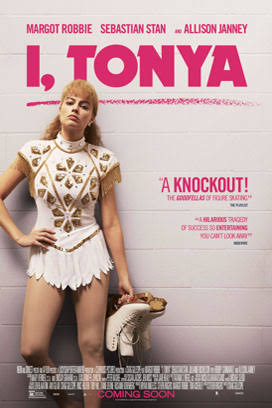
Of skates and class. Margot Robbie stars as the first US woman to successfully land a triple axel…also the most infamous woman in the history of US Figure Skating in what is likely one of the most difficult and controversial biographical films ever produced. Tonya Harding is back in the headlines and on TV, and even on the ice if you caught last night’s 2-hour Truth and Lies special on ABC. While most Olympiad names are forgotten within a short amount of time, Harding and Nancy Kerrigan’s names will always have notoriety through the years. Nearly 25 years later, we find ourselves still talking about Tonya Harding. The biopic I, Tonya directed by Craig Gillespie and written by Steven Rogers provides audiences with an unapologetic glimpse into Harding’s early life through “the incident.” It is unlike any biographical film that I have ever seen before. Most often, biopics slant toward making the central character more likable than perhaps they were in real life. This film approaches Harding from the perspective of not shying away from her foul-mouthed, inability to take responsibility, violent temper; instead, showing us an authentic Harding who struggled through life to break the chains of classless poverty and emerge onto the scene as a professional figure skating record-setting champion. While this movie does not set out to prove what really happened, it does show what is likely to have happened. Although “the incident” is what everyone remembers, this movie shows a struggling young person attempting to change but thwarted at every angle by hearing that she cannot because she isn’t what America is looking for and has no class. But why couldn’t it have been just about the skating???

Tonya Harding (Margot Robbie) took to ice like a fish takes to water. She was an ice skating prodigy from the soft age of four when she took her first lesson from coach Diane Rawlinson (Julianne Nicholson). Growing up poor, she faced obstacle at every triple toe loop. From mental and physical abuse to sexual abuse, she weathered it all. Her mother LaVona (Allison Janney) was a monster of a woman who pushed and pushed in order to toughen “soft” Tonya. Even hot-tempered Tonya found love–albeit brief–with Jeff Gillooly (Sebastian Stan). The mental and physical abuse continued and only worsened after she set the world record for being the first US woman to successfully land a triple axel in 1991. But she would come in fourth in the 1992 Olympics. She fell into despair after that crushing defeat. When the US Figure Skating association gives Harding a second chance at the 1994 Winter Olympics, all seems like it is finally going her way, and she would finally experience the success she dreamt of her entire life, until “the incident.” Of course, as we all know, she went on to become a national punchline, material for comedians and sitcoms, and the most well-known name in the US after Bill Clinton.

Even though crime and ice skating are central elements in this film, it is truly a commentary on class and abuse. From the moment the movie opens with Harding and her mother smoking a cigarette at the ice rink in Harding’s hometown of Portland juxtaposing them against the pretty and proper coach with her students, we know that we are about to watch a story of class warfare. All Harding wanted was to excel at the sport she was naturally gifted at. Only one small problem: society and the figure skating association made it incredibly difficult–if not nearly impossible–for Tonya Harding to break free of her roots in classless poverty. But don’t allow the beginning of the film fool you into thinking she Harding is a kind soul who finds herself the underdog, she has a volatile temper and foul mouth that constantly gets her into trouble during practice and in competition. This film is an underdog story, but quite the unconventional one. Because we already know going in that she went from the first woman to land a triple axel, national champion to disgraced skater and unsuccessful boxer. For all its various plot points, the common theme throughout the movie is whether or not to allow your financial station in life to determine your behavior on and off the ice. Class has little to do with money, but rather, is a state of mind and demeanor. Perhaps we have a better idea of why Tonya behaved the way she did. The film never excuses her behavior or indirect knowledge (after the fact) of what her husband mastermind, but peels back the 24-hr 1990s news coverage in order to empathize and understand what made Tonya tick.

Is it possible for a square peg to fit into a round hole? Certainly, the life of a figure skater, especially one who represents the US on the global stage, is incredibly structured, polished, and constructed in such a way that the skater always looks his or her best to the public–a facade if you will. But, the once bright career of Harding serves as evidence that if you don’t come from the right family, have the right costume (or clothes), or speak eloquently, then the arena has no place for you. Perhaps that is why Harding still has fans despite her infamy. Although according to the film, she could have spoken up a lot sooner to help the investigation along instead of being fully consumed by having to make the 1994 Olympic team and indirectly covering for her ex-husband, she was dealt a dirty hand by judges and rivals who felt she just didn’t belong with them; and America generally liked an underdog. Unfortunately, this underdog got caught up in a scandal the followed a long history of irreverent behavior. The media coverage certainly did not help Harding’s case any. With the availability of CNN’s 24-hour news coverage, birthed out of the Gulf War now able to capture everything in order to have stories constantly grabbing audience attention, the film paints a picture that the media treated her unfairly and convicted her before the court’s decision to prohibit her from ever competing or coaching again, and the subsequent stripping of titles. Just some food for thought.

The topic of abuse is not shied away from in this film. We witness Tonya suffering from the brutal tongue of her mother, as well as constant physical abuse. Because there lacked the number of social programs for the protection of children and teenagers we have today, and schools were not as in tuned to abuse at home, she had little choice but to deal. Eventually, she would succumb to lashing out in similar ways to what which she experienced every day growing up in that house–house, not home. Her mother attempts to rationalize and excise her behavior because she tells Tonya that fear and anger will drive her to be a champion, but that doesn’t change the lasting affect the lifelong abuse had upon Tonya. It’s entirely possible that Tonya sought out Jeff because she was used ot abuse and felt that she needed it. Talk about warped.

The quality of this biopic is incredible! I absolutely loved the “interview” footage in the 4:3  format whereas the main narrative was in 16:9. Felt like we were watching actual news coverage in 1998. At first, I thought we were, but then I recognized Margot Robbie behind the exquisite makeup and costuming job. It has such an organic–no pretense–feel to the film. Robbie and her costars had me fully convinced that they were their respective characters. All around, the commitment to character was outstanding. Robbie commented in an interview that she studied footage of Harding for over a year, and it shows brilliantly! When the actual footage rolls at the end of the film, it is incredibly difficult to tell the real Tonya from her screen counterpart. Robbie’s monologue in front of the mirror is certainly one for the record books because of just how authentic and powerful it is. The production design and cinematography create a time machine; you will feel as though you have been whisked back 20-30 years throughout the film. Authenticity in spades. Director Craig Gillespie should be immensely proud of the film he crafted! Excellent writing, acting, technical elements. This biographic motion picture has it all. And will certainly get you to once again talk about Tonya Harding.

Highly recommend for those who enjoy controversial biographical films. The high profile critics are not exaggerating when referring to it as one of, if not the, best film of the year. There is so much to like, and for some, hate about this film. Whether you believe her to be criminal or not, there is no doubt that you will be blown away by the quality of this motion picture.

“All the Money in the World” film review

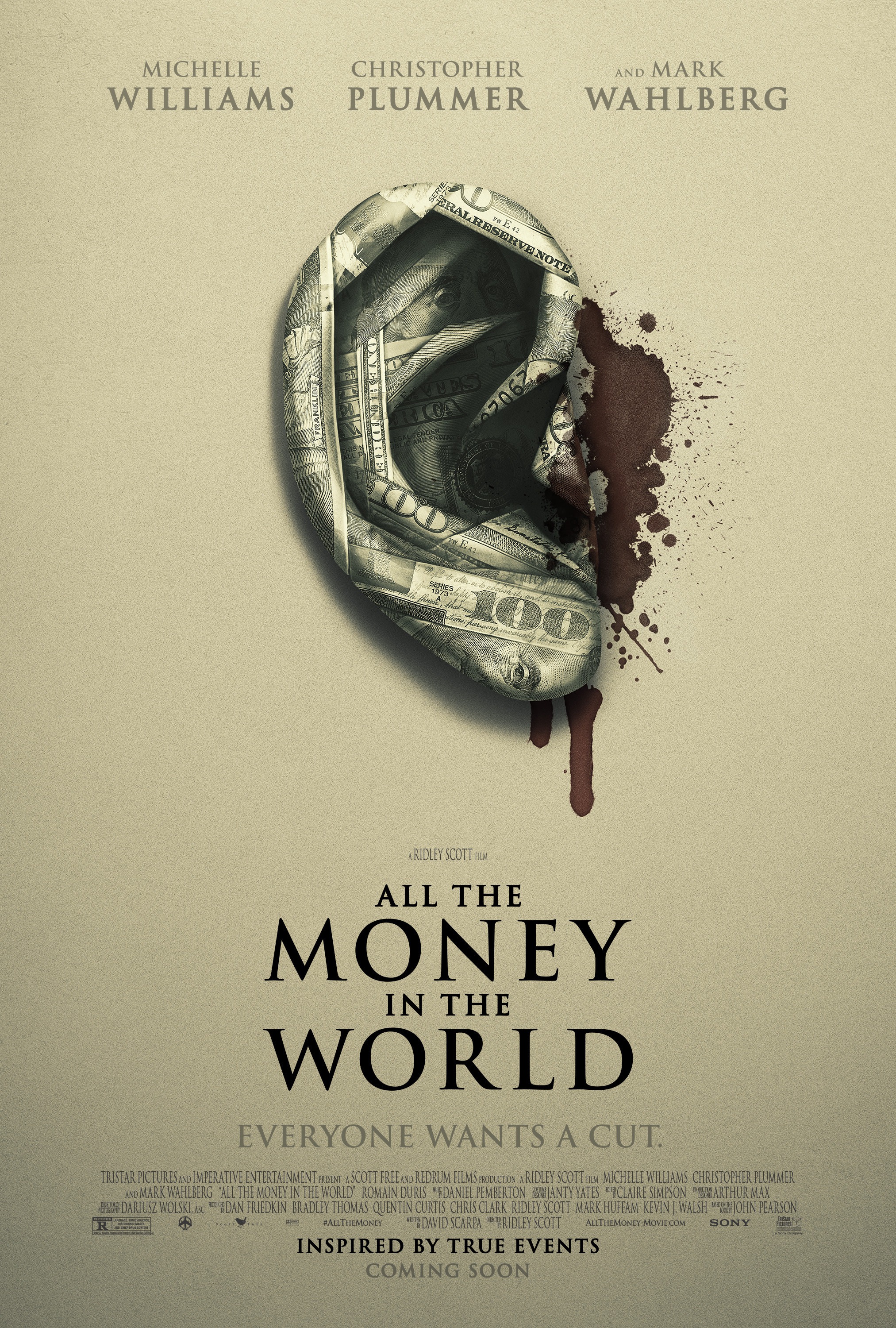
A spellbinding thriller that will hold hostage your attention. Ridley Scott’s highly anticipated historical neo-noir drama depicting the infamous kidnapping of the favorite grandson of oil tycoon J. Paul Getty All the Money in the World is an incredibly suspenseful drama that is every bit as good as you’ve been hearing. Probably the highest profile Christmas season motion picture release after the–quite literal–last minute recasting of living legend Christopher Plummer as J. Paul Getty I, this film is a non-stop search and rescue of epic proportions. The most notable element of the film is the aforementioned casting; however, there is so much more to this movie than the role played by Plummer. This film has an incredibly organic feel to it–all the way down to the practical blood effects. Although many of the roles in the film are one-dimensional, don’t let that dissuade you from buying your ticket to see it on the big screen. Each and every character in the film is played with excellence by the respective actors. No slowing down in this film, the pacing is incredibly quick but works brilliantly for this nail-biting drama that will have your attention for the entire runtime of the movie. If there was ever a real-life Scrooge, J. Paul Getty would be a contender for the famed Dickensian character. Witness the lengths a mother will go to find and free her son despite being cut off from her father-in-law’s unparalleled fortune. Love, logic, and profit are at war in this fantastic motion picture that is sure to grab the attention of the Academy of Motion Picture Arts and Sciences.

A king’s ransom. That’s what J. Paul Getty III (grandson of J. Paul Getty I) demand of the Getty family. All the Money in the World follows Paul’s mother Gail (Michelle Williams) and ex-CIA special operations Fletcher Chase (Mark Wahlberg) on their perilous journey to locate and retrieve Paul. Only one small problem, Gail’s ex-father-in-law is oil tycoon and ruthless J. Paul Getty, and he refuses to pay the ransom demanded by his favorite grandson’s kidnappers. With Paul’s very life in danger, Gail and Chase, otherwise unlikely allies because of his ties to J. Paul Getty I, are forced to team up in order to locate Paul and secure the ransom money from her former father-in-law who refuses to do anything with his money and time unless there is some sort of monetary profit in it. After Paul’s ear is found in the mail, Gail realizes that her only hope is to get J. Paul Getty to somehow agree to pay the ransom for his grandson.

From a storytelling perspective, the most notable aspect of this motion picture is the aggressively nonlinear storytelling. We begin in (then) present-day, go back to Paul’s early impoverished childhood, fast-forward to him a little older, then to the months prior to his kidnapping, back to the present-day again. We also take a look back at J. Paul Getty I in the early days of his oil business in the middle east. Although I am not typically a fan of flashbacks, it works very well for this story in order to truly understand the dysfunctional family dynamics. While his children live a life that barely gets by financially, J. Paul Getty I lives the life of the wealthiest man the modern world had ever seen. Still, J. Paul is also the embodiment of Ebeneezer Scrooge in every way shape and form. Every moment moves the story forward. Never once will you feel that the more than two-hour film is stagnated or treading water just to fill time. You will also encounter some of the most gruesome moments that Scott has ever put on screen.  The diegesis of the film is constructed with extreme precision, and it creates an overarching exemplary work of how powerful a historic crime drama/thriller can be.

But what kind of film is this? Is it a crime drama? Historic drama? Thriller? Or even classically structured and shot film noir? Often times, when writers or directors set out to create a hybrid film (meaning, more than one genre) run into the problem of the film being in a state of identity crisis. Each main genre has certain pillars and structural supports that need to be met in order to tell the genre story effectively. That doesn’t mean that you cannot have a film that has elements of more than one genre but it does mean that the more genre elements that you have, the more difficult it is to weave them all seamlessly together. Fortunately, Scott’s All the Money in the World written by David Scarpa is a masterpiece! Scarpa showcases his ability to utilize the best of the genre tropes that are in this film to tell a completely new story with a unique experience. If I were to select a genre that this film is best suited for, it would be film noir, in the vein of my review’s opening lines. For all its other elements, All the Money in the World is most closely aligned with film noir because our main character of Gail is in over her head, the non-linear storytelling, dark places and themes, Gail’s exquisite attire, and it’s a story filled with gloom, ill-fated characters, fear, and betrayal.

For those who have been to the famous Getty Museum in Los Angeles (I went a few years ago, and still remember it vividly), you will have a better understanding of how he acquired all those artifacts and art pieces, and how the museum came to be. Perhaps, much like The Founder may have caused you to call into question whether or not you want to support such an infamous legacy, you may also debate whether or not to support the museum that bears his name. Even though J. Paul Getty was a ruthless man, he did provide treasures for the American people and visitors to the states to enjoy for all time. For those who enjoy further reading after watching a historical drama, you’ll find that the Getty family continued to suffer and Paul never recovered from his kidnapping tragedy. His life was cut short after a drug overdose. This is the kind of film that you will want to watch again because of the powerful philosophical punch that pits love against money.

“Darkest Hour” film review

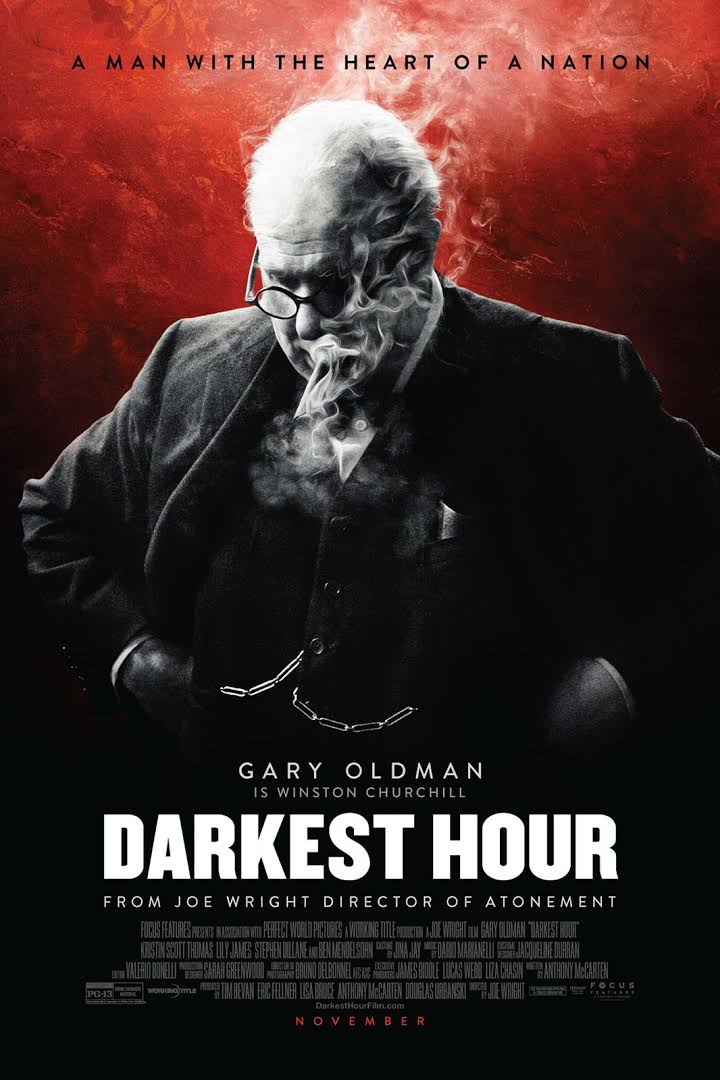
Outstanding! A gripping film that serves as a testament to rising above all odds to lead and protect. An inspirational biographical drama during one of the western world’s darkest hours. Gary Oldman’s performance as the famous United Kingdom Prime Minister is absolutely remarkable. For history enthusiasts, you will swear that you are watching THE Winston Churchill battle his own homefront of politicians and protecting against the Nazi advancement prior to the United States stepping in following Pearl Harbor. The impact of this film is greatly enhanced by the release of Nolan’s Dunkirk earlier in 2017 as this film depicts what was going on in Churchill’s office prior to the valiant rescue operation. The climax of the film includes Churchill’s “We Shall Fight” speech that rallied Parlament behind him–at least during WWII. Screenwriter Anthony McCarten chooses to interject as much amusement and humor as possible in order to balance out the otherwise cranky Churchill and the dire, deadly position that the people and government of the United Kingdom were at the time. Although it is not uncommon for historical dramas to take creative liberties in telling a visual, cinematic story, Darkest Hour sticks closely to historic accounts but does add in material that aids in constructing a cinematic film.

A thrilling biographical drama that takes place during the crucial days of the Nazi’s march to the sea to conquer western Europe. With France nearly fallen, the United Kingdom is faced with the most deadly enemy it has ever faced in all centuries leading to this very moment. The United Kingdom is searching for a new Prime Minister in the wake of an abrupt end to Churchill’s predecessor. With both the liberal and conservative sides of parliament at each other’s throats, it would take a special leader to unite the government in order to defeat the Nazis. Generally unpopular, but being the only public servant that had the least opposition from both sides, Churchill was a reluctant choice by the King and his colleagues in Parliament. Darkest Hour depicts Churchill’s rise to power and the giants he faced on his first days in office. While he is known to be an unapologetic monolith, a force to be reckoned with, this film also shows his more humble side. All within the span of a few weeks, Churchill is tasked with leading Parliment, unifying the government and people, and protecting the free world.

If you haven’t seen Dunkirk, you should watch it prior to Darkest Hour or at the very least follow up with it because it helps to paint a portrait of what was facing Churchill on his first day in office. Oldman’s performance is nothing shy of exceptional. Although all the performances are excellent, including Lily James’ supporting role, Oldman’s contribution to the film aids in creating the masterpiece that is Darkest Hour. The altruistic behaviors and vulnerable sides of Churchill are brilliantly woven into the narrative, an important move because in films past, he was always shown to be the brilliant orator and rallier that history remembers him as. Oldman’s commitment to character, in terms of speech, posture, and more is incredible; his personal commitment aside, the overall look and feel of Churchill is supported by amazing makeup work and costuming. The energy that each and every character brings to the screen is unquestionably precise and highly effective. While this is a story that takes place during wartime, the character-driven nature of the film is more closely aligned with a heavy courtroom drama than a typical war film. No mistaking it, it is still a war movie, just not in the traditional sense.

While the actors can bring unique, exceptional energy and screen presence to a film, it is often built upon the foundation of excellent writing. Despite the film exceeding the two-hour mark, no scene ever comes across as filler, unnecessary, or simply extra information. Screenwriter McCarten’s adaptation of the life and times of Winston Churchill is precise, efficient, and powerful. He chooses a no holds barred approach that is unapologetic as Churchill himself. As closely as McCarten aligned his screenplay against what we know from history, he chose to invent one particularly inspirational scene in which the Prime Minister leaves his chauffeur and takes the London Underground (what we call a subway)–a mode of transportation that he remarks never using earlier in the film. It is this scene that paves the way for the bombastic, poignant “We Will Fight” speech that will nearly have you standing up in your seat during his ovation on screen. Such a brilliant move by McCarten to invent a scene that truly feels like it very much could have taken place. It’s a scene that also shows Churchill’s heart for the people he was trying his damndest to protect against the evil across the English Channel.

Joe Wright’s Darkest Hour is a must-see film! His direction of this biographical drama is an outstanding work of cinematic excellence. Few directors could have captured the power of these events and the determination of Churchill as Wright has done. The approach of Wright and McCarten may prove to be precisely what is needed for Oscar nominations. Highly recommend for anyone who is fascinated by history or more specifically the events that took place at the time of and leading up to Dunkirk. Darkest Hour also displays a remarkable adhesion to history while adding in elements that provide a much more comprehensive experience that work to inspire audiences.

“The Greatest Showman” movie musical review

Stunningly sensational! Ladies and gentlemen, children of all ages witness the larger than life movie musical adaptation of the life of P.T. Barnum directed by Michael Gracey. Dazzling! 20th Century Fox’s The Greatest Showman is an incredible work of motion picture and performing arts magic. Never before has the magic of the American circus been captured so brilliantly. As the movie stares, “a man’s station is truly limited only by his imagination.” From the costumes to the music and choreography, this film is sure to inspire anyone who has a dream and wants to realize it. The music will have you singing along, clapping, and even tapping your toes because the emotions will get you right to the core. Ordinarily, a movie like this could generate an interest in budding performing artists and showbusiness enthusiasts to “run away and join the circus,” but the big top had its swan song earlier this year. One can only speculate that had this film been released last year that the circus that still bears his name Ringling Bros. and Barnum & Bailey would still be touring today. Sadly, the circus had its final performance in May 2017. From the moment the movie opens, you will be completely immersed in the world of P.T. Barnum, a world unfamiliar with the concept of shows that were sheer spectacle, illusion, and simply designed to put smiles on faces. It’s entirely possible that this may prove to be the greatest films of 2017, and certainly one of the greatest movie musicals ever made.

Simply stated, The Greatest Showman is the film adaptation of the life of P.T. Barnum (Hugh Jackman) and depicts how he was inspired to essentially create the very concept of showbusiness. From his successes to his failures, this movie showcases the very beginning of the American circus, a tradition that would last for nearly 150 years. Filled with incredible original music, this original movie musical displays how one man’s vision became a worldwide sensation.

My first observation of this film is just how polarizing it seems to be. On one hand, some critics and websites praise it for being an absolute delight while others are rating it rotten. Unapologetically, I feel strongly that this film musical is nearly flawless. As to how accurately it reflects the life of P.T. Barnum, I cannot speak to that because I have not spent hours researching his life; however, from what I do know about him, the movie seems to have captured the inspiration and vision accurately, as well as his faults and pitfalls. While standard holiday issue biopics are nothing new, what with The Darkest Hour also on the horizon this season, Gracey turns what could have been just another biographical film about an American icon into a larger than life dazzling display of precise choreography, effective montages, and just plain fun! Ringing Bros. may have closed the bigtop for the last time, but the soul of P.T. Barnum lives on in what Feld Entertainment (parent company to Ringling Bros and Barnum & Bailey) does. Without P.T. Barnum, we may not have the concept of showbusiness as we know it today. Despite staying away from the usual meaty themes found in Christmastime biopics, this film packs a powerful punch and supports the need for entertainment and the arts in our lives.

The high degree of passion Jackman displays for his character cannot be overstated. Though Gracey shows his directing prowess in this film, it is the labor of love of Jackman who has been trying to get this movie musical made for the better part of a decade. While the cliche underdog story may not be anything new, the method through which the story is told is a must-see spectacle. What works best in the movie are the extravagant and intricately choreographed musical numbers. The infectious and inspirational songs of The Greatest Showman were written by La La Land Oscar winners Benj Pasek and Justin Paul while the brilliant choreography was staged by Ashley Wallen. Each and every musical number is powerful and truly adds to the fantastic experience of this film. Moreover, this movie musical typifies the height of the visual and performing arts in terms of the ability to create an imaginative atmosphere that generates sheer delight in the minds and eyes of the audience.

In many ways, this movie is an extension of the circus that many of us grew up watching as kids and even adults. The circus was never about deep, complex stories; it was about entertaining audiences of all ages and bringing smiles to faces. And this film will certainly bring joy into your life this holiday season! Such a perfect movie for the week leading into Christmas because it is fun for the whole family.