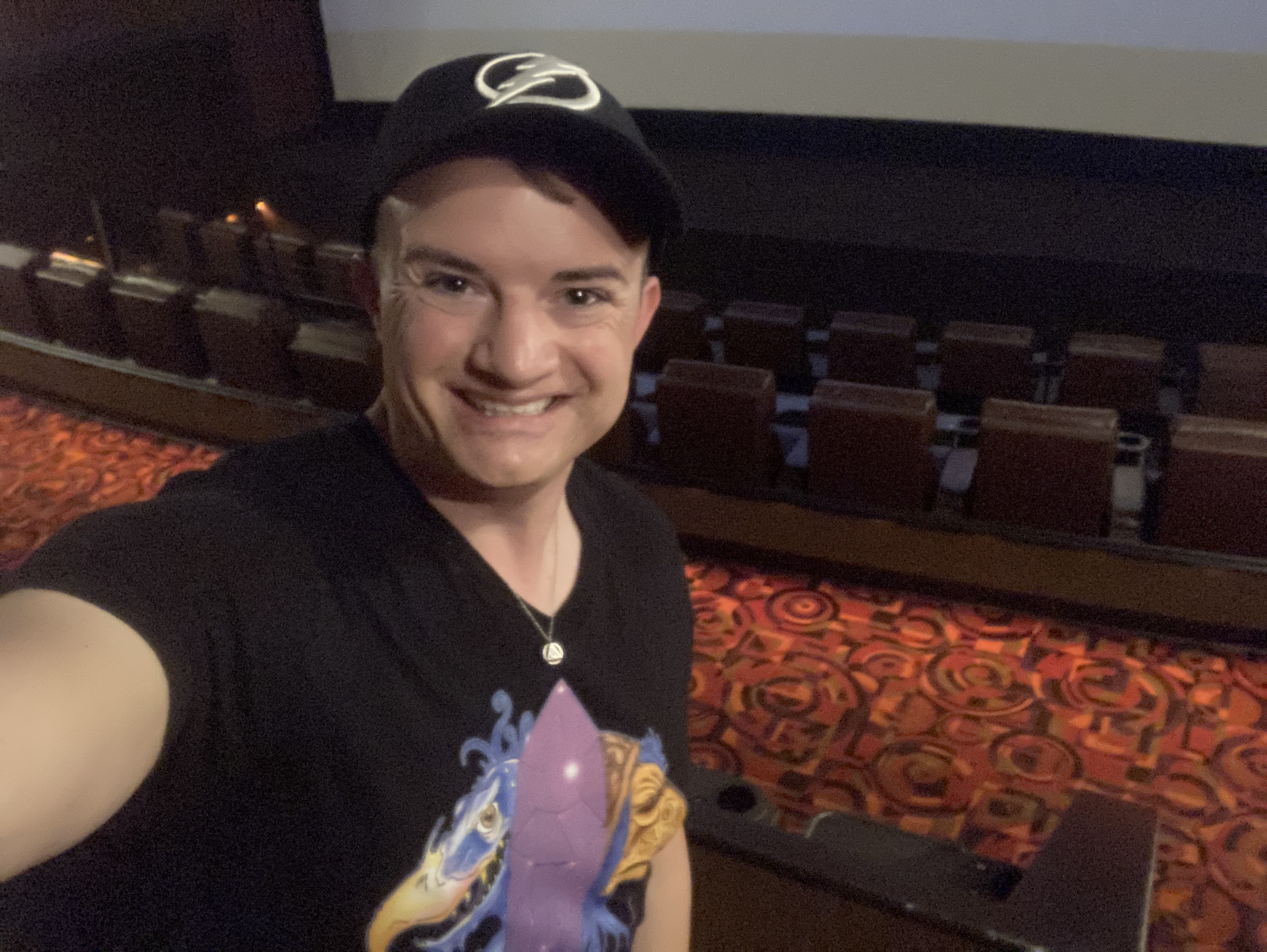
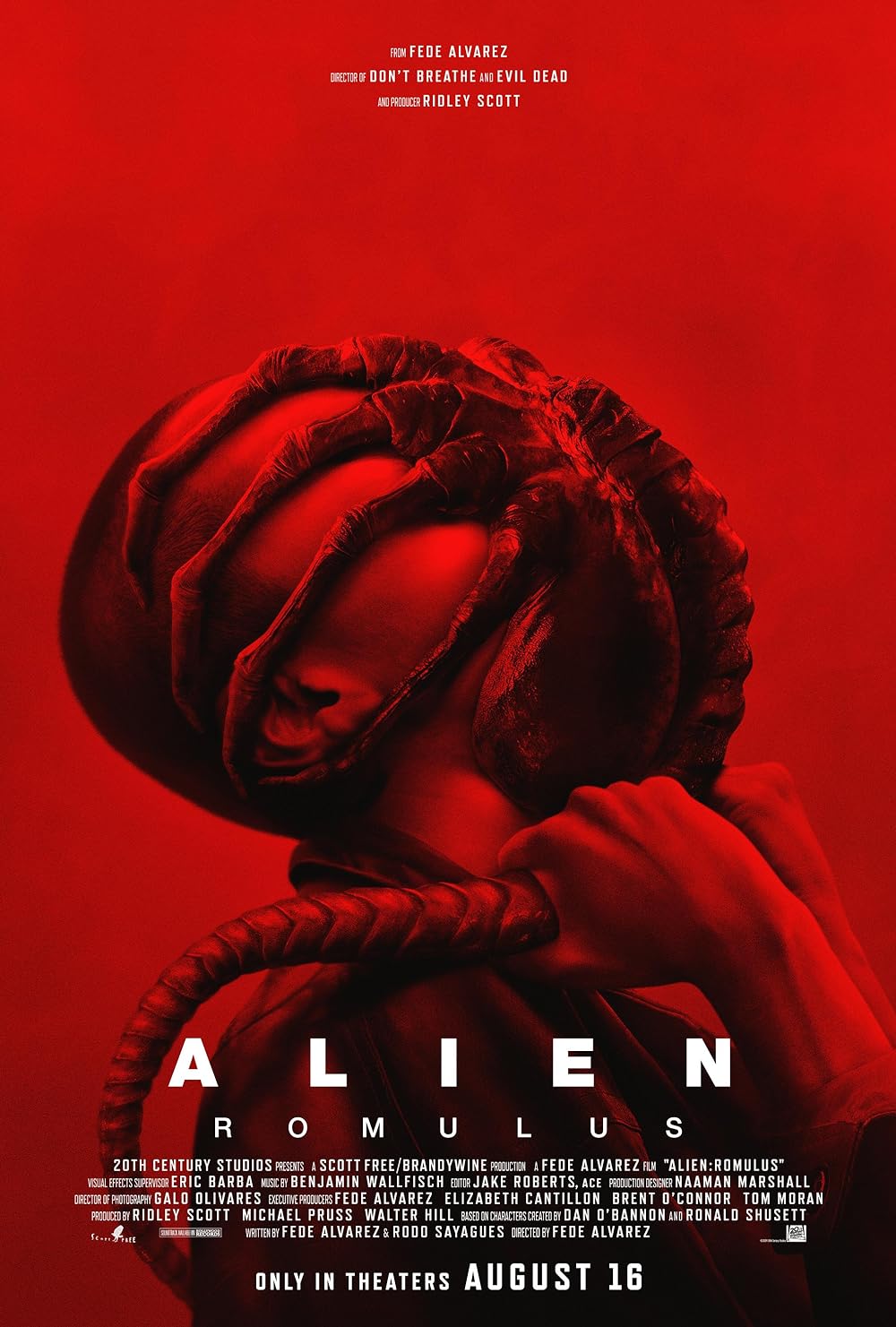
In space, these characters are screaming for dimension. Fede Alvarez’ Alien: Romulus is the closest in form that we have had since the masterful Alien (1979). And while the premise and plot are fairly solid, the plotting and exquisite design cannot compensate for the poorly written characters.
The most human character is a synthetic human, and he is the only character that is thoughtfully crafted. When characters struggle to connect with audiences, then the audience couldn’t care less whether they live or die–ostensibly mitigating any real stakes. The central character is mostly flawless and we never feel as though that they will be injured, much less die (I’m avoiding spoilers). The original Alien delivers incredibly well-written and developed characters that we want to survive. Alien: Romulus‘ characters–well–they should’ve all perished for lack of anything truly compelling. Additionally, this cast is way too young to be taken seriously in these roles that would be better suited for a cast that was at least 10–15 years older.
Where the film does succeed is the throwback design and feel of everything from beginning to end. Even the CG is integrated very well with the much-welcomed use of practical effects. Practical beats CG, nearly every time. Even though this movie is releasing more than forty years from the original, it feels very much connected to that iconic motion picture in form. Everything from the production design to the sounds to the music kept me from completely disengaging from the film. Alvarez has a fantastic eye for composition and atmosphere, but his screenwriting and character development are not on par with the technical achievement of the film. If you love the original Alien, then definitely see Romulus, and have fun with it. But I don’t imagine you will be rewatching this one over and over like the one that started it all. At least, it was way more meaningful than anything that released after Aliens.
Apologies for the short review of a movie that I highly anticipated. But Disney chose not to screen the film for all the critics in the CACF.
Ryan teaches Film Studies and Screenwriting at the University of Tampa and is a member of the Critics Association of Central Florida and Indie Film Critics of America. If you like this article, check out the others and FOLLOW this blog! Interested in Ryan making a guest appearance on your podcast or contributing to your website? Send him a DM on Twitter. If you’re ever in Tampa or Orlando, feel free to catch a movie with him.
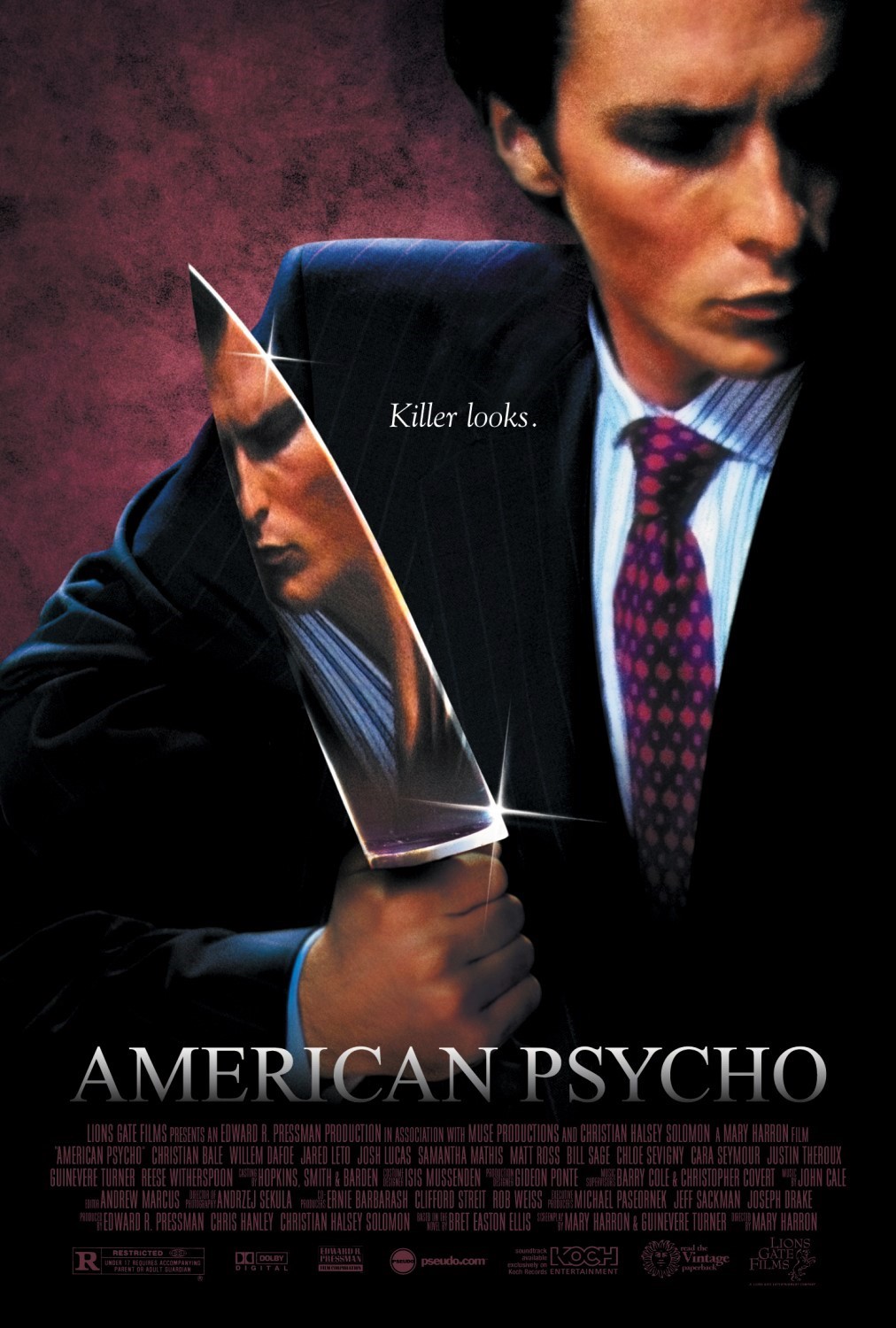
We all go a little mad sometimes. Once nearly banned on bookshelves, American Psycho (2000) is the film adaptation of a book about materialism, narcissism, yuppie culture, and the inter-personal empty feeling that comes along with it. Interestingly, despite this film commenting on and taking place in the 1980s, it also holds strong relevance for the 2020s. Except, if this movie were made in the 2020s, its social commentary would be on toxic consumerism, social media influencer culture, and political polarization.
Even though the central character of Patrick Bateman (Christian Bale) reeks of snobbery and pretension, Mary Herron’s brilliant horror-meets-dark comedy motion picture is raw, gritty, and unapologetic. The movie that was once protested by women was, in fact, directed by a woman. It’s a candid, fantastical exploration of the state of humanity when it loses its identity in exchange for the facades of prestige, money, and power. Herron externalizes all the emotions and thought processes she is exploring through the actions of Bateman. It’s a visual representation of what happens when we become so consumed with the image we project to others that we lose ourselves and are left feeling empty.
Not only is this a great horror film, but a great film period. Equal parts horror and comedy, this film can be characterized as a motion picture that forces us to reconcile our aspirations for wealth, power, and what happens when we fail to make genuine emotional connections with other individuals because we are completely consumed by image and status. Furthermore, there is a fascinating character study here on trying to fit into a society that you really don’t want to fit into, but don’t know what the other options are. Therefore you act on impulses instead of recognizing them in order to critically analyze if they indeed are the right things to do.
One of the qualities of the experience of watching a horror film compared to other genres is the power it has to force us to face our fears, look in the mirror (pun intended), and question the world around us. Moreover, it allows us to explore hard-to-talk-about subjects because it approaches them in creative, visual ways. that force us to think about some societal observation or construct in new and different ways.
In many ways, Patrick Bateman is us; the us we are when no one is looking. Perhaps most of us are not serial killers, but we certainly have a running commentary on the world around us. Also like Bateman, if we are not careful, we can fall prey to our own animalistic, self-centered instincts. I also love how this movie parallels the vicious nature of Wall Street with the murder sprees of Bateman. In this movie, it’s Wall Street, but it could very well be any number of work places. Perhaps there is little relatability to the characters on the surface, but dig a little deeper and this film is quite the microcosm of the world we live in.
American Psycho provides audiences a complex central character whose existence is more indebted to the dire strife of his reality than to the antagonism or conflicts posed by others. It’s an internal conflict that manifests itself in the elaborate, personal murders as well as the masturbatory discussions of dinner reservations and business cards. Through all of this, Bateman tries to feel something because society’s expectations have made him numb to humanity.
Although the topics of materialism, narcissism, and yuppie culture are explored in the film, the core of the film is actually about one’s self-identity. And much like Bateman’s iconic character, society in the 2000s (and by extension, the 2020s), was and is also concerned with issues of identity and where to find it after the transitional 1990s. The world of Bateman is hermetically sealed, yet there is a yearning to be set apart as an individual within this otherwise homogenous world of high rises, offices, business cards, and physical fitness. Efforts to be recognized as an individual are not limited to Bateman, but can be found in his colleagues. Moreover, any effort made by our officious, pretentious characters to be individuals within the confines of the depicted toxic culture, are shunned, ridiculed, and even ostracized.
These trivial assets are used as a means to form something resembling a personality, but so benign and meaningless that they can’t be anything other than a shallow, soulless facade, lacking any substance. There is an arbitrary box that everyone must fit into, but it’s merely a device to validate one’s existence. Validation through some arbitrary societal contract that somehow defines what one is supposed to be and how one is suppose to act WHEN people are looking. Sounds a lot like social media in the 2010s and 20s.
Many horror films began to incorporate more overt socio-political arguments and conflicts that paralleled during and emerged after the terrorism events of 9/11. The source of the terror in the real world was transported into the fictional diegesis of the horror film. This era of horror was much darker and more disturbing than its 80s and 90s counterparts. More than merely an increase in the viciousness on screen, additionally, this era of horror was socially aware of the cultural context that gave birth to it. By 2004, the news was filled with stories of enhanced-interrogation techniques that came under scrutiny from some anti-war and human rights groups. And this idea found its way from the news media into horror media.
One of the great mysteries of American Psycho is whether or not Bateman has actually committed any of the murders and violent acts in the movie. There are hypotheses that suggest that it’s all in his head, that we as the audience have witnessed the imagery of his mind and not his actions in real life. While the book American Psycho doesn’t leave anything to the imagination, Harron chose to withhold dramatic information from the audience in order to afford the audience the opportunity to form images in the mind, which can sometimes (and often are) more potent and powerful.
Ryan teaches Film Studies and Screenwriting at the University of Tampa and is a member of the Critics Association of Central Florida and Indie Film Critics of America. If you like this article, check out the others and FOLLOW this blog! Interested in Ryan making a guest appearance on your podcast or contributing to your website? Send him a DM on Twitter. If you’re ever in Tampa or Orlando, feel free to catch a movie with him.
Roger Corman was a trailblazer for independent filmmaking and left an indelible mark upon motion pictures. With a career spanning over six decades, Corman’s influence on the industry is woven into the very fabric of cinematic history. Not only was he a prolific filmmaker in the horror genre, but his decades-long career included science fiction and exploitation as well.
Despite working with limited resources, Corman churned out film after film through his assembly-line like process. In addition to his films, Corman was also responsible for launching the careers of some of the biggest Hollywood legends Jack Nicholson, Francis Ford Coppola, Joe Dante, Martin Scorsese, and many more. Because Corman simply loved movies and working with anyone that was hardworking and creative, many that would go onto A-list careers got their start working for him. Corman’s influence extends beyond his own films; his entrepreneurial spirit and willingness to take risks inspired generations of independent filmmakers to pursue their creative visions outside the now-defunct studio system.
Corman consistently demonstrated an innate passion for visual storytelling. And his particular flare for the screen led him to carve out a niche in the world of low-budget genre films. With an incredible eye for identifying talent and an unparalleled ability to transform low-budget schlock into cinematic gold, he became a pioneer of independent filmmaking, defying film business and production conventions and pushing the boundaries of cinematic art.
Looking at the filmography of pictures directed or produced by Corman, it’s clear to see that his work reads like a love letter to cinema itself, particularly within the horror and science-fiction genres. His films were often campy and fun. Just watching his pictures, it’s evident that he was having so much fun with everyone on set, both in front of the camera and behind the scenes. The plots were simple; but like a little black dress, he accessorized beautifully them to create memorable experience after memorable experience. His films, though often made with limited resources, possessed an undeniable charm and inventiveness that captured the imagination of audiences worldwide. Whether unleashing creatures from the depths of space or exploring the darkest recesses of the human psyche, Corman’s knew precisely how to take us to worlds unknown or unchartered territories of our own world.
Corman’s ability to create compelling narratives that maximized limited resources is unmatched by any other filmmaker. He perfected how to effectively blend genres and tap into the cultural zeitgeist with innovative, budget-friendly filmmaking techniques. Commonly found in his unique genre blends is a foundation in horror. Whether it was science-fiction, exploitation, film noir, or adventure movies, there is nearly always some horror adjacency found in the tone, plot, and characters. Monster from the Ocean Floor (1954), It Conquered the World (1956), Attack of the Crab Monsters (1957), Machine-Gun Kelly (1958), Bucket of Blood (1958), House of Usher (1960), Little Shop of Horrors (1960), and The Masque of Red Death (1964) are some of his best-known films. Even the films he chose to distribute delivered his authorship like Carnival of Souls (1962). From the silly to the serious, Corman made an intentional effort to keep up with changing tastes in cinema, and channeled his knowledge of the pulse of popular culture into his films.
Appearing frequently in Corman’s pictures (and the pictures of William Castle “king of the gimmicks”) was screen legend Vincent Price. His and Corman’s recurring collaboration is one of the most celebrated partnerships in the history of cinema. The talents of both men complemented one another perfectly, and they created some of the most memorable horror B-movies of all time. What made this partnership truly special was their appreciation of and respect for the material with which they were working. Corman’s trademark atmospheric storytelling and Price’s commanding screen presence worked seamlessly together to elevate the B-movie into cinematic art in every measurable sense by infusing it with sophistication, intelligence, and a touch of macabre humor.
You can catch some of his movies on SVENGOOLIE on MeTV on Saturday nights.
I had hoped to interview him for my upcoming book Monsters, Madness, and Mayhem: Why People Love Horror, but I will sadly not get that chance. But he leaves behind a legacy of love for entertaining people through the motion pictures he directed and produced. He was one of the last connections to the golden age of horror and science-fiction B-movies.
Ryan teaches Film Studies and Screenwriting at the University of Tampa and is a member of the Critics Association of Central Florida and Indie Film Critics of America. If you like this article, check out the others and FOLLOW this blog! Interested in Ryan making a guest appearance on your podcast or contributing to your website? Send him a DM on Twitter. If you’re ever in Tampa or Orlando, feel free to catch a movie with him.
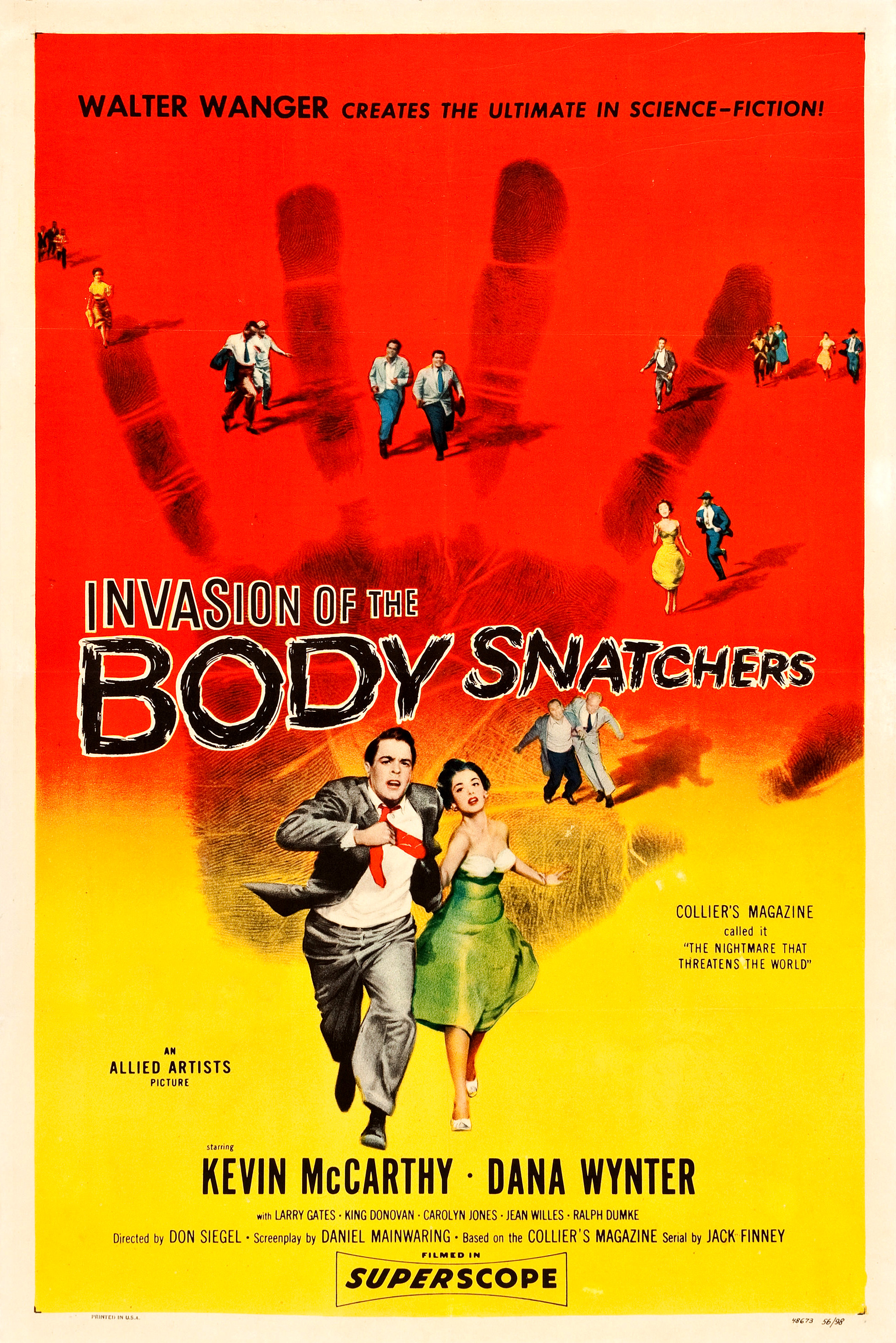
A timeless, terrifying motion picture! Based on the Collier’s magazine serial turned book The Body Snatchers by Jack Finney, directed by Don Siegel, and produced by Walter Wanger (of Cleopatra infamy), this Allied Artists’ motion picture is the single best representation of the fears and anxieties of the 1950s. But the beauty of this particular picture is that its themes including the fear of conformity, loss of identity, dehumanization, loss of individuality, and even vulnerability are still relevant today, perhaps even more so than they were at the time this seminal horror film was released.
In Santa Mira, California, Dr. Miles Bennell (Kevin McCarthy) is baffled when all his patients come to him with the same complaint: their loved ones seem to have been replaced by emotionless impostors. Despite others’ dismissive denials, Dr. Bennell, his former girlfriend Becky (Dana Wynter) and his friend Jack (King Donovan) soon discover that the patients’ suspicions are true: an alien species of human duplicates, grown from plant-like pods, is taking over the small town.
While this film sits comfortably in the horror/sci-fi subgenre, it shares a lot of characteristics in common with film noir. Between the recurring narration, a central character in over his head, and the fact events do not turn out favorably for the central character, it pulls on the best of the film noir apparatus to craft a highly unnerving cinematic story that prompts one to think about the state of the world around him or her.
Perhaps in its day, Invasion of the Body Snatchers was a commentary on the threat of communism/socialism on the American republic, but that is not the only subject to which this film can speak to us decades later. Could it still be read as a warning against the threat of communism today? Sure. But, communism doesn’t look or act like it did back in the 1950s. That’s the danger inherent with famous allegorical films such as this one; the well-known danger is pigeonholing it into only ever meaning what it meant back during the days of the Cold War. When in fact, this film can be read as a commentary on a variety of topics, depending on the worldview of the audience member.
Whatever the form the existential enemy takes, whether you choose to read it as a commentary on communism, socialism, nationalism, or woke-ism (more accurately defined as applied/reified postmodernism), this film speaks to that which is defined as a threat to one’s present existence. When we label what this film is about, we limit its potential to speak to us. So, it’s better to read the film through its various themes versus defining what the enemy is. From beginning to end, the film depicts events and behaviors that rob individuals of expression, identity, competition, entrepreneurship, and choice in exchange for homogeneity, group think, forced societal roles, and emotion. Ostensibly, this film is about an enemy that seeks to dehumanize and force conformity upon everyone—a world in which everyone is equal and exactly the same versus a world in which we are all equal but definitely not the same. The film demonstrates what happens when we are asleep to the threat of the enemy, and it comes in like a thief in the night. And when we finally recognize the threat, it’s all but too late for us, for humanity, for freedom.
The film begins laying the pipe for the second act reveal of the pod people all the way at the beginning. It’s a scene to which many may not pay particular attention; it’s the scene wherein Miles notices that the Grimaldi vegetable stand is no longer open. One of the characteristics of a society that demonstrates a lack of support or simply opposes free enterprise (or by extension the marketplace of ideas), is manifested in this imagery. Farmer Grimaldi abandoned his private farming business in exchange for supporting the planting and harvesting of the alien pods. Other disturbing imagery is the crisis between the second and third acts wherein Miles and Becky are told that the pod people (replicants of their human counterparts) mean them no harm and want to provide a peaceful existence. The real horror here is that the peaceful existence comes at the cost of freedom and one’s unique identity (all the traits that make one a unique man or woman). These pod people are devoid of any genuine emotion, only exhibit the pretense of it, and see individualism as a threat to their existence.
Invasion of the Body Snatchers is a call to action; it’s a wakeup call to all those that watch it to stand vigilant against tyranny, to stand guard against threats both seen and unseen that seek to undermine what it means to be human. Furthermore, the film posits the idea that the deadliest enemy may not be the one that can be viewed with the naked eye; rather, the deadliest enemy is the one that sneaks in unbeknownst to most individuals. Or maybe it comes disguised as something that sounds great on the surface, but only seeks the destruction of uniqueness, freedom of expression, the marketplace of ideas, and the human dimension of existence.
Due to the timelessness of the message of this terrifying film, we are drawn back to it time and time again. We are reminded to stand guard against an enemy that seeks to destroy our very way of life. It’s a story of survival and the great cost of freedom. A recurring theme throughout the horror genre is the theme of survival, and Invasion of the Body Snatchers is a brilliant exploration of how to survive against mounting odds that appear unstoppable. Horror films have a way of causing us to rally, causing us to come together in support of our right to survive. There is no other genre that inspires us to fight the enemy like a horror film.
Ryan teaches Film Studies and Screenwriting at the University of Tampa and is a member of the Critics Association of Central Florida and Indie Film Critics of America. If you like this article, check out the others and FOLLOW this blog! Interested in Ryan making a guest appearance on your podcast or contributing to your website? Send him a DM on Twitter. If you’re ever in Tampa or Orlando, feel free to catch a movie with him.
Fangtastic! Universal Pictures’ Abigail is a wildly entertaining, classically-inspired horror movie that you can really sink your teeth into. It delivers old school vampire movie elements with a contemporary sensibility. Ostensibly, it’s the metaphoric child of Dracula (1931) and The Horror of Dracula (1958). From beginning to end, the terror and laughter continually draw you into the story. Tonally, it strikes a great chord. The narrative never takes itself too seriously; however, it never devolves into parody either. It’s an effective blend of the atmosphere and music of an old school Universal monster picture and the increased gore of Hammer studios. Underscoring the blood-curdling outside/action story is an internal story with a redemptive message and even a little heart.
A group of would-be criminals kidnaps the 12-year-old daughter of a powerful underworld figure. Holding her for ransom in an isolated mansion, their plan starts to unravel when they discover their young captive is actually a bloodthirsty vampire.
From the moment the film opens, I was hooked! It opens with a solitary ballerina gracefully dancing on the stage in an empty auditorium; but what makes this scene particularly alluring is the original Dracula score (selections from Tchaikovsky’s Swan Lake) underscoring the entire opening sequence. It’s a deceptively simple scene that draws us into the beauty of the dance and music. Not only does the iconic music play at the beginning, but variations of it serve as a significant part of the movie’s score. This scene could be made greyscale, and edited to look like it was shot on 1930s 35mm film stock, and I’d almost buy that it was shot nearly 100 years ago.
While the movie may start out in the city, it doesn’t take long to venture into the countryside where a foreboding Tudor style estate serves as the main location for the events of the film. Again, Abigail is channeling Universal’s roots in classic horror by placing our relatively small cast in an isolated expansive estate that could’ve very well been used in a Carl Laemmle/James Whale motion picture. All that was missing was the eerie setting being draped in a dense fog rolling off the moors. As the characters wander through the imposing countryside mansion, the movie effectively established the rules by which the film will live by as it delivers its screamtastic narrative.
Without getting into plot specifics, I can tell you that it’s a simple plot with complex characters–so the best kind of cinematic story! Each and every character is sufficient developed, and quickly. The movie wastes no time at any point. It’s a lean, mean script that snaps, crackles, and pops. Not only is the world build, complete with rules, but the logic of the movie follows the rules and boundaries that it setup for itself during the first act. And while the movie does adhere to many classic vampire tropes, it also subverts some expectations. But not too many. There is one, in particular, to which I feel that it should’ve adhered but identified a way around it for dramatic purposes. But otherwise, I like that it pretty much stuck to the vampire playbook that has been used since Bram Stoker penned the seminal novel.
While there is a lot of blood, I wouldn’t say that it is a particularly violent picture. When the violence and gore hit–they hit–but it’s not gratuitous to the point of exhaustion from the visceral gore and projectile blood. I’d say it’s along the lines of Ready or Not levels of violence/gore. It’s never delivered in a manner that feels disturbing or disgusting; like with the tone, there is a consistent tongue-in-cheeky quality in the fighting or kill scenes. There are some fantastic skills and scenes that I hope make their way into the HHN (Halloween Horror Nights) house that this movie is destined to become this year or next.
the comedy is effectively delivered scene after scene. There is a great combination of humorous dialogue and visually-driven humor. Lots of hilarious image juxtapositions and an over-the-top quality to much of what is experienced. The movie is full of exaggerations, twists, and reversals. Whether the punchline is delivered in an argument or a sight gag, it’s done incredibly well by writers and directors that care. There is one scene that I particularly enjoyed, and it’s the vampire dancing with a headless corpse to the Dracula score. It’s just so ridiculous that you will undoubtedly laugh!
Despite the wildly entertaining qualities of this movie, it is not without some heart. One of the characters learns that constantly feeling like the victim of their circumstances is not constructive, and sometimes the best thing to do is move forward, freeing oneself from the prison of victimization. It was a nice touch that didn’t feel forced, but rather earned by the character.
You don’t want to miss seeing Abigail on the big screen, because the experience will not be the same at home. If you’re a fan of both Universal and Hammer horror, then you’ll want to make sure to watch Abigail in cinemas.
Ryan teaches Film Studies and Screenwriting at the University of Tampa and is a member of the Critics Association of Central Florida and Indie Film Critics of America. If you like this article, check out the others and FOLLOW this blog! Interested in Ryan making a guest appearance on your podcast or contributing to your website? Send him a DM on Twitter. If you’re ever in Tampa or Orlando, feel free to catch a movie with him.





 R.L. Terry ReelView