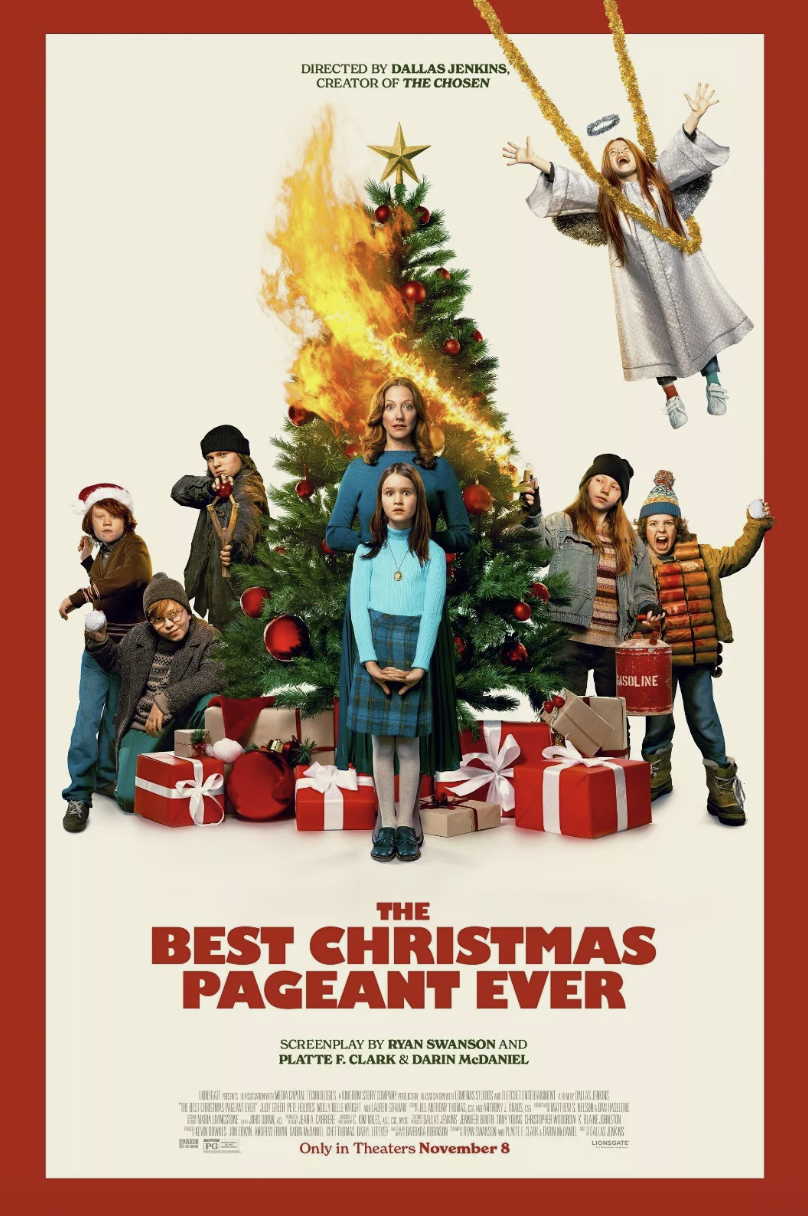
THE BEST CHRISTMAS PAGEANT EVER movie review

A heartwarming reminder of the importance of community. The movie also delivers a thoughtful critique of misplaced values. Based on the beloved 1971 children’s novel by Barbara Robinson, this big screen adaptation is a solid way to kick off the holiday season with a Christmas movie that is sure to fall into the annual movie rotations for many. Although the screenwriting demonstrably lacks refinement, there is still much to like about the movie. After a rocky first act, the movie finds its tone, despite the rough dialogue and poor pacing. Over all, it is an enjoyable movie that I will likely watch again before the Christmas season is over.

The Herdmans are six siblings who have a reputation for being the worst kids in the world. However, when they take over the local church Christmas pageant, they just might teach a shocked community the true meaning of Christmas.

Tonally, this movie falls somewhere between A Charlie Brown Christmas and A Christmas Story. While this movie may not have the same degree of memorable scenes that will find their way into the cultural zeitgeist, there are moments of hilarity and thoughtful poignancy. The movie shies not away from spotlighting the various prejudices and classism that permeate every town, particularly small towns and even amongst the imperfect people that makeup a church, but also uses the various social dynamics, at play, in the film to show how we can change for the better–after all, this is a redemption story. But it’s not a redemption story in the way we have seen in the past, with characters like Scrooge; rather, this is a redemption story about characters that talk the talk, but struggle to walk the walk. Moreover, this redemption story also follows those that are angry with the world and take out that anger and resentment on those around them. All around, this movie is full of imperfect people across the spectrum that need a wakeup call.

The movie works best when it leans into naturalism, but occasionally falters or feels uneven when it tries to strike a balance between typical faith-based movies and more mainstream ones. Some of the characters and conflicts feel like relatable albeit exaggerated versions of real life, while others feel incredibly forced and unnatural. From what I can remember, the Herdmans are more–how shall I say–earthy and raw in the book than in this film adaptation. And while we get glimpses of this, it would’ve been nice to have witnessed more of their behavioral aberrations to drive home how different they were perceived to be from their community. It’s here where we witness that Dallas Jenkins may be a better producer than director.

Bringing her trademark blend of strength, vulnerability, and sense of humor is Judy Greer as Grace, our house mom that unwittingly takes on the biggest event in her small town. All around, the principle cast is solid with a few standout performances. Some of those standout performances are from Knylee Heiman as the manic and terrifying Gladys, Beatrice Schneider as the crass Imogene, and Lorelei Olivia Mote as the self-centered diva Alice. The characters that work best are those that demonstrate stylistic differences compared to the rest of the cast. In other words, it’s the character actors that stand out in this film–and for good reason–they are both funny and act as an exaggerated reflection of real life people. We each know of people in our own lives that feel like these move people. I feel that if more characters were given something to do by the screenplay or director, that the performative dimension would’ve been above average.

Thematically, the movie reminds us that family and community traditions (particularly at Christmastime) are an important part of the human experience; however, the movie continues the conversation by its provocative reminder that traditions devoid of love and flexibility can become a trap or even a monster. It’s not the tradition itself that is important; it’s the love and community building that is most important. The tradition is merely a vessel through which we can extend love to one another. Just like Charlie Brown and his friends are reminded that Christmas is about the birth of baby King in a nondescript manger in a lowly town and, by extension, the radical changes He will bring to the world through His birth, life, death, and resurrection, the townsfolk in Emmanuel (the town in the movie) are reminded that Jesus was born for everyone, including the Herdmans, “the worst kids in the world.” And that we should care more about one another than we do keeping traditions the same simply for the sake of tradition.

After watching the movie, I am inspired to go back a reread the book. I remember reading it as a kid, and I imagine perhaps other kids of the 70s, 80s, and 90s remember reading the book as well.

Ryan taught Film Studies and Screenwriting at the University of Tampa for over eight years and has a book releasing next year titled Monsters, Madness, and Mayhem: Why People Love Horror. Recently, he has taken over 90.7 WKGC NPR in Panama City, and will be launching a film talk show soon. Additionally, he is a member of the Critics Association of Central Florida and Indie Film Critics of America. If you like this article, check out the others and FOLLOW this blog! Follow him on Twitter: RLTerry1 and LetterBoxd: RLTerry

ChosenCon 2024 Review

by Jennifer Wead

“Have you seen The Chosen?” is not a question you would have had to ask the more than five thousand people who arrived at the Orlando World Center Marriott last weekend for ChosenCon 2024. The hotel/conference center was fully dec’d out in teal and black (the official colors of The Chosen). Actors and crewmembers wandered about the concourses interacting with fans. Various panels entitled “Gates of Hell: The Devil’s in the Details” and “Welcome to Bethany” drew long lines of fans waiting to enter the conference rooms to hear behind-the-scenes stories.

This is the second year for ChosenCon, and based on the fan response and slate of upcoming projects announced by Dallas Jenkins during the convention, the studio does not appear to be easing up on the pedal any time soon. 

The first season of The Chosen debuted in 2019 and has been steadily growing in resources and fans since then. It is notable for being mainly crowdfunded. The studio is continually raising the qualitative bar on the landmark series, and has witnessed tremendous growth amongst fans and production resources over the last year. Contrary to how one may think a Biblically-inspired show may be received by mainstream Hollywood, it is continually receiving accolades from those in and, perhaps more surprisingly, outside of the faith. More and more celebrities and influencers are commenting favorably about the show, such as superstar Blake Shelton and even the hosts of The View.

My first experience with The Chosen goes back to its first season. I had seen some of the advertisements on Facebook but just thought it was probably another sub-par faith-based project. It wasn’t until my cousin and author told me I should take some time to actually sit down and watch it that I relented. I have been a believer for many years, but I generally had two expectations when it came to this kind of media, either (1) it would be, as stated earlier, sub-par and cheesy or (2) it would be a complete misunderstanding or misrepresentation of Scripture and Christianity. 

Needless to say, I spent the entire first episode waiting for something to disappoint me. Nothing really did. In fact, it touched me. So, I gave the next episode a chance. And the next. And the next. Each episode not only faithfully recreated iconic moments in the Bible but also did it in a way that defied expectations. The characters seem like real people and not just stained-glass window paintings. In general, The Chosen gives backstories to many of the characters. While we may not know the actual true-life activities of all the people written about in the Bible, The Chosen tries to fill in plausible stories. This is all done in an effort to make the well-known stories in the New Testament hit harder. Furthermore, they will often tie in flashbacks to the Old Testament. The stories also seem to surprise me. You may wonder: How can a Bible show be surprising? There shouldn’t be any spoiler alerts! It is not always what is happening but more of how it happens that can surprise you. 

However, while the show did assuage my initial misgivings, it was really the people involved that converted me into an actual fan. I try not to mindlessly accept everything that people write about the Bible or other faith-based media, so I felt that I would need to discover the motivations of this group of creators before I gave it my allegiance. What I found was authenticity. The creator of the show, Dallas Jenkins, was honest and humble about the writing process and always answered questions about why he and his co-writers (Tyler Thompson and Ryan Swanson) adapted stories in a certain way. He didn’t shy away from hard questions but he was also not the sort of person who would be blown about by every opinion. Dallas sees his job as pleasing God first. He also was clear from the beginning—in fact it is stated in the very first episode of the show—that this is not the Bible, nor is it meant to be a replacement of the Bible. 

I have been to two ChosenCons, participated in the filming of the Feeding of the 5,000 and nothing I have seen has made me think otherwise. Every actor, crewmember, and writer are passionate about the project, even though many of them come from different faith backgrounds. They tear up in gratefulness when speaking about the project and try to make genuine connections with the fans. Every actor I spoke with was thoughtful and passionate about portraying their character in the right way. They spoke of finding purpose and fulfillment in their part. Some of the crewmembers are getting to be just as famous as the actors themselves (at least among the fans who came to ChosenCon).  

The producers of The Chosen are just as passionate about sending their show out to fans around the world too! The Come and See Foundation is dedicated to funding the show as well as getting it translated into 600 languages (they have around fifty to sixty now, which makes it the most translated show of all time, surpassing Baywatch, the previous record-holder).  Outside of the US, some of their biggest markets are Brazil and Latin America. 

The Chosen is four seasons into their planned seven season run. Season five has already been filmed and is in post-production. Season five centers on Holy Week with Season six dealing with the crucifixion and season seven the resurrection. On Friday night, Dallas announced a rebranding of their studios as 5 & 2 Studios with plans to create more relevant faith-based content, which include a children’s animated show (The Chosen Adventures), a Bear Grylls adventure show (The Chosen in the Wild with Bear Grylls), shows about Moses and Joseph, and, finally, the much-anticipated show about the Acts of the Apostles (The Way of the Chosen). Of course, with the Bible being as lengthy as it is, there is no shortage of material from which they can pull in the future. 

As someone who grew up with a dearth of well-written faith-based material but who always appreciated a TV show that could pull you in, it is exciting. If the quality remains the same, they will be able to continue growing as they have. I have enjoyed every episode I have watched, and it is truly hard to pick a favorite. So, my final question for you is: “Have you seen The Chosen?” 

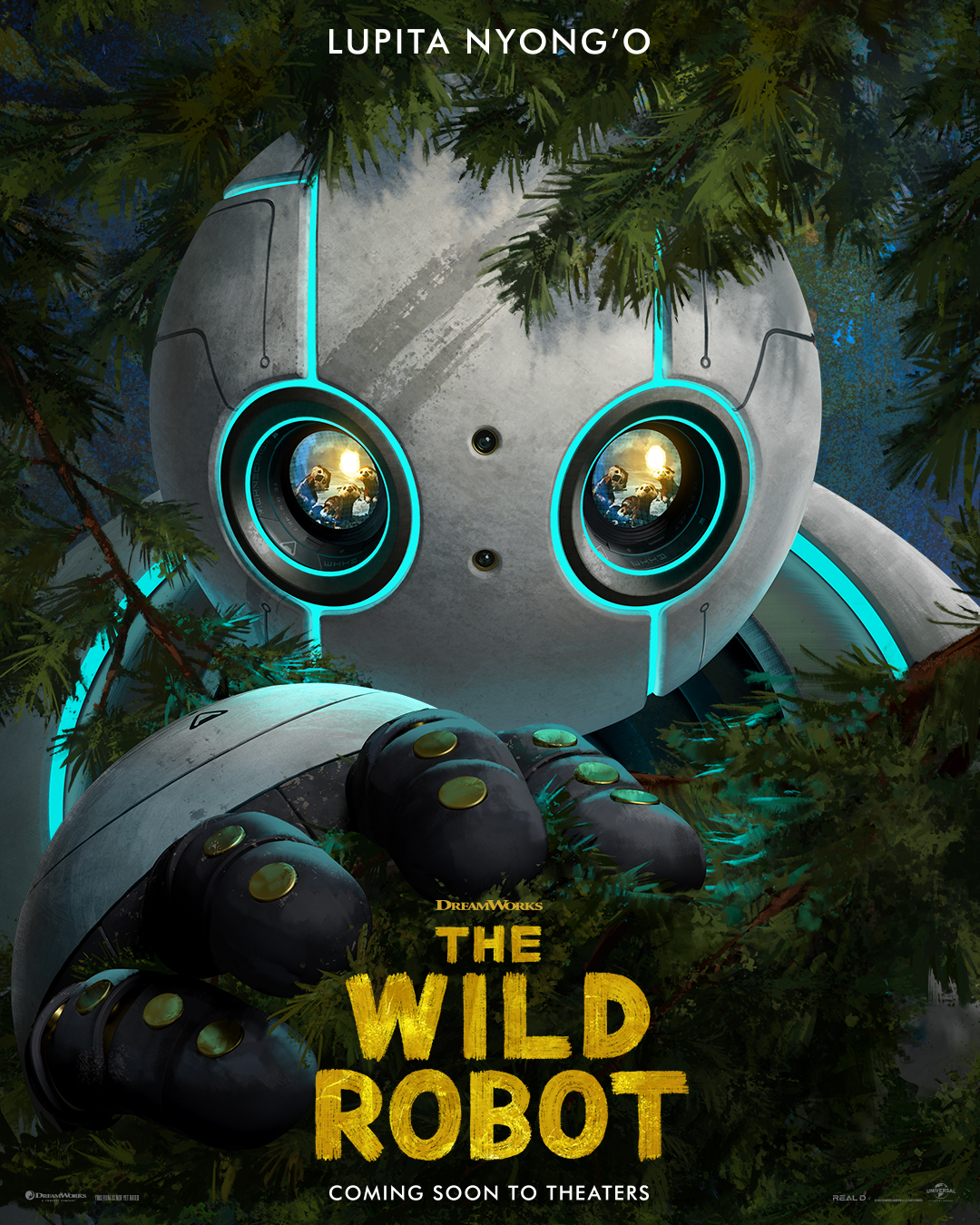
THE WILD ROBOT movie review

Wildly heartfelt and uplifting! Universal and DreamWorks Animation’s The Wild Robot is among the best films of the year, period. Director Chris Sanders delivers a truly compelling and smartly written fish-out-of-water story about found family and being more than the sum of our parts–or programming. Easily on track to make my Top 10 Films of the Year list. Based on the book by the same name, DreamWorks Animation hits a homerun with this outstanding animated motion picture that will challenge you, thrill you, and tug at your heartstrings.

Shipwrecked on a deserted island, a robot named Roz must learn to adapt to its new surroundings. Building relationships with the native animals, Roz soon develops a parental bond with an orphaned gosling.

I’ll admit it up front, I cried. It really is such a beautiful animated motion picture that likely rocketed its way into my best films of the year list. Not since The Iron Giant have we had an animated motion picture with such gravitas. While I still feel that 2016’s Kubo and the Two Strings remains the best animated motion picture in the last ten years, I must say that The Wild Robot is solidly my No.2 pick. The strength of this picture is in the compelling story, relatable characters, and efficient plotting (sometimes a little too efficient). My only real negative criticism of the film is the pacing in the first act; while refreshingly lean, some scenes and sequences needed a little more room to develop and breathe. Even though The Wild Robot shares little in common with The Iron Giant‘s plot, it shares Iron Giant‘s heart and soul.

Fish-out-of-water premises have been a staple of cinema for nearly as long as films have been around. So the real challenge for writers and directors is to find original ways of expressing these foundational ideas. And what is precisely what we have in this film. There are actually three fish-out-of-water narratives within the film, and the film is better for them because each of these layers adds personal and interpersonal complexities to character relationships with the world in which they finds themselves and amongst each other. The films provides thoughtful commentary on what it is like to both be in a world that is unfamiliar and have unfamiliar tasks thrust upon oneself.

Furthermore, this film depicts the importance of adapting to one’s environment and overcoming obstacles, even those that are innate. I also appreciate what the film has to say about self-determination and taking personal responsibility for one’s circumstances and one’s mistakes. Fish-out-of-water stories are some of the most relatable, because we have all been placed in an unfamiliar environment, and know how that can feel. It’s a terrifying prospect to be dropped into a world that is alien to us, and the film does not shy away from the challenges, joys, and even the tragedies that can befall us.

Another narrative area of strength in the film is challenging us not to quickly pass judgment on that fish-out-of-water when they find themselves in your world. Or to presume that one’s past behavior is always an indication of how that person (or animal, as it were) will always behave. Yes, past behavior can indicate predisposition to moral and ethical aberrations, but that does not mean that redemption is not to be considered a possibility. I love how the film paints a portrait that we can change, if we have the will and support to do so. It rarely comes naturally, we have to work at it. We have to work at overcoming natural behaviors that may not be constructive and ultimately selfish. We are more than the sum of our parts–or our programming.

To a lesser extent, there is come social commentary on the relationships between the work place and the employee and even cultures that decry the individual in exchange for group think. Without getting into spoilers, the film depicts imagery of how some, if not many, companies treat and feel about their employees. How a company does not view the employee as an individual; rather, as a means to an end, just another cog in the machine that will be disciplined for any individuality or unique expression. But not before the company assimilates the knowledge of that employee, particularly those that do think outside the box. Difference will not be tolerated. That is the feeling of many companies and even governmental systems. The film challenges these ideas by showing cooperation between diverse groups, even groups that are naturally enemies. Furthermore, the film demonstrates how differences can be overcome or even set to the side in order to serve, protect, and survive.

Lastly I’d be remiss not to touch on the global idea of the film, which is the concept of found family. Throughout the entire film there are images of the important role one’s found family fills in life. Found family is that family-like unit that may not be blood-related, but very much fill the same role as a more traditional family in one’s life. It’s a group of friends that have a relationship that goes beyond typical friendship, and includes family-like dynamics. Sometimes these are formed because someone feels rejected or neglected by their real family, and find family with a close group of friends. Other times, and I’d venture say most of the time, a found family can be formed out of the significant distance between you and your family of origin. So when in a new place because of school, work, or even military transfer, it’s important to form a strong bond with friends (or a friend’s family) to fill that important role even when separated from one’s family of origin. We are creatures that have an innate need for connection and companionship.

I cannot recommend The Wild Robot enough! Don’t miss seeing this incredible animated motion picture on the big screen.

Ryan teaches Film Studies and Screenwriting at the University of Tampa and is a member of the Critics Association of Central Florida and Indie Film Critics of America. If you like this article, check out the others and FOLLOW this blog! Interested in Ryan making a guest appearance on your podcast or contributing to your website? Send him a DM on Twitter. If you’re ever in Tampa or Orlando, feel free to catch a movie with him.

Follow him on Twitter: RLTerry1 and LetterBoxd: RLTerry
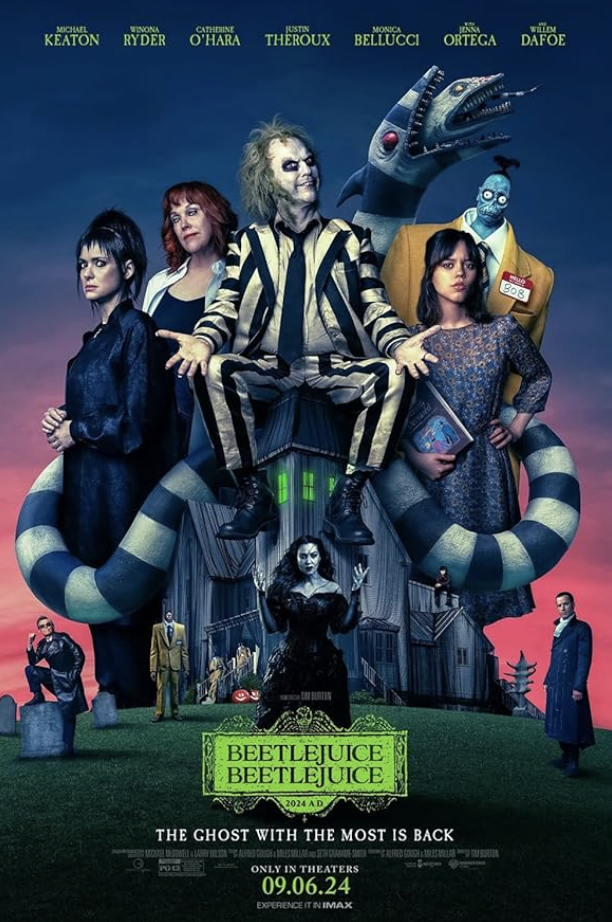
BEETLEJUICE BEETLEJUICE movie review

Forgettable and messy. The long awaited and much anticipated sequel to the campy cult classic Beetlejuice is unfortunately an underwhelming return to the fantastical, whimsical universe of colorful and dynamic characters. I’m left asking myself, this is the story for which Burton has been waiting???

Three generations of the Deetz family return home to Winter River after an unexpected family tragedy. Still haunted by Beetlejuice, Lydia’s life soon gets turned upside down when her rebellious teenage daughter discovers a mysterious portal to the afterlife. When someone says Beetlejuice’s name three times, the mischievous demon gleefully returns to unleash his very own brand of mayhem.

Beetlejuice Beetlejuice is a disjoined mess of setup after setup, with little development or meaningful resolution. Even though it successfully channels some of the charm and macabre whimsy of the original, this one is missing something vital–heart. What is most painful to witness is that there is actually a good and even compelling story in there, but its’ buried beneath a garbage heap of subplots and characters that are little more than the equivalent of an NPC (video game-speak for non player character). While the screenplay is abysmal, the bright spots in the movie are Michael Keaton’s delightful reprisal of Beetlejuice, despite his reveal appearing too early in the story. Other highlights of the movie are the quintessentially Burton special makeup and practical effects, including miniatures and puppetry. And composer Danny Elfman lends his distinctive authorship to the score. For fans of the original, this one is likely going to disappoint, but perhaps for those that may be getting introduced to the world of Beetlejuice for the first time, will seek out the original campy classic. At the end of the day, it’s not all bad, but it’s far from good. At best, it’s sufficiently entertaining.

Before getting into what didn’t work, which is substantive, I’d be remiss not to spotlight what the movie did right. The big question, did Burton and Keaton revive ol’ Beetlejuice? And the answer is, yes. The character of Beetlejuice himself is the reason the movie has enjoyable moments and will keep you moderately entertained. Keaton delivers a Beetlejuice that makes you forget that he hasn’t played this character in nearly 40 years. For the most part, he captures the energy, wit, sarcasm, and offbeat charm of his original incarnation. Unfortunately, that cannot be said for the rest of the performative dimension. But more on that later.

Over all, the design of the movie harkens back to the Burton’s golden age in the 80s and 90s, except when he lays practical effects over CGI backgrounds or oscillates between both mechanical and digital in jarring ways. From beginning to end, movie magic is witnessed everywhere. Burton was committed to capturing the imagery of the original in both the costumes and set design, and by in large, he accomplished just that. This movie is a reminder that computers cannot replace the way real light bounces off real objects into the camera lens. The magic of motion pictures is a combination of tactile, chemical, performative, and lighting elements. Despite the Afterlife lacking true camp value, it was a successful return to the imaginative world created by Burton in the original movie.

Regrettably, the movie fails to deliver a compelling or even coherent story. It’s a disjoined mess of ideas that couldn’t have possibly made sense on paper, let alone on the screen. The first act moves along sluggishly, but picks up pacing in the second and third; however, very little (if anything of meaningful value) is developed or resolved that is setup in the first and second acts. There are literally entire characters that serve little to no purpose in the story. And, without getting into spoilers, there is a compelling plot that is excellently setup, but the development and resolution is so sloppy it just hurts the narrative all the more. Even a notable cameo is completely wasted as it bears little importance to the story. It’s hard to even call it a story because it’s lacking a plot, a central character, and a character of opposition; there isn’t even a real goal to be achieved. While the character of Beetlejuice is known for his chaotic behavior, the narrative need’t exhibited the same level of randomness and chaos as exhibited by our title character.

Speaking of characters, the reason that the performative dimension is sorely lacking any modicum of substance is because the characters are given nothing to do. There is little reason for anyone to be doing anything. Furthermore, the Delia and Lydia we get in the original are not the Delia and Lydia we witness in this movie, and Lydia’s daughter Astrid is simply not believable as an angsty teenager. With a little motivation and dimension, the characters would’ve likely been highly entertaining and compelling; but, they are lacking any dimension whatsoever.

Tonally, the movie is all over the place. All over the place except for the one place it needed to be. And that is camp. For a movie that should’ve eat, slept, breathed camp, it plays it too seriously and tonally inconsistent. Yes, there are what we would usually refer to as campy costumes and characters in the movie, but the context is lacking that camp aesthetic and sensibility, for which Burton is (or used to be) known. Contributing to the tone of the movie is the Elfman score that only feels like Elfman sometimes. It’s like a composer imitating Elfman. Yes, we get the classic Beetlejuice theme music, but other than that, I’d be hard -pressed to identify any other musical moments that felt like Elfman.

The movie does deliver some entertaining moments, but sadly they are few in number. When the movie works, it works! But it simply does not work sufficiently enough. Also, the lines “…strange and unusual” and “it’s showtime” are nowhere to be found. There was also a setup for a much-needed scathing critique on influencers and influencer culture, but that setup too wasn’t developed. So many great ideas that are completely disconnected.

Watch if you simply want to enjoy some movie magic and familiar characters, but don’t expect to be quoting this sequel like you do the original. I’ll leave you with this, the fact that Lydia’s TV show is titled “Ghost House” is a nice nod to the original title of Beetlejuice.

Ryan teaches Film Studies and Screenwriting at the University of Tampa and is a member of the Critics Association of Central Florida and Indie Film Critics of America. If you like this article, check out the others and FOLLOW this blog! Interested in Ryan making a guest appearance on your podcast or contributing to your website? Send him a DM on Twitter. If you’re ever in Tampa or Orlando, feel free to catch a movie with him.

Follow him on Twitter: RLTerry1 and LetterBoxd: RLTerry
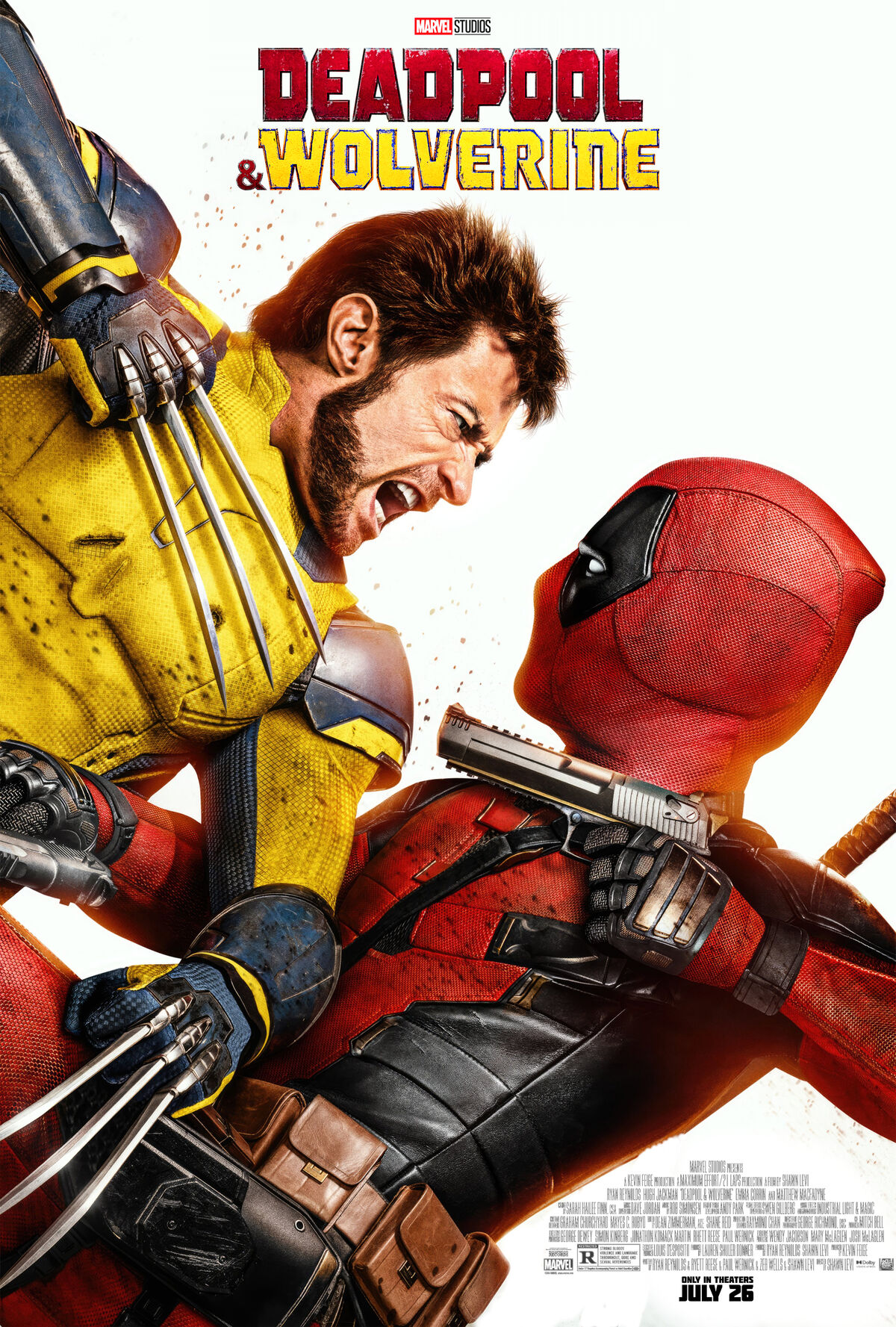
DEADPOOL & WOLVERINE movie review

Exhausting. Deadpool & Wolverine is a step down from its predecessors in terms of quality and cleverness of storytelling. While clearly intended to be a movie that reinvigorates the MCU, the screenwriting is both pandering and derivative. While effective in smaller doses, the hyper-meta humor is overplayed to the point of being obnoxious. Moreover, there are many gags that are recurring to the point of boredom. While expertly choreographed, shot, and edited, the endless barrage of fight sequences overstays its welcome. In terms of the premise, the whole multiverse idea that has been integrated into so many superhero movies (both MCU and DCEU) is overplayed. Had the movie been closer to 90-100 minutes, then perhaps the pacing would’ve been better and the Deadpool jokes, satire, and gags would not have felt overplayed, but the 2+ hours runtime works against the full potential of the narrative. If you can’t get enough of the Deadpool schtick, then you’ll undoubtedly like this movie. But if you were hoping for something as clever as the first two Deadpool movies, then you may be as disappointed as was I.

When the multiverse is threatened by a powerful Omega class mutant, Deadpool’s services are retained to protect the multiverse from complete collapse. In order to defeat this new deadly enemy, Deadpool teams up with the Wolverine, whom is recovering from psychological injuries.

Because of the movie’s setup, I had hoped that Deadpool and Wolverine’s goal would have been to eliminate all timelines except the sacred timeline (I guess that’s supposed to be the real/our world), putting an end to the multiverse, but that wasn’t the motivation or goal. So, I suppose that means the multiverse theory will continue steamrolling through this and other franchises. The whole multiverse theory needs to die. At this point, it is way past its half-life and rather limiting on the stories that can be told. Sounds counterintuitive, right? For how could a multiverse limit the stories that can be told? Simple. Everything is connected in a codependent sort of way. In a cinematic (including television counterparts) multiverse, no story, character, or plot is truly independent of the other; therefore, a filmmaker is unable to craft an original story; for any story involving the characters in a multiverse, has to fit in with the rest of the multiverse.

In a manner of speaking, a multiverse actually mitigates freedom of expression and variety of storytelling. When filmmakers return to crafting original expressions of stories and plots for comic book characters, then the quality of comic book movies may agin reach the levels of the Burton-verse. To this day, Batman 89 and Batman Returns are still the two best examples of superhero/comic book movies with X-Men the Animated Series being the best example of a superhero/CBM television series.

Fortunately, Hugh Jackman’s Wolverine’s gritty, no nonsense personality helps to balance out Ryan Reynolds’ manic Deadpool. While I have many reservations with this movie, I cannot deny the great chemistry between the two of them. Jackman’s X-Men the Animated Series inspired Wolverine was my favorite part of the whole movie. Partly because I grew up with X-Men TAS and have enjoyed the X-Men 97 series. Seeing that yellow and blue suit filled me with such happiness. Additionally, there are other nods to X-Men TAS and the Fox X-Men movies, including a particular surprise cameo that I know my friend Shawn of the Solving for X podcast will immensely enjoy! (If you’re an X-Men fan, then you should add this podcast to your lineup). What I liked most about this movie was the X-Men dynamic. Even though I have my reservations, I am curious how this newest iteration of cinematic X-Men will be adapted for the big screen. It is my hope that it will have the quality of storytelling of X-Men TAS that successfully addressed difficult topics in the real world both creatively and accessibly, all while bringing everyone to the table. Just as Professor X dreamed humans and mutants could engage in meaningful discourse one day.

Breaking the fourth wall and meta-humor can be effective tools for both humor and plot/character development; however, recurring pot shots and real-world references detract from the cleverness of the humor, and can ultimately take the viewer out of the movie. More so than the previous installments in the Deadpool franchise, this one is particularly packed with, what I am calling, hyper-meta humor. Hyper in that it’s so over the top and repetitive that it loses its charm quickly and grows stale. Most movies serve as a means of escape from the dullness, harshness, or complexities of reality; this is certainly true of superhero/comic book movies–or rather, was. I don’t know about you, but I don’t go into most movies hoping to be reminded of reality. Unless of course, for example, it’s based on a true story or a melodrama that is intended to evoke a real-world emotive response. So many of the jokes in Deadpool & Wolverine take me out of the movie, especially one recurring pot shot, that I won’t mention, that is borderline disrespectful of an historic Hollywood institution.

Despite most of the movie, in my opinion, to be lacking in genuine, clever humor, I manages to at least laugh here and there. The problem with a movie built entirely on the humor of middle school boys is that the move is ironically inappropriate for that same age group. When the first Deadpool released (by 20th Century Fox), they did the responsible thing by reminding parents that, even though this was a superhero movie, that its intended audience was 17+. I’ve yet to see an effort on Disney/Marvel’s part to remind potential audiences that this movie is rated R, and not appropriate for younger audiences due to the sexual innuendoes and language. Violence wise, other than the increased amount of blood, it’s on par with many PG-13 movies. When Deadpool hit the scene, he was different from that of most other superhero characters at that point, and his schtick was refreshingly funny; now, with the increased amount of middle school base humor in many comic book movies (mainly the MCU), it’s no longer refreshing and now borderline obnoxious. If I had to select one word that best describes Deadpool & Wolverine it would be obnoxious.

Ryan teaches Film Studies and Screenwriting at the University of Tampa and is a member of the Critics Association of Central Florida and Indie Film Critics of America. If you like this article, check out the others and FOLLOW this blog! Interested in Ryan making a guest appearance on your podcast or contributing to your website? Send him a DM on Twitter. If you’re ever in Tampa or Orlando, feel free to catch a movie with him.

Follow him on Twitter: RLTerry1 and LetterBoxd: RLTerry