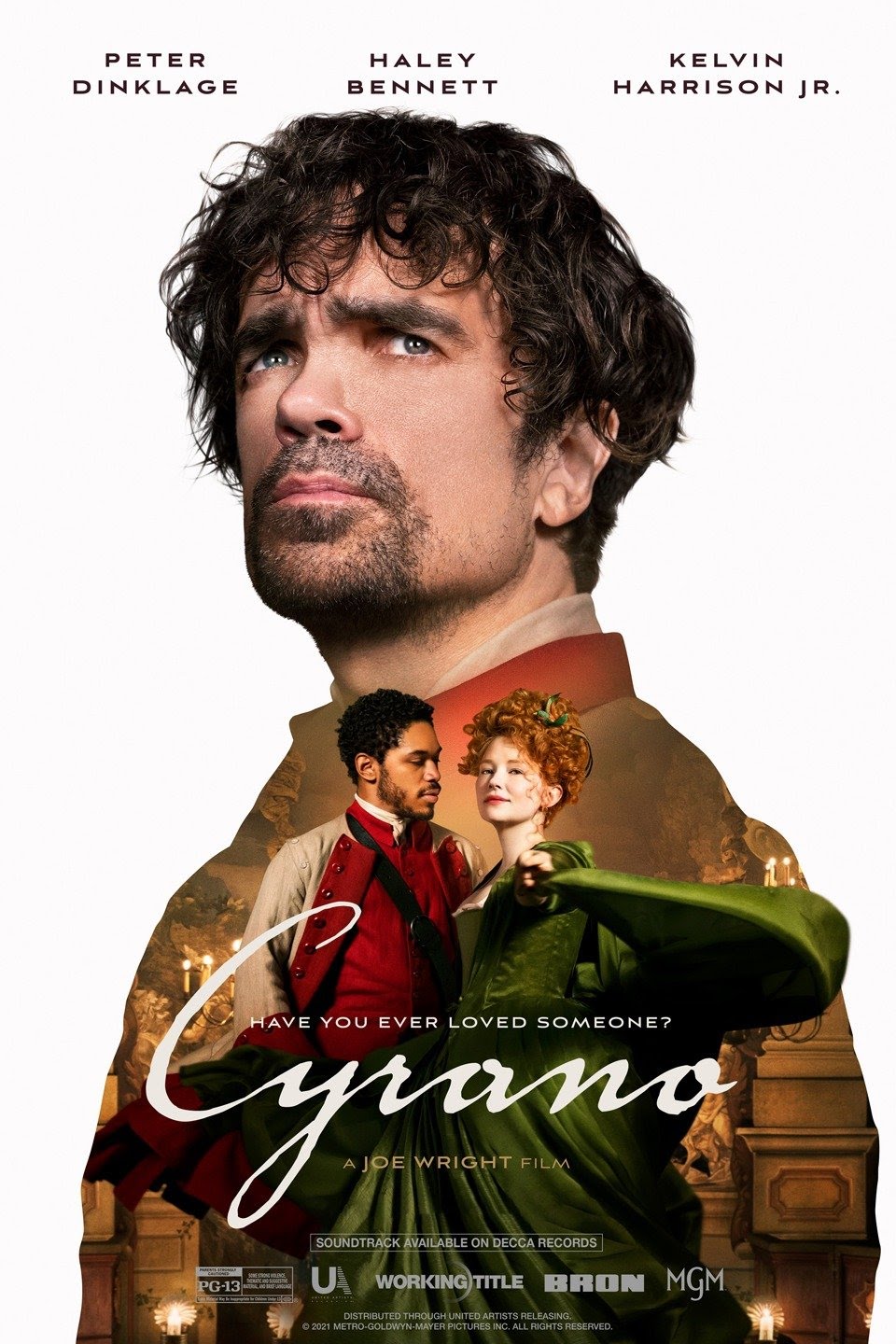
Outstanding! Move over În the Heights and West Side Story, this is the best musical since Greatest Showman. Joe Wright (Darkest Hour) delivers a thought-provoking musical adaptation of the classic story inspired by the real Cyrano de Bergerac–yes that’s right, before he was immortalized in Edmond Rostand’s 1897 play, he was indeed a real-life person. Furthermore, this adaptation of the timeless stage play provides audiences with immense depth by exploring romanticism versus reality. A topic that resonates with anyone that experiences this mesmerizing motion picture. From the 17th century Sicilian setting to the beautiful costumes to the phantasmagorical choreography, Wright captures the soul of the original story yet finds a fresh perspective that will touch audiences everywhere. Peter Dinklage’s Cyrano writes and sings things (my fellow Game of Thrones fans will appreciate that reference). The chemistry between he and his co-stars Haley Bennett (Roxanne) and Kelvin Harrison Jr. (Christian) is fantastic! Although there is undeniably a healthy level of intentional camp in this otherwise naturalistic melodrama, Wright strikes a perfect balance between the two common approaches to musicals, in order to comment on relevant interpersonal topics whilst keeping the live theatre-like experience highly entertaining. The subtext of the entire story isn’t so much one of star-cross lovers caught in the middle of a deadly rivalry, but one of romanticism versus reality. Often times, we imagine a relationship or experience through an idyllic lens that constructs every element in the most ideal way possible, yet the reality of the relationship or experience is much more gritty and rough. Perhaps a great sacrifice must be made in the pursuit of the relationship that we had not anticipated. Perhaps the pursuit of the relationship may mean losing who you are. The possibilities of romanticism versus reality are endless. While Wright isn’t the first to bring de Bergerac to the big screen, he is the first to reinvent the classical tale though a spectacular big screen musical in the vein of the MGM Musicals of the Golden Age of Hollywood. You don’t want to miss seeing Cyrano on the big screen!
Ryan teaches American and World Cinema at the University of Tampa. If you like this article, check out the others and FOLLOW this blog! Interested in Ryan making a guest appearance on your podcast or contributing to your website? Send him a DM on Twitter or email him at RLTerry1@gmail.com! If you’re ever in Tampa or Orlando, feel free to catch a movie with him.
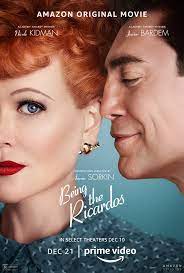
I LoveBeing the Ricardos. Whether you are a fan or scholar of I Love Lucy or not, this biographical motion picture is for you! Go behind the walls of 623 E. 68th St. (an address that in real life would be in the East River), and get up close and personal with one of the toughest weeks in Lucille Ball and Desi Arnaz’ careers and the run of the sitcom. Being the Ricardos also represents Aaron Sorkin’s directorial debut, and be brings with him his penchant for exploring the human condition through dialogue steeped in subtext, thus adding the dramatic dimension to the dialogue. What I appreciate about Sorkin’s approach is how he seamlessly layers two timelines and a meta narrative into one another, in a manner that is consistently driving the plot forward in terms of plot and character. While the central focus of the film is on Lucille Ball being accused of being a communist, there are ancillary stories on Desi’s affairs and Vivan Vance’s complicated relationship with Lucille Ball and her character Ethel Mertz. William Frawley is depicted as the most level-headed out of the whole cast. Other dynamics of the mother of all sitcoms include the the power dynamic between the writers Madelyn Pugh, Bob Carroll Jr., and executive producer Jess Oppenheimer. Throughout the film, one theme is clear: home. What does a home mean or look like to you? Lucy desires a home, and she will fight for it.
In 1952, Hollywood power couple Lucille Ball and Desi Arnaz face a series of personal and professional crises that threaten their careers, their relationship and their hit TV show.
With so many layers at play, it may have proven to be disastrous for many if not most writer-directors, but not Aaron Sorkin. Any reviews you’ve heard or read that suggest Being the Ricardos is too inside baseball are wildly exaggerated. Yes, there is a greater appreciation for the film by those that know I Love Lucy well, but even those that only know of the sitcom will appreciate it. The friend that attended with me had virtually no substantive knowledge of I Love Lucy, yet he laughed along with this film, and knew precisely what was going on and why it was so important. If you are a member of the creative economy that runs, writes for, or acts in a sitcom, then you will have a greater level of empathy and understanding for the ups and downs faced by writers, actors, producers, and sponsors in Being the Ricardos.
Being the Ricardos starts out “in the future” with interviews with the (late in real life) Jess Oppenheimer, Bob Carroll Jr., and Madelyn Pugh about I Love Lucy and that week–and they all had the same reaction. Although I thought the three comedy writers had passed away, I was completely convinced that Sorkin was interviewing the TV legends. I actually had to check Wikipedia for the death dates. Anyway. The illusion of a documentary layer added to the authenticity of this film. Periodically throughout the film, we return to our writers and executive producer for some retrospective commentary on the “past” or “present” story. These interview segments provide a more substantive context for the conflict to follow. Furthermore, it adds come comedic relief for the otherwise serious film.
Often times, these type of biographic motion pictures work to humanize or make relatable the central figure(s), and Sorkin’s film does just that. Even though the world knows that Lucille Ball and Desi Arnaz divorced in 1960 (following the final performance of the Lucy Desi Comedy Hour), we still think fo them as the madly-in-love couple at 623 E. 68th St (and later at their house in West Chester, CT). Going behind the scenes, we witness four actors with their own demons and flaws. Perhaps you can identify with the struggles experienced by Lucy, Desi, Vivian, or William (Bill). And not just them, but Madelyn, Bob, and Jess too. More than a historical biographical picture, this is a motion picture that is very much a story of what it means to be human that is paired with a deep dive into one of the most beloved TV shows of all time.
Kidman’s performance as Lucille Ball and Javier Bardem’s performance as Desi are excellent! While Bardem may not disappear behind the costuming, hair, and makeup to the degree that Kidman does, he had Desi’s mannerisms and body language down pat! Clearly, he spent a great deal of time preparing for a role that has major shoes to fill, or should I say bongos to play. From her voice to her appearance to her body language, Nicole Kidman will wow you with her portrayal of the Queen of Comedy Lucille Ball. Kidman’s preparation for this role of a lifetime paid off in spades. If I didn’t know any better, I’d almost believe that I was watching Lucille Ball on screen. It reminds me, in many ways, of Jessica Chastain’s outstanding performance as Tammy Faye in (my favorite film of 2021) The Eyes of Tammy Faye.
For fans of the show, you may notice some continuity errors. Now, these errors don’t detract away from the film, but may surprise you. The show is in the middle of the second season, but the apartment set is the apartment they would move into after Little Ricky was born in Season 3. The giveaway was the window in the back. And in the film when they are referring to baby the Ricardos will have, it’s actually Desi Jr. that would be born during the third season and not Lucie, which is what is depicted in the film.
While we get a flashforwards to the famous grape vat scene, we do not get the most famous scene from I Love Lucy of all time: Vitameatavegemin. It is referenced, but we do not get to see Kidman recreate this scene. Maybe it’s a bonus feature on the BluRay. I hope so anyway!
Ryan teaches American and World Cinema at the University of Tampa. If you like this article, check out the others and FOLLOW this blog! Interested in Ryan making a guest appearance on your podcast or contributing to your website? Send him a DM on Twitter or email him at RLTerry1@gmail.com! If you’re ever in Tampa or Orlando, feel free to catch a movie with him.
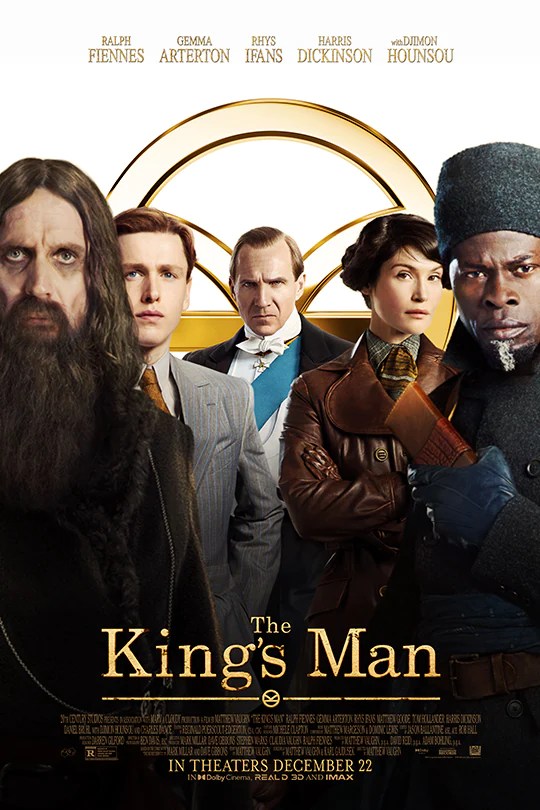
Highly entertaining! This film can be read as a commentary on the necessities and atrocities of war and the emotional cost of freedom. After the disappointing sequel to the outstanding Kingsman: the Secret Service, I was unsure what to expect from this prequel-sequel. So often, prequels simply do not capture the magic of the original. While the original is still the best in this franchise, this prequel taking us back to the origins of the secret agency operating at the most extreme discretion, will keep you engaged as it parallels world history leading up to World War I. The movie is well-paced and structured, and will keep your eyes and ears glued to the screen for the duration of the movie that surprisingly exceeds two hours; you will not feel like you’ve sat there for over two hours. Teaching World Cinema, I spend a lot of time each semester discussing the historical events that helped to shape the content therein and direction of cinema, so I was particularly interested in how closely this film would follow the Russian Revolution and the preamble to the Third Reich in Germany. Even though this film is not intended to recreate all the actual events that plunged the Western world into World War I, there are quite a number of nods and references to major turning points in the revolutions and wars. Most notably in this film, is the subplot of Rasputin and the Romanov family. Ralph Fiennes’ role as the Duke of Oxford (founder of Kingsman) finds a nice balance between serious and campy. Tonally, the original still strikes the best balance, but this one is certainly aiming for that balance between serious espionage movie and camp; perhaps the landing is a little bumpy, but never does it detract away from the experience. If you enjoy spy movies that are exciting and take place within real world history, then you will undoubtedly enjoy this film!
One man must race against time to stop history’s worst tyrants and criminal masterminds as they get together to plot a war that could wipe out millions of people and destroy humanity.
Decades prior to the events of the original, Kingsman was formed, but only after the Western world was plunged into World War I, inclusive of the Russian Revolution and preamble to the Third Reich. While we know from history that there wasn’t an organization of villains who’s goal was to overthrow democracy and monarchy in exchange for socialism and totalitarianism, the film does a good job of applying some fiction to the real historical events. In terms of history, the months leading up to the Russian Revolution provide the bulk of the historic context. Yes, that means the infamous Rasputin plays a major role in the film. And the film plays it close to history, because unlike the Rasputin we get in Anastasia, this one isn’t a sorcerer; however, it does hint at him possessing some dark magic (but that mythos is grounded in reality). The real life Rasputin was a dark priest, alchemist, healer, and advisor to Tsar Nicholas Romanov II, the last emperor of Russia. One prominent historical theory suggests that the British Secret Service was involved in Rasputin’s assassination, and this film leans into that theory in order to motivate the founding of Kingsman. For a while, I thought that the legend of Anastasia (which lasted about 90 years) was going to factor into this movie, which would give rise to a plot point in its sequel. But sadly, I don’t think we will be searching for Anastasia in the next movie (if there is one, which there probably will be).
What I appreciate most about this film is the commentary on the atrocities and necessities of war and the emotional cost of victory. This isn’t really a spoiler because it happens in the first few minutes of the film, but we open on the death of the Duke of Oxford’s (Fiennes) wife, and it’s this death that radically alters his opinions on getting involved in war and fighting for your country. Moreover, his radical ideological shift was exhibited through his rearing of his son, whom he (over)protected and kept from entering into military service. Understandably, the Duke did not want to lose his son on the war front, in the same way he lost his wife and son’s mother. Without spoiling the plot, the Duke goes through a redemption arc and through various conflict, his pacifist ideology is challenged, and he must decide what he’s going to do about it, as the world is crumbling around him. Sometimes, war is necessary to fight for what is right. But even the most justified wars come as a cost. That cost may be emotional, psychological, or relational; yet, the cost is worth it because it may have saved tens of thousands or even millions of lives in the long run. The King’s Man challenges our views on war, by placing us in the family units and in the trenches along No Man’s Land (and no, Wonder Woman does not show up). Some things in life are truly worth fighting for, and fights are not always going to be debates on a stage. Furthermore, if you’re a parent, perhaps you will be challenged to be the kind of man or women your child would be.
You’ll want to add The King’s Man to your list of movies to watch in cinemas over Christmas! You get a little of everything: some classic espionage, a World War I film, and commentary that is applicable to our own lives.
Ryan teaches American and World Cinema at the University of Tampa. If you like this article, check out the others and FOLLOW this blog! Interested in Ryan making a guest appearance on your podcast or contributing to your website? Send him a DM on Twitter or email him at RLTerry1@gmail.com! If you’re ever in Tampa or Orlando, feel free to catch a movie with him.
Excels in technical achievement, staging, and casting; in fact it will transport you to the glory days of the movie musical. Did the Academy Award-winning West Side Story (1961) need a 2021 update? That is the question at the forefront of many minds going into this update to the adaptation. And in terms of the visible mise-en-scene, Spielberg delivers an outstanding update to the original big screen adaptation. From the cinematography to the editing to the choreography, it certainly displays the soul of the original adaptation–all the way down to the film grain that gives it a classical aesthetic. But the full transformative potential of the timeless story suffocates under the theoretical identity politics of Spielberg’s Woke Side Story. While the plot and story remain largely unchanged, there is an attempt to integrate theoretical contemporary social politics, derived from applied postmodernism, into the motivations of the characters. Gone is the theme of mutually assured self-destruction through (in the case of West Side Story) gang violence, in exchange for themes rooted in criticalcynical theories that, counterintuitively, ultimately harm everyone on screen and in real life.
Love at first sight strikes when young Tony (Elgort) spots Maria (Zegler) at a high school dance in 1957 New York City. Their burgeoning romance helps to fuel the fire between the warring Jets and Sharks — two rival gangs vying for control of the streets.
While the original film has long-since been criticized negatively (and fairly so) for many of the casting choices and the use of brown face, Spielberg’s film rights the insensitivities of the past in his casting choices that are far more true to the original characters. Perhaps Ansel Elgort’s Tony isn’t particularly memorable, but audiences will be completely elated by Rachel Zegler’s Maria! Her voice and screen presence will capture your imagination! Furthermore, audiences will love seeing the great Rita Moreno (Anita from the 1961 version) on screen as the shoppe keeper and Tony’s mentor. And to top it all off, Moreno is given the honor of singing the titular song Somewhere.
Since the story and plot are largely unchanged, I won’t spend any time analyzing the bones of this iteration of Romeo and Juliet. Personally, I find West Side Story to be the best expression of Shakespeare’s greatest romantic tragedy. When the original stage (quickly turned film) production was released, it was a critique on gang violence and race relations at the time, and to a lesser extent, there was a critique on gentrification as well. And on the surface, that is still in the 2021 adaptation. But the power dynamic between the Jets and Sharks changed from the original. Whereas originally both groups were equal contributors to the gang violence, each despising the other; in this version, it is the Jets that receive the dominant share of the antagonism and prejudice, with the Sharks in a mostly defensive position.
In the mid-20th century, the problems with acceptance of others that deviated from the homogenous world in which one was reared were more organic and needed to be dealt with before mutually assured destruction befell everyone; however, the vast majority of the presently visible evidence of prejudice between groups is manufactured by activist scholars who seek to make everything about “race, gender, and identity–and why this harms everyone” (from Cynical Theories). This update of West Side Story was a golden opportunity to show the world that we aren’t that different from one another, and should work cooperatively in order to avoid violence and death due to perceived existential threats. Instead, this film has the opposite effect of continuing to point blame, theorize, and perpetuate “social diseases” (to quote the film).
This nuanced shift hinders the critique on racial/ethnic prejudice because it perpetuates the contrived cynical theory that white members of society are mostly to blame for the problems in the streets. Instead of the timeless story tackling the root of the problem, which is ultimately a heart issue in everyone, it places most of the blame on the Jets and everything they are shown to represent.
As you may have heard, the Spanish is not subtitled in this adaptation. And many have praised Spielberg for this decision; however, if you do not speak Spanish, you will be unable to fully understand some of the dialogue. Yes, there are context clues that will aid in deciphering what the characters are saying, but there are plenty of times that non-Spanish-speaking audiences will be unable to know what’s being said and how/why it’s important. In the press conference for this film, Spielberg said, “it was out of respect that we didn’t subtitle any of the Spanish. That language had to exist in equal proportions alongside the English with no help.” He goes on to cite that 19% of the US population reports being hispanic. Furthermore, screenwriter Tony Kushner added at the conference, “We’re a bilingual country,” and in reply Spielberg stated, “We sure are.” It doesn’t take a scholar to see through the virtue signaling to this decision being problematic for the film. (1) the US is not mostly bilingual (2) not everyone takes Spanish in high school or college (3) why would you want more than half the audience to not be able to understand dialogue in the film? (4) are we just going to stereotype and assume that the entirety of the hispanic population is fluent in Spanish??? and (5) it carries with it the notion that if you do not speak Spanish, you are the problem. Subtitling the Spanish would not have detracted by the film; on the contrary, it would have allowed for a greater use of the language by the Puerto Ricans in the film.
I want to end on some positive notes, because there is much to like about the aesthetic of the film. From the first scene to the last, the framing, lighting, and character blocking are outstanding! There is a beautiful classical dimension to this film. I absolutely loved the how every visible or audible element of the mise-en-scene looked! There is a magic the look and feel fo classical musicals that is seldom witnessed today. The last film to find this balance between naturalistic and staged blocking and choreography was La La Land. There are moments in this film that you will feel that you are watching the original, and it’s not simply because there are shot-for-shot sequences, but the lighting, angels, and film grain give 2021’s West Side Story dimension.
Rachel Zegler is the perfect Maria! I love everything about her performance. It’s strong, yet vulnerable, and she is stunning in the trademark white dress with red belt. The naturalism she brings to this character is outstanding. There isn’t one minute that goes by that you doubt she was born to play Maria. And her voice! Her voice is crystal clear and mesmerizing. It was also a real treat to get to see Rita Moreno return to West Wise Story 60 years later. While she may be in a different role (Valentina), she still commands the screen. Spielberg and Kushner deciding to give the titular song Somewhere to Valentina was the best decision in the whole film. It packed a power that it lacks in the placement in the stage and original film versions. While Elgort showed us that he can sing (when given the right song, which is not the case with his first number), but he is ultimately upstaged by Mike Faist who plays Riff.
Ryan teaches American and World Cinema at the University of Tampa. If you like this article, check out the others and FOLLOW this blog! Interested in Ryan making a guest appearance on your podcast or contributing to your website? Send him a DM on Twitter or email him at RLTerry1@gmail.com! If you’re ever in Tampa or Orlando, feel free to catch a movie with him.
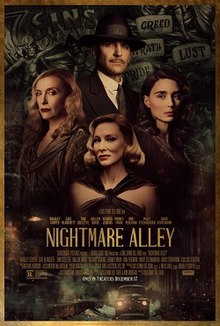
A phantasmagorical cautionary tale on the cruel predictability of the human condition that’s told through a beautifully orchestrated symphony of exploitation, deception, and just desserts, wrapped in a delicious neo-noir film. In the second big screen adaptation on the 1946 novel by William Lindsay Gresham, del Toro certainly applies his particular cinema stylo to Nightmare Alley, yet delivers a motion picture that stays true to its roots in film noir. Gresham’s book and Edmund Goulding’s critically acclaimed 1947 adaptation are the perfect source material for del Toro’s penchant for dark fantasies. But what this film allows for del Toro to do, that he hasn’t done before, is direct a neo-noir, complete with all the tropes and stylistic conventions. And he’s recently announced that there is a grayscale version of the film, which I will want to check out soon. Del Toro’s update to the dark dale explores characters that are impacted by vicious business practices built around exploitation and deception. Audiences will simultaneously find the story and performances, by the lead and supporting cast, both alluring and repulsive.
In 1940s New York, down-on-his-luck Stanton Carlisle (Bradley Cooper) endears himself to a clairvoyant and her mentalist husband at a traveling carnival. Using newly acquired knowledge, Carlisle crafts a golden ticket to success by swindling the elite and wealthy. Hoping for a big score, he soon hatches a scheme to con a dangerous tycoon with help from the mysterious psychiatrist Lilith (Cate Blanchette) who might be his most formidable opponent yet.
Much like we witness sleight of hand in the carnival acts managed by Willem DaFoe’s carnival barker character, del Toro himself is a master magician. Teaching film history as part of my cinema studies classes reminds me every semester of how the world thought of film as the work of a magician, and I love just how many layers of magic we have within this marvelous motion picture. Just as various characters are playing on the predictability and fears of the audiences within the film, del Toro is toying around with our perceptions of what is really going on. The art of misdirection and illusion is alive and well in Nightmare Alley. Unlike most of del Toro’s previous films such as Pan’s Labyrinth and The Shape of Water, there is neither a monster, in the conventional sense, nor mystical or supernatural dimension in this film other than the magic and mentalism of the metaphoric monsters in the film.
Taking place in the early 20th century at the time when carnival sideshows, with their seemingly endless variety of oddities (still a fun attraction at modern day fairs and carnivals), dotted the rural landscapes, this film is populated with characters that have in one way or another experienced some form of trauma that has prompted them to find solace or absolution in their (exploitive) work as a sideshow performer. And our central character of Stanton (Bradley Cooper) is of no exception. Following the dumping of a dead body and setting a house in an idyllic setting ablaze, Stanton joins a seedy carnival. Although we are never given explicit details as to why he did what he did, it works perfectly because we don’t always need to know what a character’s motivation is. This unknown makes them more terrifying and unpredictable.
From what I have read, there are a few changes from the book that del Toro made in this adaptation, and for all the better! One of these changes is not spending too much time on Stan’s backstory. We learn and see just enough to keep his history ominous–he keeps this film lean. Far too often, nowadays, writers and directors feel compelled to psychoanalyze and delve into all the reasons for immoral or unethical behavior, and somehow try to rationalize and explain. This explanation removes a significant degree of threat. All we need to know is that a trauma affected Stanton to the degree that he killed the source of the trauma in order to start a new life. And the same could be said for other characters and their respectful traumas. But for all their baggage, this ragtag group of sideshow acts forms a close-knit community.
Without getting into specifics, the story follows the character (negative) growth arc model, which is very much in line with many film noir motion pictures. Furthermore, del Toro includes the iconic femme fatale (in the form of Blanchette’s character) and a villainous mob-like boss that is not to be trifled with. Nightmare Alley embodies a cynical soul, which is often a characteristic of film noir. This cynical nature demonstrates two or more opposing forces that are opposite sides of the same coin, both equally corrupt. As Stan is refining his skill and showmanship for what would become his high society headlining mentalist act, he receives a dire warning not to do the “spook” show because it leads to a dark path, a path on which the actor starts to believe his or her own lies.
Through lead characters Stan and Lilith, we witness two strong-willed, cunning individuals that are equally master manipulators. There are few things more dangerous than a con-artist who believes their own spiel, and del Toro takes that dynamic to its inevitable conclusion. While the level of violence and gore in this film are rather subdued compared to his other work, when the gore hits, it HITS! There is one scene in particular that is reminiscent of the Pale Man scene in Pan’s Labyrinth. When you hits all the tropes necessary for a neo-noir, you can then bend the conventions a little in order to maintain your authorship of cinema. For fans of Sunset Boulevard (my pick for greatest film of all time), you will also love the rich character-driven conflict.
The film can be read as a cautionary tale on various systemic societal constructs and practices that prey on the most vulnerable. And many that ascribe to applied postmodernist worldviews, will find this resonating in the film. However, it can also be read through the lens that individuals may find themselves ripe for the picking to be a carnival’s next “geek” by intentionally making decisions that lead them to the carnival barker’s office. When you are in this weakened state, there are systems that will swallow you whole. So, I feel that it’s the opposite: a cautionary tale on what happens when we lead a humanist or nihilistic life; furthermore, this film is a fantastic metaphor on reaping what you sow. If you sow deception, eventually you will reap deception by (1) being deceived by someone or (2) maybe even deceiving YOURself by beginning to believe your own lies. The systems are a symptom of the broken world in which we live, a broken world whose source is, at the end of the day, a heart problem.
Ryan teaches American and World Cinema at the University of Tampa. If you like this article, check out the others and FOLLOW this blog! Interested in Ryan making a guest appearance on your podcast or contributing to your website? Send him a DM on Twitter or email him at RLTerry1@gmail.com! If you’re ever in Tampa or Orlando, feel free to catch a movie with him.