Unknown's avatar

About R.L. Terry

Ryan “Professor Horror” Terry teaches film studies and screenwriting at the University of Tampa. He holds graduate and undergraduate degrees in film and media studies. He has regularly published film reviews since 2014 and has been a featured speaker at Tampa Bay Comic Con, Spooky Empire, and the historic Tampa Theatre. His work has appeared in both political and entertainment magazines.

“On Cinema and Theme Parks” (part 11)

My BookThis is the second to last part for this series of excerpts from my peer-reviewed book and research study. So, if you’ve enjoyed reading and following, head over to Amazon to order a copy of the complete study with lots of added material from the focus groups and interviews.

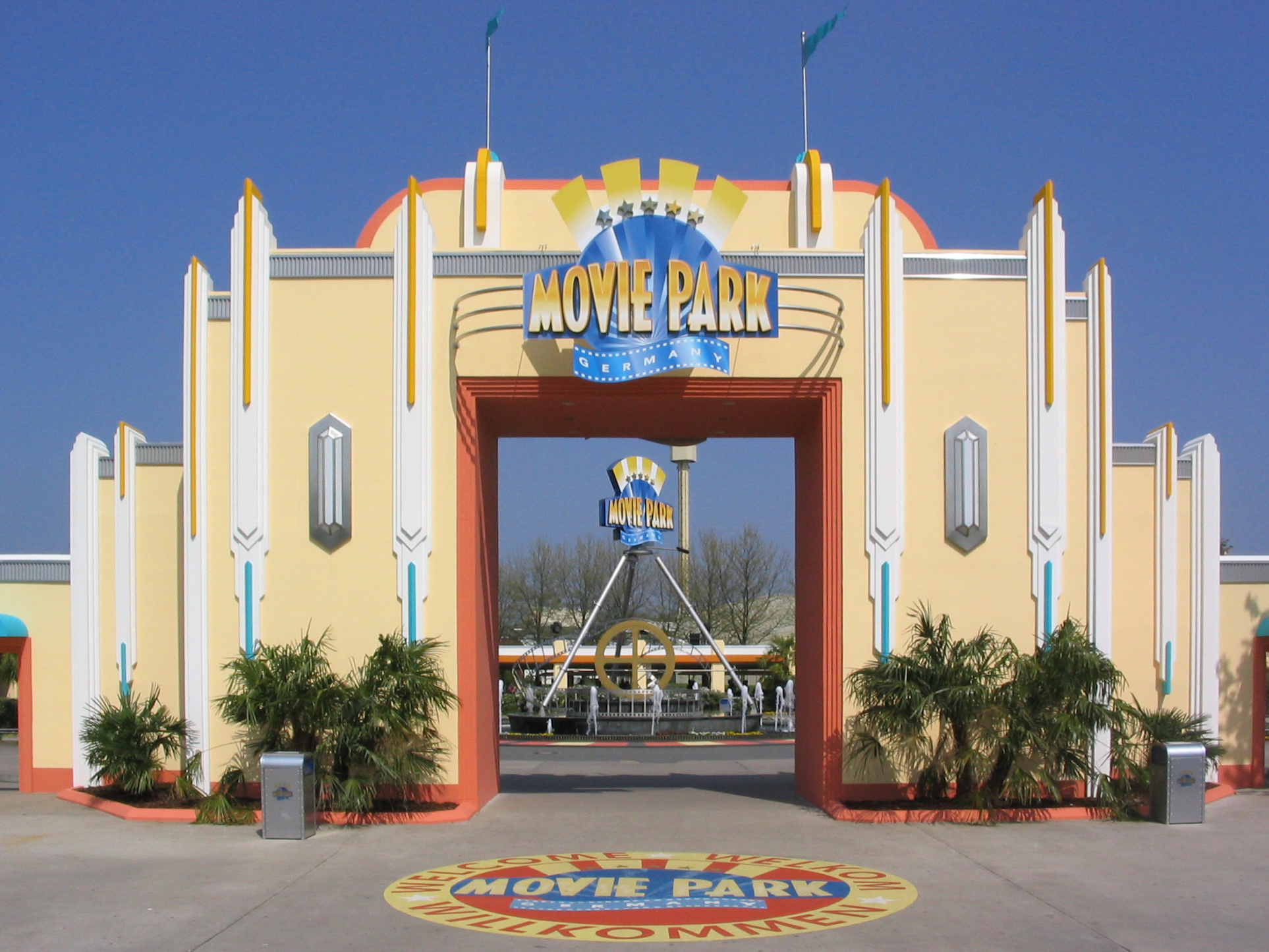
Away from hustle and bustle and bright lights of Hollywood, past the palm treelined streets and white sand beaches of Florida, and beyond the Roman ruins on a century-old Italian studio lot is another example of the convergence of cinema and theme parks. Movie Park Germany is a cinema-based theme park in Bottrop-Kirchhellen. It “is a unique theme park, which is devoted entirely to movies. The former Warner Bros Movie World has six theme areas and more than 40 attractions and shows. It will not take long before you feel like a movie star or cartoon hero!” (About Us, 2014).

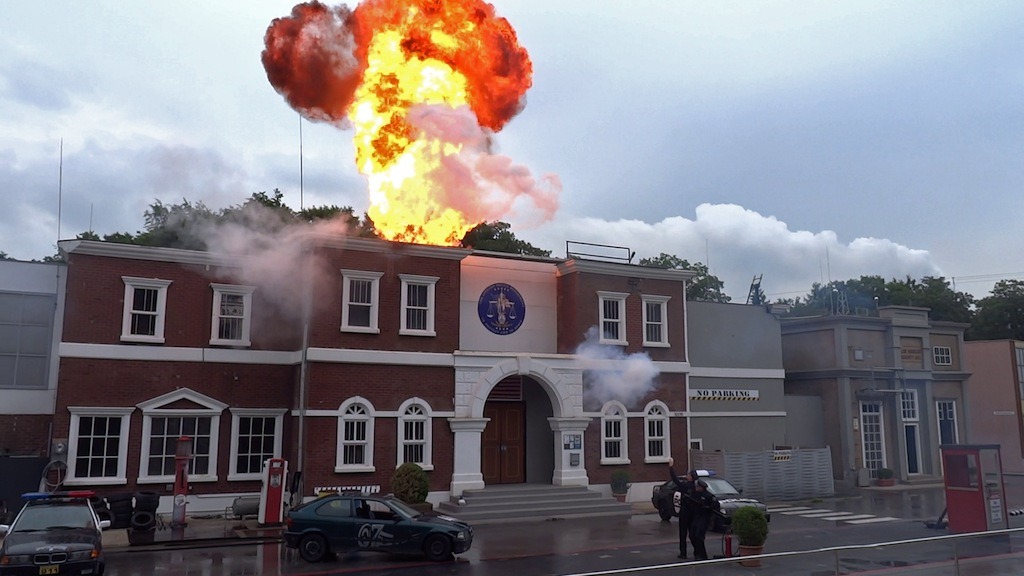
Moviepark-TorMuch in the vein of Universal Studios Florida, Movie Park Germany blends both the benefits of an amusement park with movie-based themes throughout the whole park. Its motto is “Wow! I’m in the Movies.” According to the website, “Our visitors will not only have the opportunity to meet well-known series Heroes but also get to enjoy first class entertainment like an action-packed stunt show as well as two song and dance shows. For those guests who like it a bit more spooky, the park transforms itself at sunset into an extraordinaire chamber of horrors. In short: There’s a personal highlight for everyone!” (Movie Park Germany, 2014). Unlike Universal Studios parks which have a Halloween theme for two months a year, Movie Park Germany holds on to the very cinema theory that birthed out of Germany and found its way to Hollywood—German Expressionism. Some of the first movies were horror movies, and it is refreshing to see that this park is holding on to its horror heritage throughout the year (Movie Park Germany, 2014).

MovieParkGermanyTourClearly, the idea to create synergy between cinema and theme parks is at the forefront of media conglomerates and business holdings companies. It takes the best of 43 what each has to offer respectively and combines them to create a business entity that has the power to entertain, educate, immerse, and inspire all at the same time. For the guest this means that they can experience the magic of movies and TV in dynamic ways, and for the owners, this means unparalleled cash flows to fund movies, reinvest in the parks, or fund other ventures. But, one set of questions remains. How should a media company choose to theme the parks, what rides to make based on movies, and should a theme park attraction be in the minds of studio executives when looking at screenplays for future movies? At the end of the day, studio executives/media moguls who also run theme park divisions need to know what connections and moves to make in order to assure the mutual success of both the movies and the theme parks.

The final part in this series will be uploaded next week! It will include themes learned from the empirical research method used in this study. The focus groups were located in Florida, New York, Ohio, and California.

In order to return to the beginning of this series, click HERE!

“Blade Runner” (1982) movie review

BadeRunnerStill a visionary masterpiece? On the rare occasion that I do not feel compelled to see one of the weekly new releases, I enjoy taking my Thursday night and watching an older movie that would be fun to review. As it turns out, it dawned on me that I had never seen Ridley Scott’s Neo-Noir Blade Runner despite the fact that it it a critically acclaimed film and highly regarded by many of my contemporaries. I have found that sometimes you have seen clips, heard people reference it, and simply hear the title so much that you think you have seen it. Then you realize that you’re familiar with the ideas, concept, or story but not the movie itself. So, I decided to watch it for Throwback Thursday and review it today. Unfortunately, I have been struggling with connecting with the film as so many other filmmakers and film lovers have. When watching a movie from 30+ years ago, I do my best to place myself in the shoes of the audience then. But, I am having difficulty this time. As a peer-reviewed cinema researcher, I believe that no matter how old a film is that it should still be relevant and impact audiences many decades down the road. Truthfully, I am not entirely seeing why it is such a regarded film still to this day. However, it is definitely an artistic masterpiece due to the technical elements of the production. So in many ways, yes, it still IS an iconic visionary masterpiece; but, fails to connect or resonate with audiences today.

Travel to a dystopian Los Angeles in the year 2020, or present day Detroit; take your pick. Many have fled the city for colonies on other planets or to the far north of the city to escape the rampant chaos. In the early to mid 2010s, Tyrell Corporation invented Replicants (or human-like androids) to carry out menial tasks and hard labor in a modern slavery fashion. Each unit was programmed to last for a specific amount of time (4yrs +/-). When a small band of Replicants decided that they wanted to take their lives into their own hands, they return to earth from the planet they were slaving way on and are determined to force Tyrell Corp to fix them. These Replicants led by Roy (Rutger Hauer) will stop at nothing. Over the years, when the Replicants began to pose a threat to humanity, special operations forces known as Blade Runners were trained to “retire” the androids. Former Blade Runner Rick Deckard (Harrison Ford) has been reactivated and forced to retire the small band of Replicants that pose a threat in the already dystopian Los Angeles. Follow Deckard as he conducts an investigation and is fearful of his own life as he attempts to track down and “retire” the remaining Replicants before they achieve long-lasting life. All seems pretty routine until he encounters a special Replicant named Rachael (Sean Young) at Tyrell Corp.

It doesn’t take long to understand that this film is a neo-noir detective movie that takes place in a dystopian future. Neo-noir is regarded as a film noir style movie produced after the classic film noir period (which was relatively short (~1940s-50s). This genre [although, technically, there is sufficient evidence to suggest that film noir is more of a style not a true genre] follows many of the same tropes and elements found in film noir (think Billy Wilder’s Sunset Blvd, Double Indemnity, classic detective movies, or Orson Welles). Often, the protagonist is a solitary individual who finds him or herself in over his or her head who faces or exhibits perpetual pessimism, fatality, or menace in a plot consisting of cynical attitudes and sexual motivations. From a technical perspective, film noir (or neo-noir) is stylistically dark, high contrast, low key lighting, contains strategic shadows, and shots filled with symbolism and dichotomy. The plots are usually slow burning and contain social commentary or a self-reflexive narrative. Once analyzing this movie as a neo-noir, it becomes more fascinating but still lacks that timelessness that can be found in some of the examples mentioned earlier in this paragraph. As a artistic film, I am impressed with the vision of Ridley Scott. As a classically-regarded and praised film, I am not very impressed. Although, I find that it is an excellent example of how many in the early 1980s viewed the future and that is is a fantastic example of neo-noir style filmmaking.

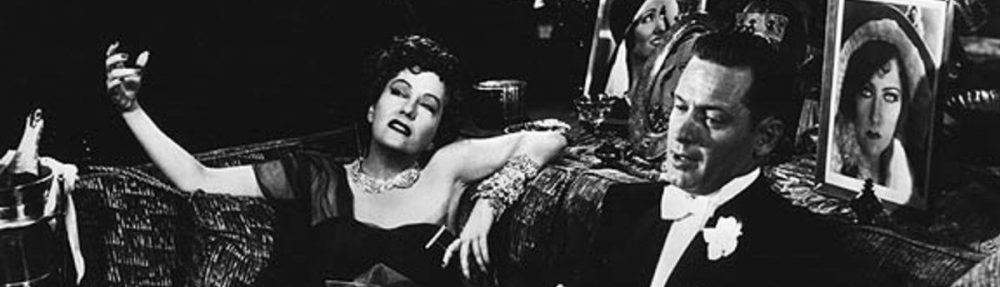
One of the biggest problems I had with the film is the fact that I had trouble loving the protagonist or hating the antagonist, or feeling sympathy for either of the aforementioned. In screenwriting, it is imperative that the audience make a firm connection with either the protagonist or the antagonist. Note: the antagonist in a film/neo-noir is not always the “bad guy.” Whereas even Gloria Swanson’s Norma Desmond in Sunset Blvd made a strong connection with the audience in that we feel great sympathy for her plight, yet she is the antagonist in the story–or many agree as such. Harrison Ford’s Deckard in Blade Runner never quite garnered strong support from me in the same way his nemesis Roy failed to elicit disdain. Both Deckard and Roy are fairly static characters–meaning they lack dynamic development. There is, however, an indirect glimmer of character development in Roy at the very end that plays significantly into the plot for a brief but strategic moment. As regularly reoccurring throughout the narrative the character of Rachael is, she can almost be removed from the film and change little in the overarching story. For the most part, she simply exists and pays into Deckard’s motivation, but mildly so. She neither causes him to view Replicants differently or becomes his sole goal. It is clear from early on in the plot that Deckard already had reservations in retiring Replicants. Rachael simply amplifies or intensifies the feelings that were already brewing.

Looking back at movies from the mid to late 20th century that take place in the early to mid 21st century can be quite entertaining. Sometimes the future portrayed in the film, in one form or another, has actually come to pass. Although, other times, the future is incredibly inaccurate. The dystopian Los Angeles in Blade Runner is definitely the latter. Yes, there are themes of unchecked immigration, authoritarian power, and capitalism that can be read as not so different from today; but, for all intents and purposes, the future is much more grim in the movie than in today’s reality. Perhaps that’s why it can be difficult to connect with this movie. It takes place in a “future” that never happened, and probably won’t happen in the now near future. I think that’s the danger when writing or directing a movie set in a future that relies heavily upon technology directly related to the plot. Some movies can pull it off. Take Back to the Future for instance. It works because the technology in the culture of the future isn’t significantly integrated into the essence of the plot or are solely responsible for some dystopian world. The futuristic technology merely exists and helps to move the plot along. In Blade Runner, the whole reason for the plot is because futuristic technology in our present day has turned on its creators and became the catalyst for a world drowning in chaos.

If you have never seen Ridley Scott’s Blade Runner, I definitely encourage you to do so, especially if you enjoy film or neo-noir movies. It provides us with a glimpse into how the world viewed a possible future in the early 1980s; and prompts us to think about life and how we might behave if we knew that we only had a few years to live. Survival of the fittest maybe? Or, fight or flight? If I was a psychologist, I think that this would be fascinating to analyze from a psycho-social perspective. At the end of the day, the film was quite the visionary masterpiece for its day and still remains a favorite of many filmmakers, scholars, and just film lovers alike.

*This review is in reference to the original theatrical release
“Rebirth” web series review

RebirthGritty and visceral. NonHuman Films’ Rebirth is a new web series that will beg for your attention. Pulling out all the cliche stops, and whatever else comes with AfterEffects templates, the prologue and episode I attempt to draw you in; and they are quite successful. The problem is that it is such a train wreck that you cannot look away. Complete with a highly ambiguous plot, choppy editing, and color temps and audio all over the spectrum, Rebirth needs to die and try to come back again another day. Adapted from the original series Jacob, Rebirth is inspired by CreepyPasta and other urban myths. Mostly shot in the POV style, the majority of the cinematography is stylistic. However, not every style needs to leave the think tank at the fashion studio. YouTube and Vimeo present fantastic opportunities for aspiring professional visual storytellers to get films in front of people without having to rely on a distribution company; but because of this wide open door, there is a lot more mediocre content to sort through while searching for that movie with which to fill your weekday evening.

Structurally, the video suffers greatly. A traditional web series should be divided up into short segments that all tie together in an over-arching story. It should not come across as a short film that has been divided up simply by cutting the segments out of the main timeline. Unfortunately, the Prologue and Episode I come across as the latter. It is important for each web series video to follow the three-act structure while the whole series also follows the same. The dialog lacks development much in the same way the characters do. As videos (or film) are a visual medium, it is important for writers to “show, don’t tell;” and the perpetual narration serves as a distraction and occasionally comes across as redundant. For a sloppily produced web series, I’ll give it this: the editing stye is creative. I’m not claiming that it’s edited well by any means; but I can definitely infer the direction the editor was going. It’s sloppy and crude, but there is definitely potential there for horror film editing.

It is not unusual for a series to have a weak opening, although it is perhaps the episode that is the most important to hook the audience, as many will not progress past the first episode. That was certainly the case for me when I watched the then-anticipated Scream Queens on Fox. After the first episode was so painful to watch, I never gave it a second chance. Since web series don’t have near the money or publicity behind them, they more often than not have a difficult time hooking an audience. So, when I was invited as a member of the blogosphere to an early screening of Episode I part II, I went in with an open mind because perhaps it was walking out of the starting gate instead of sprinting. Unfortunately, I am left wondering what happened even after watching it twice. Due to the POV style of shooting and the disorienting music, I had great difficulty in following the story. However, it is certainly macabre and creepy. In many ways, it kind of reminds me of the previews for the Green Room horror movie featuring the accomplished Patrick Stewart, of all people. I cannot help but conclude that NonHuman Films does, albeit a moderately long shot, have a future in horror filmmaking. Just because a series is crudely produced, doesn’t mean that it is devoid of potential. I see the potential, but the company needs to spend more time developing the narrative and polishing the post-production elements.

Perhaps this cult series will find an audience, as so many online video do; but, it will not likely become material picked up by YouTube Red or other outlets for professional online distribution–not in its present form. This is one of those series that clearly has some budding talent behind it; but the leadership of the film series needs to regroup and identify methods to correct the presentation and storytelling.

“On Cinema and Theme Parks” (part 10)

My Book

The overall theme of movie-based theme parks has gone from exposure and education to simulation and immersion—much more experiential. Instead of seeing how Harry Potter movies are made, guests at the Studio-Parks want to feel like they are Harry and his friends. And, this is not something that could be achieved by the former models of original Universal Studios Parks or Disney’s Hollywood Studios. So, the parks have to change in order to remain relevant and viable tourist destinations. Concurrently, movie and television studios are going through their own evolutionary process. In many ways, a careful examination of modern cinema compared to its predecessors reveals that storytelling has been removed from its pedestal to play second fiddle to salesmanship.

As explored earlier, spectacle and visceral thrills are the principal drive for the modern (1990s-present) cinema-based theme park attractions, and, for some, they confirm the worst tendencies identified within the Hollywood blockbuster: the epitome of apparently vacuous rollercoaster experiences. According to King (2000), “the label ‘thrill ride’ is a term often used approvingly in Hollywood publicity and by some film reviewers in the press, presumably because a trill ride is precisely what many viewers want from modern cinema” (2000, P27). The late 1980s and the 1990s saw the arrival of theme park attractions that claim to allow the park guest to ride the movies; movies became theme park attractions. But now, theme park attractions are inspiring films. Beyond being the inspiration for films, the idea of being able to market a horror, action, or epic film or film franchise or the ability to create themed attractions from the narrative is at the forefront of studio executives’ minds, as cross-promotion is an important financial strategy (King, 2000).

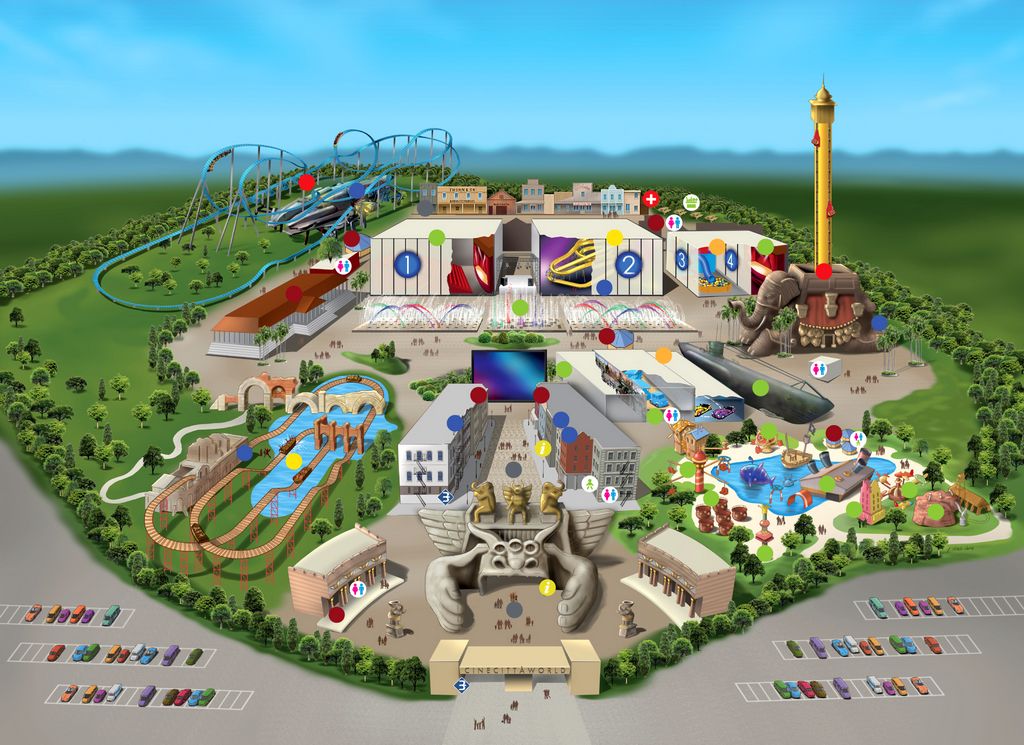
CinecittaParkMapCreating attractions from cinema is not unique to the United States. The former Italian cinema powerhouse, from the early to mid twentieth century, Cinecittá Studios, known as the “Hollywood on the Tiber” is following suit with its American counterparts and converting the production lot(s) into a movie-based theme park. Located outside Rome, Cinecittá Studios, Italian for “Cinema City,” opened its gates this year (2014) to the public to experience the magic of movies on this side of the screen (Associated Press, 2014). According to Emmanuel Gout, president of Cinecitta, “Here, the idea is that people will also enter not only sets, but the confusion of a place where we are shooting movie. Everything will be illusion…the visitor will become a protagonist of the day, becoming a star, becoming involved in some fake movie” (Associated Press, 2014).

CinecittaStreetsThe model of this theme park appears to be more reminiscent of how the classic American movie-based theme parks were setup; however, there is one big difference. At the new Cinecitta Studios (theme park), park guests will actually don costumes and take hold of props to act in scenes from movies. So, in many ways, this park differs from its American counterparts because it is not defaulting to digital simulations and special visual effects; instead, it’s using practical technologies to create the illusion that the guest is actually on the set in the movie as a character in a given scene. Still, three-time Academy Award® winning production designer Dante Ferretti knows that audiences and guests want more than an immersive experience into movies, but want thrills as well. So, there are rollercoasters and water slides, amidst Roman and Egyptian ruins, to accommodate those guests seeking more conventional amusement park attractions (Associated Press, 2014).

Catch what you missed by buying the book on AMAZON!

Return to the beginning of the series by clinking HERE.

“Huntsman: Winter’s War” movie review

HuntsmanWintersWar“Let it go” Universal, Disney already has dibs on the Snow Queen. Prepare for the unnecessary prequel/sequel Huntsman: Winter’s War this weekend. It won’t take long for you to realize that you have seen this story before. Albeit, a more family friendly and Disney’d version, but this plot nevertheless. However, after researching the actual Hans Christian Andersen fairly tale The Snow Queen, it is clear that Universal Pictures does a more accurate job of adapting the fairy tale’s words than Frozen did. The problem with this attempt is that it feels like it’s coming around a little too late. With one-dimensional characters and a predictable plot, Huntsman attempts to tell the “real” story of the Snow Queen that appeals to teens and adults, but it looks so incredibly “Frozen” that it leaves you feeling like you’ve done this all before. Although there are increased action and romance scenes in the film, the whole idea of close sisters having a falling out, the one heading to the frozen north, while the other remains in the south with the north creeping on its doorstep, and love melting frozen hearts, is the foundation of the narrative and feels like a bad case of deja vu with little to add.

Travel back to the land of Snow White, and come face to face with a little known story that has yet to be told. Before poison apples and dwarfs, Queen Ravenna (Charlize Theron) and her sister were running the kingdom after the death of the good king (Snow White’s father). Ravenna’s younger sister Freya (Emily Blunt) falls in love with a man promised to another woman but has come to bare his child. After Freya finds her lover having set fire to the nursery and the innocent child, Freya becomes acutely overcome with anger, grief, and hatred and suddenly displays powers of ice and snow. Unable to control her anger and power, Ravenna send her sister to the north to find a kingdom of her own. After having her child murdered, Freya decides to raise a kingdom by making love illegal and taking children from villages and raising them up as warriors known as huntsman. When she finds that two of the huntsman Brighton (Chris Hemsworth) and Sara (Jessica Chastain) have committed the unpardonable sin of falling in love, Freya steps in to put a stop to their forbidden love. Banished from the kingdom of the frozen north, Brighton is contacted by Snow White’s kingdom to retrieve the infamous mirror filled with dark magic before it falls into the wrong hands.

Every once in a while, I come across a movie that really doesn’t require a lengthy description of the critical elements of the film; and this is one of those. Just felt very much under-developed and forced. Anyone who has seen Frozen—and let’s face it, that’s practically everyone whether they wanted to or not–will instantly pickup on the parallels between both movies. Huntsman: Winter’s War is definitely geared towards an adult audience but it still feels like it stole many elements from Frozen. Even the coloring and costuming are very similar. For those who have examined Frozen from a critical perspective and read up on the development of the blockbuster, you may be familiar with the evolution of the script: it starts out as an adaptation of The Snow Queen but then the writers scrapped that idea for more of a contemporary Disney animated feature story. But then the writers didn’t like that direction either, they essentially took the first half of the first draft of the script and spliced it together with the second half of the second draft, added in some catchy music and boom! You have Frozen. Huntsman is similar to what you would have got in Frozen had the first draft been the produced movie.

On the plus side, this film contains some beautiful imagery and simple but stunning visual effects. The goblins are extremely well done–too bad you get so little time with them in a scene that is completely removable from the rest of the film. That scene and others were clearly under-budgeted and under-developed. Despite the fact that you can watch this movie in D-Box and IMAX, there is really no reason to spend the extra money. Watching it in a standard auditorium will suffice perfectly. If you want to get a better idea of the darkness of the original Hans Christian Andersen fairy tale before Elsa and Anna, then you may enjoy this movie. However, if you would rather wait for it to be on Amazon Prime or iTunes, then that works too.