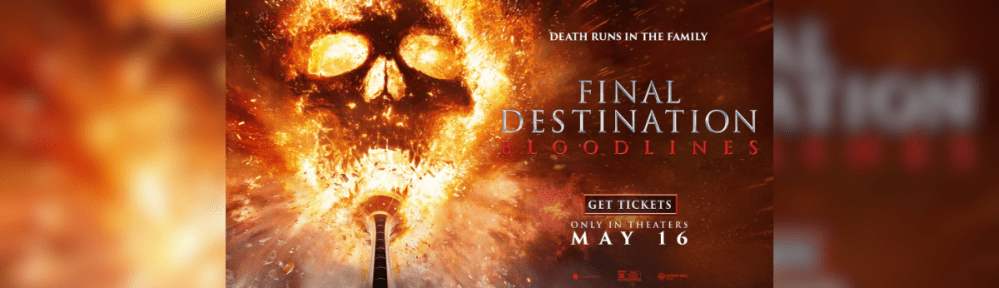
Deliciously terrifying! Final Destination: Bloodlines is a sleek, thrilling experience that delivers heart-pounding, nightmare inducing fuel that feels familiar yet fresh. And underscoring the outside/action plot is an emotionally-driven family drama. You’ll root for their survival! After a decade-long hiatus, the Final Destination franchise roars back to life with Bloodlines—an edge-of-your-seat, high-octane installment that doesn’t just rest on its laurels on its signature Rube Goldberg-esque kills; rather, it dares to deepen the mythology and inject real emotional stakes. This isn’t just a parade of spectacularly elaborate kills; Bloodlines brings humanity and emotional vulnerability to the forefront, making every death feel earned—and every survival all the more desperate.
Plagued by a violent and recurring nightmare, a college student heads home to track down the one person who might be able to break the cycle of death and save her family from the grisly demise that inevitably awaits them all.
Bloodlines doesn’t reinvent the “Final Destination” wheel, but it certainly retooled the 26yo engine. It’s faster, more furious, and surprisingly emotionally compelling—a rare horror film that makes you care who dies and how. (Except for perhaps Julia–pretty sure everyone applauded when she met her demise). By blending the franchise’s signature fatalism with real human drama, it proves that even after all these years, Death still has some fresh tricks up its sleeve. And it’s that “heart” that makes this installment different from the rest. After the original and traumatizing second movie (never drive behind a logging truck ever again), this is the first installment to inject an emotionally resonant core into the narrative. Despite the family drama, it’s clear that everyone cares about each other, even though some distance has grown between some of them. And the fact they care about one another compels us to root for their survival.
But what about the kills? The deaths, of course, are still inventively gory and meticulously choreographed—this is a Final Destination movie, after all—but they’re no longer the sole draw nor does the camera linger too long. Instead of being a schlocky bloodbath from beginning to end, this Final Destination movie is more punctuated with the death scenes, and never feel like the scenes themselves–the kills are more like buttons on a dramatic sequence that delivers sufficient setup, development, and resolution. Each death in Bloodlines serves a narrative purpose, reflecting character choices and emotional arcs. When someone dies, it’s not just shocking—it hurts. The deaths are all the more painful because our characters matter. Each character is given a moment to breathe, before the inevitable occurs. Character decisions matter; their respective relationship with each other and the world around them matter. When they die, it doesn’t feel like a spectacle; it feels like a loss (except for you, Julia, I think that was a gain).
Directed by Zach Lipovsky and Adam B. Stein, Bloodlines brings a more mature tone to the franchise without losing its pulse-pounding suspense. This isn’t just death coming for the next in line—death is unearthing long-buried histories, and the characters are forced to confront more than just their mortality–they are forced to confront family secrets. The screenplay benefits greatly from being measurably more character-driven than plot-driven, which bestows upon this movie a narrative quality seldom experienced in the Final Destination franchise (or nearly any horror franchise this far into its franchise). The film also expands the franchise’s mythology in subtle, intriguing ways, threading in ideas about fate as something both predetermined or inherited. Without diving too far into exposition, Bloodlines cleverly explores what it means to be marked—not just by death, but by family history.
And I’d be remiss if I didn’t mention the final appearance of the late horror great Tony Todd. Like Vincent Price, Todd’s mere presence in a horror film added a qualitative dimension that could not be replicated by any other actor. Todd’s contributions to horror and science-fiction TV (namely Star Trek) are many and each delivered with class. RIP.
Final Destination: Bloodlines isn’t just a refreshing return to form—it’s a redefinition. It proves that slasher-adjacent (which this is; we just don’t see the slasher) movies can be character-first without losing the terrifying or nightmare-inducing edge. Bloodlines also subverts our feelings about being a survivor in a horror movie–sometimes the scariest thing isn’t dying–it’s questioning why you’re still alive.
Ryan is the general manager for 90.7 WKGC Public Media in Panama City and host of the public radio show ReelTalk about all things cinema. Additionally, he is the author of the upcoming film studies book titled Monsters, Madness, and Mayhem: Why People Love Horror. After teaching film studies for over eight years at the University of Tampa, he transitioned from the classroom to public media. He is a member of the Critics Association of Central Florida and Indie Film Critics of America. If you like this article, check out the others and FOLLOW this blog! Follow him on Twitter: RLTerry1 and LetterBoxd: RLTerry
 R.L. Terry ReelView
