
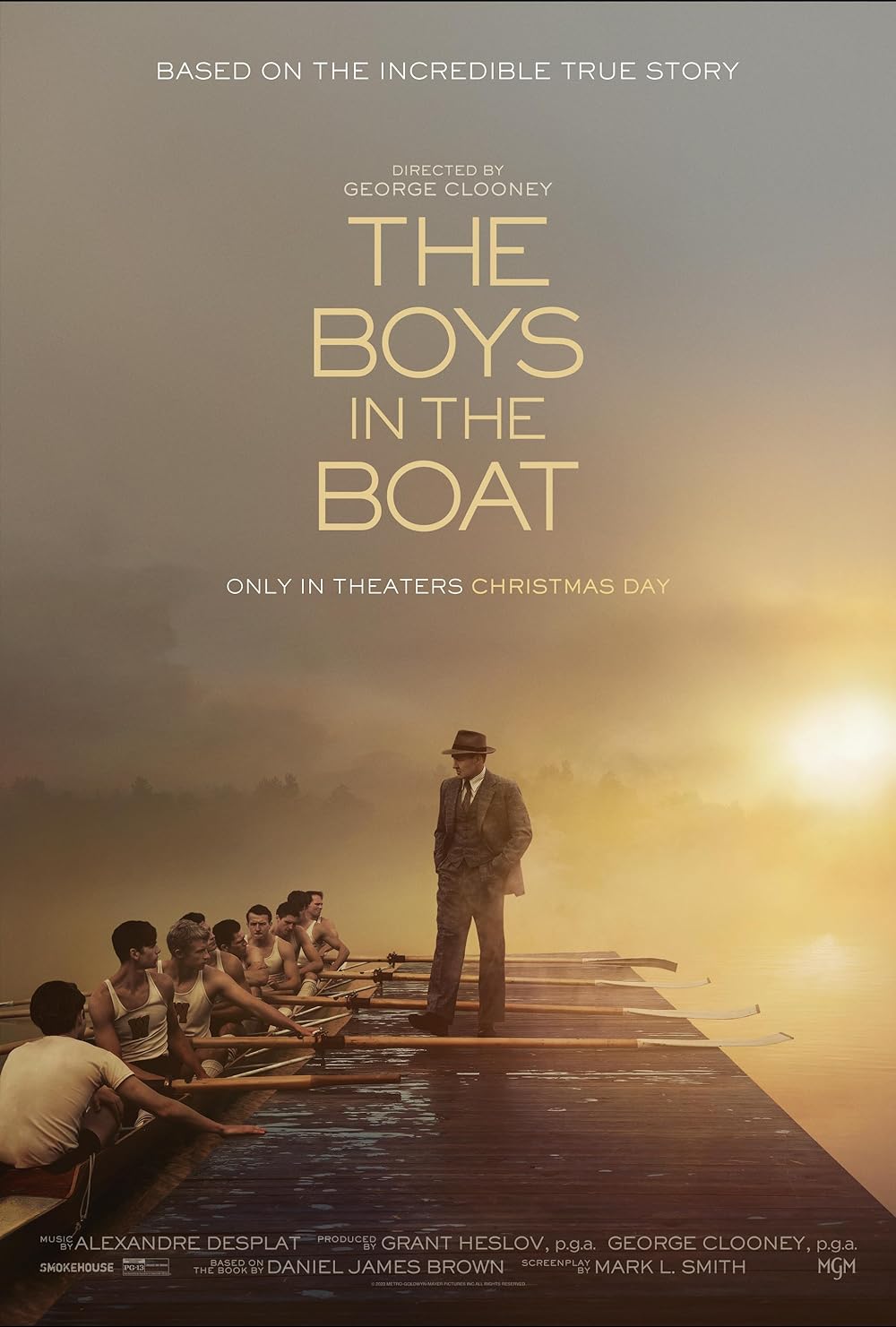
A solid but unremarkable film. The Boys in the Boat is a standard historical drama that sufficiently meets expectations. Unfortunately, there lacks anything truly remarkable about the film. While the performances are better than average, the directing and screenwriting fall slightly short of where they should have been for this film. Thematically, the film delivers a big screen adaptation of a truly inspirational story, but beyond the uplifting feeling of a traditional underdog story, the film itself doesn’t particularly leave an emotive mark upon the mind and soul. Still, I was unaware of this story connected with the 1936 Summer Olympics held in Berlin, and am thankful that I now know about it. If nothing else, this film does a sufficient job of reminding us that we are more than the sum of our parts and really can achieve greatness by working collaboratively with one another to overcome the obstacles of life.
During the height of the Great Depression, members of the rowing team at the University of Washington get thrust into the spotlight as they compete for gold at the 1936 Olympics in Berlin.
While the screenplay demonstrates an understanding of what it means and the importance of a well-developed outside/action story with solid plotting, the screenplay falters in delivering a well-developed emotional drive that supports the action plot. Moreover, the screenplay fails to develop ancillary plots that it sets up in the first act. Without going into details, our central character has a need for a job (which is what leads him to go out for Rowing Crew) but we never revisit that need. And later, a member of the crew is deathly ill, but we never revisit that either. The author of the book upon which the film is based, co-wrote the screenplay, and it shows. Often times, novelists demonstrate difficulties in a storytelling medium that is cognitively-driven to one that is visually-driven. And we have a lot of telling instead of dramatizing in this film.
George Clooney makes some questionable directorial choices that leave me scratching my head. Clearly the talent for directing is there, but scenes that should be allowed to breathe aren’t given the chance, and other scenes that steep, should have been ended or started later. Some scenes work very well, but there are too few of those. Funnily, there is this sexual tension that is observable in two characters between whom there is no romantic interest, and that is based upon how the scenes were directed and subsequently assembled in the editing room. There is even a quick scene (and scene is being generous as it’s more of a cutaway) between the Crew from Washington and famed Olympian Jesse Owens that was sloppily executed.
The Boys in the Boat reminds me more of a movie that I’d expect to find as content on a streaming platform than it does genuine cinema. In the hands of a different director and screenwriter, this movie could’ve easily been crafted to be more impactful that it presently is. It has it’s high points, and for that, the filmi s above average, but the lack of anything truly remarkable about it drags it down from where I feel it wanted to be. Perhaps had more attention been paid to developing characters instead of focusing on the outside/action story, then we may have had something more meaningful than it is. Many movies these days place a substantial amount of focus on the ethos, subtext, or emotional parts of a story, thus sacrificing the art and science of proper plotting, so I am glad to witness proper A-story plotting; however, that does not excuse the lack of care paid to the B and C stories and emotional drive that parallels and supports the outside/action narrative.
While I don’t find anything remarkable about the film, it’s not a bad film either. In fact, I am so glad that I now know of this inspirational underdog story. I wish more than the mere knowledge of the historical event is was what was inspirational, but we can take from it that those that are perceived to be least likely to succeed, may just need the right coach and opportunity to demonstrate to the world what they are made of and capable to accomplish.

Ryan teaches Film Studies and Screenwriting at the University of Tampa and is a member of the Critics Association of Central Florida and Indie Film Critics of America. If you like this article, check out the others and FOLLOW this blog! Interested in Ryan making a guest appearance on your podcast or contributing to your website? Send him a DM on Twitter. If you’re ever in Tampa or Orlando, feel free to catch a movie with him.
 R.L. Terry ReelView
Title: Boys in the Boat
Director: George Clooney
Distributor: Amazon MGM Studios
Genre: Narrative nonfiction
MPAA rating: PG-13
USCCB rating: A-III
Your rating on a 5 star scale: 5/5 stars
Primary audience: Adults and teenagers
Year of release: 2023
THE BOYS IN THE BOAT | Official Trailer
Summary (SPOILER ALERT)
Boys in the Boat is a narrative nonfiction about the nine men who rose from homeless and barely scraping by to Olympic champions: an inspiring story of underdogs. Starring Callum Turner, who plays Joe Rantz, a homeless university student in Washington with no money and no jobs in sight. He finds the rowing team and tries out because it promises a salary and free boarding. He gets onto the team, and the classic eight boat is filled with seven other men who were chosen, each struggling with their own problems. They grow together into a strong boat, eventually getting chosen to go to an olympic-qualifying regatta over the varsity boat, causing an uproar. But, they went, and qualified for the olympics.
At the Olympics, they were constantly getting bad odds. Their stroke seat caught a bad virus, Joe Rantz almost quit during one of the practice days, and they were given a bad lane for the final race. The three boats on the podium were separated by mere inches – America coming out in first. It was an impossible outcome, yet a true story nonetheless.
I will analyze Boys in the Boat using the Seven media keys in Gan’s book: Infinite Bandwidth.
Balance (temperance)
The first media key I will analyze this movie with is Balance. Gan defines balance as: “our attitude towards media, our approach to technology” (Gan, 21). This movie is very worthwhile, it has good morals and they are very prominent throughout. I know of many people who try to stay away from nonfiction movies or even books, because they tend to be sad or “too real” for them. But Boys in the Boat has a fun and inspirational ending that makes you think and desire more for yourself.
Each media key has a virtue tied to it to help us analyze the media further, and the media tied to balance in temperance. According to the Catechism of the Catholic Church, as cited in Gan’s book, temperance is “the moral virtue that moderates the attractions of pleasures and provides balance in the use of created goods” (CCC 1809). The characters in this movie are hardworking and desire simply what is good, since they don’t have much money.
Attitude-awareness (prudence)
The second key is attitude-awareness, which helps us “maintain a critical perspective about the messages coming at us through the media” (Gan, 37). Like I said before, this movie has very good morals and the messages from it are very good and well-placed. Just before the big race, Joe Rantz almost quit the team. But the morning before, he walked up to his coach and asked for forgiveness. It was a really good message, especially for the teens watching to ask for forgiveness and second chances.
The virtue tied to this key is prudence, defined by the Catechism and quoted in Gan’s book as: “the virtue that disposes practical reason to discern our true good” (CCC, 1806). Throughout the movie, the messages are really good, and the characters rise to the occasion and win something that is not only for them, but for their country. Characters throughout the book it was based off of have somewhat slower character development than the movie may allow for. The director, George Clooney, did his best to slow down the character development by making certain scenes slower.
Dignity of the Human Person (justice)
The third key is dignity of the human person, which states that “all media should reflect, uphold, and enhance human dignity” (Gan, 52). The main character of the movie, Joe Rantz, was abandoned by his father as a teenager and left to fend for himself. He was trying to attend university with the little money he had, and was failing miserably at the lack of jobs during the great depression. The crew team was his last resort, and the coach saw his struggle, took him under his wing, and helped him rise to greatness.
The virtue that goes along with this key is justice, which is defined by the Catechism as: “the moral virtue that consists in the constant and firm will to give their due to God and neighbor” (CCC 1807). This is not only shown through the coach but through Joe Rantz, who, when meeting his father who had lied to him and abandoned him, proved him wrong and did incredible things with his life.
Truth-filled (fortitude)
“The media we watch, listen to, read, and play should be filled with truth” (Gan, 68). This is the definition of this media key in Infinite Bandwidth. It is shown through the characters as the teammates lift each other higher by pushing them physically and mentally, along with supporting them in whatever way they may need or can do for them. Even if it was just small affirmations after a hard practice, or helping another find a job so they could eat that night.
Fortitude is the virtue that goes along with this key, and it is defined as “the moral virtue that ensures firmness in difficulties and constancy in the pursuit of the good” (CCC, 1808). This is so vibrantly shown in this movie. Rowing is a very difficult sport, endurance-wise, but especially just to learn. And the fact that they had so little time in between learning, trying out for the team, and racing at the Olympics shows that they really put all of their effort in and that message is portrayed very well through the movie.
Inspiring (hope)
The fifth key states that the media has to be inspiring; to “inspire us to the good” (Gan, 84). This movie is a living example of inspiration. The story-line and movie itself truly makes you joyful and moved, but the fact that it is a true story really amplifies that even more.
The virtue that goes along with this key is hope. Hope ties into our desire for “the kingdom of Heaven and eternal life as our happiness” (CCC 817). To be able to watch this movie, you need to have hope, and the characters in this movie really did portray the virtue well. They would not have gotten to the Olympics if they did not have at least a seed of hope within them. For example, when Joe Rantz heard he had gotten on the team, his eyes lit up hopefully. He thought this was his one way out of the dumps, for a better life.
Skillfully Developed (faith)
The sixth media key is skillfully developed, which Gan says is not the most important key, but still important enough to be mentioned. The Boys in the Boat is based off of a book, which is based off of a true story. There is so much dialogue that there was almost no way that Amazon MGM Studios could’ve messed it up. It is beautifully made with good cinematography, casting, and dialogue which keeps you interested the whole time.
The virtue to this key is faith, and although it was hard to mess this movie up with everything they were given, it was also a lot to handle. Having faith in the producers must have been crucial through the movie, especially since many of the scenes may have been hard to get as they were out on the water.
Motivated by and Relevant to Experience (charity)
Gan says that by the seventh media key, relevant to experience, all media “should reflect our experience of the human condition” (Gan, 116). With The Boys in the Boat being based off of a true story, it especially fills this category. People really like an underdog story, and this gave it to them, full-fledged and well-made.
The virtue that goes along with the final media key is charity. Charity is needed, and is shown through the movie through the poor characters, and even to their opponents. But it also must be shown to the filmmakers, who put their careers on the lines and are human too.
Conclusion
The Boys in the Boat is a fantastic movie, and a must-watch for any family. It beautifully shows the art of rowing and the rise of a seemingly worthless man with nothing to give, but really, he just needed an outlet. Anyone who may watch it may like it because of the good morals and well-made story line of the movie. Especially those who may have read the book before or had a history with crew would like this movie because it represents both well.
LikeLike