NOSFERATU (2024) horror film review

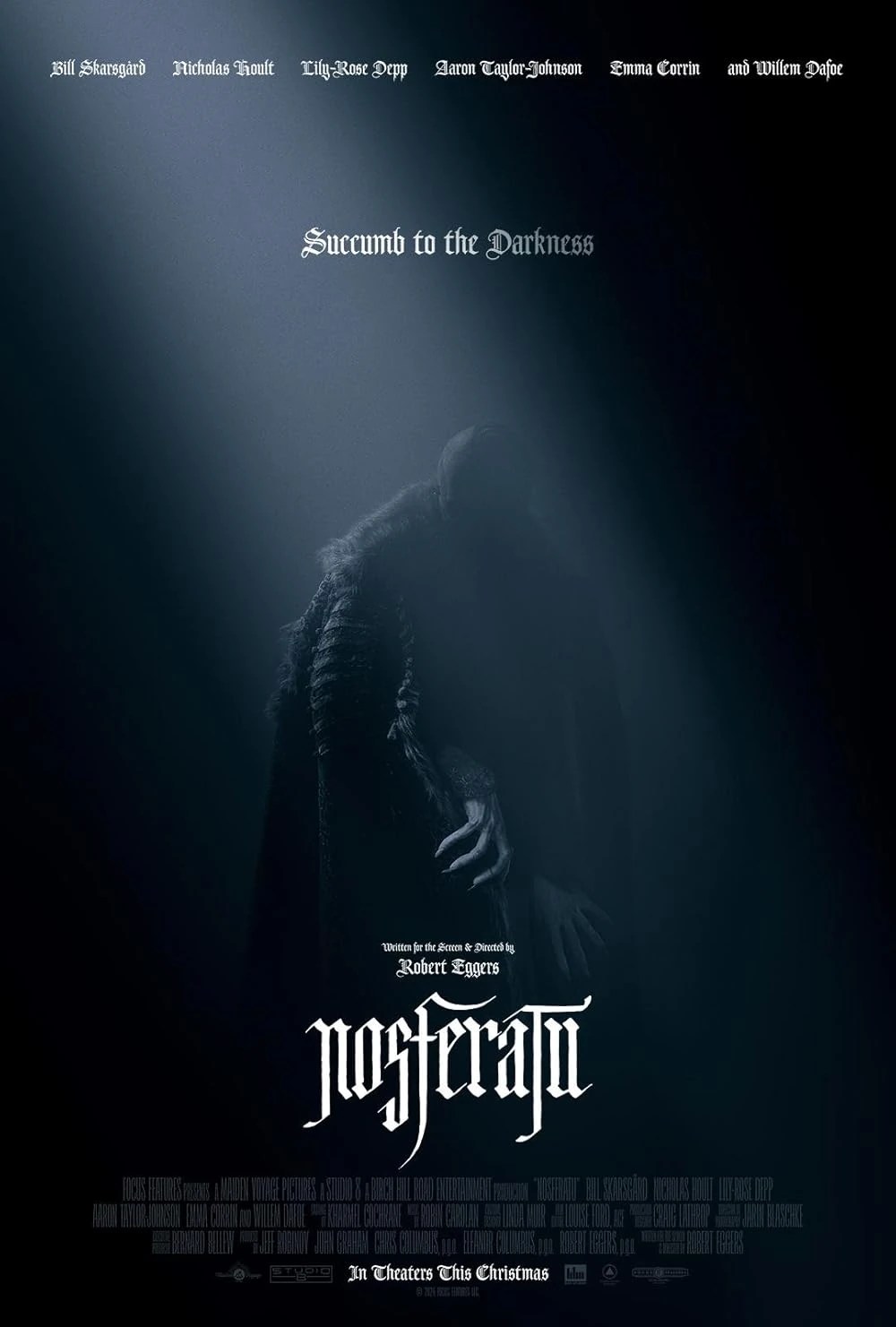
Gothic horror is truly timeless. Universal is going back to its roots in horror with its latest motion picture. More than a century after F.W. Murnau gifted us with the original Nosferatu (1922), director Robert Eggers delivers audiences his take on Murnau’s unauthorized Dracula adaptation; however, Eggers’ vision for his expression of Nosferatu is more closely aligned with Warner Herzog’s Nosfertatu the Vampyre (1979) than with Murnau’s original film. Ostensibly, Eggers’ adaptation sets out to bridge elements of both the 1922 and 1979 versions, whilst incorporating the postmodern ideologies that he has integrated in his past works. This expression of Nosferatu combines the atmosphere, mood, and settings from the 1922 version with the characters and erotic tone of Herzog’s version. Each iteration of Nosferatu reflects its director’s vision and the cinematic sensibilities of its time. For it was Oscar Wilde whom reminded us that all art is self-portraiture, “Every portrait that is painted with feeling is a portrait of the artist, not of the sitter.” As cinema is art, and the director is often considered the author thereof, then each of these versions expressed something to us about his beliefs, fears, anxieties, or worldview. Eggers took the expressive techniques and vampire lore of Murnau, the existentialism and romanticism of Herzog, and combined those with his applied postmodernist worldview to create 2024’s Nosferatu.

In the 1830s, estate agent Thomas Hutter travels to Transylvania for a fateful meeting with Count Orlok, a prospective client. In his absence, Hutter’s new bride, Ellen, is left under the care of their friends, Friedrich and Anna Harding. Plagued by horrific visions and an increasing sense of dread, Ellen soon encounters an evil force that’s far beyond her control.

Egger’s expression of Nosferatu demonstrates a desire to explore themes of mortality, isolation, corruption, and desire all while underscoring each theme with a sense existential dread. The primal fear of death is perhaps the most overt theme, because Orlok represents the lengths people will go in order to escape that which is inevitable. While monstrously depicted in the film, there is a parallel here between that and the obsession people can have in the real world over youth, vitality, and longevity. We can even draw further parallels between the desire vampires have for human blood with the desire humans have for medications and medical procedures that claim to prolong life and youthfulness. 

A recurring there of vampiric imagery is obsession, not only with youth and life, but obsession in connection with desire—specifically primal desires for that which appears or feels forbidden. Long since has the vampire been used as a personification of forbidden desires. While this was particularly true in the Victorian era—what with its many romantic and sexual mores—it can also be seen today by some as the informal boundaries that Western culture places upon depictions of romance and sexuality. In the postmodern era, many feel that the Eastern ways of life are more liberating, and that is represented in the fact that Orlok hails from Eastern Europe (presumably in the area of Transylvania).

Our central character of Ellen (which is a switch from the typical male central character in variations of the Dracula story), represents the idea that some women feel confined by the boundaries placed upon them by a patriarchal society. By Eggers’ endowing the character of Ellen with a greater sense of agency, he is able to convey more focus on the confines of the Western and/or patriarchal world upon the primal desires of Ellen, and how she must overcome the ties that bind her to both written and unwritten societal expectations. In turn, Orlok can be read as the means to free oneself from all societal inhibitions, but that liberation comes at a great cost. Ellen’s desire for Orlok is both attractive and repulsive—she wants what he represents but doesn’t want the monster himself. In the end, the only way to save her town of Wisborg (and world) is by giving into her primal desires as a means of sacrifice. 

One of the biggest differences in both previous versions and Eggers’ is the imagery of Count Orlok himself. In both previous iterations, there was something sympathetic, darkly whimsical, and even suave about the Count; but in this version, Count Orlok is exponentially more monstrous looking, which offers a stark contrast to that of the alluring appeal of the vampire. Interestingly, Eggers’ interpretation of a vampire is much more closely aligned with traditional eastern European folklore than the words and descriptions of Bram Stoker. Reaching beyond the Dracula novel and both previous versions of Nosferatu, Eggers set out to create an interpretation that demonstrated concern for historical detail and traditional folklore to give his version a sense of realism. Unfortunately, this realism is somewhat hampered from beginning to end, given the film takes place in Germany but none of the characters speak with a German accent, much less in Deutsch. But I digress.

Another difference between this Nosferatu and past versions of both Nosferatu and Dracula is the absence of consistent religious iconography or ritual. Even our esteemed Dr. Albin Eberhart (played by Willem DaFoe) incorporates Western medicine, Eastern medicine, and religions from around the world in his cocktail of methods for healing Ellen and vanquishing Count Orlok. This can be read as Egger’s commentary on how all religions are variations of the same thing, and that the best parts of each can be used in dealing with the obstacles of life. In many ways, this is a reflection of the views many have of religion and tradition in a postmodern world—the strength of a religious practice is in the belief itself and not in the person or object at the center of it. Interestingly, however, in contrast to the views many have of evil in a postmodern world, the movie posits the idea that there is evil in the world, and it isn’t a matter of perception or opinion—that there is evil out to devour all good and innocent in the world. What I appreciate about the character of Dr. Eberhart is his views that science and religion are not mutually exclusive; his character demonstrates that both science and religion are two sides of the same coin, and we need both in our lives.

Like with Eggers’ past work, this one too suffers from the same lack of thoughtful plotting that plagues his other films. Whether we are talking The Witch, The Lighthouse, or The Northman, Eggers demonstrably places far more emphasis on atmosphere, production design, and cinematography than he does plotting or character development. In fact, the original Nosferatu demonstrates stronger plotting despite the lack of spoken dialogue and title cards. This remake is yet another example of the shortcomings of prestige horror—focusing on how everything looks versus how it is written and plotted. Moreover, this continues to be a problem I have with many (if not most) writer-directors—the lack of strategic checks and balances. When the writer is also the director, then there isn’t usually someone that is part of the preproduction of a film that is in a position to state that something works on paper that doesn’t work on screen, or something that looks great an screen doesn’t make sense for reasons of storytelling mechanics. While I have many reservations for the demonstrable trends in postmodern horror, I will say that prestige horror works more effectively as the equivalent of the type of art that hangs in a museum beckoning for guests to sit in front of it for hours, contemplating that which is being conveyed by the collection of images.
Ryan is the general manager for 90.7 WKGC Public Media in Panama City and host of the public radio show ReelTalk about all things cinema. Additionally, he is the author of the upcoming film studies book titled Monsters, Madness, and Mayhem: Why People Love Horror. After teaching film studies for over eight years at the University of Tampa, he transitioned from the classroom to public media. He is a member of the Critics Association of Central Florida and Indie Film Critics of America. If you like this article, check out the others and FOLLOW this blog! Follow him on Twitter: RLTerry1 and LetterBoxd: RLTerry
BEETLEJUICE BEETLEJUICE movie review

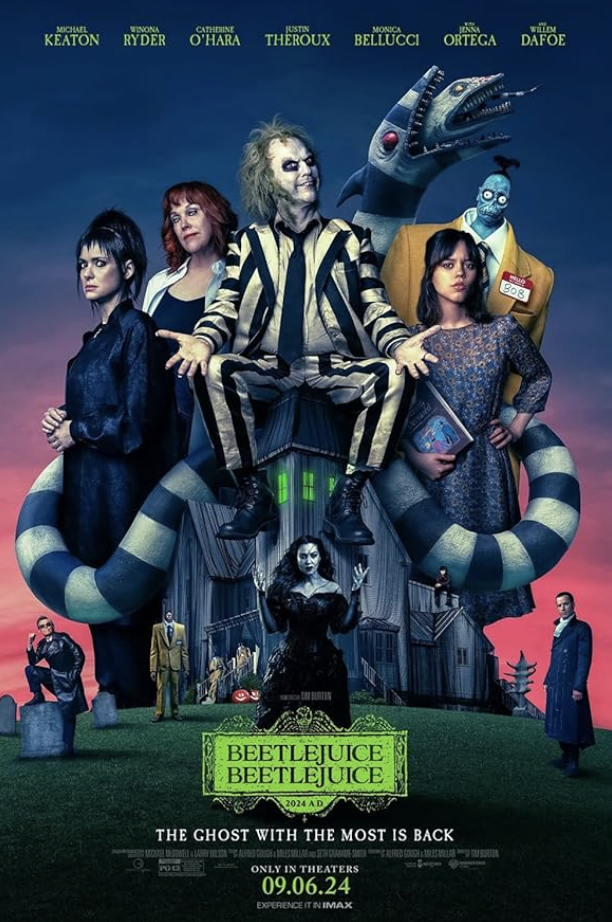
Forgettable and messy. The long awaited and much anticipated sequel to the campy cult classic Beetlejuice is unfortunately an underwhelming return to the fantastical, whimsical universe of colorful and dynamic characters. I’m left asking myself, this is the story for which Burton has been waiting???

Three generations of the Deetz family return home to Winter River after an unexpected family tragedy. Still haunted by Beetlejuice, Lydia’s life soon gets turned upside down when her rebellious teenage daughter discovers a mysterious portal to the afterlife. When someone says Beetlejuice’s name three times, the mischievous demon gleefully returns to unleash his very own brand of mayhem.

Beetlejuice Beetlejuice is a disjoined mess of setup after setup, with little development or meaningful resolution. Even though it successfully channels some of the charm and macabre whimsy of the original, this one is missing something vital–heart. What is most painful to witness is that there is actually a good and even compelling story in there, but its’ buried beneath a garbage heap of subplots and characters that are little more than the equivalent of an NPC (video game-speak for non player character). While the screenplay is abysmal, the bright spots in the movie are Michael Keaton’s delightful reprisal of Beetlejuice, despite his reveal appearing too early in the story. Other highlights of the movie are the quintessentially Burton special makeup and practical effects, including miniatures and puppetry. And composer Danny Elfman lends his distinctive authorship to the score. For fans of the original, this one is likely going to disappoint, but perhaps for those that may be getting introduced to the world of Beetlejuice for the first time, will seek out the original campy classic. At the end of the day, it’s not all bad, but it’s far from good. At best, it’s sufficiently entertaining.

Before getting into what didn’t work, which is substantive, I’d be remiss not to spotlight what the movie did right. The big question, did Burton and Keaton revive ol’ Beetlejuice? And the answer is, yes. The character of Beetlejuice himself is the reason the movie has enjoyable moments and will keep you moderately entertained. Keaton delivers a Beetlejuice that makes you forget that he hasn’t played this character in nearly 40 years. For the most part, he captures the energy, wit, sarcasm, and offbeat charm of his original incarnation. Unfortunately, that cannot be said for the rest of the performative dimension. But more on that later.

Over all, the design of the movie harkens back to the Burton’s golden age in the 80s and 90s, except when he lays practical effects over CGI backgrounds or oscillates between both mechanical and digital in jarring ways. From beginning to end, movie magic is witnessed everywhere. Burton was committed to capturing the imagery of the original in both the costumes and set design, and by in large, he accomplished just that. This movie is a reminder that computers cannot replace the way real light bounces off real objects into the camera lens. The magic of motion pictures is a combination of tactile, chemical, performative, and lighting elements. Despite the Afterlife lacking true camp value, it was a successful return to the imaginative world created by Burton in the original movie.

Regrettably, the movie fails to deliver a compelling or even coherent story. It’s a disjoined mess of ideas that couldn’t have possibly made sense on paper, let alone on the screen. The first act moves along sluggishly, but picks up pacing in the second and third; however, very little (if anything of meaningful value) is developed or resolved that is setup in the first and second acts. There are literally entire characters that serve little to no purpose in the story. And, without getting into spoilers, there is a compelling plot that is excellently setup, but the development and resolution is so sloppy it just hurts the narrative all the more. Even a notable cameo is completely wasted as it bears little importance to the story. It’s hard to even call it a story because it’s lacking a plot, a central character, and a character of opposition; there isn’t even a real goal to be achieved. While the character of Beetlejuice is known for his chaotic behavior, the narrative need’t exhibited the same level of randomness and chaos as exhibited by our title character.

Speaking of characters, the reason that the performative dimension is sorely lacking any modicum of substance is because the characters are given nothing to do. There is little reason for anyone to be doing anything. Furthermore, the Delia and Lydia we get in the original are not the Delia and Lydia we witness in this movie, and Lydia’s daughter Astrid is simply not believable as an angsty teenager. With a little motivation and dimension, the characters would’ve likely been highly entertaining and compelling; but, they are lacking any dimension whatsoever.

Tonally, the movie is all over the place. All over the place except for the one place it needed to be. And that is camp. For a movie that should’ve eat, slept, breathed camp, it plays it too seriously and tonally inconsistent. Yes, there are what we would usually refer to as campy costumes and characters in the movie, but the context is lacking that camp aesthetic and sensibility, for which Burton is (or used to be) known. Contributing to the tone of the movie is the Elfman score that only feels like Elfman sometimes. It’s like a composer imitating Elfman. Yes, we get the classic Beetlejuice theme music, but other than that, I’d be hard -pressed to identify any other musical moments that felt like Elfman.

The movie does deliver some entertaining moments, but sadly they are few in number. When the movie works, it works! But it simply does not work sufficiently enough. Also, the lines “…strange and unusual” and “it’s showtime” are nowhere to be found. There was also a setup for a much-needed scathing critique on influencers and influencer culture, but that setup too wasn’t developed. So many great ideas that are completely disconnected.

Watch if you simply want to enjoy some movie magic and familiar characters, but don’t expect to be quoting this sequel like you do the original. I’ll leave you with this, the fact that Lydia’s TV show is titled “Ghost House” is a nice nod to the original title of Beetlejuice.

Ryan teaches Film Studies and Screenwriting at the University of Tampa and is a member of the Critics Association of Central Florida and Indie Film Critics of America. If you like this article, check out the others and FOLLOW this blog! Interested in Ryan making a guest appearance on your podcast or contributing to your website? Send him a DM on Twitter. If you’re ever in Tampa or Orlando, feel free to catch a movie with him.

Follow him on Twitter: RLTerry1 and LetterBoxd: RLTerry

POOR THINGS film review

Imaginative and provocative! Yorgos Lanthimos’ adaptation of POOR THINGS is a fascinating motion picture that takes audiences on a whimsical, otherworldly exploration, but unfortunately suffers from sluggish pacing midway through the adventure. This interpretation of Frankenstein, in both substance and form, delivers a labyrinth of social commentary on expectation versus reality, pretense versus disillusionment and the consequences of metaphoric prisons.

Brought back to life by an unorthodox scientist, a young woman runs off with a lawyer on a whirlwind adventure across the continents. Free from the prejudices of her times, she grows steadfast in her purpose to stand for equality and liberation.

The most striking element of the film is stunning production design! It’s whimsical and dark, gothic and post-modern all at the same time. Audiences will be completely transported to a highly stylized variation of the real world that is clearly inspired by the gothic imagination of Tim Burton filled with quirky characters that feel lifted right out of a Wes Anderson film. If it sounds like a Frankenstein’d film, you’d be correct because the very apparatus of the film is a bunch of pieces sewn together to create a new whole that arrives on screens by way of The Isle of Dr. Moreau. There is even a nod to a famous sene and shot in Metropolis!

From what I could tell, the entirety of the film was shot on a sound stage with highly theatrical, emotive sets and costuming. Lanthimos combined the best of German Expressionism and French Surrealism to craft a 19th century world that both felt part of our own, yet, not of our world. I liken the highly stylized designs to the motion pictures of Tim Burton in the 1980s-90s with exaggerated shapes, harsh shadows, and a substantial helping of dark whimsy. This intentional move to create a world that resides in this liminal space between that which we know to be real(istic) and fantasy works to the film’s advantage because we are prompted at the very beginning that we are about to embark on a bizarre adventure. Lanthimos’ story needed this stylized version of our 19th century world to be the playground for his quirky characters so that we believe and become vested in the journey. 

Without getting into plot points that spoil the film, it’s difficult to go into the degree of detail that I would like in order to analyze the very apparatus of the film itself, as it is in many ways self-reflexive of the narrative itself. But, I’d be remiss to not spend some time on spotlighting the Frankenstein’s creation-like form the film takes in telling this reimagined interpretation of Frankenstein. It is not simply by chance that this Lanthimos film looks different that his previous works such as The Lobster, The Killing of a Sacred Deer, and The Favourite, he intentionally took discernible tropes and elements of his own cinematic authorship and combined it with the gothic-inspired stylized worlds of Burton with the quirky characters and dry humor of Anderson to create a new experience for audiences. In essence, he Frankenstein’d his film, which is populated by Frankenstein and Isle of Dr. Moreau characters and animals. There are animals that are right out of the latter and characters that are expressions of the former. 

Poor Things captures the imagination and whisks audiences away to this whimsical world, but this adventure is not without its rich subtext and theming. Honestly, this is going to be one of those films wherein each member of the audience may read it differently. In my screening alone, I overheard conversations ranging from #MeToo to modernity versus postmodernism to capitalism versus socialism and even a critique of the affects of Victorian culture on society. 

My reading of the film consists of arguments around the ideas of the expectation versus reality, the expectations placed upon us by the world and society in which we live (which can feel like a prison) and the reality of when the world and society do not meet our expectations placed upon it. Moreover, we can expand upon this idea by including what happens to us when we become disillusioned by the pretenses and facades that are projected by various individuals in our lives—we learn who and how they really are. And lastly, the film depicts many different images of prisons. These prisons can be our family of origin, our occupation(s), or the norms and mores of society—we feel trapped and long for adventure; we long to stimulate our senses with new experiences that challenge the status quo.

Tony McNamara and Alasdair Gray’s screenplay is mostly well-crafted; however, after a solid first act, the second act drags on and on to the point there are many redundant scenes and repeated sexual exploits that cross the line from being able to justify them dramatically to self-indulgent and gratuitous. As a film professor, my philosophy for sex, drugs, and violence in screenplays (and in motion pictures)  is that as long as it can be justified dramatically and adds to character or world-building, then it is appropriate. However, it’s when these elements are used for shock value or to indulge warped fantasies that they become inappropriate. And I must say that the sexual content of the film borders on gratuitousness.

I don’t bring this up as some sort of moral judgment on the film as much as I bring it up because it’s due to this borderline gratuitousness that the second act gets bogged down, which it could have easily been written much more leanly. Beyond the repeated sexual exploits of the second act, there are other sequences and scenes that simply drag. Sufficient time developing the story is one thing, but some of the sequences and scenes become superfluous and excessive, revisiting the same conflicts or relationships over and over to the point that it feel pedantic. 

Fortunately, after the protracted second act, the third act returns to proper pacing and delivers a satisfying resolution. However, there is a coda (of sorts) that I could take or leave. It is definitely setup, but was it necessary? I’ll leave that up to you. 

For everything in the film that works so incredibly well, it needed another editing pass to mitigate the self-indulgent second act that continues to the improper pacing. Fortunately, the cast is superb and the candid, brutal honest of the film is intoxicatingly funny. Because of the phenomenal production design, it is a film that will be best experienced on the BIG screen, so I advise not waiting until it’s available to rent on-demand to watch at home. 

Ryan teaches Film Studies and Screenwriting at the University of Tampa and is a member of the Critics Association of Central Florida and Indie Film Critics of America. If you like this article, check out the others and FOLLOW this blog! Interested in Ryan making a guest appearance on your podcast or contributing to your website? Send him a DM on Twitter. If you’re ever in Tampa or Orlando, feel free to catch a movie with him.

Follow him on Twitter: RLTerry1 and LetterBoxd: RLTerry