

Lights, Camera, MotionGate! A Look into Dubai’s Newest Theme Park

Dubai_Parks_mapWhile the themed entertainment industry continues to explode with new lands and attractions at the US’ biggest players, the luxury destination Dubai, UAE is throwing its hat into the ring. MotionGate may just be the competition that Disney and Universal were not expecting. Primarily including intellectual property (IP) from Sony Pictures, LionsGate, and DreamWorks Animation (now owned by Comcast), MotionGate will boast some of the most advanced attractions in the world. Starting out the gate with 27 attractions and shows based on some of the most well-known IP from the worlds of cinema and television, this brings the total attraction numbers to more than 100 when added to the existing offerings at Dubai Parks and Resorts (a government owned themed entertainment holdings company).

motiongate_image.fw_Unlike the public-private partnership of the parks in China, the government of UAE is uniquely positioned to capitalize on the wealth of the nation. That allure and wealth has driven millions of tourists from around the world to their nation as it is; factor in a world-class leading theme park, and those numbers will increase exponentially. This influx of revenue may actually pave the way for the non-wealthy classes of people to be able to enjoy the Dubai Parks and Resorts as additional flights, hotels, and transportation methods will be added. One of the biggest advantages that MotionGate has over its Disney and Universal competitors (Fox will soon be added to that as well) is that it is being constructed amidst digital, wireless, and multimedia technologies. Whereas the big boys have to modify existing technologies in attractions as they change, these parks are built with the latest technology which directly impacts efficiency of operation.  This same idea of being late to the game but a quickly asserted leader can be seen in nations like South Korea who only recently, relatively speaking, have had access to wireless internet technologies. As they did not have to adapt or modify existing legacy infrastructure, they built on current communications technologies and have a much faster, reliable, cheaper, and efficient ‘internet of things’ than the United States.
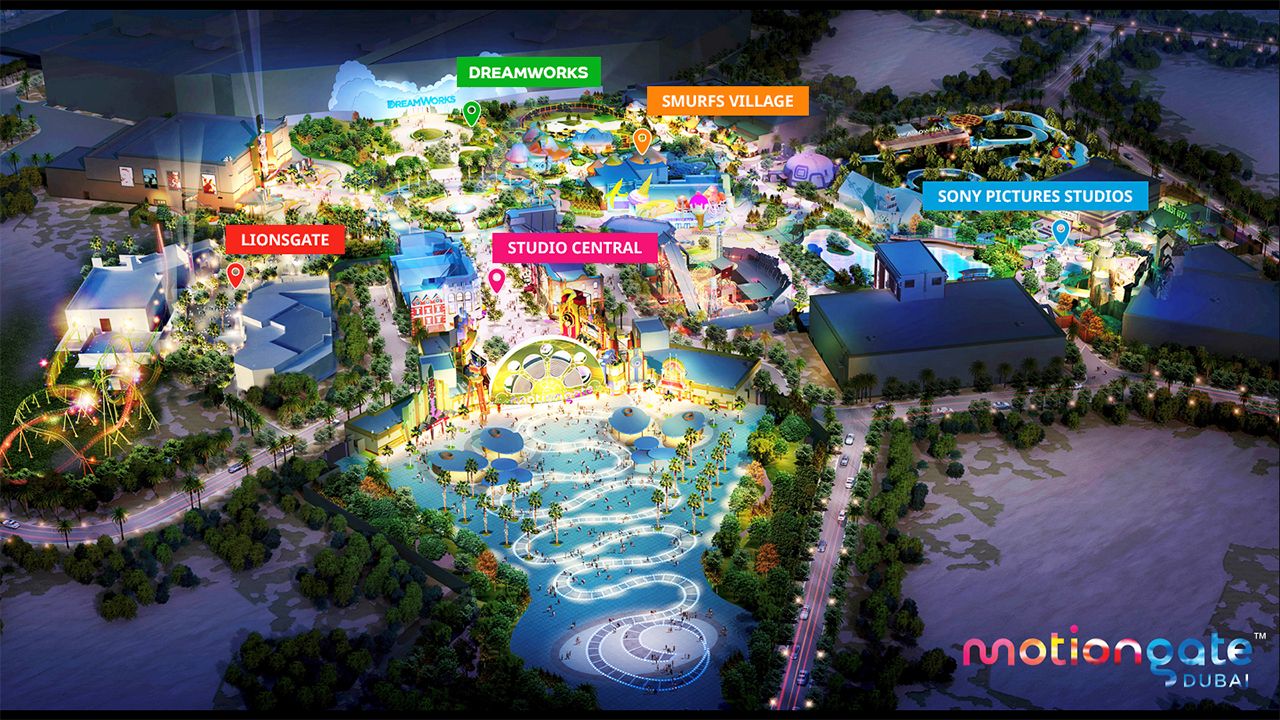
MotionGate_DubaiIn the vein of Walt Disney World and Universal Orlando, Dubai Parks and Resorts is a themed entertainment complex featuring separately themed parks. Specifically, MotionGate bares a striking design modeled after Magic Kingdom in that it is ONE theme park that contains five distinctly different themed lands that all center in and around the concept of motion pictures, filmmaking, and live entertainment. Each land, much like the ones at Magic Kingdom, has its own gateway, themed rides, restaurants, shows, and landmarks. Also, keeping with the Magic Kingdom layout, MotionGate contains the hub and spoke system. Unlike Universal Studios, Islands of Adventure, SeaWorld, or Busch Gardens, MotionGate employs the hub-and-spoke system in order to make maneuvering the park user-friendly and aesthetically pleasing to the eye. This provides opportunities for centralized entertainment offerings and landmarks. Prepare for the glitz, glamour, nostalgia, and excitement of the lands: Studio Central, LionsGate, DreamWorks, Sony Pictures, and the Smurfs’ Village. What makes this concept additionally interesting is the fact that MotionGate includes IP from different studios that are self-contained. Instead of taking the IP from the different companies and integrating them in more generically themed lands, each IP is contained within its respective land.

sony-motiongateOne cannot help but notice that the concept of Dubai Parks and Resort’s flagship theme park MotionGate resembles the original Universal Studios Florida or to a lesser extent Disney-MGM Studios. How so? If you are not familiar, both Universal Studios Florida and then Disney-MGM Studios were theme parks inspired by the idea of “what lies beyond the fifth dimension” (Tower of Terror, Disney); moreover, the story that exists outside of the frame–beyond mise en scene. In addition to attractions and shows inspired by filmmaking or theatre, both parks were also east coast counterparts to the Hollywood stages. Universal/Nickelodeon and Disney produced major motion pictures and television shows in the sound stages that are all but gone (or turn into conventional  attractions) in the 1980s and mid to late 90s. By 2000, most filmmaking and television production operations ceased because it was cheaper to move operations back to Hollywood and to other places like North Carolina and now Georgia. MotionGate goes back to the drawing board to resurrect a dying idea of turning filmmaking into an attraction. It truly holds up Geoff King’s studies and theories of “the cinema of attractions.” Universal founder Carl Leammle knew there was more to filmmaking than making movies. That’s why he opened his movie making ranch outside of Los Angeles to day guests to be entertained by special effects and stunt shows as well as watching the magic behind the camera.

20thCenFoxWorldIt is an exciting time for the themed entertainment and motion picture industries. For the longest time, Disney and Universal (Comcast) were the kings of cinema and TV based theme parks. Now, Dubai is becoming a heavy hitter and once MotionGate opens in October, the landscape has the potential to shift drastically. Now, the parks in the US will not only be competing against each other, but against heavy competition on the other side of the world in an area with much deeper pockets. All the while the word is focussed on the Word of Pandora, The Reign of Kong, Cobra’s Curse, Mako, Star Wars Land, Toy Story Land, and the unnamed new theme park under construction for Universal’s third park (not counting the forthcoming water park), MotionGate will open and create a whole new atmosphere of innovation amongst the chief players. In addition to the parks in Dubai, Fox is also entering into the game with their 20th Century Fox World opening in Malaysia in 2017. Also on the books is the 20th Century Fox World expansion to Zoo Miami AND another indoor Sony theme park in Wisconsin. With all these parks opening, there are more and more opportunities for careers in either cinema or themed entertainment. Or, a career that spans both (which is what yours truly is trying to do). I just love all the new completion because it will drive continued innovation. However, it’s also nice to see that we have a new park that is getting back to the roots of what started it all: motion pictures.

On Cinema and Theme Parks (part 2)

My Book

(Continued from Part 1)

Understanding the synergy or convergence that exists between the cinema and theme parks requires looking to the history of the relationship between the two entertainment giants. Before Disney’s Hollywood Studios (formerly Disney-MGM Studios), Universal Studios Florida, and more than 40 years before Disneyland was opened, the founder of Universal Studios (studio) German immigrant Carl Laemmle, opened his 250-acre-movie-making ranch, just north of Los Angeles, to the public for a mere $0.25 (Murdy, 2002). More than side income for the trailblazing studio, most well-known for its pioneering of the horror film, the original studio tour began on the outdoor backlot in March 1915. Laemmle desired to immerse the “people out there in the dark,” as famously referred to by Norma Desmond in the timeless classic Sunset Boulevard, into the magic behind the screen (Sunset Blvd, 1950).

Interestingly, according to famed psychiatrist Sigmund Freud, horror is often concerned with revealing “other” scenes to the audience (Freud, 1919). And, keeping with this theoretical approach to horror cinema, Laemmle opened this “other” scene to the guests of Universal Studios Hollywood.  But more than horror, Laemmle also brought the studio guests face-to-face with western action/drama (Murdy, 2002). From early in the 20th century, the concept of cinema and theme park convergence was born. The happy marriage, however, was not to last very long. Upon the introduction of cinema sound, Laemmle was forced to close the studio “park” to the not-so-quiet guests in order to facilitate appropriate recording sound for the motion pictures (Murdy, 2002). The Universal Studios tour would remain closed to the general public for over 30 years. But, in 1961, the studio would once again open its gates to a new generation of movie lovers (Murdy, 2002). Between 1961 and 1964, Universal outsourced the famed tram tour to the Gray Line bus company.  Following a feasibility study, conducted by researcher Buzz Price, the same man who helped determine the locations for Disneyland and Walt Disney World, Universal decided to start its own tram tour of its facilities, and Universal Studios Hollywood opened in July 1964 (Murdy, 2002).

Following the ending of the Studio System, the now bankrupt motion picture studios had been purchased by various conglomerates looking for new sources of income (Riley, 1998). One of the sources of income that studios began investing into was the concept of movie-based theme parks. With the opening of Walter Elias Disney’s Disneyland in 1955, Universal Studios made the decision to incorporate stand-alone attractions into its newly reopened studio tour (Davis, 1996). Both Disneyland and the future Universal Studios used their intellectual property (IP) as the basis for creating theme park rides, shows, and attractions. Although movie studios as a “park” began with Laemmle, in its current incarnation, the convergence of cinema and theme park began with Disneyland, and later was perfected by Walt Disney World and Universal Studios Florida. Since the movie studios already had dedicated movie-going audiences, it made sense to capitalize on the idea of incorporating the concepts from the movies into attractions that the general public could enjoy and be immersed in (Davis, 1996). This action both acts as advertising for the respective studios and generates income for the movies and park improvements.

In today’s entertainment marketplace, media conglomerates are restructuring themselves to be as large a player in entertainment and media as possible with the ability to integrate various products and services into multiple areas of exhibition (Taubman, 1970).  This is easily witnessed in how the Walt Disney Company, Sony, and Comcast companies are setup. Walt Disney Company has significant investments in: motion pictures (i.e. Disney, Buena Vista, Touchstone), theme parks, TV (i.e. ABC, Disney Channel), leisure/tourism, radio, video games, stores, and record labels). Sony has investments in consumer/commercial electronics, computers, video game systems, motion pictures (i.e. Sony, Columbia, Tristar), television (CBS), record label, recording studios, radio, and stores. And, much in the same way, Comcast has investments in motion pictures (i.e. Universal Pictures, DreamWorks-SKG), theme parks, resorts, television (i.e. NBC, Golf, SyFy), video games, radio, record labels, and recording studios.

Whereas the fall of the original studio system set the precedent for media companies not to own or operate all the elements of media creation from conception to employment to production to the distribution, also known as vertical integration, companies are now embracing the idea of horizontal integration. Horizontal integration allows a media company to push or market its products or services through various media channels. And, this is a perfect example of why media conglomerates own and operate theme parks. This is a common practice by Disney and Universal in their respective parks and resorts. Disney can release a movie, base an attraction off that movie, use that movie as the basis for a video game, and even include costume characters in the parks and on the cruise ships. In the same vein, Universal can take one of its movie properties and integrate the characters and story into a theme park experience, use the concept for a video game, and maybe even develop a TV series as a spinoff of the movie. This type of integration allows the companies to effectively customize glorified marketing campaigns for their brand. Having a given branding on various commercial outlets allows a company to maximize its exposure to general audiences/customers (Taubman, 1970). As companies acquire more intellectual properties, media outlets, and commercial infrastructure, they are able to actively change entertainment offerings over the years; and this is definitely the case with the theme parks owned by media conglomerates that also have movie studio interests.

Continue to Part 3

“Risen” movie review

RisenThe Gospel–detective movie style! For more than 100 years, stories of Jesus have been the topic of movies. Many early works of cinema featured not only Jesus, but Moses, Sampson, David, etc, but this film is quite different in that it carries a much lighter tone than most faith-based productions. Sticking to the basics of what is known from the Bible and other Jewish and Roman historical accounts of the event, Risen lacks the pious and pretentious nature many of the films in this same sub-genre contain. Not quite cinematic per se or traditionally action-packed, the film has relatively slow pacing but keeps it interesting by supplying well-developed characters and simply the thrill of the original man-hunt. Although the message of the Gospel is clearly stated and shown in the movie, it does not come off as proselytizing. In many ways, the central character is an everyman because it is fairly easy to place yourself in his shoes–or sandals in this case–and imagine what it must have been like to have been in charge of guarding Christ’s tomb and then having to answer for the disappearance. One thing puzzles me; and that is Columbia Pictures’ timing of this release. Honestly, it makes more sense to have released it the weekend prior to Easter. Anyway, I digress.

Risen is about the most famous and controversial man-hunt in the history of the world–and no, I’m talking Jimmy Hoffa–but for the Jesus of Nazareth. You may have heard the Gospel before, but not like this. Follow Roman tribune Clavius (Joseph Fiennes) as he is personally commissioned by Pontius Pilate (Peter Firth) to supervise the burial and subsequent Roman guard of the famed tomb. Assisted by Lucius (Tom Felton), Clavius closely manages the burial of Jesus’ body and instructs the guards to keep watch to make sure the body is not stolen so Jesus’ disciples can claim resurrection. As we know from history, the tomb is discovered to have been blown open and thus begins Rome’s search for the body of Jesus in order to snuff out any uprising or violent radical upheaval. Clovis’ search for the body of the proclaimed messiah will force him to question his own beliefs as he encounters appearances and fervent faith that we cannot reconcile against the world he knows.

A history and mystery in one! From either objective or subjective points of view, this is my pick for the best “Jesus” film ever. And yes, I am including the box office smash Passion of the Christ in that assessment. But what makes this particular movie more receptive and less controversial and other faith-based films in the past? Answer: lack of pretense. Whether talking God’s Not Dead or Passion of the Christ, both films do not attempt to appeal to a broad audience. They play on the court with the rest of the faith-based movies both good and bad. Risen plays to the audience differently because it concentrates on developing the realistic historic characters by pairing what is known by way of Biblical or Jewish/Roman historic texts with logical conclusions or using context clues to fill in the gaps. The writers did an excellent job in developing the character of Clavius as someone with whom many in the audience could identify because whether believers int he resurrection or not, we have all questioned our various and respective beliefs at one point or another and often look for answers very much in the same way a detective solves a mystery.

Unlike other films where the focus is either directly or indirectly on Jesus, the focus of this film is primarily on the delicate political landscape between the Jews and Romans and of course our protagonist Clavius. However, this film uses the indirect approach to discover why Jesus’ was so special to his followers (and it still to this day). This indirect approach is far more effective for speeding the Gospel message than typical “Christian” films. Although this film is clearly about the mystery surrounding the resurrection of Jesus in the background, the foreground is a personal journey thus making it more of a historic film than a “Christian” one, so to speak. Therefore, most anyone who enjoys Roman or Jewish history will find something of interest in this film. The relationship between the Romans and Jewish leadership is handled very well. It shows the game the Romans had to play with the Jews in order to keep peace in Jerusalem–especially because Caesar is arriving soon and Pilate needs to show him that he has the Jews under control.

The person of Jesus is also handled better than any other film I have seen. He comes off as an average Joe–that is, an average Joe who can heal lepers. But, he connects well with the audience and is very much down to earth in his appearance and mannerisms. Sometimes it’s hard to understand why his disciples then and followers to this day would choose to follow such a man, but this film makes it clear why. He embodies love. On a lighter note, I’ve always found it funny that in most historic/Biblical films, such as this one, most of the characters speak with a British or transatlantic accent. Pretty sure that was not the case back then. But, at the same time, it does not hinder the story in any way. Although the film is a little slow and the pacing isn’t always executed well, over all, it keeps in line with the traditional three-act plot structure and sufficiently supplies the audience with the proper turning points. Risen also handles character development very well. I really appreciate the development of not only Clavius but also Pilate and Lucius as well. To an extent, we also see some development in some of Jesus’ disciples as well. At the end of the movie, the characters in the story felt like real people, and that is a remarkable achievement in this movie.

Ordinarily, we don’t see movies like this until Easter time. Even though we are a month out from it, I feel that if you enjoy Biblical or simply historic movies that are down-to-earth, written, acted, and developed well that you will enjoy this movie. Traditionally, I am not a fan of most faith-base movies because they are cheesy, pious, over the top, or just executed poorly; however, I very much enjoyed this film and hope you do too.

“The 5th Wave” movie review

FifthWaveAnother cliche wave of ‘only attractive young people can save the world because they are special’ movies. Really??? Do we really need another one of these films with an overly used and tired plot? I suppose so–or at least that is what Sony Pictures is hoping for. Once again, the world is at the brink of destruction by an alien race that has taken over most adults. It is up to a small band of rebel young people to save the world by overcoming the impossible. Only this time, the dialog and plot are so incredibly blasé that you may likely find yourself often glancing at your watch to see when this painful movie will be over. Can we survive the fifth wave??? That question is all too apropos. From the unimpressive digital effects to the crazy quilt consisting of pieces and patches from every other  YA fantasy action thriller, hopefully this movie signifies the last wave of boring and predictable franchises that try to compete with The Hunger Games but fail miserably.

I normally summarize the plot here, but I am pretty well sure that you already know all that you need to know, given the repetition of such films in this sub-genre of young adult movies.

If you simply enjoy mild, mindless, cliche young adult (trying so hard to appeal to teens and adults) entertainment, then this film is for you. On the other hand, if you are tired of this same vapid plot that we have been accosted with for the last several years, then this is not the way to spend the weekend. Haha. I wanted to see The Boy instead last night; but unfortunately, it was not getting a Thursday night release. I think distribution companies and theatre chains should have released it instead last night, and saved this travesty for today.

“007: SPECTRE” movie review

SpectreA brilliant Bond film and excellent followup to the wildly popular Skyfall. Director Sam Mendes pulls out all the stops in MGM and Columbia’s Spectre the 24th official title in the Bond 007 franchise. After the soaring success of the previous chapter in the Bond anthology, who would have known that this final appearance of Daniel Craig as the heartthrob MI6 “paid assassin” would be just as thrilling! Just the opening sequence of the movie will have you on the edge of your seat, and the many throwbacks to past Bond film plots or characters will capture your attention for the two and a half-hour runtime. Even Blofeld, the original Bond villain, and his fluffy white cat appear in this epic Bond story. The jaw-dropping action will satisfy even the most ardent and long-time James Bond fans. Whether you’re an old-school or new 007 fan, you are definitely in for a treat. Some of the most refreshing and getting-back-to-authentic Bond elements, of the Craig chapters in the series, is the lack of over-the-top and at times absurd gadgetry, and a return to the very essence of what makes this franchise stand the test of time.

After the tragic events at Skyfall and the destruction of MI6’s massive facility on the Thames, James Bond 007 (Craig) is following a lead in Mexico City thanks to a cryptic posthumous message from the former Agent M (Judi Dench). When the actions in Mexico City draw the attention of the UK’s new head of security and Agent M (Ralph Fiennes), 007 is both grounded and puts the very existence of MI6 in jeopardy. After an unauthorized mission to northern Africa, 007 learns of the sinister crime syndicate known as SPECTRE. Coming face-to-face with the leader of Spectre, 007 learns of a chilling connection between the leader and himself. From northern Africa to the Austrian Alps, 007 must race against the clock to stop a big surveillance data collection organization from being the eyes of the world, and take out the leader of Spectre before he has his hands in the security pockets of several countries around the world.

This final chapter in the Craig Bond series has it all: action, romance, espionage, intrigue, and car chases. But probably the best elements of the movie are connected to  getting back to the very core of what has kept this franchise alive for over 50 years and 24 official titles. Despite the success and popularity of the 90s Brosnan 007 movies, they tended to place a lot of significance on the futuristic and ultimately impossible gadgets. Understandable, because the 90s were a time of massive personal electronic device innovation and the dot com boom. However, this emphasis on the gadgets took away from the plot and character development. Still, those era of Bond movies were exciting and still popular today amongst mostly the newer Bond fans. Returning to the very essence of what make Bond the 007 that fans adore is what makes the Craig films unique and exciting–especially in Skyfall and Spectre where 007 truly comes into his own. We still get some gadgets and the famous Bond film cars, but there is a degree of believability and realism that exists in these films that did not exist in the 90s Bonds. Even though these are still high concept films that have over-the-top action packed sequences, these movies still have a sense of old-school espionage class about them. An interesting side note: there is definitely a hint of the plot from Tomorrow Never Dies in this current installment.

No 007 movie would be complete without an original song that is eerie, romantic, and mysterious all at the same time. The title song from Skyfall performed by the incomparable Adele was an outstanding work of music and lyrics. It truly embodied the film itself and cemented her career as a master of soul/jazz. I cannot say the same for Sam Smith’s performance of “The Writing’s on the Wall.” I was not all that impressed with his performance and I thought the song itself paled in comparison to 2012’s “Skyfall.” Despite the fact that I didn’t personally care for Sam Smith performance or the song, it definitely still had that Bond theme flare about it. Between the graphics and editing, you still knew that you were watching a 007 movie without needing to see the poster or title. Looking to the next vocal artist, I’d like to see Elle King perform the next Bond theme song after her very Bond-ish sounding “Under the Influence.” Regarding the film score, Thomas Newman shines as he so often does with his remarkable talent for capturing the soul of a film in the score that accompanies it.

Facing the popularity of Skyfall, it was definitely a monumental task for Mendes to direct this Bond film. And although I do not feel that Spectre is better than Skyfall and at times I felt that I enjoyed the previous one more, I still thoroughly enjoyed this present installment of the anthology. And to my pleasant surprise, Dame Judi Dench makes a small cameo appearance as the M we’ve had for nearly 20 years. In respect to the characters in and of themselves and their personal/interpersonal relationships with one another, I really felt that the chemistry between M, Q, 007, Money Penny, and Blofeld was right on the ‘money.’ There really isn’t much in the way of traditional or conventional character development but that is commonplace in high-concept films. However, the glimmer of development in both M and 007 was enough to show that these characters and actors were almost made for each other. It was never awkward or boring to watch their interactions with one another.

Ready for an actual spy movie filled with assassins, intrigue, espionage and romance–especially after having sat through Bridge of Spies??? Then definitely watch the next chapter in the Bond, James Bond 007 anthology SPECTRE! Prepare yourself for over two hours of excitement, explosions, and dynamic car chases. Return to old school Bond! Watch as many plot elements through the years and even the villain who started it all make it full-circle.