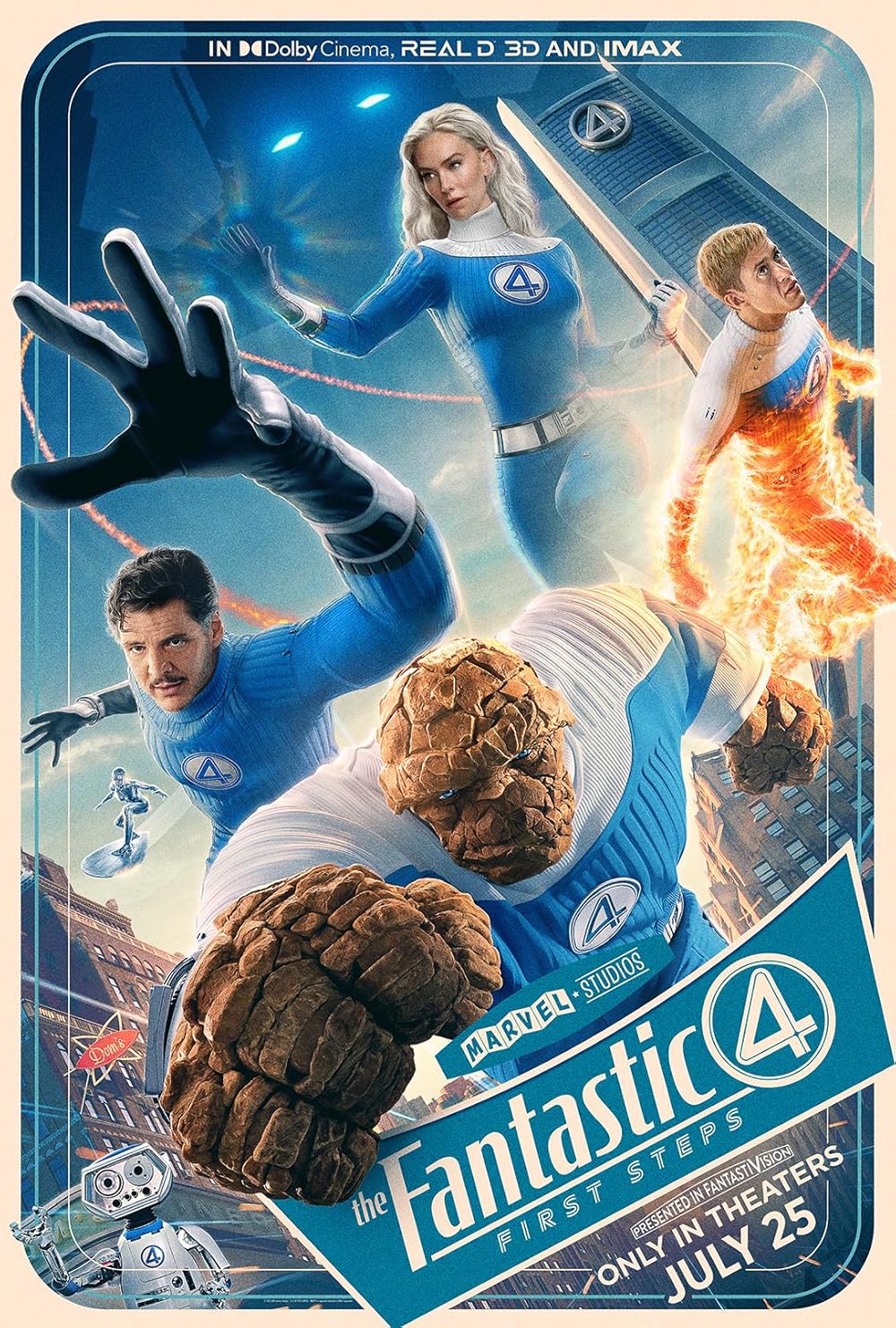
Fantastic? Let’s not get ahead of ourselves. Somewhere, Doctor Doom is laughing—because the real villain here is the script. The Fantastic Four: First Steps is a superhero movie that boasts an eye-catching retrofuturistic aesthetic and the welcome return of a classically evil villain, but it stumbles narratively with a lopsided screenplay, fragmented character dynamics, and a superfluous Silver Surfer who’s more prop than presence. With a protracted first act, truncated second act, and anticlimactic third, the swing the screenplay makes results in a foul ball–not a complete miss. Ultimately, it feels like a blueprint more than a building—an origin story more concerned with establishing than enthralling. It may offer the glimmer of potential, but that potential is still waiting for a film that knows how to make the most of these characters and each other. For a franchise reboot that proudly wears its Jet Age design language on its sleeve—from sleek, chrome-laced laboratories to wardrobe choices evocative of a Tomorrowland dreamscape—it’s ironic that the narrative propulsion of First Steps feels so grounded.
Mister Fantastic, Invisible Woman, Human Torch, and the Thing face must defend the Earth against the evil Galactus and his henchman Silver Surfer.
One of Fantastic Four: First Steps‘ undeniable triumphs is its commitment to a bold, 1960s retrofuturistic aesthetic that feels lovingly ripped from the pages of a Silver Age comic book or the Saturday morning cartoons of yesteryear. From the clean, curved architecture to the brightly colored jumpsuits and analog-style gadgetry, the film creates a world brimming with mid-century optimism—where science gleams, and adventure is just a rocket launch away. It’s visually delightful, evoking a kind of lost future that’s both nostalgic and fresh. However, the illusion occasionally falters due to jarring technological inconsistencies—most notably, the inexplicable presence of flying police cars in a world where most other vehicles appear rooted in vintage combustion-era design. And, I’d be remiss not to mention the futuristic pregnancy test that doesn’t jive with the world around it. These moments by no means sink the aesthetic, but they do momentarily snap the viewer out of the carefully constructed retro bubble.
Had the screenplay been better developed, then it may have been a “fantastic” superhero movie. The first act overstays its welcome by devoting undue time to setup that borders on exposition overload. By the time the plot remembers to move forward, the second act breezes by in a montage-like sequence of conflicts and discoveries, depriving the audience of organic development. Then, just as stakes are positioned to crescendo, the third act fumbles its own climax—settling for a resolution that feels more contractual than cathartic. While I appreciate the under two-hour runtime, I would not be surprised if there are entire scenes and sequences left on the cutting room floor.
But the most glaring issue isn’t pacing—it’s people. Or rather, the lack of connection between them. The titular quartet never quite gels. Chemistry between Reed, Sue, Johnny, and Ben is virtually nonexistent, with interactions that feel less like family dynamics and more like coworkers meeting on a Monday morning Zoom call. Attempts at humor or sentimentality fall flat, not because the lines are poorly written (though many are), but because the actors rarely feel like they’re occupying the same emotional wavelength. Pescall and Kirby have solid chemistry, and separately Quinn and Moss-Bachrach have fantastic comedic chemistry; but collectively, Marvel’s first family is lacking in sufficient chemistry. However, compared to previous cinematic attempts, seeking to adapt the Fantastic 4 for the big screen, this one is the strongest attempt.
Silver Surfer’s inclusion is more puzzling than pivotal. A character of mythic stature reduced here to a glorified Uber driver with a shiny board. She floats in and out of scenes with little impact on the plot, contributing neither urgency nor depth. Her presence suggests a franchise desperate to expand its cosmic CV but unsure of how to weave her meaningfully into the narrative tapestry. In fact, Silver Surfer could be removed from the story, and pretty much everything plat out much in the same way. No mistaking it, there IS an interesting backstory there, but it was barely tapped and even less developed. I am not suggesting Silver Surfer needs a movie or TV series, but a few more minutes of development in this movie, wouldn’t have hurt anything.
I did enjoy the refreshing return of a classic villain in Galactus. So often, modern cinema and television go to great lengths to demonstrate how villains are merely misunderstood or solely formed by societal factors–not Galactus. He’s neither misunderstood nor sympathetic. Just evil. In an era where antagonists are often softened by tragic backstories or moral ambiguity, the choice to lean into a classically malevolent foe is surprisingly refreshing. The character brings weight and threat to the film, standing as a stark reminder that sometimes the best villains are the ones who like being bad.
To the movie’s credit, audiences can watch it without having to know much about the Fantastic 4 and there is little need to watch any preceding movies or TV series. That said, I’ve been told that there are TV series and movies that will help to better understand or appreciate certain elements–but not required. When it’s all said and done, The Fantastic Four: the First Steps is sufficiently enjoyable and doesn’t overstay its welcome. Feels like a late summer movie, and there’s nothing innately wrong with that.
Ryan is the general manager for 90.7 WKGC Public Media in Panama City and host of the public radio show ReelTalk “where you can join the cinematic conversations frame by frame each week.” Additionally, he is the author of the upcoming film studies book titled Monsters, Madness, and Mayhem: Why People Love Horror. After teaching film studies for over eight years at the University of Tampa, he transitioned from the classroom to public media. He is a member of the Critics Association of Central Florida and Indie Film Critics of America. If you like this article, check out the others and FOLLOW this blog! Follow him on Twitter: RLTerry1 and LetterBoxd: RLTerry
 R.L. Terry ReelView