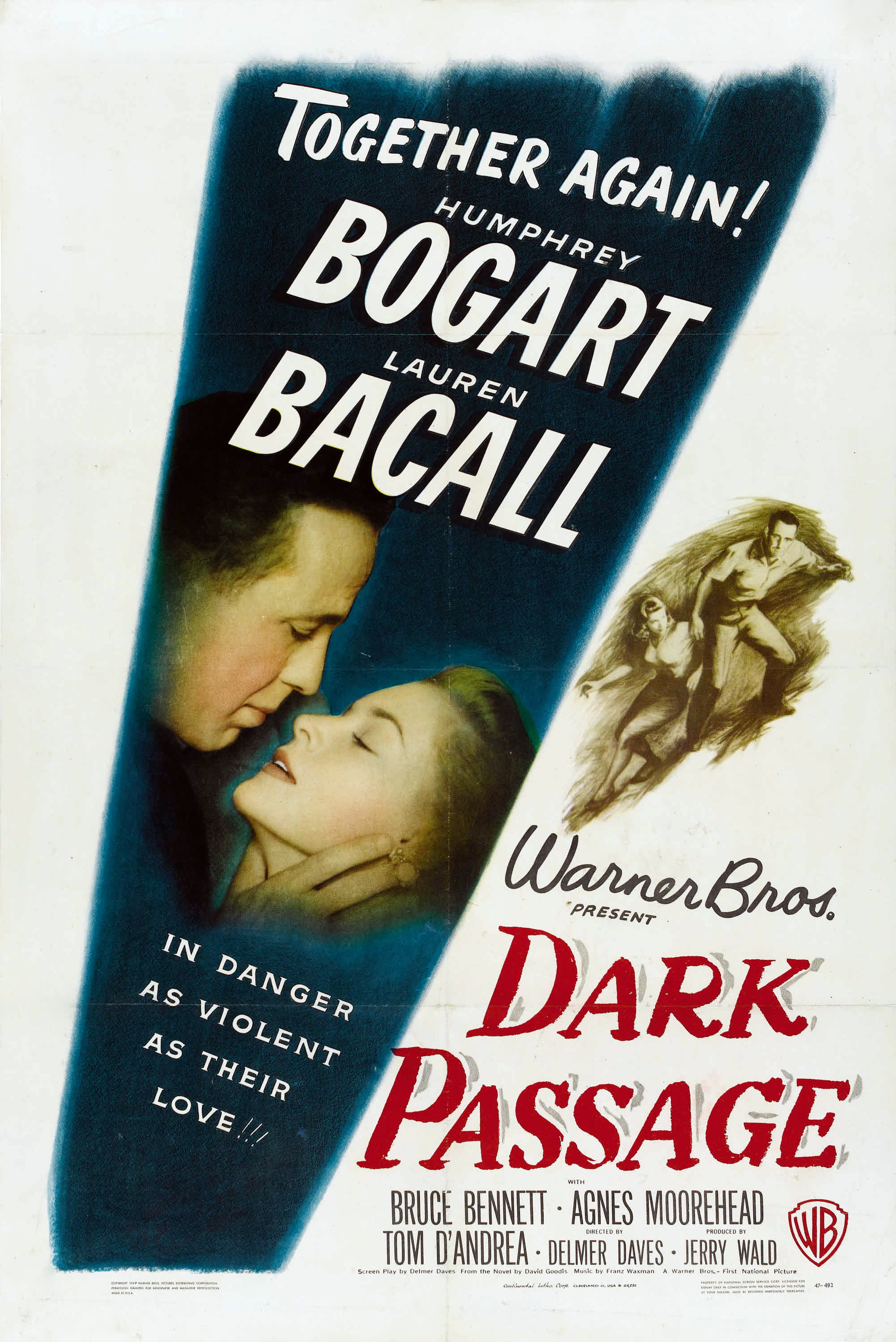
DARK PASSAGE (1947) throwback Thursday review

Spectacular and immersive! Dark Passage is the outstanding Bogie-Bacall film noir that you’ve likely never seen or even heard of, but you’ll want to change that. From beginning to end, this motion picture never ceases to draw you into its mysterious, seductive atmosphere. Bogie delivers a noteworthy performance through his dynamic facial expressions and body language, but it’s Bacall that steals the show through her sultry, smart, and sensational screen presence and performance. Dark Passage simultaneously checks all the film noir boxes whilst delivering something fresh and exciting.

Vincent Parry (Bogart) has just escaped from prison after being locked up for a crime he did not commit–murdering his wife. Vincent finds that his face is betraying him, literally, so he finds a plastic surgeon to give him new features. After getting a ride out of town from a stranger, Vincent crosses paths with Irene Jansen (Lauren Bacall), who believes in his innocence and helps him unravel the mystery surrounding his wife’s murder.

The most striking production element of Dark Passage is its innovative use of motivated camera framing and movement, which provides a unique and immersive perspective for the audience. By presenting the action from Vincent’s point of view (POV), the audience is drawn into his experiences and emotions, creating a sense of empathy and connection with the character. This technique adds a layer of suspense and tension to the film, as the audience is kept in the dark about Vincent’s true identity until later in the story. While POV camera is commonplace today, in the 1940s it was almost unheard of, which may have contributed to the reception of the film. But, if you’re searching for an excellent example of emotive POV camera, then definitely add this movie to your watch list.

Thematically, the film concerns itself with exploring concepts such as identity, justice, and redemption. Vincent’s transformation through plastic surgery raises questions about the nature of identity and whether changing one’s appearance can truly alter who they are on psychological, physiological, and emotional levels. As Vincent searches for his late wife’s real killer in order to clear his name, he grapples with issues of morality and the quest for justice in a corrupt world.

Underscoring the aforementioned themes is the compelling and complex relationship between Vincent and Irene. Irene’s unwavering belief in Vincent’s innocence provides him with hope and motivation to continue his search for the truth. Their growing bond adds depth to the story and serves as a contrast to the darker elements of the plot, because of the humor generated by their conflicting personalities. Film noir isn’t characterized merely by grayscale images (commonly referred to as black and white), but specifically the high contrast between light and dark. The high contrast isn’t only communicated visually, but is communicated thematically as well. In Dark Passage, the humor in Vincent and Irene’s relationship is the light to the film’s dark elements. 

Lauren Bacall delivers a captivating performance as the determined Irene Jansen, Bacall’s portrayal of Irene is both alluring and sympathetic, adding depth to the character and serving as a crucial counterpart to Humphrey Bogart’s Vincent. Bacall’s performance exudes confidence and intelligence, traits that are essential for Irene as she navigates the morally ambiguous world of the film noir genre.

Perhaps the very definition and embodiment of femme fatale, Bacall communicates strength and cunning whilst never at the expense of sensuality and seduction. Moreover, she simultaneously conveys both fortitude and vulnerability beneath her character’s poised exterior. Bacall authentically portrays a relatable human dimension, allowing the audience to empathize with Irene’s plight and unwavering support for Vincent.

Furthermore, Bacall brings a sense of sophistication and glamour to the role, seamlessly fitting into the noir aesthetic. Her distinctive voice and sultry demeanor add to Irene’s allure, making her a memorable presence in every scene in which she appears. Humphrey Bogart delivers a compelling and nuanced performance in the film, even when we do not see him. Even his voice work is outstanding. His portrayal of Vincent is a masterclass in film noir acting, showcasing his ability to convey complex emotions and inner conflict.

Bogart’s performance is particularly noteworthy for his use of facial expressions and body language to convey Vincent’s emotions. Even when his face is hidden from view during the first part of the film, Bogart manages to convey a wide range of emotions through his voice and physical presence alone. His expressive eyes, in particular, become a focal point for conveying Vincent’s inner turmoil and determination.

Bogie’s performance is a truly an underrated performance in his illustrious career. With his skillful portrayal of Vincent Parry, Bogart elevates the film beyond its genre trappings, creating a compelling and unforgettable character that lingers in the minds of audiences long after the credits roll.

On an aesthetic level, one of film noir’s most striking elements is the high contrast grayscale imagery. The moody grayscale cinematography brilliantly captures the shadowy streets of San Francisco, thus crafting an atmosphere of dread. Beyond mere aesthetics, however, the lighting and camera movement communicate a sense of unease and mystery, mirroring Vincent’s (and by extension film noir’s) emotional journey through this murky world of crime and deception.

Why isn’t this brilliant picture more well-known? Most likely the reasons are three fold (1) competition from other better-known Bogie-Bacall collaborations like The Big Sleep (2) overt subjective camera framing and movement and (3) availability on broadcast/cable TV and home video.

Points one and three are somewhat interlinked because other Bogie-Bacall pictures like A Gentleman’s Agreement and The Big Sleep are much better known because they received higher praise from critics and audiences (even though Dark Passage received mostly positive reviews at the time of its release). And because of this, other Bogie-Bacall pictures received more airtime on broadcast and cable TV and were more widely available to own on home video and DVD. The second point, which may have led to the mixed-positive reception, concerns the (what would’ve been interpreted at the time as experimental) subjective camera techniques. In retrospect, the POV shots are an outstanding use of motivated camera movement that simultaneously conveys the film’s theme of identity and advances the plot. 

While not as well-known as it should be, Dark Passage holds significance within the film noir genre and remains appreciated by cinephiles for its innovative cinematography, compelling performances from Bogie and Bacall, and atmospheric storytelling. And underscoring the technical and performative achievement is the film’s exploration of identity and injustice. It remains a captivating and influential motion picture.

Ryan teaches Film Studies and Screenwriting at the University of Tampa and is a member of the Critics Association of Central Florida and Indie Film Critics of America. If you like this article, check out the others and FOLLOW this blog! Interested in Ryan making a guest appearance on your podcast or contributing to your website? Send him a DM on Twitter. If you’re ever in Tampa or Orlando, feel free to catch a movie with him.

Follow him on Twitter: RLTerry1 and LetterBoxd: RLTerry

ORDINARY ANGELS movie review

Warms the most cynical of hearts. Two-time Academy Award-winning Hilary Swank makes a triumphant return to the silver screen in Ordinary Angels. Her outstanding performance in this remarkable true story will stir your soul, and remind us that with all the conflict and self-centeredness in the world, that there are still those that strive to make it a better place, even if it’s just helping one person. Despite some pacing issues, most notably in the second act, and some forced dialogue here and there, Ordinary Angels genuinely surprised me by how well it was written and directed. Moreover, there is a discernible emotive dimension to the editing and cinematography as well. Many movies based on true stories can feel like an extension of a Wikipedia article, but not so with this film. From beginning to end, it is a moving story that provides hope for humanity even when we feel broken.

Sharon (Swank), a struggling hairdresser, finds a renewed sense of purpose when she meets Ed (Alan Ritchson), a widowed father, working hard to care for his two daughters. With his youngest critically ill and waiting for a liver transplant, the fierce woman single-handedly rallies an entire community to help.

Okay, let’s address the white elephant (for many) in the room, and get it out of the way. Yes, Ordinary Angels is a motion picture from a faith-based production company. And even I have written how those types of movies are often poorly written and acted. Generally, the technical aspects of production are on par with more mainstream studios; but the writing and acting usually suffer. Suffice it to say, that is not the case here. I was shocked by how much I enjoyed the story and how the story was crafted.

The conflict is real, relatable, and raw. The characters feel like real people, flaws and all, especially Sharon and Ed. Whether it’s a true or fictional story, I always strive to find a character(s) with whom I can identify with his or her struggles and goals, because it’s our flaws and dreams that bring us together.

Why? Relatability. Characters in motion pictures need to feel relatable. Sometimes that relatability is identified in paralleling struggles or conflicts in our own lives to that which we observe on the screen. That which is most personal is most relatable. Furthermore, often times the best heroes are those that are just as broken as those around them, but it’s the overcoming of emotional or psychological baggage that greatly resonates with us.

It’s been a while since we’ve seen Hilary Swank on the silver screen, and it was so refreshing to see her once again. She brings such gravitas to every scene in which she is featured in Ordinary Angels. Throughout this performance, there are hints of the indelible quality she brought to us in Boys Don’t Cry and Million Dollar Baby. Sharon feels like your hairdresser or your friend or neighbor. She’s the perfect every man because there is neither pretense nor anything particularly special about her, save her infectious, brassy energy. And as much fun as she’s having on the outside, she is broken on the inside. That is, until she reads of the story of the little girl who needs a liver transplant and lost her mother the year prior.

And before you begin thinking this otherwise self-centered alcoholic mother with a son from whom she is estranged does everything without care for herself, you learn that she is using her philanthropic skills to help fill a void in her own life. Yes, she cares deeply for the little girl and her family; however, deep down, Sharon is also hoping to makeup for her failures as a mother. But through her journey helping this little girl, Sharon learns how to acknowledge the demons in her own life, and to grow from them instead of always compensating for or excusing them. True healing begins in the heart.

The character of Ed is also incredibly relatable. He represents an every man whom is angry at the world, angry at God, angry with himself, and full of stubborn pride. After losing his wife, five years after she gave birth to our dying little girl, he feels abandoned by the faith he once held dear. And how many of us wouldn’t feel exactly the same after losing a loved one, and on the verge of losing another, all while trying to manage a household on a shoestring budget with medical bills mounting? His response is a very human response. I particularly like his behavior after there is a light at the end of the tunnel–he is still wrestling with all those same anger issues, but demonstrates the beginning of recapturing his faith in God and humanity.

While the subject matter is rather dark–the dire straights in which the little girl’s family finds themselves–and the fact without a liver, the little girl will most certainly die, there are moments of levity that serve as emotional resets. My biggest problem with the writing is the second act in which pacing is rather sluggish. There is about 10-15mins that could’ve easily been carved out of the second act in order to maintain proper pacing throughout the entirety of the movie. Furthermore, there are moments in which the dialogue feels more plot-driven than character-driven. Not to the point it turns into a melodrama, but some lines feel a trifle artificial.

If you’re looking for a motion picture that shows that there is still hope for humanity, hope that we can–despite differences–help one another, help our neighbor, then this is a picture to check out while it is still in cinemas.

Ryan teaches Film Studies and Screenwriting at the University of Tampa and is a member of the Critics Association of Central Florida and Indie Film Critics of America. If you like this article, check out the others and FOLLOW this blog! Interested in Ryan making a guest appearance on your podcast or contributing to your website? Send him a DM on Twitter. If you’re ever in Tampa or Orlando, feel free to catch a movie with him.

Follow him on Twitter: RLTerry1 and LetterBoxd: RLTerry
DUNE: PART TWO movie review

A visually spectacular motion picture with a killer score that’s the storytelling equivalent of a bridge to nowhere. Denis Villeneuve’s DUNE: PART TWO is perhaps the most movie you will watch this year, as there is such a prolific amount of a variety of subplots and conflict that all converge in a single intersection to create figurative gridlock on the highway of cinematic storytelling. There is no argument, Dune: Part Two delivers cinematic scale and scope, but the grand potential of this modern-era epic is hampered by poor screenwriting.

Paul Atreides unites with Chani and the Fremen while seeking revenge against the conspirators who destroyed his family. Facing a choice between the love of his life and the fate of the universe, he must prevent a terrible future only he can foresee.

Word to the wise, be sure to rewatch the first movie before watching Part 2, because you will likely feel as lost as I was in trying to follow the central characters and main plot. With so much going on, the plot map is all over the place; in fact, one can hardly call it a map, as it’s lacking any meaningful direction. Think of an entire limited run series, jampacked into a single movie. I spent most of my time feeling completely lost in attempting to follow the outside/action plot. Fortunately, there is more action in this second installment compared to Dune: Part 1, but, ironically, more action makes for an even less engaging movie. And since the first part was sleep inducing enough, I was shocked it was possible to achieve twice.

The real star of this movie isn’t one of the A or B-listers, it isn’t the director or writer, but it’s Hans Zimmer. Zimmer’s score is mesmerizing and immersive. It truly feels like a character in and of itself. There is a beautiful otherworldly quality about his score that draws you in (too bad there’s nothing of great substance into which to be drawn) to the Duniverse. An extension of the environment is how the score plays throughout the movie.

Not even the movie’s performative dimension is sufficiently engaging, save Austin Butler, his deplorable character of Feyd-Rautha is the most entertaining out of the ensemble. Except for a few moments here or there, the performative dimension is completely uneven as some actors over-act, others under-act, some are clearly phoning-in, whilst others are visibly bored with their character. Character development, or lack thereof, is another storytelling process that is rushed in some places and creeping along in others. Ultimately, there lacks any characters with whom the audience can empathize or with which to connect as there isn’t a single likable character in the whole Duniverse. But perhaps that’s the idea: sometimes in the real world, it can be difficult to identify the most likable side in a conflict, and that is what we have here. One of life’s complexities.

During the second act (and I use that term loosely as it feels like one big second act) of the movie, there is a sequence of scenes that take place on a grayscale planet–and it looks gorgeous!!! This was probably my favorite part of the movie because it felt like an old-school gladiator-like epic in a classic sword and sandle picture.

If there were miniatures used in the film, I had difficulty identifying them. Nearly everything that wasn’t a sand dune felt like it was computer-generated. When the special/visual effects, ships, and palaces feel more computer than practical, it takes me out of the movie. That’s not to say the CGI isn’t high fidelity–it certainly is. Speaking to the quality of Dune: Part Two‘s CGI, it is exceptionally well-made. But the problem is, and yes, I know I’ve said it a hundred times, you cannot replace the way real light bounces off real objects into the camera lens. Had this movie leaned into practical effects, models, and sets more, then used the CGI for extreme wide shots or to fill in what couldn’t be made through craftsmanship, then it may have helped to compensate for the poor writing.

It’s well-known that Frank Herbert’s novel was a response to the global powers and conflict during the Cold War. That thematic idea is carried into David Lynch’s original Dune in 1984 and even in the SyFy Channel limited run series from 2000. Even though there are elements of the Cold War commentary in this adaptation of Dune, the socio-political themes and critiques are far less cohesive. While I greatly appreciate the ability to read a film differently over the years and identify what a film’s message or commentary could mean at that given time, the ability to be read differently over time does not negate the need for coherency, cohesion, and consistency. What Villeneuve and Jon Spähts’ movie is missing is consistency in representation in their interpretation of the socio-political commentary they find is more important or relevant to spotlight today.

On a side note, one of the parts of the movie that I did find surprising was Rebecca Furguson’s character’s (I don’t even remember her name) unborn baby being treated like a person. There is even a scene in which it is all but acknowledged that a human exists within her character’s womb. Certainly caught me off-guard, because the manner in which this part of the movie is presented challenges the dominant ideology so often found in media and pop culture today.

If you plan to watch it, definitely watch it in cinemas in a premium format such as Dolby. I must say, I am glad I screened it in Dolby because the score, sound design, and the grand scale is what I enjoyed most.

Ryan teaches Film Studies and Screenwriting at the University of Tampa and is a member of the Critics Association of Central Florida and Indie Film Critics of America. If you like this article, check out the others and FOLLOW this blog! Interested in Ryan making a guest appearance on your podcast or contributing to your website? Send him a DM on Twitter. If you’re ever in Tampa or Orlando, feel free to catch a movie with him.

Follow him on Twitter: RLTerry1 and LetterBoxd: RLTerry
ARGYLLE movie review

A perfectly choreographed espionage action movie with a dash of whimsy! Matthew Vaughn delivers a wildly entertaining genre-bending spy movie that simultaneously subverts and satisfies expectations for enigmatic espionage movies. Written by Jason Fuchs, Argylle delivers that metaphoric roller coaster ride that we love in this genre-blend. Bryce Dallas Howard shines opposite the gritty-charm of Sam Rockwell in the lead roles, and they are surrounded by an all-star cast of supporting characters. And that technicolor-spectacular sequence at the end is clearly inspired by the dance scenes from Romy and Michele’s High School Reunion and Dirty Dancing. One part fish-out-of-water and another part reluctant hero, this movie is just the thing to start February off with a blast at the cinema.

Reclusive author Elly Conway (Howard) writes best-selling espionage novels about a secret agent named Argylle who’s on a mission to unravel a global spy syndicate. However, when the plots of her books start to mirror the covert actions of a real-life spy organization, the line between fiction and reality begin to blur.

As entertaining as the movie is, we do not actually know the significance of the content in the secret file(s) nor do we know why our heroes must send the files to the former head of the CIA; however, the movie is so much fun to watch, that it almost doesn’t matter–though, I am a little bothered that I was not informed as to the point of the whole sequence of missions, duplicitous relationships, and endless masquerades. But ultimately, Vaughn uses the power of declaration to state that the object to be retrieved is in fact important. And for what it’s worth, that’s all that really matters in this light-hearted espionage action movie.

Much of the movie exists in that liminal space between reality and fantasy, wherein so many authors find themselves as they create compelling characters and craft enigmatic plots to thrill the reader. A well-written character speaks with their own voice and metaphorically take on a life of their own. I appreciate how we are placed in a subjective point of view throughout the move so we can experience the unfolding story from Elly Conway’s perspective. Moreover, the film also has something substantive to say on art as a reflection of life. Writers of all types often take inspiration from their own lives, and mold it to fit the type of story they want to write. We also see this in subject matter experts as authors of fictional stories based on their real life work or inspired by the nature of their work. Whether or not Vaughn and Fuchs intentionally gave Argylle this depth is neither here nor there, the point is that there are opportunities here to closely read the film as a commentary on an artists relationship with their art.

Without getting into spoilers, it’s difficult to talk about too much (this is a spy movie after all) of the plot. Suffice it to say, this movie has some wild twists and turns, reversals, and reveals, but they all feel grounded in the reality of the world that has been created for us on the screen. I appreciate the movie’s foundation in classical story structure, because it allows for character complexities to be revealed through simple plotting–simple plot, complex characters.

If you enjoyed The Beekeeper, then you will also enjoy Argylle. While the former is the stronger movie, I must say that Argylle‘s whimsical nature makes it equally as entertaining.

Ryan teaches Film Studies and Screenwriting at the University of Tampa and is a member of the Critics Association of Central Florida and Indie Film Critics of America. If you like this article, check out the others and FOLLOW this blog! Interested in Ryan making a guest appearance on your podcast or contributing to your website? Send him a DM on Twitter. If you’re ever in Tampa or Orlando, feel free to catch a movie with him.

Follow him on Twitter: RLTerry1 and LetterBoxd: RLTerry

Dario Argento PANICO documentary review

Informative but bland. For a director who’s responsible for some of the most vibrant and stunning films that continue to influence and captivate audiences decades after their initial release, comes a documentary about Dario Argento that is ultimately underwhelming and lifeless. From his hypnotic, phantasmagorical, symphony of terror in Suspiria to his nightmarish Opera and his quintessential giallo in The Bird with the Crystal Plumage, Argento has been crafting cinematic sensory explosions for over 50 years. But this documentary plays more as a podcast, for it leans more heavily into talking heads (one of which is Argento himself) than it does incorporating behind the scenes or footage of his movies. Argento is visually driven storyteller, but this documentary is such that you can turn off the screen and get nearly the same experience listening to the stories.

The documentary starts off very well. Argento is bring driven by the documentary filmmaker to an Italian countryside hotel. Underscoring this scene is mysterious music, and as Argento looks out the window, we see memorable clips from from Suspiria. Suzy arriving at the Freiburg train station. The forest with the dance academy student frantically running for her life. And ad he is pulling up to the hotel, we cut to the vibrant crimson Tam Dance Academy arrival scene from Suspiria. That opening intercut with scenes from Suspiria set me up to enjoy a fantastic, engaging documentary. Unfortunately, the opening of the doc overpromised because the rest of the documentary underdelivered.

While the documentary provides family history and his early days as a writer and producer, most of the doc concerns itself with his feature films from The Bird with the Crystal Plumage to his most recent work. The films that receive the lion’s share of attention are Bird, Inferno, and Opera. No, you didn’t misread that, nor did I forget to include it, but Suspiria represents a small part of the feature-length doc, even though it is inarguably Argento’s greatest motion picture and the one that is best known worldwide. It’s be like a documentary on Spielberg that spent little time with Jurassic Park or with Batman Returns in a documentary about Tim Burton. I am left with questioning the documentary filmmaker on why Argento’s most well known film only has a place in the doc when that iconic, hypnotic Goblin score is the subject.

The documentary continues through Argento’s incredible career, both in Europe and the US. The section on Opera delivers the most footage from behind the scenes, and is fascinating to watch. But throughout much of the documentary, where there should (or could have been) footage, there was a talking head(s). Granted, the talking heads consisted of heavy hitters like Guillermo del Toro, but even that wasn’t enough to make the interviews more engaging. In terms of variety of personalities in the doc, the filmmakera brings together industry professionals and members of Argento’s family, including his ex-wife and daughters.

Panico is certainly informative, but lacks any visual or experiential appeal. All that said, I am thankful that Argento is still around to participate, because it was wonderful to hear from him as his movies and legacy are being expressed through a documentary.

Ryan teaches Film Studies and Screenwriting at the University of Tampa and is a member of the Critics Association of Central Florida and Indie Film Critics of America. If you like this article, check out the others and FOLLOW this blog! Interested in Ryan making a guest appearance on your podcast or contributing to your website? Send him a DM on Twitter. If you’re ever in Tampa or Orlando, feel free to catch a movie with him.

Follow him on Twitter: RLTerry1 and LetterBoxd: RLTerry