
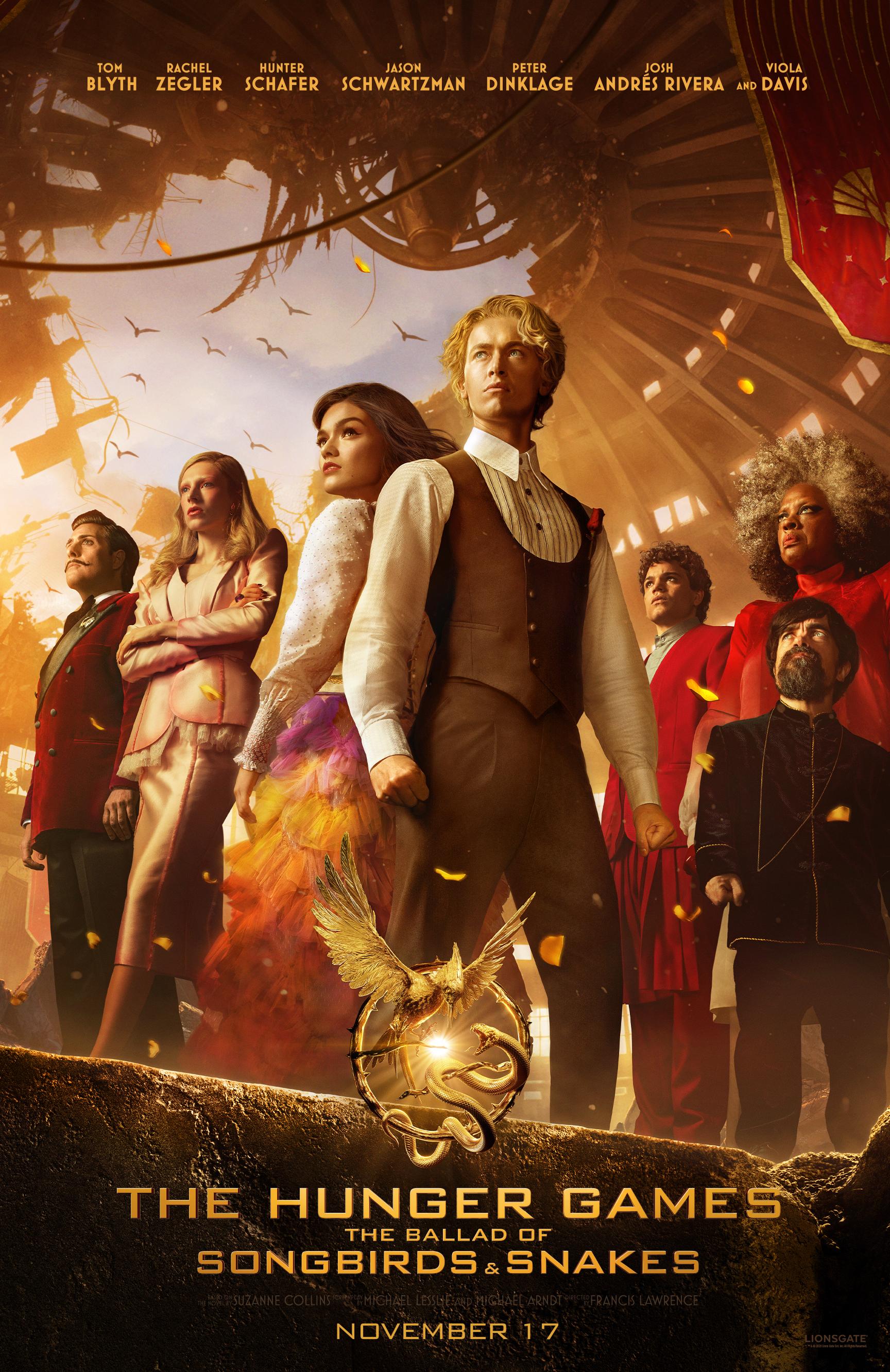
THE HUNGER GAMES: THE BALLAD OF SONGBIRDS & SNAKES movie review

Starts strong, ends off-key. Return to the gritty world of Panem in The Ballad of Songbirds & Snakes. What we have here is too much story crammed into a single movie, which results in poor pacing and forced character and plot development. Despite the uneven screenwriting, there is no doubt that you will be completely enthralled by Rachel Zegler’s (West Side Story) charismatic and courageous Lucy Gray! Moreover, you will also be charmed by her excellent chemistry with Tom Blyth’s (future President) Snow. But the performance that stands out the most is Viola Davis’ campy, delightfully ruthless Dr. Gaul (Game Maker)! In contrast to the struggling third act, the first two acts are well-written, but the third act desperately tries to keep your attention. Ultimately, there is enough material both presented and hinted at, in the film, to support two or even three films. Perhaps audiences were hungry for more Panem, but this movie leaves audiences feeling overstuffed, with little room to breathe and digest the story.

Years before he becomes the tyrannical president of Panem, 18-year-old Coriolanus Snow remains the last hope for his fading lineage. With the 10th annual Hunger Games fast approaching, the young Snow becomes alarmed when he’s assigned to mentor Lucy Gray Baird from District 12. Uniting their instincts for showmanship and political savvy, they race against time to ultimately reveal who’s a songbird and who’s a snake.

Come for the event-like movie, but stay for Davis’ and Zegler’s performances. I don’t know if Zegler’s Lucy Gray felt like she came from District 12 or not, but her command of the character is fantastic! And how could Zegler be cast in the Hunger Games and not take advantage of her beautiful voice? If she ever wants to switch careers or add to her entertainer resume, she can add country singer to it, because her country singing should be opening for the likes of Dolly, Reba, or Shania. I am confident that she could own that country stage for an entire set, and audiences would be ecstatic! Beyond the singing, her Lucy Gray feels human. And by that, I mean both strong and vulnerable, with deep convictions for how she treats others. While many will be drawn to her character’s confidence and independence, I am drawn more to her flaws and vulnerabilities, because it is that with which we struggle that makes us most human.

Viola Davis’ Dr. Gaul steals every scene in which she appears. I cannot think of this role belonging to any other actor after witnessing her bring this sinister character to life. I know nothing of this character from the book, as I have not read it, but it feels like a role that was written for Davis. Even though there is a significant element of camp in her performance and physical appearance, she isn’t always over the top–in fact–there is a great deal of emotive nuance to her character. And that’s in part of what makes her character great–she strikes a perfect balance between camp and playing it straight. As diabolical as President Snow is in the original trilogy, her character is far more terrifying and dangerously sly. She doesn’t simply enjoy the Hunger Games, she is the Hunger Games. Suffice it to say, she slays with this role, and the film benefits greatly from her immense screen presence.

Not to be overlooked, Blyth’s Coriolanus Snow is a complex character, with whom the audience will empathize. Granted, the character isn’t quite as likable as he should have been, to achieve the full effect of the struggle of empathizing with him now with the foreknowledge of whom he becomes, but he does connect with the audience. Blyth’s performance is mildly uneven, but not so much so that it isn’t sufficiently compelling. It’s really in the third act that the performance is hit or miss, but that blame is partly laid upon the poor screenwriting in the last act. When he is on screen with Zegler or Davis, his performances shines best. The chemistry he shows with Zegler is solid, as is his interactions with his closest friend.

Since we are familiar with the games from the original trilogy, this movie is more of a character study and origin story for future President Snow than it is about the history of the games. After the prologue, which takes place one year before the first Hunger Games, the rest of the movie takes place during the tenth anniversary of the games. Ever since Disney’s Maleficent, there has been a trend to give villains origin stories so we can understand why they are how they are. And I am on the fence about this, as I believe that some people are born predisposed to sociopathy or psychopathy; and some system is not to blame, but rather it is a heart and mind struggle within that individual. But I digress. It is established that Snow comes from a once proud, well-to-do Capital family, but in the wake of his General father’s death, the family struggles to keep their house and food on the table. Coriolanus Snow struggles with needing to provide a future for his cousin and grandmother, but not lose his humanity in the process. Unfortunately, we’ve seen the original trilogy, so we know what happens. Lucy Gray and Dr. Gaul may steal steal the scene, but no mistaking it, this story is about the emotional and psychological development of future President Snow.

And I’d be remiss not to mention that it was a treat to see that Peter Dinklage still “drinks and knows things” (for my fellow Game of Thrones fans).

If you’re interested in returning to Panem, definitely catch The Hunger Games: the Ballad of Songbirds & Snakes on the big screen. I saw it in Dolby Cinema at the screening. As I honestly, could take or leave the exhausting YA genre, I do feel there could be another movie or two in this Hunger Games saga. I’d like to see more of Dr. Gaul and future President Snow.
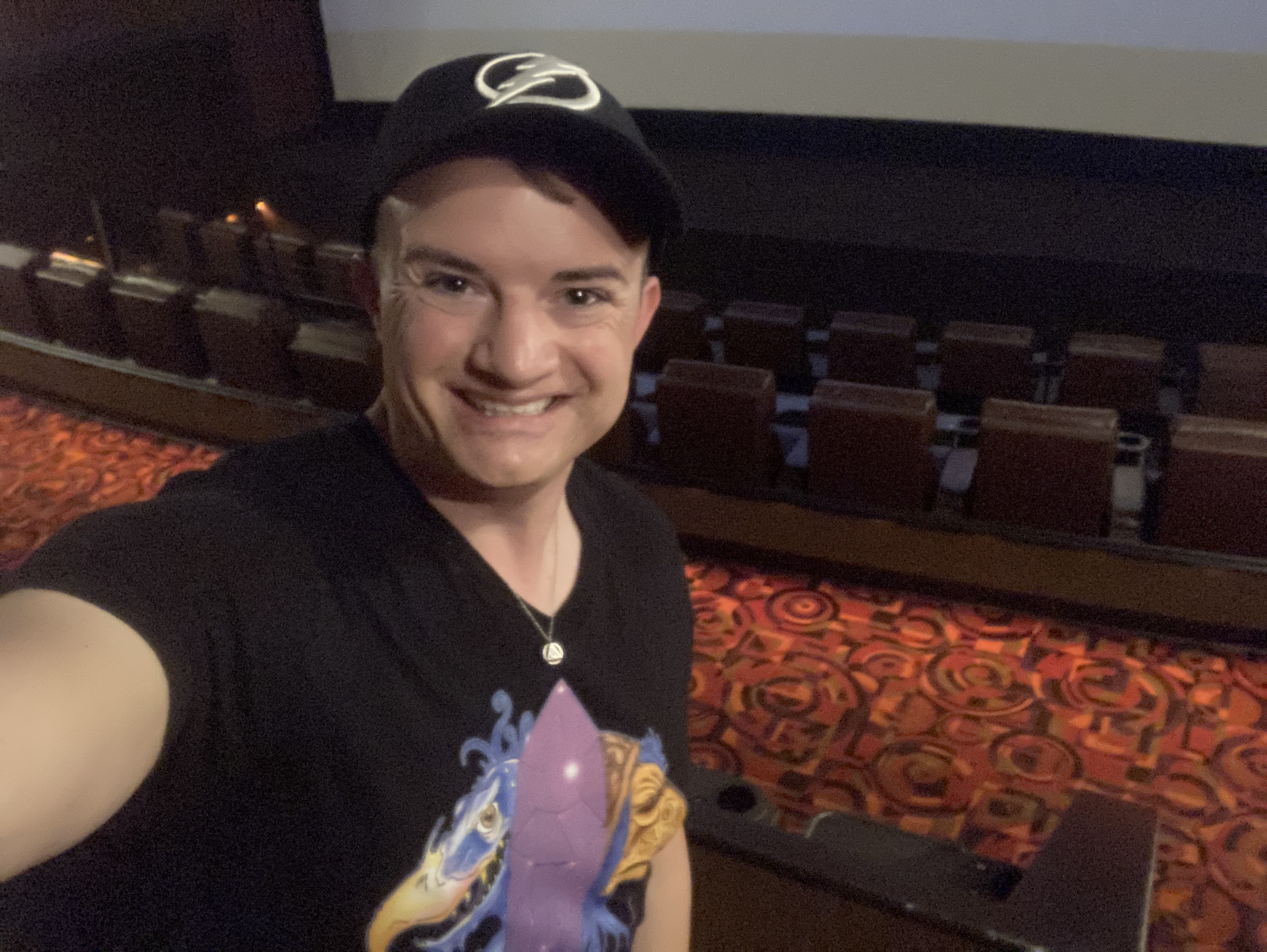
Ryan teaches Film Studies and Screenwriting at the University of Tampa and is a member of the Critics Association of Central Florida and Indie Film Critics of America. If you like this article, check out the others and FOLLOW this blog! Interested in Ryan making a guest appearance on your podcast or contributing to your website? Send him a DM on Twitter. If you’re ever in Tampa or Orlando, feel free to catch a movie with him.

Follow him on Twitter: RLTerry1 and LetterBoxd: RLTerry

SHAZAM! FURY OF THE GODS movie review

Sufficiently entertaining. SHAZAM! Fury of the Gods starts and ends well, but the middle wanders aimlessly with the only goal to inflate runtime. After the explosive first act, the second act mostly serves as filler material to augment the narrative by making it about twenty to thirty minutes longer than it needed to be. Fortunately, the third act delivers a climatic showdown, which greatly aids in the audience experience. But the movie struggles narratively between the inciting incident (at the beginning) and the showdown at the end. Clearly, there was a good superhero movie in there, but it gets lost during the meandering developmental stage. To the movie’s credit, though, it’s the enthusiastic cast that ultimately saves the audience from complete disengagement. This is especially true with Helen Mirren and Lucy Liu, playing our villains, and Jack Dylan Grazer in his well-played comedic relief. While it’s not terribly memorable superhero movie, neither is it a bad movie.

Bestowed with the powers of the gods, Billy Batson and his fellow foster kids are still learning how to juggle teenage life with their adult superhero alter egos. When a vengeful trio of ancient gods arrives on Earth in search of the magic stolen from them long ago, Shazam and his allies get thrust into a battle for their superpowers, their lives, and the fate of the world.

If you have not seen the trailer, DON’T. While I have not seen the trailer myself, I’ve read that the BIG cameo at the end of the movie is spoiled. So, do yourself a favor and do NOT watch the trailer. As I stated in the beginning, it is sufficiently entertaining; moreover, I honestly enjoyed myself more than I thought I would for a movie aimed at kids and young teens. When I say aimed at kids and young teens, I do not use that as a pejorative or as a tool to belittle the movie. In fact, I am glad to see that there is a superhero movie that is aimed at kids. Seems like the majority of superhero movies nowadays are inappropriate for developing minds. It pleases me that we have a movie here that is suitable for the whole family.

Ryan teaches Film Studies and Screenwriting at the University of Tampa and is a member of the Critics Association of Central Florida and Indie Film Critics of America. If you like this article, check out the others and FOLLOW this blog! Interested in Ryan making a guest appearance on your podcast or contributing to your website? Send him a DM on Twitter. If you’re ever in Tampa or Orlando, feel free to catch a movie with him.

Follow him on Twitter: RLTerry1 and LetterBoxd: RLTerry

WEST SIDE STORY (2021) movie musical review

Excels in technical achievement, staging, and casting; in fact it will transport you to the glory days of the movie musical. Did the Academy Award-winning West Side Story (1961) need a 2021 update? That is the question at the forefront of many minds going into this update to the adaptation. And in terms of the visible mise-en-scene, Spielberg delivers an outstanding update to the original big screen adaptation. From the cinematography to the editing to the choreography, it certainly displays the soul of the original adaptation–all the way down to the film grain that gives it a classical aesthetic. But the full transformative potential of the timeless story suffocates under the theoretical identity politics of Spielberg’s Woke Side Story. While the plot and story remain largely unchanged, there is an attempt to integrate theoretical contemporary social politics, derived from applied postmodernism, into the motivations of the characters. Gone is the theme of mutually assured self-destruction through (in the case of West Side Story) gang violence, in exchange for themes rooted in critical cynical theories that, counterintuitively, ultimately harm everyone on screen and in real life.

Love at first sight strikes when young Tony (Elgort) spots Maria (Zegler) at a high school dance in 1957 New York City. Their burgeoning romance helps to fuel the fire between the warring Jets and Sharks — two rival gangs vying for control of the streets.

While the original film has long-since been criticized negatively (and fairly so) for many of the casting choices and the use of brown face, Spielberg’s film rights the insensitivities of the past in his casting choices that are far more true to the original characters. Perhaps Ansel Elgort’s Tony isn’t particularly memorable, but audiences will be completely elated by Rachel Zegler’s Maria! Her voice and screen presence will capture your imagination! Furthermore, audiences will love seeing the great Rita Moreno (Anita from the 1961 version) on screen as the shoppe keeper and Tony’s mentor. And to top it all off, Moreno is given the honor of singing the titular song Somewhere.

Since the story and plot are largely unchanged, I won’t spend any time analyzing the bones of this iteration of Romeo and Juliet. Personally, I find West Side Story to be the best expression of Shakespeare’s greatest romantic tragedy. When the original stage (quickly turned film) production was released, it was a critique on gang violence and race relations at the time, and to a lesser extent, there was a critique on gentrification as well. And on the surface, that is still in the 2021 adaptation. But the power dynamic between the Jets and Sharks changed from the original. Whereas originally both groups were equal contributors to the gang violence, each despising the other; in this version, it is the Jets that receive the dominant share of the antagonism and prejudice, with the Sharks in a mostly defensive position.

In the mid-20th century, the problems with acceptance of others that deviated from the homogenous world in which one was reared were more organic and needed to be dealt with before mutually assured destruction befell everyone; however, the vast majority of the presently visible evidence of prejudice between groups is manufactured by activist scholars who seek to make everything about “race, gender, and identity–and why this harms everyone” (from Cynical Theories). This update of West Side Story was a golden opportunity to show the world that we aren’t that different from one another, and should work cooperatively in order to avoid violence and death due to perceived existential threats. Instead, this film has the opposite effect of continuing to point blame, theorize, and perpetuate “social diseases” (to quote the film).

This nuanced shift hinders the critique on racial/ethnic prejudice because it perpetuates the contrived cynical theory that white members of society are mostly to blame for the problems in the streets. Instead of the timeless story tackling the root of the problem, which is ultimately a heart issue in everyone, it places most of the blame on the Jets and everything they are shown to represent.

As you may have heard, the Spanish is not subtitled in this adaptation. And many have praised Spielberg for this decision; however, if you do not speak Spanish, you will be unable to fully understand some of the dialogue. Yes, there are context clues that will aid in deciphering what the characters are saying, but there are plenty of times that non-Spanish-speaking audiences will be unable to know what’s being said and how/why it’s important. In the press conference for this film, Spielberg said, “it was out of respect that we didn’t subtitle any of the Spanish. That language had to exist in equal proportions alongside the English with no help.” He goes on to cite that 19% of the US population reports being hispanic. Furthermore, screenwriter Tony Kushner added at the conference, “We’re a bilingual country,” and in reply Spielberg stated, “We sure are.” It doesn’t take a scholar to see through the virtue signaling to this decision being problematic for the film. (1) the US is not mostly bilingual (2) not everyone takes Spanish in high school or college (3) why would you want more than half the audience to not be able to understand dialogue in the film? (4) are we just going to stereotype and assume that the entirety of the hispanic population is fluent in Spanish??? and (5) it carries with it the notion that if you do not speak Spanish, you are the problem. Subtitling the Spanish would not have detracted by the film; on the contrary, it would have allowed for a greater use of the language by the Puerto Ricans in the film.

I want to end on some positive notes, because there is much to like about the aesthetic of the film. From the first scene to the last, the framing, lighting, and character blocking are outstanding! There is a beautiful classical dimension to this film. I absolutely loved the how every visible or audible element of the mise-en-scene looked! There is a magic the look and feel fo classical musicals that is seldom witnessed today. The last film to find this balance between naturalistic and staged blocking and choreography was La La Land. There are moments in this film that you will feel that you are watching the original, and it’s not simply because there are shot-for-shot sequences, but the lighting, angels, and film grain give 2021’s West Side Story dimension.

Rachel Zegler is the perfect Maria! I love everything about her performance. It’s strong, yet vulnerable, and she is stunning in the trademark white dress with red belt. The naturalism she brings to this character is outstanding. There isn’t one minute that goes by that you doubt she was born to play Maria. And her voice! Her voice is crystal clear and mesmerizing. It was also a real treat to get to see Rita Moreno return to West Wise Story 60 years later. While she may be in a different role (Valentina), she still commands the screen. Spielberg and Kushner deciding to give the titular song Somewhere to Valentina was the best decision in the whole film. It packed a power that it lacks in the placement in the stage and original film versions. While Elgort showed us that he can sing (when given the right song, which is not the case with his first number), but he is ultimately upstaged by Mike Faist who plays Riff.

Ryan teaches American and World Cinema at the University of Tampa. If you like this article, check out the others and FOLLOW this blog! Interested in Ryan making a guest appearance on your podcast or contributing to your website? Send him a DM on Twitter or email him at RLTerry1@gmail.com! If you’re ever in Tampa or Orlando, feel free to catch a movie with him.

Follow him on Twitter: RLTerry1