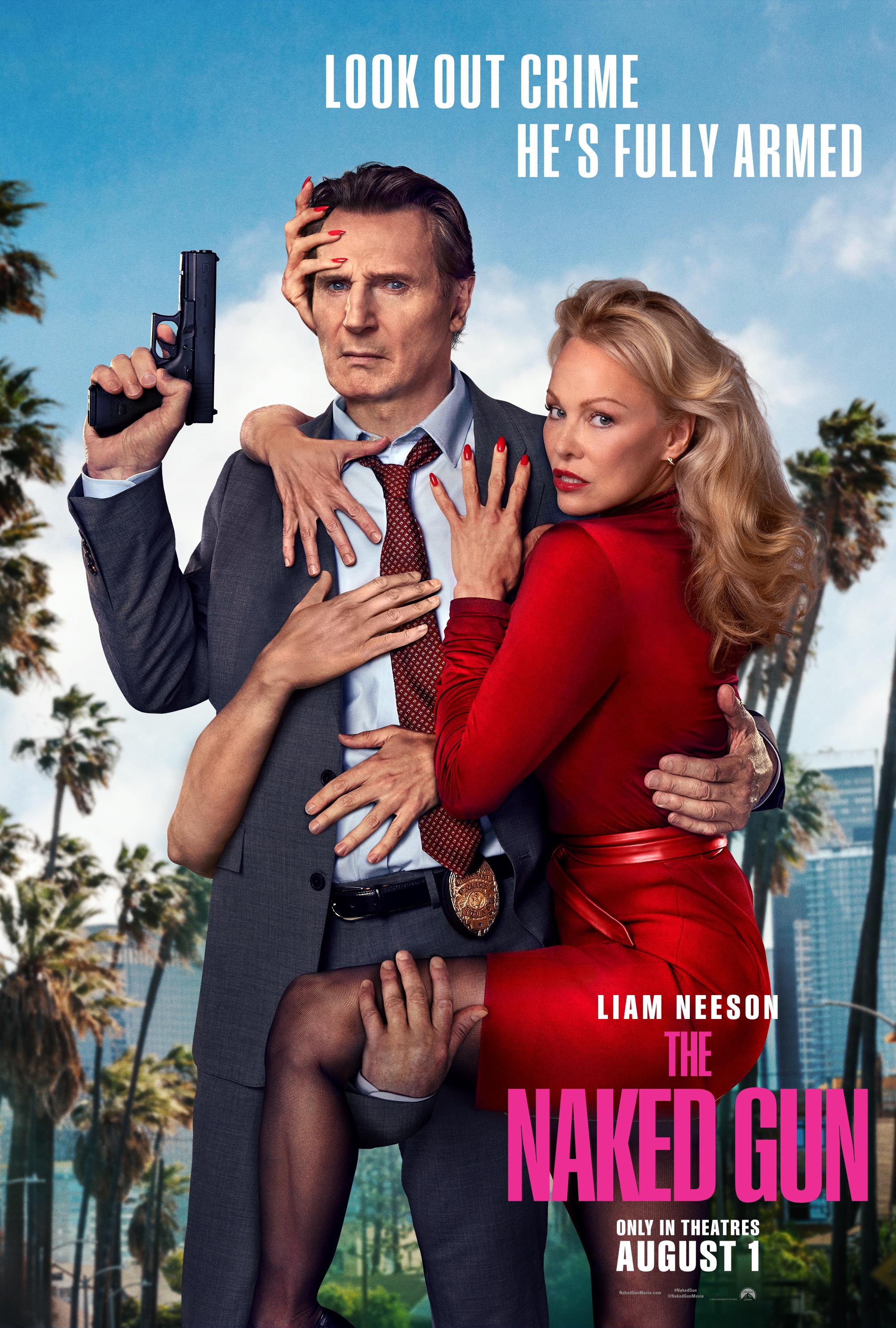
Best comedy since SPY! The Naked Gun (2025) is a spectacular noir/detective-comedy that has it all: smart screenplay, sensational cast, and it clocks-in at just under 1.5hrs. This reboot/reimagining of the beloved classic tiptoes along a treacherous tightrope: how to honor a slapstick legacy while avoiding the hollow echo chamber of recycled gags. Remarkably, thanks to a razor-sharp script, a fully committed cast, and a surprisingly fresh narrative, it pulls it off with chutzpah and precision. Directed by Akiva Schaffer, The Naked Gun is a masterclass in tonal balance, threading the needle between absurdity and plot progression, all while leaving room for character beats that land harder than a collapsing filing cabinet. Every setup pays off, every non sequitur doubles as a stealth punchline, and, most critically, the story and characters matter.
At the center of the madness is Liam Neeson, weaponizing his deadpan gravitas in a way that would make Leslie Nielsen nod in approval from the great beyond. As Frank Drebin Jr., he’s not playing his father’s shadow—he’s illuminating a new one. His comedic chops are precision-engineered. Neeson doesn’t mug for the camera or chase punchlines; he commits, deadpanning his way through verbal landmines, visual gags, and escalating mayhem with the kind of straight-faced sincerity that made Leslie Nielsen legendary. The secret ingredient to his delivery? His restraint. Marrying glamour and goofiness is Pamela Anderson, fresh off her outstanding performance in The Last Showgirl. Her tone, cool gaze, and knowing glances lend a classic noir energy to the role, but it’s her self-awareness and comic precision that elevate the performance. She glides through scenes with old-Hollywood poise in the vein of Lauren Macall, only to puncture the atmosphere with a well-timed double entendre or whip-smart aside.
In a cinematic landscape where many reboots are content to wink at the audience and roll credits, The Naked Gun dares to be funny—consistently, inventively, and unapologetically so. It doesn’t just recapture the soul of the original; it gives it a new pair of shoes and sends it running headfirst into traffic. And you’ll be laughing all the way.
Ryan is the general manager for 90.7 WKGC Public Media in Panama City and host of the public radio show ReelTalk “where you can join the cinematic conversations frame by frame each week.” Additionally, he is the author of the upcoming film studies book titled Monsters, Madness, and Mayhem: Why People Love Horror. After teaching film studies for over eight years at the University of Tampa, he transitioned from the classroom to public media. He is a member of the Critics Association of Central Florida and Indie Film Critics of America. If you like this article, check out the others and FOLLOW this blog! Follow him on Twitter: RLTerry1 and LetterBoxd: RLTerry
Anderson dazzles in spite of lackluster screenplay. Pamela Anderson’s captivating performance in The Last Showgirl is truly compelling. Gia Coppola’s film may lack strong, cohesive plotting, but serves as a fantastic character study that remains with you long after you leave the theatre. This is particularly true for anyone that has ever worked in live entertainment or felt left behind due to being perceived as irrelevant or outdated due to changing times and shifting audience taste. This film unapologetically explores universal fears and anxieties associated with change, relevance, and identity. It’s only flaw, which is a biggie, is that I wish the screenplay had been a better vessel for the performative dimension to showcase the talent and passion on screen.
Written by Kate Gersten, the film follows iconic Vegas showgirl Shelly (Pamela Anderson) after her legendary Las Vegas showgirl spectacular is coming to an abrupt end after more than thirty years. Now, she much grapple with the uncertainty of her future because of the extinction of the Vegas showgirl shows.
The Vegas showgirl used to be an institution, but unfortunately shifts in audience taste have all but made the iconic showgirl an obsolete fixture of live entertainment. The idea of the Vegas showgirl in all her sequined and feathered glory is still alive, but that’s all it is anymore–an idea that exists only in our collective memories of a bygone era. Anderson’s performance is particularly compelling because of her effortless ability to oscillate between vulnerability and strength without the end result ever feeling fabricated or unrelatable. In retrospect, I cannot think of a better actor to have brought this character to life than Pamela Anderson, because a signifiant portion of the gravitas she is able to bring to the character is inspired by channeling the energy of her own past glory days, which she infuses into each step and gesture. Anderson’s charisma shines in the scenes where the character performs, even if only in the solitude of her own living room. Delivering a gritty, raw honesty to the role, the former Baywatch megastar relinquishes glamor in exchange for authenticity in a role that feels achingly real and profoundly human.
Shelly represents all those that have worked on stage in live entertainment, whether that is in a theatre or at a theme park. While the focus is on the stage talent, many of the ideas that the film posits can be connected to work backstage as well, as entertainment changes. Shelly is not only haunted by the loss of relevance, but also by the deeper, existential terror of becoming invisible–something we all fear. As such, Anderson’s character connects to us on both a personal level and to society at large. Whether on the Vegas stage, at the cinema, on the television, or even at the theme park (looking at you, Universal Orlando), this film comments on the broader idea of how cultural shifts in audience tastes can be destructive to dreams, experiences, and careers.
Coppola’s film delves provides audiences a candid portrait of a former starlet from the golden age of Vegas entertainment, now struggling to find her way in an unfamiliar world that is all but alien to her. What Shelly is going through is not unlike what some (if not many) of us go through–or fear we will go through during the course of our professional careers or interests. While the film takes place in Vegas, many parallels can be drawn to changes in cinema, theme parks, and television. As shown in the film, the Vegas audience of today has drifted away from the opulent, theatrical traditions that were a staple of Las Vegas toward minimalism, concerts, and new media. And while there is nothing innately damaging about any of those, collectively they rendered the classic Vegas experience obsolete. The audience Shelly once captivated, no longer values or finds enjoyment in that which she represents.
I recently learned this when I found that I will be attending the NAB convention in Las Vegas. And the first thing I did was look to find a classic Vegas showgirl show–like from Show Girls. Didn’t take long to learn that those shows do not exist anymore. So, this film was all the more relevant and even poignant because Shelly represents something that I had hoped to experience, but can only find in, as I gather, Vegas: the Show and films and television from decades past. I was saddened, really. To think that something that was a Vegas mainstay for decades, inspiring movies, songs, and playing a signifiant role in the whole Rat Pack aesthetic, was just a faded memory. Originality was exchanged for an extension of what you could find on Broadway or a concert venue near you.
Something else that hit me was how Shelly and events of the film prompted me to think about my own career and professional aspirations, because the Hollywood that I fell in love with as a kid is nearly a distant memory. Just like the Universal Studios Florida that I fell in love with as a kid no longer exists except for the Horror Makeup Show and the E.T. Adventure. Sitcoms and non-serialized drama and horror programs are nearly an entertainment medium of television past and the slasher film has largely fallen out of favor with mainstream audiences. Even film criticism–it’s no longer about applying a critical lens to motion picture arts and sciences; rather, it’s now about your means of garnering attention on YouTube or Instagram matters more than what you have to say. Even blogging has nearly become a thing of the past. Scary to think that you can become obsolete in the very field in which you’ve worked do diligently, smartly, and hard.
Through this character study film, we learn that there is a quiet, enduring value in the traditions and artistry Shelly represents, even in an age of social media influencer, superficial trends, and fleeting attention spans. Perhaps we are drawn to films like this because, for example, the Vegas showgirl is truly timeless. Maybe she isn’t on the stage any longer, and the last remnants of French Lido culture are extinct except for Moulin Rouge in Paris and (in a manner of speaking) the Rockettes at Radio City Music Hall, but her legacy will live on, if only in our memories.
I highly recommend watching this film if you enjoy compelling character studies. I wish it was more than a character study, but that’s no fault of the actors or director. The weakness in the storytelling of this film is found in the vapid screenwriting and lack of following proper screenwriting mechanics that require, at minimum, a well-defined central character with a well-defined external goal opposed by a well-defined character of opposition.
Ryan is the general manager for 90.7 WKGC Public Media in Panama City and host of the public radio show ReelTalk about all things cinema. Additionally, he is the author of the upcoming film studies book titled Monsters, Madness, and Mayhem: Why People Love Horror. After teaching film studies for over eight years at the University of Tampa, he transitioned from the classroom to public media. He is a member of the Critics Association of Central Florida and Indie Film Critics of America. If you like this article, check out the others and FOLLOW this blog! Follow him on Twitter: RLTerry1 and LetterBoxd: RLTerry


 R.L. Terry ReelView