
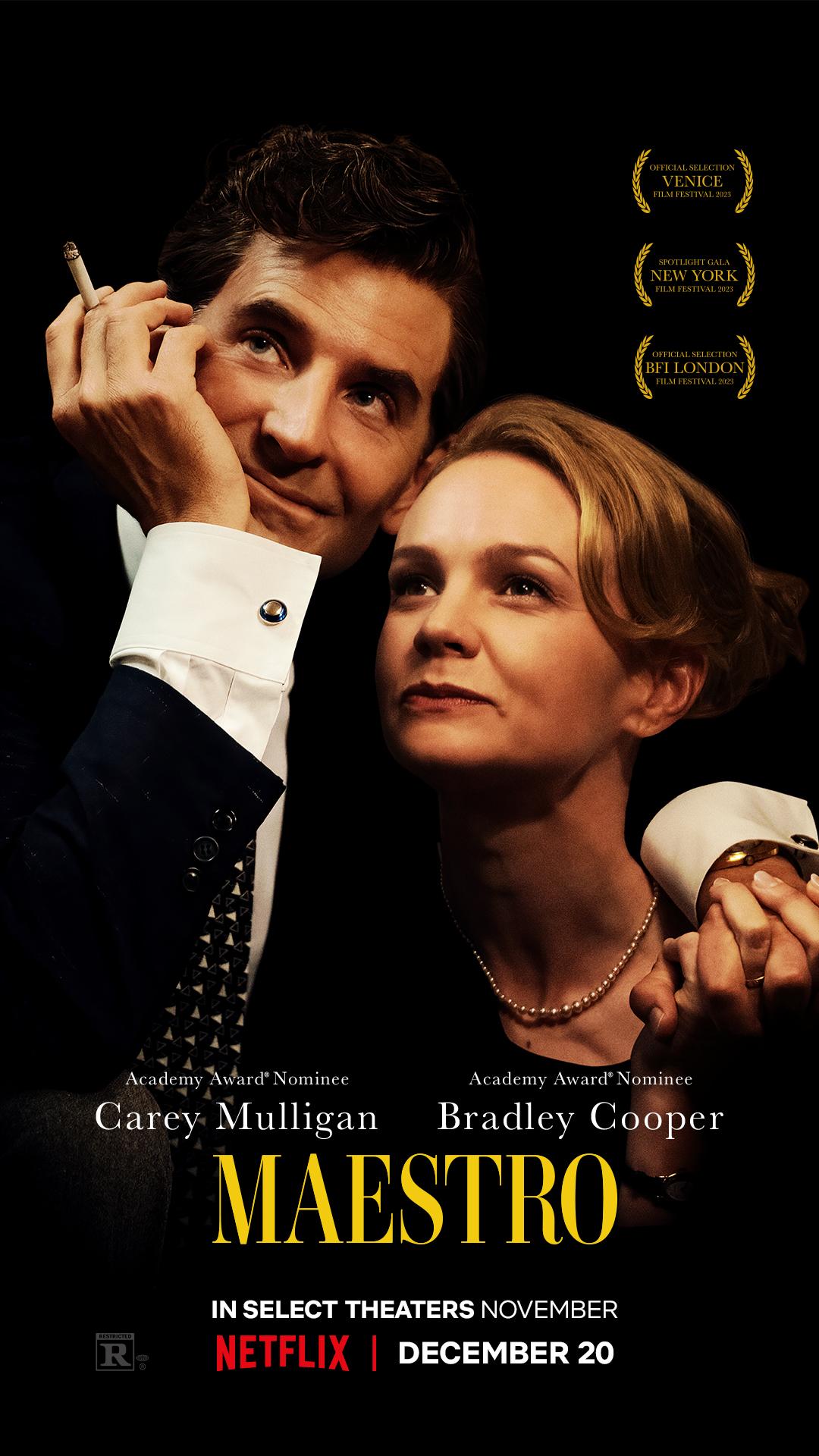
MAESTRO film review

Maestro‘s reach exceeds its grasp. Bradley Cooper’s biopic on Leonard Bernstein is an exemplary motion picture in many respects, but ultimately its potential for excellence is hampered by a disjointed screenplay. The performative dimension of the film is impressive, as is the emotive apparatus of the film itself. Furthermore, Cooper’s talent for the director’s chair is witnessed beautifully in most areas of the film except for the storytelling mechanics–not the story itself–but rather how the story is told. Another example of the dangers of being both writer and director (and in this case producer too). Most films need the checks and balances that come from having a different individual at the helm of writing, directing, and producing. If most of what you know of Bernstein’s legendary career comes from West Side Story, then you should read up on his accomplishments prior to watching the film, as it feels very inside baseball. There is a great story in this film, but the screenwriting mechanics hold it back from being truly outstanding.

Maestro tells the complex love story of Leonard and Felicia, a story that spans over 30 years-from the time they met in 1946 at a party and continuing through two engagements. It also chronicles the prolific and influential career of one of the greatest composers and conductors in American history.

The most striking dimension of the film is the apparatus of the film itself, the mechanics employed to visually craft the method of telling this story. The film starts in then-present day with an on-camera interview in color and widescreen, then as the film jumps back to the 1940s, it changes to a 4:3 ratio and is in grayscale (with a blue tint). As the story unfolds, the film transitions from 4:3 grayscale to 4:3 color to eventually 16:9 (if you will) color. To the casual observer, this was to signify time jumps alone–and to stop there would be limiting the art and affects of this tool. More than signifying chronology, it was used to spotlight the emotive dimension of the film as it evolves (or devolves, depending on how you look at it) from an old Hollywood conventional romance to post-modern subversive romance.

Bernstein goes from being in love with people to being in love with his music, but always in need of muses and people around him. He was almost never alone–he was scared of being alone. The irony in that is he simultaneously brought people together with his music but drove them away because his first love was his music. Beyond the montage of the film, this emotive apparatus incudes a complete score by Bernstein, and the inclusion of Bernstein’s music to accompany audiences along this journey was a brilliant choice to increase the intimacy of the story for audiences both familiar and unfamiliar with his library of compositions. Cooper’s use of a cinematic storytelling apparatus such as this, elevated mere storytelling montage for cause/effect chronology to that which communicates emotion and introspection.

Both Bradley Cooper and Carey Mulligan shine in their respective roles; moreover, Mulligan’s Felicia Montealegre-Bernstein is truly the heart and soul of this film. Not mere impersonations, both Cooper and Mulligan completely transform into the real-life characters they are portraying. The performances were so incredibly intimate and personal that the authenticity leaped off the screen. When they hurt, we hurt, and when they were joyous, we were joyous. While Leonard is the title role, the character with whom most in the audience will identify is Felicia. She is the conduit through which we experience most of this biopic. Furthermore, she is the character that feel the most human, because Leonard’s level of talent was so out-of-the-world that it is hard to connect with him to the same degree most in the audience connect with the unconventional romance of Felicia and Leonard.

On a more personal note, I found myself connecting with Leonard the most because there is a line from Bernstein in the movie that goes something to the effect of (and I am paraphrasing) “I am so many things, but society only wants me to be one thing. I cannot be that one thing because I am all these things, and to not be any one of them would be to deny who I am.” Despite the fact I feel that Cooper is as much a screenwriter as Sorkin is a director, this line is representative of the central theme in the film and one with which I identify greatly. For I too am so many things, but society wants me to pick (and be successful) at just one of them, but I cannot because I am all these things. I am a professor, academic writer, event planner, film critic, and public speaker. For me to not do any one of these things would be to deny who I am. On that level, this film felt incredibly personal.

With all these wonderful elements going for this motion picture, the film’s reach exceeds its grasp due to the disjointed screenwriting. I’ve said it before, and I will say it again, most directors are not screenwriters (and the inverse is also true). Very few writer-directors can do both jobs equally well. If for no other reason, a film built upon a writer-director lacks sufficient checks and balances to ensure the narrative mechanics are adequate for translating a story from the mind of a screenwriter to the screen of a director. And this is where I draw the inside baseball analogy I mentioned earlier. The full potential of this film requires audiences to be knowledgable in the career of Bernstein beyond West Side Story and Our Town.

The screenplay fails to start on common ground before its deep dive into the career and romances of Bernstein. For example, unless you are a student of music, it is doubtful that you were aware of his work outside of West Side Story and Our Town. Therefore, since that is most people, the screenplay should have established a common connection between Bernstein’s work and general audience members early on in the film. Then, once common ground was established, take audiences on the journey through his personal and professional life. His contributions to Broadway are little more than one-off mentions during the film. The pacing of the story also plagues the film as it provides few, if any, transitional scenes and simply jumps from time period to time period. The stylized editing and cinematography mentioned earlier in the review help to communicate chronology, but there is more to telling a biographical story than time and place.

Alfred Hitchcock stated to start every scene in a film as close to the end of the scene as possible and end the scene as soon as possible all while ensuring that something dramatic happens at the end of the scene (in screenwriting terms a button) that sets up the proceeding scene. Nothing should happen in scene B that wasn’t setup in scene A and every scene should in some way point to the end of the film. It is basic screenwriting conventions that are ignored in hopes that the stylistic apparatus and performative dimensions of the film will make up for the lack of care in the how the story is being told. Screenwriting is more than a narrative to be delivered on the silver screen, it’s more than dramatize don’t tell, it’s all of that plus how story is being told even before the first shot is filmed. Screenwriting mechanics (inclusive of conventions and guidelines) are important because they work.

Bradley Cooper’s Maestro is a beautiful-looking motion picture that attempts to capture the gravitas of the professional and personal life of one of the greatest composers and conductors in American history. While it’s no Amadeus or Mr. Holland’s Opus, it is a solid film that students and fans of his career will thoroughly enjoy. For those that may only know him from his contributions to Broadway, the film will still be interesting enough, but may not be as impactful without more in-depth knowledge of his career and life.
Ryan teaches Film Studies and Screenwriting at the University of Tampa and is a member of the Critics Association of Central Florida and Indie Film Critics of America. If you like this article, check out the others and FOLLOW this blog! Interested in Ryan making a guest appearance on your podcast or contributing to your website? Send him a DM on Twitter. If you’re ever in Tampa or Orlando, feel free to catch a movie with him.

Follow him on Twitter: RLTerry1 and LetterBoxd: RLTerry

THE KILLER (2023) movie mini-review

The sleeper. David Fincher’s The Killer is lethargic and uninteresting. It’s an uninspired and predictable deconstruction of a hitman that is self-indulgent, lacking any concern for the audience experience.

After a fateful near-miss, an assassin battles his employers, and himself, on an international manhunt he insists isn’t personal.

From the opening credits that are reminiscent of a 1990s movie-of-the-week (MOW) to the exhaustive voiceover narration from beginning to end, this is one movie that you neither want to see in cinemas nor allocate time for at home to watch on Netflix. I am reminded of Fox and FX’s Deliberate Intent (2000), which was a MOW about a first amendment scholar whom is recruited by an attorney to sue Paladin Press after a hit man commits a triple murder by allegedly following a its how-to manual titles Hitman. The deconstruction of the book and hitman contained therein was far more engaging than this sleep-inducing character study by Fincher. Seems hard to believe that a movie about a hitman could lack less dimension and interesting qualities than sheet of cardboard. I kept waiting for the first act to transition into the second, but it’s nearly two hours of a first act and a very rushed third. Anticlimactic best describes the conclusion to this sleep-inducing character study.

Ryan teaches Film Studies and Screenwriting at the University of Tampa and is a member of the Critics Association of Central Florida and Indie Film Critics of America. If you like this article, check out the others and FOLLOW this blog! Interested in Ryan making a guest appearance on your podcast or contributing to your website? Send him a DM on Twitter. If you’re ever in Tampa or Orlando, feel free to catch a movie with him.

Follow him on Twitter: RLTerry1 and LetterBoxd: RLTerry

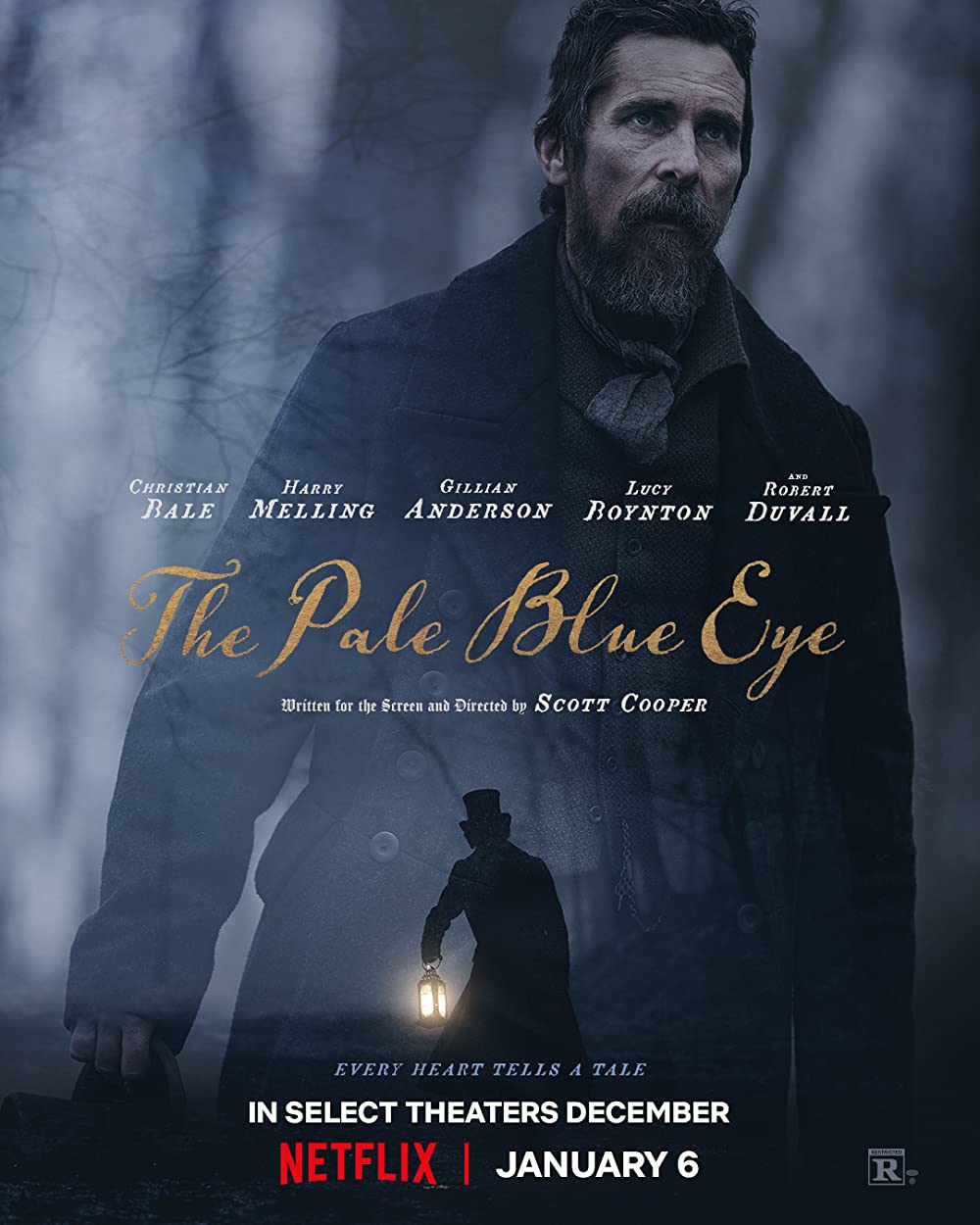
THE PALE BLUE EYE period mystery review

The unsettling atmosphere will transport, while the macabre mystery intrigues. Scott Cooper’s The Pale Blue Eye is both a period murder-mystery drama and serves as an imaginative origin story for Edgar Allan Poe. With skeletons in every character’s closet, the enigma of a mystery will beckon audiences to solve the mystery along with Christian Bale’s character. Based on the novel by the same name, the film adaptation is in the same vein as The Cursed from earlier this year and Antlers from last year. Both of which are among my favorites of the last two years. So, if you liked either of those films, you will mostly likely enjoy this one as well. In addition to the aforementioned, the film also reminds me a little of Tim Burton’s Sleepy Hollow (1999). Unlike the film’s to which I have likened this one, The Pale Blue Eye is heavier on mystery than it is horror. While Edgar Allan Poe’s short stories and poems have been the inspiration for hundreds of films, and his writing itself, foundational in the development of the American Horror Film (expressionism+surrealism+Freud+Poe), this is one of few films that feature Poe himself–or rather–a fictionalized version of the towering literary figure. What I appreciate about this imaginative origin story is showing a different side to Poe–a side that is actually funny and quirky. Because this is a mystery, I am unable to discuss details as that could spoil important plot points. But it’s important to note that this film’s mise-en-scene strikes a balance between one that is concerned with atmosphere and proper plotting. So often, films that are heavy on atmosphere are lacking in the story-structure department, but not this one. Despite the runtime of 2-hours, no scene ever lingers too long. If you enjoy period murder-mysteries, then you’ll undoubtedly enjoy this film. The Pale Blue Eye hits cinemas on December 23rd and Netflix on January 6th.

Ryan teaches Film Studies and Screenwriting at the University of Tampa and is a member of the Critics Association of Central Florida. If you like this article, check out the others and FOLLOW this blog! Interested in Ryan making a guest appearance on your podcast or contributing to your website? Send him a DM on Twitter. If you’re ever in Tampa or Orlando, feel free to catch a movie with him.
Follow him on Twitter: RLTerry1

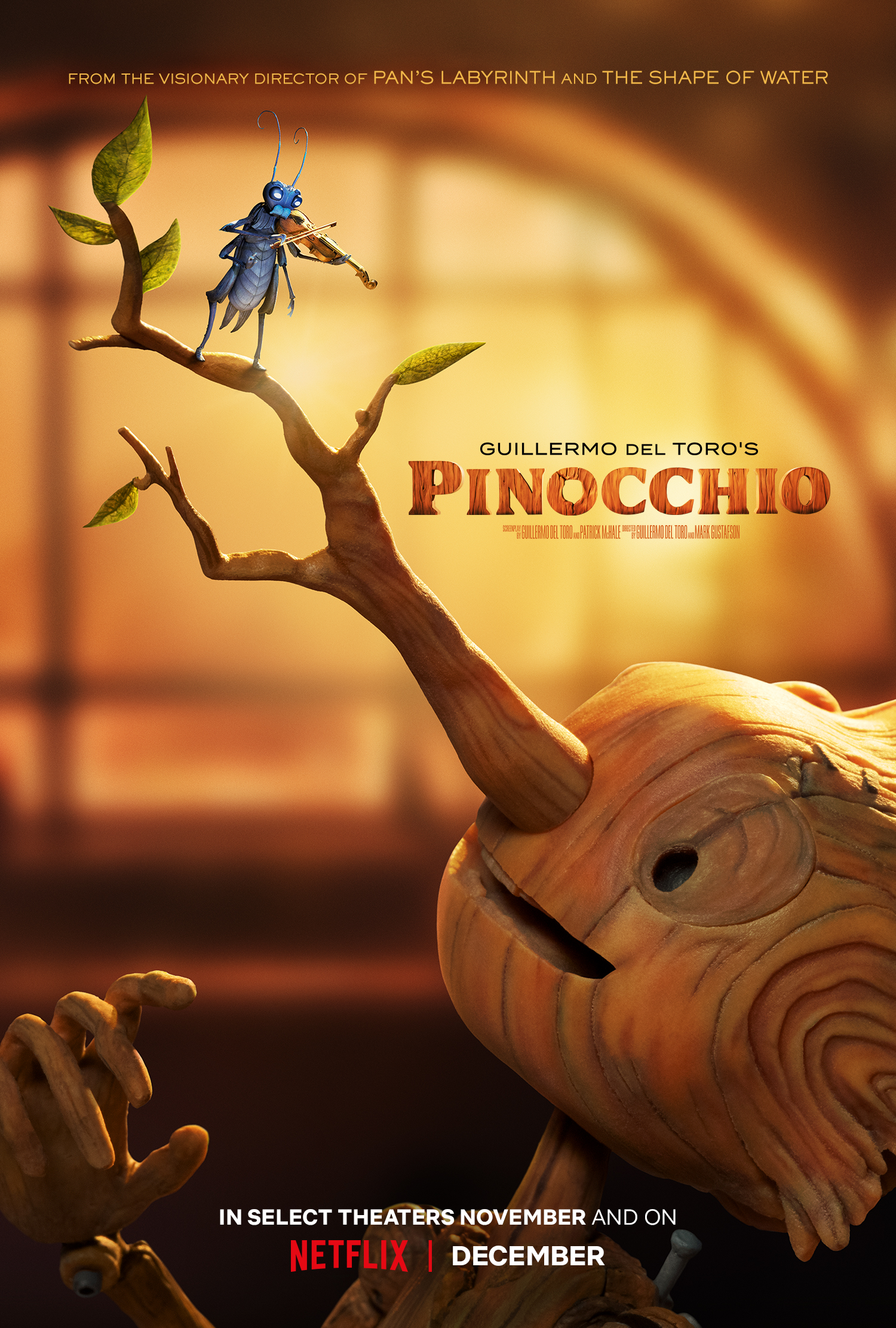
GUILLERMO DEL TORO’S PINOCCHIO motion picture review

Positively avant-garde! Easily among the best pictures of the year, period. Guillermo del Toro’s Pinocchio is a brilliant stop-motion picture that will stir the hearts and minds of any audience! In many ways it’s reminiscent of 80s dark fantasies such as The NeverEnding Story and The Dark Crystal. Which should come as no surprise that del Toro worked in collaboration with the Jim Henson Company. Audience will be completely transported to the post-World War I Italian world that del Toto meticulously recreates, complete with the fascist movement, which underscores much of the film. Not since Kubo and the Two Strings have we had such a gorgeous, imaginative animated feature film–a film that was robbed of its deserved and earned Beast Animated Film Oscar (no, Zootopia is in no universe a superior film). Let’s hope that the Mouse doesn’t rob Pinocchio of it’s well-deserved Academy Award for Best Animated Feature.

The story may seem familiar: A father’s wish magically brings a wooden boy to life in Italy, giving him a chance to care for the child. But you’ve never seen Pinocchio like this before!

Before you dismiss Del Toro’s Pinocchio as another soulless, cash-grab remake, this much more macabre version of the titular puppet’s story delivers immense depth and dimension. Not only of technical achievement, but of theme, plot, and character development. This animated film proves that animation isn’t only for kids, because this film is far more thoughtfully crafted than most live action films this ear. And yes, I agree with recent comments from Quintin Tarrantino that we are experiencing one of the worst eras of cinema in history. No doubt this is true. However, this year has seen some real winners such as Top Gun: Maverick and now Pinocchio. Suffice it to say, this is not your kid’s Pinocchio. And, although there are important life lessons in the film, it goes to places, both figuratively and literally, that may not be appropriate for kinds under 12 years of age. While Pinocchio is in its limited theatrical run, see it on the BIG screen!

While there are certainly plot beats which are shared by the original 19th century story, the 1940 Disney adaptation, the wretched Robert Zemeckis’ remake earlier this year, and countless stage adaptations (funnily enough, I saw the operetta Pinocchio this week as well), Guillermo del Toro’s Pinocchio takes on a life of its own. It isn’t often that the filmmaker added a possessive to the film title. Whereas it’s commonplace for Disney to add Disney’s… to literally everything, it’s uncommon for director’s or producers to add a possessive to the film’s title. Notable exceptions include Tim Burton’s Nightmare Before Christmas (directed by Henry Selick), Bram Stoker’s Dracula (directed by Francis Ford Coppola), and now Guillermo del Toro’s Pinocchio. This possessive form of title is often employed to signify (1) the filmmaker’s confidence in his or her work of motion picture art and (2) to separate it from all other versions of the same story (and/or title). Moreover, this often indicates to audiences that they are about to witness the work of a true auteur (not the case when we see Disney’s…–that’s just plain branding).

Is it del Toro’s arrogance or an ego trip that prompts such chutzpah in this film’s title? Not at all. Del Toro has been working on this passion project for over 15 years. Before you feel that’s an exaggeration, let the finished motion picture be the demonstrable evidence of meticulous work frame-by-frame in this nearly two-hour film. Images are most often captured at 25-frames-per-second, so to achieve the fluid motion del Toro has, you just do that math. Del Toro crafted intricate animation captured by a camera that is repeatedly started and stopped over the course of day, weeks, years. Each mouth, arm ear, eye, literally any object that has movement, is moves a little at a time, frame-by-frame. Not only does del Toro’s craftsmanship translate to beautiful, seamless movement by the characters and environment in the film, he successfully captures the visual and emotional miracles that can only be accomplished through stop motion animation. There’s a reason why we go back to the Rankin & Bass Christmas classics every year; there is immense simplicity and beauty in stop-motion animation. Why? Same reason why practical effects will always be superior to (overt) CGI effects–depth, dimension, the way real light bounces off objects and into the camera lens.

Even though the film is quite dark from the moment the atrocities of war are witnessed, it is not without its levity and uplifting scenes. To get into a central theme of the film involving stages of grief (which makes it unique compared to other iterations), would mean venturing too far into spoilers, which I would like to avoid, and with that theme, there are many scenes that force the audience to confront what many fear most. Because of this theme, one might think the film is somber most of of the time, and fortunately, this is not true. There are plenty of moments that break up the sadness to inject a healthy dose of laughter. And more often than not, we have Sebastian J. Cricket to thank for that! (I’m sure the “J” is a playful jab at Disney). DelToro’s sardonic, raconteur cricket always has the perfect witty remark or anecdote to provide insight into a given plot point or emotional beat. Because of Sebastian J. Cricket’s running commentary and moral/ethical guidance, the audience is willing to go on this emotional roller coaster. The moment of levity allow for an emotional and psychological reset to face the darker moments.

Outside of the imagery of the stages of grief, there are other fascinating areas of social commentary in the film as well. I love how del Toro moves the real boy imagery, how it’s traditionally interpreted: wood vs. flesh, to one that posits ideas of what it means to be a real man. These arguments are mostly seen in the Mussolini’s youth armies scenes. In the world of fascist Italy, to be a real man meant taking up the arms and creeds of Mussolini’s Italy to fight the allied forces. Pinocchio must decide what it means to be a real man. Another area that is interesting is the relationship between Geppetto and the village (Catholic) Church. While there may be various ways of interpreting this imagery and these scenes, which are bookends for the film, I feel it is best interpreted as Geppetto never compromising on his faith in God even though the Catholic Church, at that time in Italy, was being infiltrated by Mussolini’s fascist ideals (cleverly disguised to sway some in the faith community).

Lastly, we cannot talk about this film without highlighting the moving score and outstanding original songs. While Pinocchio is not a musical, it has several original songs that will move audiences! Not only does this film boast exquisite animation, but it delivers outstanding original music and lyrics as well. Audiences will find both diegetic and non-diegetic musical numbers in the film. This combination works incredibly well to wrap audiences in the mesmerizing story!

Even though Guillermo del Toro’s Pinocchio is coming to Netflix in December, look to see if it’s playing at theatre near you for the full experience!

Ryan teaches Film Studies and Screenwriting at the University of Tampa and is a member of the Critics Association of Central Florida. If you like this article, check out the others and FOLLOW this blog! Interested in Ryan making a guest appearance on your podcast or contributing to your website? Send him a DM on Twitter. If you’re ever in Tampa or Orlando, feel free to catch a movie with him.
Follow him on Twitter: RLTerry1

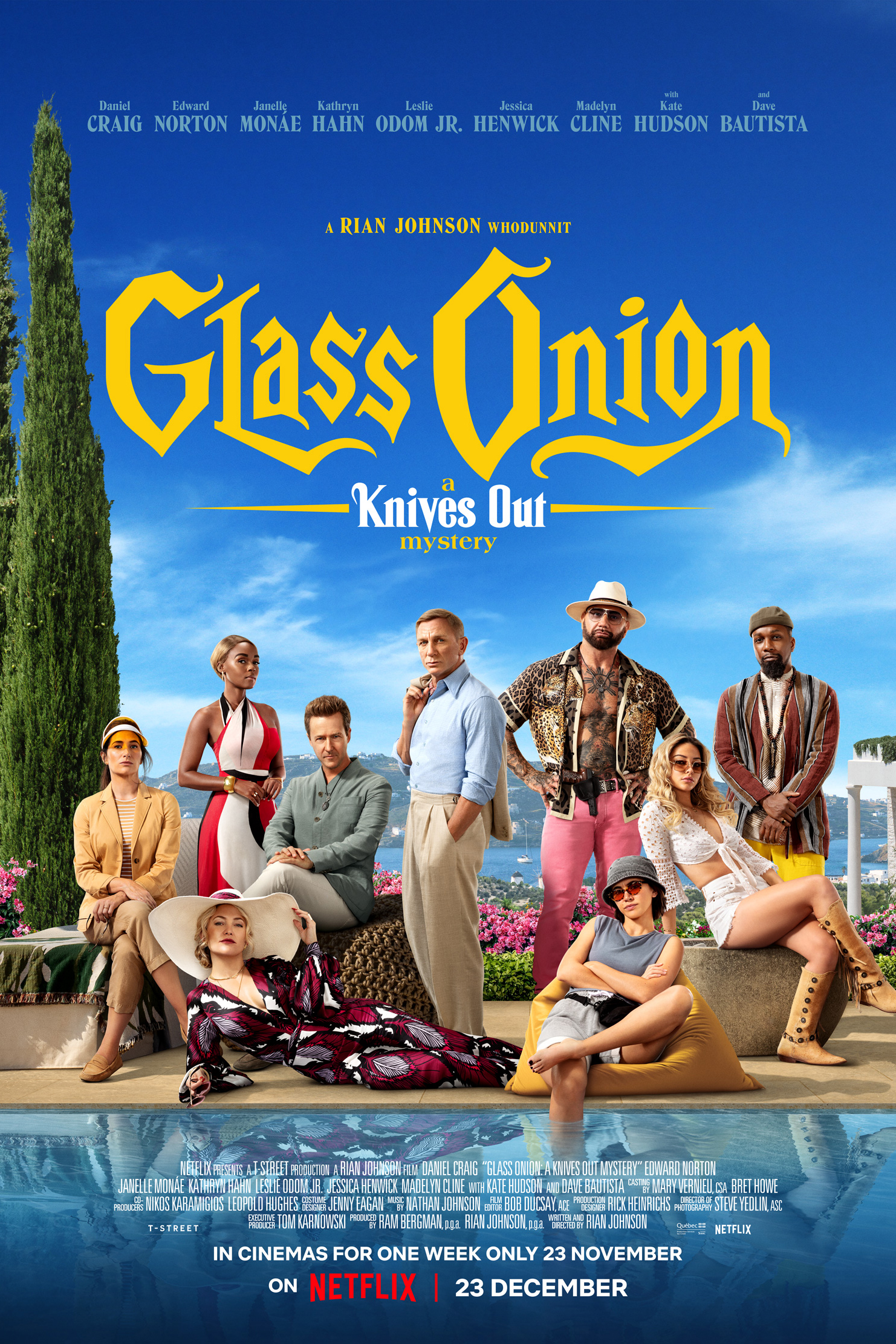
GLASS ONION: A KNIVES OUT MYSTERY whodunit movie review

Cloth Mask: a COVID Mystery. The real mystery is why Johnson didn’t turnover his idea for this chapter in the fledgling franchise to a different screenwriter. World famous detective Benoit Blanc is back, but this mystery suffocates under constant reminders of the varying degrees of response to COVID-19. At the core of this Knives Out installment is an intriguing mystery; however, throughout the whole movie, the audience is reminded of about two years of recent history that most people would rather forget. The best part of the movie is a cameo, near the beginning, of a truly legendary TV detective. Even if you don’t want to watch the whole movie, watch the first few minutes, because you will undoubtedly love the cameo as much as I did.

Tech billionaire Miles Bron invites his friends for a getaway on his private Greek island. When someone turns up dead, Detective Benoit Blanc is put on the case.

Before I break down my thoughts on the movie, just who is that legendary TV detective that surprises us with a heartwarming cameo? None other than Dame Angela Lansbury, aka Murder, She Wrote‘s Jessica Fletcher! Knowing she makes her final film appearance in a murder mystery is incredibly poetic, and will absolutely thrill audiences.

While there is certainly a time and place for films that depict or are an abstract representation of events and people from real life, for purposes of inspiring conversations, most fictional films should transport us, be a momentary break from the negative stressors of life. From beginning to end, Glass Onion is a manifestation of COVID Theatre–and not for purposes of parody or satire–because it’s neither funny enough to be parody nor clever or thoughtful enough to be satire. Even though Rian Johnson is reprising his role as the writer-director of this one, the loss in quality from the brilliant Knives Out to this installment is rather conspicuous. Perhaps this is yet another example of why some directors need to stick to directing, and turn their ideas over to a screenwriter. Evidence of the poor pacing and structure is demonstrably witnessed in the simple fact that nothing big happens for an hour and fifteen minutes into the movie.

Another troubling aspect of this movie is the showdown. And no, I am not about to get into spoilers. But it’s a subject matter that certainly requires critiquing. Keeping in mind that when Glass Onion was written, Johnson could not have possibly known about now-recent headline-grabbing events (in Europe presently) about a group that feels by being a (to quote the movie) a disruptor that they can get their way. And in the film, something rather disturbing happens that could very well serve as inspiration for the continued despicable actions of this group. When these events began happening a few months ago, Johnson (or Netflix) should have rewritten and shot the ending because as it stands, the ending is tasteless.

The set and production design of the movie is nothing short of impressive. While the constant reminders of COVID do nothing to transport us to another world, the setting of this movie certainly does! I absolutely love witnessing the hand of the artist in the design of the palatial house and manicured gardens of the location where the murder mystery takes place. Much like the house in the original Knives Out felt like the Game of Clue, this one delivers a similar feel, which causes the house to feel like a character in and of itself.

While the story execution and writing leave much to be desired, the casting is great! Daniel Craig’s Benoit Blanc is just as entertaining as he was in the first movie. Outside of the foghorn leghorn detective, Jannelle Monáe delivers a fantastic performance as the ex-wife of our murder mystery weekend host Miles Bron, enthusiastically played by Edward Norton. You’ll recognize many to the other cast members and there are a few cameos that will garner a laugh or two. Some of the characters aren’t given much to do, so they become filler. But for the characters that have something of substance to do, they are mostly entertaining.

Unlike the previous movie, this one feels very “Netflixy,” so it’s not one that benefits from a theatrical viewing. Watching it at home will be sufficient enough. However, an advantage to watching it during its limited theatrical run is avoiding spoilers on social media.

For more on the movie, visit Netflix.com/GlassOnion.

Ryan teaches Film Studies and Screenwriting at the University of Tampa and is a member of the Critics Association of Central Florida. If you like this article, check out the others and FOLLOW this blog! Interested in Ryan making a guest appearance on your podcast or contributing to your website? Send him a DM on Twitter. If you’re ever in Tampa or Orlando, feel free to catch a movie with him.

Follow him on Twitter: RLTerry1