THE BEST CHRISTMAS PAGEANT EVER movie review

A heartwarming reminder of the importance of community. The movie also delivers a thoughtful critique of misplaced values. Based on the beloved 1971 children’s novel by Barbara Robinson, this big screen adaptation is a solid way to kick off the holiday season with a Christmas movie that is sure to fall into the annual movie rotations for many. Although the screenwriting demonstrably lacks refinement, there is still much to like about the movie. After a rocky first act, the movie finds its tone, despite the rough dialogue and poor pacing. Over all, it is an enjoyable movie that I will likely watch again before the Christmas season is over.

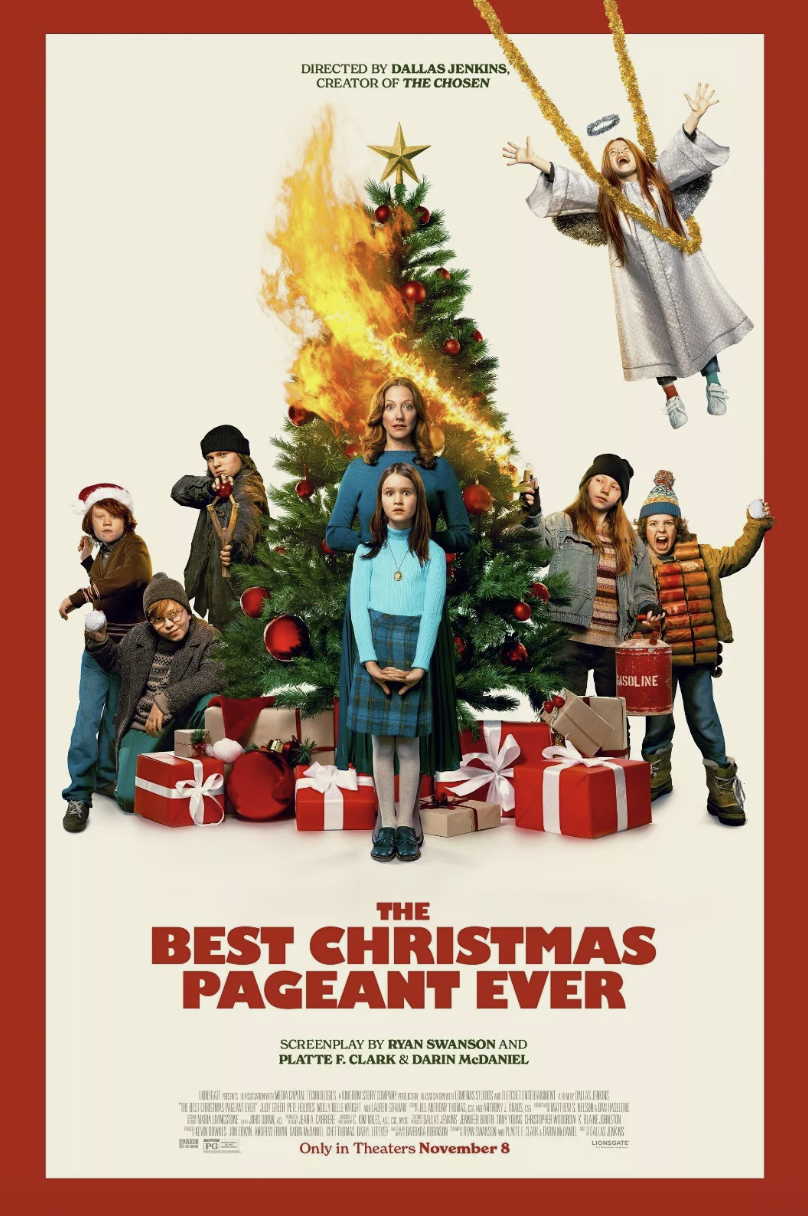
The Herdmans are six siblings who have a reputation for being the worst kids in the world. However, when they take over the local church Christmas pageant, they just might teach a shocked community the true meaning of Christmas.

Tonally, this movie falls somewhere between A Charlie Brown Christmas and A Christmas Story. While this movie may not have the same degree of memorable scenes that will find their way into the cultural zeitgeist, there are moments of hilarity and thoughtful poignancy. The movie shies not away from spotlighting the various prejudices and classism that permeate every town, particularly small towns and even amongst the imperfect people that makeup a church, but also uses the various social dynamics, at play, in the film to show how we can change for the better–after all, this is a redemption story. But it’s not a redemption story in the way we have seen in the past, with characters like Scrooge; rather, this is a redemption story about characters that talk the talk, but struggle to walk the walk. Moreover, this redemption story also follows those that are angry with the world and take out that anger and resentment on those around them. All around, this movie is full of imperfect people across the spectrum that need a wakeup call.

The movie works best when it leans into naturalism, but occasionally falters or feels uneven when it tries to strike a balance between typical faith-based movies and more mainstream ones. Some of the characters and conflicts feel like relatable albeit exaggerated versions of real life, while others feel incredibly forced and unnatural. From what I can remember, the Herdmans are more–how shall I say–earthy and raw in the book than in this film adaptation. And while we get glimpses of this, it would’ve been nice to have witnessed more of their behavioral aberrations to drive home how different they were perceived to be from their community. It’s here where we witness that Dallas Jenkins may be a better producer than director.

Bringing her trademark blend of strength, vulnerability, and sense of humor is Judy Greer as Grace, our house mom that unwittingly takes on the biggest event in her small town. All around, the principle cast is solid with a few standout performances. Some of those standout performances are from Knylee Heiman as the manic and terrifying Gladys, Beatrice Schneider as the crass Imogene, and Lorelei Olivia Mote as the self-centered diva Alice. The characters that work best are those that demonstrate stylistic differences compared to the rest of the cast. In other words, it’s the character actors that stand out in this film–and for good reason–they are both funny and act as an exaggerated reflection of real life people. We each know of people in our own lives that feel like these move people. I feel that if more characters were given something to do by the screenplay or director, that the performative dimension would’ve been above average.

Thematically, the movie reminds us that family and community traditions (particularly at Christmastime) are an important part of the human experience; however, the movie continues the conversation by its provocative reminder that traditions devoid of love and flexibility can become a trap or even a monster. It’s not the tradition itself that is important; it’s the love and community building that is most important. The tradition is merely a vessel through which we can extend love to one another. Just like Charlie Brown and his friends are reminded that Christmas is about the birth of baby King in a nondescript manger in a lowly town and, by extension, the radical changes He will bring to the world through His birth, life, death, and resurrection, the townsfolk in Emmanuel (the town in the movie) are reminded that Jesus was born for everyone, including the Herdmans, “the worst kids in the world.” And that we should care more about one another than we do keeping traditions the same simply for the sake of tradition.

After watching the movie, I am inspired to go back a reread the book. I remember reading it as a kid, and I imagine perhaps other kids of the 70s, 80s, and 90s remember reading the book as well.

Ryan taught Film Studies and Screenwriting at the University of Tampa for over eight years and has a book releasing next year titled Monsters, Madness, and Mayhem: Why People Love Horror. Recently, he has taken over 90.7 WKGC NPR in Panama City, and will be launching a film talk show soon. Additionally, he is a member of the Critics Association of Central Florida and Indie Film Critics of America. If you like this article, check out the others and FOLLOW this blog! Follow him on Twitter: RLTerry1 and LetterBoxd: RLTerry

CLUE: LIVE ON STAGE play review

“I. Am. Your singing telegram (POW!)” here to tell you that you do not want to miss the hilarious hijinks of CLUE: Live on Stage! It successfully channels the film whilst crafting a new experience. And yes, all the iconic, quotable lines and slapstick moments are in the show!! It’s a laugh out loud riot that will uplift the human spirit!

Playing the Straz Center in Tampa now through June 2nd.

Designed for fans of the cult classic, complete with all the camp, but can still be appreciated by all! This stage adaptation of the beloved star-studded film owes its success to the playwriting that retained the soul and memorable moments of the film yet injected new dialogue, scenes, comedic irony, and physical comedy that together craft a familiar yet fresh experience. From the moment the play opens with the original theme music, you know that you will be in for an uplifting time at the theatre. Some stage adaptations of films neglect to include so much of what makes their respective film source beloved, such as the score, quotable lines, or slapstick humor; not true with CLUE. This is one of the best stage adaptations of a film that I have ever witnessed.

One of the subtle strengths of the playwriting is the inclusion of some meta humor such as characters carrying around the original board game detective notepads and even the game board. Other elements that elevate the meta humor of the play include musical cues and slight fourth wall breaking as if to nod to the audience that “we know you know.” The stage design is fantastic! Every inch of space is used efficiently and effectively to achieve the feeling of a vast mansion on a single stage. Furthermore, the design retains that beautifully gothic atmosphere that we associate with the iconic board game and campy film.

With such great cast/character chemistry in the film, I was curious if this adaptation would be able to capture even half of the magic. It pleases me to report that the cast’s chemistry is fantastic! And while they certainly recreate notable moments from the film, each of them puts their own spin on the expression of those moments. From “Let us out, let us out; let us in, let us in” to “Fla, fla, flames, flames on the side of my face” to “I. Am. Your singing telegram,” all those memorable moments are part of the stage production!

And if you were curious if the multiple endings from the film are included, that they are! But, the solution(s) are different than the film, so don’t think that you have it figured out. Even this faithful adaptation throws curve balls that will keep you on the edge of your seat.

I had such an incredibly enjoyable time with this play, and I know you will too. CLUE: Live on Stage is currently touring the country, so look for a showing near you! CLUE is playing the Straz Center in Tampa now through June 2nd, but checkout the CLUE website for when it will be touring in your area.

Ryan teaches Film Studies and Screenwriting at the University of Tampa and is a member of the Critics Association of Central Florida and Indie Film Critics of America. If you like this article, check out the others and FOLLOW this blog! Interested in Ryan making a guest appearance on your podcast or contributing to your website? Send him a DM on Twitter. If you’re ever in Tampa or Orlando, feel free to catch a movie with him.

Follow him on Twitter: RLTerry1 and LetterBoxd: RLTerry

CIVIL WAR (2024) film review

A gripping, thought-provoking motion picture about the power and cost of capturing the human experience in a single frame during war. While it would be easy to describe Alex Garland’s Civil War as a thoughtful, if not painful, graphic warning of what happens when society is completely deconstructed and humanity is lost, this film is actually about the power of storytelling through a single frame. Specifically, the state of what remains of humanity and the cost thereof amidst war. Not for the faint of heart, this film takes you only where imbedded journalists have been during a war, complete with all the death and destruction. The film reminds us of the human cost on the battlefield, in the neighborhood, and those that are capturing the images that will tell the story of societies darkest days.

In a dystopian future America, a team of military-embedded journalists races against time to reach Washington, D.C., before rebel factions descend upon the White House.

A picture is worth a thousand words, or so we hold true, but a picture can come at great cost, particularly during wartimes. Instead of focussing on the backstory or who is fighting for whom and for what principles, Garland uses the apparatus of a dystopian warn-torn United States to explore the human dimension and cost of a polarizing, grizzly domestic war. And he does this through a group of imbedded journalists played by Kirsten Dunst, Wagner Maura, Cailee Spaney, and Stephen McKinley Henderson. Together, they face certain death as they strive to cover the war and reach the President for a one-on-one interview.

We aren’t given enough information about the reason for the Western Front (California+Texas) and Florida Alliance secession from the rest of the country, but that’s because Garland wants us to focus on a different story, the human story told through the power of a single frame and the lives that bring these photos before our eyes. Perhaps you’ve never thought of how these photos get from the battlefield to online and traditional magazines and newspapers, but you’ll think twice the next time you are viewing photographs from current or past wars.

But it isn’t simply a motion picture depicting the difficulties in working as a wartime imbedded journalist–that is incidental–this is a picture of the human lives on the battlefield and the places seemingly removed from the atrocities of war. We seldom think of all the different human reactions to war, and this film brings us face to face with those that are fighting for their respective causes, those documenting the various campaigns, and those that go about their daily lives as though the country isn’t ripping apart at the seems a few hundred miles away. Garland doesn’t offer any particular slant, neither does he steer the audience in agreement or disagreement with any faction involved in the war; rather, he crafts a mosaic, if you will, of a collection of metaphoric still images that capture each type of reaction to the war.

I often talk about the emotive difference between film and digital in my classes, and this film is a great example of that argument. It’s the argument that film is superior to digital because with film, there is a tangible relationship between the filmmaker and the film stock, and by extension, a relationship is developed between the editor and film stock. We particularly witness this relationship in Civil War between Jessie (Spaney) and her classic Nikon SLR (film) camera. Whether as depicted in this movie or in real life, there is far more value placed on and discernment in using film to capture people and events, because the photographer/filmmaker is limited to the number on frames on each roll/reel. Therefore, the photos won’t be of just anything, the artist is only going to take a photo that has meaning. Granted, the keeper may still be 1/30, but each was taken with explicit intent, creating immense value in each still frame.

Even after the shutter has opened and closed, imprinting the image on the 35mm frame, the relationship continues through the development process because the developer sends the film through a chemical process that reveals the full spectrum of light–something tangible, that the developed can see, touch, and feel. Digital cannot capture the full spectrum of light the way film can: one is a replicated process that actually cuts off the whitest of whites and blackest of blacks, whilst the other is a chemical process that captures the full range and spectrum of light as imprinted on the film cell. Film photography (or cinematography) creates an emotive dimension between the artist and image, there is a tangible relationship, so everything is done with immense care, consideration, and discernment.

Why is any of this important in discussing Alex Garland’s Civil War? Because to gain the full appreciation of the story he is telling, it is imperative that we understand the relationship between the photojournalist and tragic, devastating events in which they are working to capture the human dimension behind the atrocities of war. Neither Jessie nor Lee (Dunst) will take photos of just anything, every move is thoughtful, the people and events being captured by their respective cameras carry meaning, they carry the human story. That story is made up of those fighting for the Western Front, Florida Alliance (which we don’t see in the movie), or what’s left of the (former) United States’ armed forces.

Beyond what emerges as the main story, Garland’s film does contain a graphic warning of a possible future in which the United States becomes embroiled in domestic warfare (civil war) due to whatever the reasons were that lead to the secession by California, Texas, and Florida (the three most populous states, by the way). It’s to the film’s credit that Garland does leave the backstory vague, as it’s less important what led to this point, but rather the importance is found in the reactions to the war. Both sides of this war are being fought by those that believe they are right, and will fight for the principles in which they believe. The problem isn’t simply the divergence of opinion and belief as it is in the complete disregard or sacrifice of humanity in exchange for a manmade or arbitrary identity.

This is witnessed in an exchange between our journalists and a group of paramilitary civilians, led by Jesse Plemons). Our journalists state they are American journalists, and Plemons’ character reacts by demanding to know what kind of American. This represents those that discriminate or hold prejudice against those that don’t look or sound like they are originally from the United States. In his mind, being from the United States looks and sounds like a particular type, and if one does not fit into that type, then they are not welcomed and ultimately expendable.

Other reactions to the war are also witnessed by our journalists. Such as the lack of reaction to that which is tearing the country to shreds. On their way from New York City to Washington, D.C., our central characters stop in a West Virginia town that is seemingly removed from the war. When the citizens of this town are asked how can they behave as though a few hundred miles away that the very foundations of the country are being shattered, the town reacts in apathy to the war. They are certainly knowledgeable that there is a war, but they choose to stay out of it. Just as the front lines are a reaction to war, this too is a reaction that bares consideration. Garland leaves it up to each audience member where they fall along the full spectrum of the human dimension in war.

In addition to the writing, directing, and technical achievement demonstrated in the film, the performative dimension is outstanding. The genuine reactions to and emotions on display are dripping with authenticity. You will feel what these actors’ characters are feeling throughout the movie. And not just the gut-wrenching parts, the strategically placed moments of humor will stir your soul as well.

Garland crafts a motion picture that serves as cautionary tale of what happens when we stop thinking about one another as unique individuals, as children of God, and instead treat those that are different in some way as a threat to our very existence. What happens when we care more about someone’s identity (with whatever the ideal or principle) than we do about them as a person. There is a time to defend that in which one believes or when one’s life is in danger, but left unchecked, that defense can turn into an offense due to primal fears, anxieties, obsession, and selfishness. Perhaps this film will serve as a reminder of what can happen when we stop treating one another with respect as fellow humans (as fellow Americans) and instead merely treat one another as threats to our very existence. Treatment with respect and dignity does not equate to endorsement or agreement, but it does leave an opportunity to change open. We’ve seen throughout history that there is sometimes a cause for war, but it should always be the last resort.

Often times, I am negatively critical of the writing in the film’s A24 produces or distributes, because I find many of these films are poorly written; however, this film demonstrates the power of acknowledging storytelling/screenwriting conventions and guidelines. Why? Because they work! At first I was wondering why with such a fantastically written screenplay was the realization missing at the end. Then I realized that it is there in character, plot, and in myself. You’ll just have to watch the film to fully understand that which I am attempting to describe without giving away any spoilers.

Garland’s Civil War is unlike anything I expected. I expected a movie dripping with overt socio-political ideology and commentary, but what I got was an incredibly thoughtful motion picture about the human dimension of war, particularly a domestic war between the states. Garland does not hold back on the violence, so those with PTSD from war or uncomfortable with violent movies should be cautioned before watching this film.

Ryan teaches Film Studies and Screenwriting at the University of Tampa and is a member of the Critics Association of Central Florida and Indie Film Critics of America. If you like this article, check out the others and FOLLOW this blog! Interested in Ryan making a guest appearance on your podcast or contributing to your website? Send him a DM on Twitter. If you’re ever in Tampa or Orlando, feel free to catch a movie with him.

Follow him on Twitter: RLTerry1 and LetterBoxd: RLTerry
ELVIS biopic review

The King of visually spectacular biopics! Tom Hanks and Austin Butler deliver command performances that transcend impersonations and transform them into The Colonel and The King. You’ll want to sing along with this dazzling tribute to the King of Rock ‘n Roll from visionary director Baz Luhrmann. A landmark biographical motion picture for both the technical achievement and performative elements of the mise-en-scene; however, the screenwriting (inclusive of plotting and narrative) lacks the gravitas of the visual elements. Needless to say, my initial reaction to the film was higher than it is now that I’ve had some time to think on it. That’s not to say that I wasn’t impressed by it–I was! Parts of it, anyway. The more I thought about the screenwriting, the more frustrated I became with the film. Frustrated in that it felt like a hybrid biographical film meets documentary. Furthermore, the full impact of the story is hampered by the poor pacing. Perhaps Elvis would have made for a better limited run HBO series. Of course, then you’d not likely have Luhrmann at the helm, which is ultimately why this film works as well as it does. From his humble beginnings to Graceland and Vegas, the film includes milestones in Elvis’ legendary career. The influence of rhythm and blues and gospel music on Elvis’ life is witnessed throughout the filmWhile the storytelling may be weak, the sensory explosion of the film coupled with the performances are the reasons to watch this on the big screen.

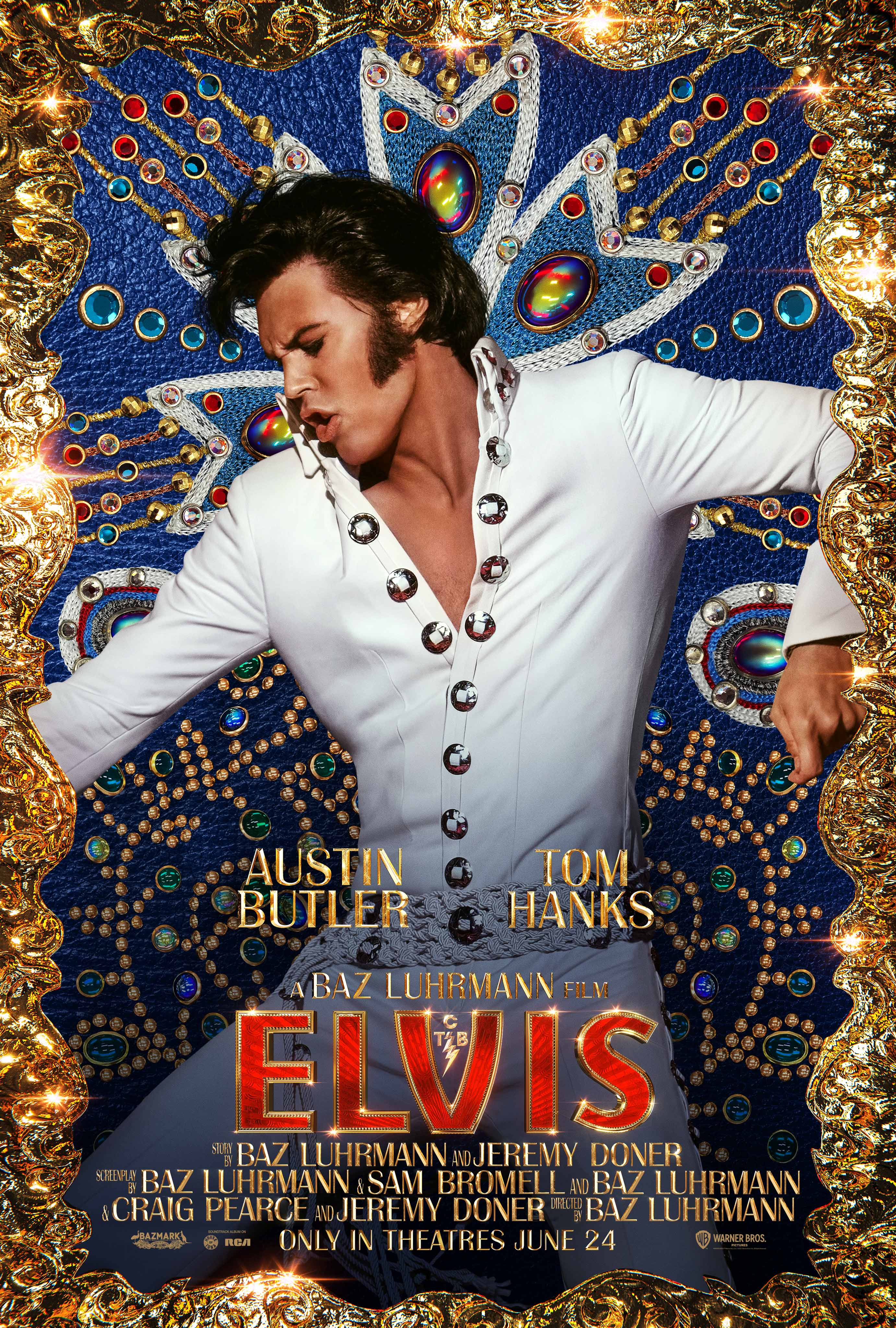
Elvis Presley rises to fame in the 1950s while maintaining a complex relationship with his manager, Colonel Tom Parker.

What performances! Both Butler and Hanks are sure to wow you with their portrayal of The King and the Colonel. We could definitely see some Best Makeup Oscar nominations for both, especially for the Colonel. Other than when it was established that Elvis put on a significant amount of weight (but we cut back to Butler’s slender Elvis), he completely embodied the legendary entertainer. From his voice to his signature pelvic moves, everything about Butler screamed that he was truly Elvis. With so many impersonators out there, and some very good ones, it’s difficult for an actor to take on an iconic role such as this, and elevate it from impersonation to transformation. Fortunately for Elvis, Butler transformed with great authenticity. Moreover, Hank’s unbelievable transformation as the Colonel is on par with the Oscar award-winning hair and makeup of Jessica Chastain’s Tammy Faye last year in The Eyes of Tammy Faye. Although Butler certainly has the moves to drive you wild, it’s really Hanks’ story. Oh you get lots of Elvis, but the main action plot is really told from the perspective of The Colonel. Which is why there are narrative problems.

The movie opens and ends with The Colonel, with all the Elvis in the middle. Because of the competing plotlines, the movie suffers from poor pacing and clearly misguided diegetic direction. Audiences are never able to go as deep as they would like because as soon as we begin to focus on one element of Elvis’ or The Colonel’s life, we are then thrust into a different chapter in Elvis’ life. While that may seem like the movie to too quickly paced, it actually has the opposite effect by dragging it down. Stays too long in some places, whilst not enough in other places. BioPics like this often suffer from poor plotting, because they are ultimately a visualization of a Wikipedia page. Lots of information and chronological events, but little time and room to become emotionally involved with the characters. If this movie had not been about Elvis, and was just another tragic story of an entertainer from humble beginning, hitting it big, losing themselves, just to have a major comeback before an untimely death, then I would probably not care about these characters as much as I do. I am invested in them because of who they are, not because of the journey I witnessed in the film.

The technical achievement of the film is off the charts good! The stylistic cinematography and editing choices are Luhrmann’s signature style. It’s an experiment of the apparatus of film, and how it can be manipulated and crafted to take a typical BioPic, and transform it into a cinematic experience. And that’s what Elvis is, an experience! It is a brilliant combination of stagecraft and cinema. Yes, some of the sets look like they are on a stage, but that adds to the dimension and character of the film. It gives it this other worldly feel that wouldn’t be achieved simply by using all real places (as many still exist). Several times during the film, the cinematography and editing made me feel like I was literally at an Elvis concert! A sensory explosion that only Luhrmann could dream up. The down side to this approach is that there is so much emphasis on the visual elements and the technical achievement of the film that the actually storytelling suffers….sometimes feels like a bad television limited run series.

While I have my reservations with the screenwriting, there is no doubt in my mind how much fun I had with this film! Whether you’re a lifelong fan of Elvis or not, you will have a wonderful time!

Ryan teaches Film Studies and Screenwriting at the University of Tampa. If you like this article, check out the others and FOLLOW this blog! Interested in Ryan making a guest appearance on your podcast or contributing to your website? Send him a DM on Twitter or email him at RLTerry1@gmail.com! If you’re ever in Tampa or Orlando, feel free to catch a movie with him.

Follow him on Twitter: RLTerry1

“Unhinged” (2020) Movie Review

Unbridled blunt force carnage. Academy Award winner Russell Crowe’s rampage-filled Unhinged hits theatres this weekend. And if you’re in the mood for a throwback B-movie well-suited for the indoor big screen or a drive-in theatre, then hop in the driver’s seat. Unhinged is the kind of movie that is so bad yet is actually a lot of fun–the one time you will ever watch it anyway. There are really only two acts in this movie; the rushed setup with an attempt to attach some deeper meaning to the gnarly violence that starts immediately and the lengthy showdown. But you won’t care that it’s a shallow, vapid plot; you are there for three reasons (1) to see Crowe go absolutely bonkers (2) the unhinged brutal, cringy no-holds-barred violence and (3) the scarily realistic car chases through this unnamed city in this unnamed state only known as America’s Heartland. The manner in which The Man stalks Rachel (and later, her son) reminds me of the same pattern of actions we get in many horror movies. While this movie is not a genre horror movie, it is very much horror-adjacent. Moreover, this horror-adjacent movie nearly follows the same tropes as a slasher. Slasher? That’s right. And get this–I found this particularly interesting–Russell Crowe’s lumpy misogynist is credited only as The Man, and where have we seen such a vague, anonymous description of a character before? John Carpenter’s original Halloween with Michael Myers being credited as The Shape. When viewed as a horror-adjacent movie, you will likely enjoy it more. The fact that we are never told much about The Man’s motivations, makes his over-the-top kills, his look, and his barbaric behavior incredibly campy. It’s this level of camp that makes the movie serviceable, and even fun during the violence and high-impact car chases; one could say the car chases are fast and furious. Director Derrick Borte delivers a guilty pleasure action-thriller that is sure to keep you entertained for its relatively short fun time. He knows precisely what kind of movie he’s direction, and rocks it! And you now what, it looks like the director and Crowe has a fun time making this schlock fest. Even actors of Crowe’s repute need a cathartic movie every now and again.

Unhinged is a horror adjacent action-thriller that is built upon something we have all experienced–road rage. Only, this story takes everything you have ever feared about what could happen after you honk your horn to bizarrely unpredictable levels culminating in a terrifying conclusion. Rachel (Caren Pistorius) is running late taking her son to school when she meets The Man (Crowe) at a red light. When the light turns green, he sits there. After she lays on the horn a few times, races past him, and gives him that look, you now the one (as we’ve all done it), she finds herself and everyone she loves the target of a man whom, in his own words, feels invisible and is looking to leave his mark on the lives of those whom dismiss him, in deadly games of cat and mouse.

The movie starts with a stylistic montage depicting violence in the streets of America, particularly road rage. Incidentally, this movie seems to have predicted the current and recent outburst of violence in the streets, months prior. So for some, these images may hit a little too close to home. Or perhaps they will be a wakeup call for how we treat one another, because you never really know if the person standing next to you is about to go over the edge because of continued brushes with trauma. Often times, an opening montage such as this one is used to prime the pump, if you will, in order to setup social commentary or other existential critique on the events that are about to unfold. Unfortunately, this setup really goes nowhere, except to remind us that we really never know next to whom we are standing, or sitting in your car. Early on in the film, just before the deadly cat and mouse road rage game sets into full motion, The Man comments that (and I am paraphrasing), “people nowadays feel as though they should ever have to apologize to anyone for anything.” And perhaps there is a nugget of truth in that because apologies do seem to be fewer in number than they used to be. Newsflash: sometimes we are wrong or have wronged someone else, be it intentional or unintentional. So, apologies and forgiveness should be in our arsenal before grudges and rage.

Talk about bloody. This movie sets the bar ridiculously high with its opening scene of The Man obliterating his axe wife, her lover, followed by torching the house. But the bar doesn’t stop there; the ante literally keeps going up. This man displays the most extreme forms of sociopathy, and he is virtually unstoppable, just like a classic horror slasher in the vein of Michael or Jason. Perhaps he isn’t lurking in the shadows, isn’t wearing a mask, doesn’t have a trademark weapon, or doesn’t come with catchy music, but he is still a slasher! Even when he is shot, he keeps going. And is always right on the bumper of Rachel. While you will likely not care about ANY of the characters in this movie, you will enjoy the campy slasherness of The Man. Unfortunately, The Man also doesn’t give us any reason to root for him, as is the case with Michael, Freddy, or Jason. The Man is a disgusting representation of toxicity of every kind. But, he does know how to put on a show for the audience.

Word to the wise, should you encounter a vehicle sitting at an intersection when the light turns green, I wouldn’t honk your horn. If you do, then you may unleash a sociopath that will literally stop at nothing until you apologize.

Ryan teaches screenwriting and American cinema at the University of Tampa. If you like this article, check out the others and FOLLOW this blog! Interested in Ryan making a guest appearance on your podcast or contributing to your website? Send him a DM on Twitter or email him at RLTerry1@gmail.com! If you’re ever in Tampa or Orlando, feel free to catch a movie with or meet him in the theme parks!

Follow him on Twitter: RLTerry1