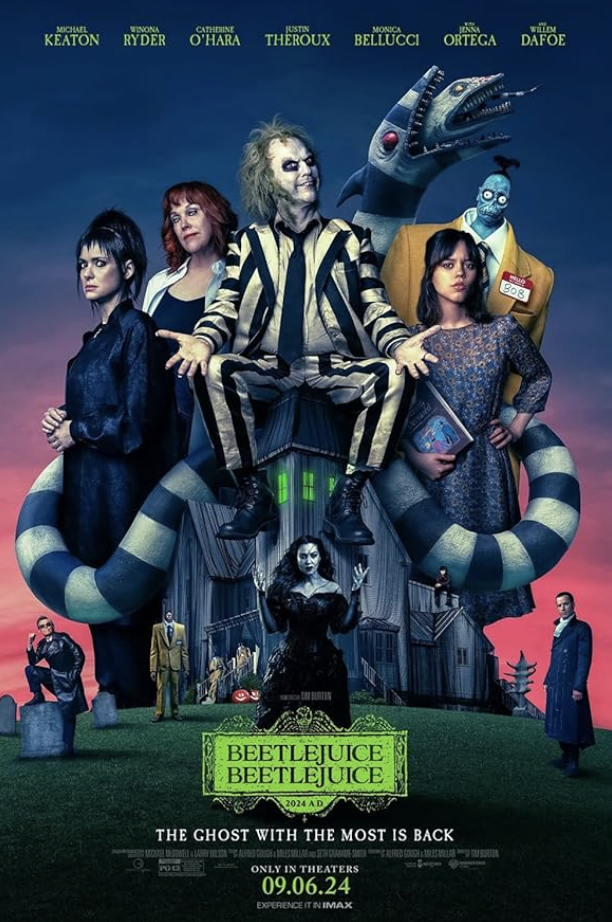
Forgettable and messy. The long awaited and much anticipated sequel to the campy cult classic Beetlejuice is unfortunately an underwhelming return to the fantastical, whimsical universe of colorful and dynamic characters. I’m left asking myself, this is the story for which Burton has been waiting???
Three generations of the Deetz family return home to Winter River after an unexpected family tragedy. Still haunted by Beetlejuice, Lydia’s life soon gets turned upside down when her rebellious teenage daughter discovers a mysterious portal to the afterlife. When someone says Beetlejuice’s name three times, the mischievous demon gleefully returns to unleash his very own brand of mayhem.
Beetlejuice Beetlejuice is a disjoined mess of setup after setup, with little development or meaningful resolution. Even though it successfully channels some of the charm and macabre whimsy of the original, this one is missing something vital–heart. What is most painful to witness is that there is actually a good and even compelling story in there, but its’ buried beneath a garbage heap of subplots and characters that are little more than the equivalent of an NPC (video game-speak for non player character). While the screenplay is abysmal, the bright spots in the movie are Michael Keaton’s delightful reprisal of Beetlejuice, despite his reveal appearing too early in the story. Other highlights of the movie are the quintessentially Burton special makeup and practical effects, including miniatures and puppetry. And composer Danny Elfman lends his distinctive authorship to the score. For fans of the original, this one is likely going to disappoint, but perhaps for those that may be getting introduced to the world of Beetlejuice for the first time, will seek out the original campy classic. At the end of the day, it’s not all bad, but it’s far from good. At best, it’s sufficiently entertaining.
Before getting into what didn’t work, which is substantive, I’d be remiss not to spotlight what the movie did right. The big question, did Burton and Keaton revive ol’ Beetlejuice? And the answer is, yes. The character of Beetlejuice himself is the reason the movie has enjoyable moments and will keep you moderately entertained. Keaton delivers a Beetlejuice that makes you forget that he hasn’t played this character in nearly 40 years. For the most part, he captures the energy, wit, sarcasm, and offbeat charm of his original incarnation. Unfortunately, that cannot be said for the rest of the performative dimension. But more on that later.
Over all, the design of the movie harkens back to the Burton’s golden age in the 80s and 90s, except when he lays practical effects over CGI backgrounds or oscillates between both mechanical and digital in jarring ways. From beginning to end, movie magic is witnessed everywhere. Burton was committed to capturing the imagery of the original in both the costumes and set design, and by in large, he accomplished just that. This movie is a reminder that computers cannot replace the way real light bounces off real objects into the camera lens. The magic of motion pictures is a combination of tactile, chemical, performative, and lighting elements. Despite the Afterlife lacking true camp value, it was a successful return to the imaginative world created by Burton in the original movie.
Regrettably, the movie fails to deliver a compelling or even coherent story. It’s a disjoined mess of ideas that couldn’t have possibly made sense on paper, let alone on the screen. The first act moves along sluggishly, but picks up pacing in the second and third; however, very little (if anything of meaningful value) is developed or resolved that is setup in the first and second acts. There are literally entire characters that serve little to no purpose in the story. And, without getting into spoilers, there is a compelling plot that is excellently setup, but the development and resolution is so sloppy it just hurts the narrative all the more. Even a notable cameo is completely wasted as it bears little importance to the story. It’s hard to even call it a story because it’s lacking a plot, a central character, and a character of opposition; there isn’t even a real goal to be achieved. While the character of Beetlejuice is known for his chaotic behavior, the narrative need’t exhibited the same level of randomness and chaos as exhibited by our title character.
Speaking of characters, the reason that the performative dimension is sorely lacking any modicum of substance is because the characters are given nothing to do. There is little reason for anyone to be doing anything. Furthermore, the Delia and Lydia we get in the original are not the Delia and Lydia we witness in this movie, and Lydia’s daughter Astrid is simply not believable as an angsty teenager. With a little motivation and dimension, the characters would’ve likely been highly entertaining and compelling; but, they are lacking any dimension whatsoever.
Tonally, the movie is all over the place. All over the place except for the one place it needed to be. And that is camp. For a movie that should’ve eat, slept, breathed camp, it plays it too seriously and tonally inconsistent. Yes, there are what we would usually refer to as campy costumes and characters in the movie, but the context is lacking that camp aesthetic and sensibility, for which Burton is (or used to be) known. Contributing to the tone of the movie is the Elfman score that only feels like Elfman sometimes. It’s like a composer imitating Elfman. Yes, we get the classic Beetlejuice theme music, but other than that, I’d be hard -pressed to identify any other musical moments that felt like Elfman.
The movie does deliver some entertaining moments, but sadly they are few in number. When the movie works, it works! But it simply does not work sufficiently enough. Also, the lines “…strange and unusual” and “it’s showtime” are nowhere to be found. There was also a setup for a much-needed scathing critique on influencers and influencer culture, but that setup too wasn’t developed. So many great ideas that are completely disconnected.
Watch if you simply want to enjoy some movie magic and familiar characters, but don’t expect to be quoting this sequel like you do the original. I’ll leave you with this, the fact that Lydia’s TV show is titled “Ghost House” is a nice nod to the original title of Beetlejuice.
Ryan teaches Film Studies and Screenwriting at the University of Tampa and is a member of the Critics Association of Central Florida and Indie Film Critics of America. If you like this article, check out the others and FOLLOW this blog! Interested in Ryan making a guest appearance on your podcast or contributing to your website? Send him a DM on Twitter. If you’re ever in Tampa or Orlando, feel free to catch a movie with him.

 R.L. Terry ReelView