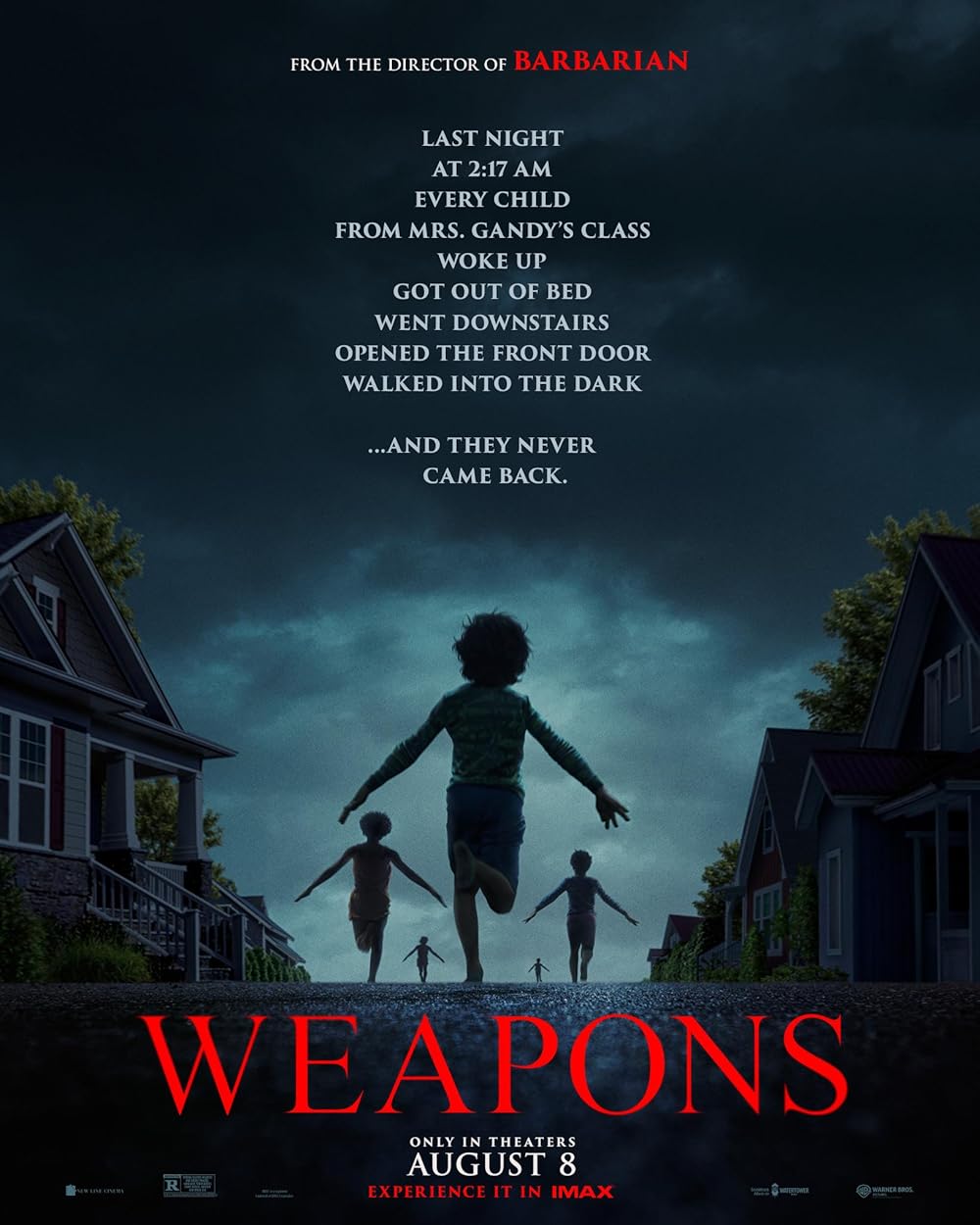
WEAPONS horror movie review

Sleek, stylish, and appears razor-honed, but needs a little sharpening. Zach Cregger’s Weapons takes audiences on a visually arresting and emotionally charged journey that blends suspense, terror, and moments of surrealism. While the film excels in crafting atmosphere through its immersive sound design, haunting imagery, and striking cinematography, its story ultimately collapses under the weight of overwriting and structural ambition. Despite moments of genuine tension and intrigue, the story struggles to cohere into something emotionally resonant or thematically satisfying. In the end, Weapons proves to be more refined in aesthetic than in substance—an experience-driven work that favors tone over storytelling.

When all but one child from the same classroom mysteriously vanish on the same night at exactly the same time, a community is left questioning who or what is behind their disappearance.

Weapons positions itself as a psychological horror anthology-adjacent film that aspires to echo the structural ambition of Trick ‘r Treat and the dread-soaked atmosphere of Hereditary. Each composition is meticulously crafted, echoing the influences of Ari Aster, David Lynch, and Paul Thomas Anderson. The film’s immersive sound design, scored with unnerving precision, deepens the psychological tension, ensuring that audiences feel trapped within the same spiraling unease as its characters. Cregger, best known for the unexpected 2022 breakout Barbarian, attempts something far more sprawling here: a multi-threaded, nonlinear horror tapestry that spans time, location, and character perspectives. On paper, the structure is bold and ambitious. But unlike Barbarian, which grounded its twists in a tightly wound narrative, Weapons ultimately feels thematically scattered and emotionally distant. Characters arrive with weight, but rarely evolve; connections are drawn, but their meaning feels underdeveloped.

What Weapons does exceptionally well is craft an experience. Cregger’s talent for generating sustained suspense, is elevated here to a more mature and stylized level. The tonal consistency, even across multiple timelines and narrative threads, is admirable. Individual sequences build atmosphere masterfully, utilizing silence and suggestion as effectively as sudden, jarring visuals. The sound design alone is enough to make your skin crawl—unsettling, precise, and deeply immersive. The cinematography delivers an unnerving blend of realism and the uncanny, grounding even the most supernatural or surreal moments in believable textures and light.

Weapons boasts an outstanding performative dimension. Each of the lead and key supporting actors deliver performances that are uniformly committed, standing out for their subtle, tortured portrayals of people unraveling in the wake of the trauma of the kids vanishing. After the mostly disappointing Wolf Man earlier this year, I was curious to see if this film would be the vehicle needed for Julia Garner (until the Madonna bio pic that’s calling her name) to showcase her acting chops. The performative quality we witnessed of her in Ozark is what we have in Weapons. Josh Brolin offers stoic gravitas, while Austin Abrams adds a jittery, unpredictable energy. And then there’s Cary Christopher’s unsettling Alex, complete with enough creepy kid energy to fill a whole classroom. Collectively, their efforts lend some gravitas and humanity to a film that often prioritizes vision over narrative.

Without getting in to spoilers, the film takes a turn midway through the second act that completely shifts the experience and even the tone of the picture. One might say that the movie sets up one mystery and eventual payoff, but then deviates onto a different (and ultimately more predictable) path. Once that (unfortunately too obvious) reveal is made midway through the investigation into the disappearance of the classroom of kids–save one (Alex)–then it becomes quite the twisted fairytale. But therein likes one of the most significant problems I have with the film–because of this twist, there are questions that emerge for which we will not be provided answers. We can certainly draw conclusions, that are most likely correct, but this isn’t the type of picture that should require that level of guesswork. When that twist is revealed, explanations of reasons for the motivation and consequences, should the plan fair, are not sufficiently clear.

Horror thrives in that liminal space between order and chaos, but Weapons leans too heavily into the latter. Instead of meticulously peeling back layers to reveal a deeper truth, it obscures character arcs and emotional payoffs beneath narrative experimentation. In striving to be a psychological puzzle-box, the film forgets to provide the audience with enough meaningful pieces to solve it. As a result, Weapons leaves audiences with questions that the film should have answered because it clearly desires to be a genre horror film–it’s not Memento. However, the climax of the picture, while somewhat predictable, is none-the-less satisfyingly bold.

In the end, Weapons is a film that demands attention but struggles to justify its complexities. It will certainly appeal to fans of the prestige horror aesthetic, but despite the converging narratives it never quite hits the mark of a film that invites multiple viewings in order to fully appreciate the story and the apparatus thereof. But for general audiences, or those seeking a tightly woven narrative, the film’s impact may feel more like a glancing blow than a direct hit. Visually stunning and rich in atmosphere, Weapons captivates the senses but lacks the narrative clarity and cohesion to land its thematic strikes. A bold motion picture outing, it’s a film that’s more experience than story—one that feels sharpened in presentation but blunted in meaning.
Ryan is the general manager for 90.7 WKGC Public Media in Panama City and host of the public radio show ReelTalk “where you can join the cinematic conversations frame by frame each week.” Additionally, he is the author of the upcoming film studies book titled Monsters, Madness, and Mayhem: Why People Love Horror. After teaching film studies for over eight years at the University of Tampa, he transitioned from the classroom to public media. He is a member of the Critics Association of Central Florida and Indie Film Critics of America. If you like this article, check out the others and FOLLOW this blog! Follow him on Twitter: RLTerry1 and LetterBoxd: RLTerry

“Deadpool 2” movie review

“Deadpool, can you hear me?” Subversive, irreverent, brilliant, meta. It very well may be better than the first. How often do we get to say that about direct sequels? Ryan Reynolds’ witty, crass, charmingly naughty superhero is back to take even the most unrelentingly serious movie patron, and drive them to complete laughter. The square peg of the X-Men’s round universe returns with non-stop action, antics, and fourth-wall breaking humor virtually deconstructing everything from the opening credits to the post-credit scenes. Nothing new there; however, Deadpool assures the audience that the story they are about to see is a family movie. And after watching it, it may be unconventional, but it’s a solid family film. Maybe not “family entertainment,” by the Disney definition, but about family nevertheless. Speaking of which, we may have just watched the final Deadpool as we know it before it gets the Big D sanitization treatment, should Comcast (NBC Universal) not swoop in to save 20th Century from the otherwise inevitable Disney acquisition. Deadpool 2 isn’t just better than the first one simply because it’s funnier, more risqué, or more clever; in measurable ways, it possesses stronger villain(s), stronger opposition to the goal, and a better plot overall. Not your everyday “family” film, but filled with emotional tugs at your heart strings, all the same. Just with a heaping helping of self-aware and self-deprecating bawdy humor.

For two years, Wade Wilson/Deadpool (Ryan Reynolds) has continued his mercenary work, taking down villain after villain, crook after crook; but, after he fails to kill one of his targets on an extra-special day to him, he is faced with tragedy. Through a series of bizarre events–yes, even bizarre for Wilson–Wilson finds himself in a maximum-security prison ran by the DMC (Dept of Mutant Control) along with a renegade 14yo mutant named Russell. When Cable (Josh Brolin), a high-tech assassin, arrives from the future to take out a target that he claims leads to total destruction, Wilson must battle inner and outer demons in order to get his heart into the right place. Knowing he’s facing the most dangerous villain he’s ever encountered, Wilson forms the X-Force, a diverse “superhero” group of many talents in order to apprehend the target to prevent the world from plunging into complete chaos.

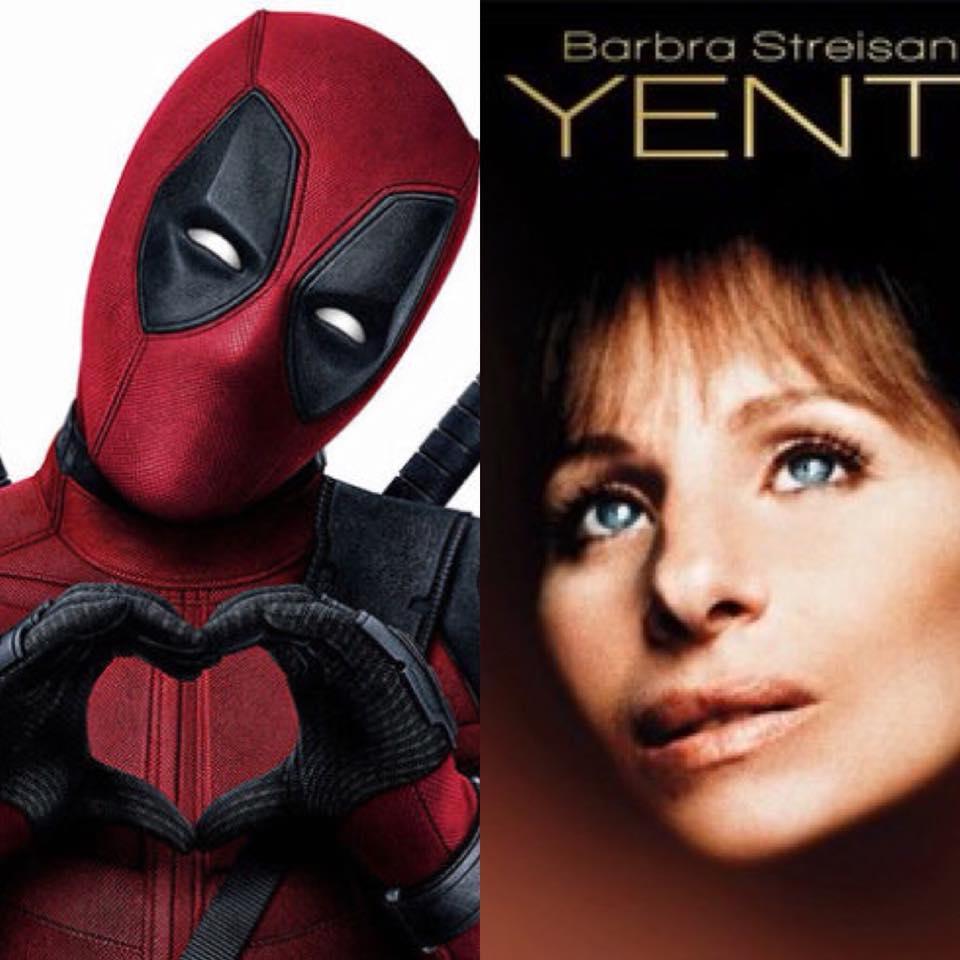
There is a comedic power in the plot of Deadpool 2 that invites the audience, at every turn, to laugh with the movie as it laughs at itself. There are a few running schticks throughout the film, but my favorite is the continued references to Barbra Streisand’s groundbreaking film Yentl featuring the iconic Streisand ballad Papa, Can You Hear Me? To which, Deadpool points out sounds an awful lot like Do You Wanna Build a Snowman from Disney’s Frozen. And it’s the implication of Disney appropriating Streisand’s song where the “Disney joke” was likely cut from the movie. Other jokes carry over from the first film such as the X-Men mansion with only Negasonic Teenage Warlord and Colossus roaming around. Some of the schticks from the first movie are transformed for this direct sequel. Contrary to the Wade Wilson from the first film, this one, this one diverts from his persistent aversion to companionship and a desire to be the “lone ranger,” as it were, and expresses a need for family. This desire for family serves as the backdrop of running jokes, gags, and extreme snark.

Streisand isn’t the only female vocal artist highlighted in the film, Dolly Parton’s 9 to 5, Pat Benatar’s We Belong, and Cher’s If I Could Turn Back Time are all featured, all that we were missing was Cyndi Lauper’s Time After Time. Unlike the completely unconventional opening credit sequence from the first Deadpool, this sequel’s opening credit sequence takes a page out of the James Bond handbook, complete with the new single Ashes by Celina Dion. Like the opening credit sequence from the first film, this one also replaces the names with jokes that certainly aid in setting the irreverent mood of the film. Although a film should never primarily rest upon the music, as the plot should stand on its own, the score and featured songs are incredibly important assets that can greatly enhance the experience. Deadpool 2 contains a few montages set to song that will certainly have you rolling over laughing. Sometimes it’s the complete contrast or juxtaposition that the lyrics provide against the action in the foreground that drive the audience to complete hysterical laughter.

For all the first film got right, one of the elements missing from it was a well-developed, dynamic villain (more specifically, opposition to the external goal). Deadpool 2 provides solid central opposition to the external goal (which, for spoiler sake, I won’t mention) flanked by two villains taken directly out of the X-Men comics (and X-Men: the Animated Series). Cable, mentioned earlier, and the Juggernaut. Not to pigeonhole Cable into the villain category, there is more to this villain than first meets the eye. He can be more accurately described as an anti-hero because of his reasons for returning to the past to stop Armageddon, so to speak. Knowing Cable’s backstory, his goals, and that which he sees as opposition to his goals, gives him a character depth seldom seen in many superhero villains. When a villain (or anti-hero) can get the audience to empathize with his or her plight, then the villain succeeds in being well-developed and complicated. Having a complicated villain enables the audience to love or love to hate the villain. But in both cases, the audience loves to see the villain (or anti-hero) on screen. Supplementing the cast of villains in Deadpool 2, is the iconic X-Men character Juggernaut. His introduction into the film comes at a strategic turning point that launches the plot into the showdown.

The film makes an important observation about the lack of plus-sized lead characters in superhero movies. Russell is a plus-sized mutant who wants so desperately to be a superhero, but sends the message to Wilson (and by extension, the audience) that there should be room for non-athletic types in the superhero universe. It’s an important message that I think would have played out more effectively had the actor not been so childish. I understand that the character is a 14yo mutant who is still struggling to find his place in this world and understand his powers, but I kept seeing the actor and not the character. The ability to bring a character to life without the actor showing is part of the art of acting. In most cases, the audience wants to see the character, not the actor playing him or her. I liked the character of Russell, just think he could have been portrayed by another actor who could have more effectively driven the message home that diversity in the superhero universe mans more than male, female, straight, gay, etc. It should also incorporate a diversity of body types. Having non-athletic body types represented in lead characters–superheroes specifically–is an element that I hope continues to improve.

There truly is so much to enjoy about Deadpool 2. Behind the ballsy jokes, suggestive poses, and hilarious meta observations, is solid writing and direction. With the Disney acquisition of 20th Century Fox all but complete, with the wild card of Comcast’s (NBC Universal) bidding 19% more than Disney in cash that could alter the direction of the deal, I hope that we did not witness the last Deadpool free of Disney sanitization. Knowing that they strong-armed Fox into cutting a Disney joke from the film during post-production, does not help matters any. Hopefully, the third installment of Deadpool will be just as funny, if not funnier than the first two. Oh yeah, it should go without saying but this NOT a superhero movie for kids.

“Hail, Caesar” movie review

HailCaesarA brilliant post-war self-reflexive commentary on the Hollywood studio system. Go inside classic showbiz! Before the decentralization of “Hollywood” filmmaking, the big studio was king. And Hail, Caesar captures the socio-economic mountains and pitfalls of the decline of the Golden Age of Hollywood perfectly, complete with a pure message about love, dedication, and highbrow humor along the way. You couldn’t have asked for a better cast. From the excellent writing to the impeccable acting, this film is sure to provide you with old-school style entertainment paired with plenty of topics of discussion–especially for cinema scholars and historians like myself. Return to the Hollywood that still inspires dreamers today and experience life in the studio system. This is one of the best self-reflexive films about Hollywood itself since Singin’ in the Rain. Although, the social-commentary is more or less a plot device that plays in the background while the main plot is the true focus of this exceptional narrative. Truly a remarkable film that will likely find its way into sociology and film studies classes alike.

Hail, Caesar takes place during the final days of filming of an adaptation of the story of the Christ. During a set break, Baird Whitlock (George Clooney) is drugged and kidnapped by a couple of extras and taken to a secluded beachside mansion in Malibu. Meanwhile, Eddie Mannix (Josh Brolin), head of physical production for Capital Pictures, is busy running the show–from personnel management to the shuffling around of actors. Early on, you learn that Mannix is being aggressively pursued by the Lockheed corporation and he must decide either to pursue a career that will allow him to be with his family more and retire early or remain in Tinseltown to head up production and develop motion pictures.

Where to begin?!? As a peer-reviewed published cinema [and themed entertainment] scholar and historian, there are are so many different ways of applying a critical analysis to this film. Leaving the cinema last night, I was perplexed as to how to write about it. Ordinarily, I have a general idea of the direction I will head in my review by the time the credits roll–not this time. There is definitely a subplot in the movie that would be great material to dissect and analyze but I don’t want to spoil that for you; although, I can say that is is very apropos for that period in 1940s/50s Hollywood.

In order to analyze the material that I found most interesting, I want to first spend a moment on the film itself. Even before watching it, you already know that it boasts a brilliant cast and thankfully everyone lives up to the expectation that comes with their respective talent. From the leading players down to the A list cameo appearances, all the actors bring a unique flavor to the overall recipe of the movie. One of the elements that stands out the most is the attention to detail in the classic Hollywood production design. Essentially, we are watching a movie containing the making of another movie. The matte backdrops and traditional rear projection doesn’t stop in the story of the film being made in Hail, Caesar, but the classic production styles and designs cross over into the production of the Hail, Caesar itself. From the color schemes to the wardrobe and makeup, the attention to detail is flawless. Although much more humorous and satirical than the epitome of self-reflexive post-war Hollywood films, Billy Wilder’s Sunset BoulevardHail, Caesar does a superb job of going inside the word of showbiz and highlighting positive and negative consequences of the former studio system.

The film opens up with Mannix pulling Gloria DeLamour (Natasha Bassett) from an unauthorized photoshoot because the image the studio has of her could be tainted. That is really the first glimpse into what life was like for stars who worked in the Hollywood Studio System. Not limited to the talent, Mannix even told directors who would star in the pictures that they were hired to direct. Capital Pictures pulled a cowboy off his motion picture to then star in a drawing room comedy. When you worked for the studio, you worked FOR the studio. From your image to the projects you worked on (whether talent or technical crew), your every move was managed by the studio heads. Sounds like the perfect setup for exploitation, doesn’t it? In many ways, yes. However, the studio system also provided a central hub for working in motion pictures. One of the scenes shows Mannix walking down a corridor of editing offices, and that is something that isn’t quite the same today. Studios had exponentially more full-time staff until the final collapse of the studio system in the late 1950s/early 1960s. You had a regular job Monday-Friday and were typically on a salary. You were provided meals and other amenities during the work day. Yes, many aspects of your career were managed–even down to who accompanied you to the premiere of the film you either worked or starred in. But, many more people were employed by the studio directly than today. Just something to think about.

The studio is aptly named Capital Pictures. And rightly so, because at the heart of the movie, the two-fold plot of the film contains socio-economic commentary. The counterpart to the socio-economic side is about being dedicated to one’s true passions. Mannix can easily represent anyone who has a job that they work hard at and are dedicated to but often drawn to opportunities that would be easier and make more money. Do you choose to follow your passion? Or, do you choose the easy way out that would be more profitable? You will have to see the movie in order to discover how Mannix dealt with that real-world conundrum. Although the story of the passion of Christ is a backdrop in the film, it actually plays quite an important role near the end of the third act. The message of love transcends the screenplay (being shot in the movie) and impacts the actors and studio leadership. There are so many wonderful elements to discuss in Hail, Caesar and I have just touched on a few of them. I encourage you to make your way to the cinema this weekend in order to experience it for yourself.