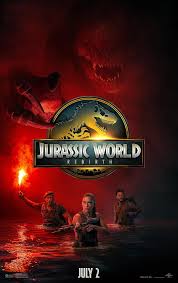
JURASSIC WORLD: REBIRTH movie review

Possesses dino DNA, but missing strands and sequences, leaving an uneven and forgettable movie. Jurassic World: Rebirth begins with an intriguing enough premise, but the characters are poorly written, which is then amplified by way of a subplot that only serves to clutter the story. After a rough first two acts–except for a thrilling and fantastically written T-Rex chase scene (that was part of Crichton’s original novel and script for Jurassic Park)–the third act is surprisingly exciting and suspenseful, and at times terrifying.

Zora Bennett (Scarlet Johansson) leads a team of skilled operatives to the most dangerous place on Earth, an island research facility for Jurassic World. Their mission is to secure genetic material from dinosaurs whose DNA can provide life-saving benefits to mankind. As the top-secret expedition becomes more and more risky, they soon make a sinister, shocking discovery that’s been hidden from the world for decades.

Perhaps Koepp’s screenwriting works best when the original version of a script is written by the novel’s author (which, I know wasn’t possible for this movie in more ways than one), and he then crafts the original version to be more effective for the screen. To put it simply, no one knows what is going on or when/where they are. Harsh? Not really, when the movie opens with lazy exposition through on screen text describing an event that happened 17 years ago…keep that in mind, 17 years (placing it in line with Jurassic World not Jurassic Park). But then the characters talk about the research and development facility as if it was connected to the original park–not possible. Even popcorn movies should adhere to the logic of their own world building. It’s as if no one thought about the events that unfold in this movie, and how they relate to the previous movies. Kind of basic storytelling logic.

There are many elements of this movie that fail to make any logical sense (and again, that is the logic setup by the movie itself) or are setup, and never developed or connected to any motivation or stakes. To go into them, would take too much time.

Aside from logic problems, the movie is plagued by poorly written characters, an extraneous, shoehorned subplot, and weak first and second acts (with one exception in the second act that was thrilling). While I appreciate the minimalistic cast of characters compared to the cast of characters in all the Jurassic World movies, there are two competing groups that are pretty much independent of one another and could have each been in their own movie altogether. Yet, somehow, they are sloppily fused together in this movie. For argument’s sake, we’ll call them the Mercenaries and the Family. The Mercenaries and their outside/action plot are fine–I’d even go so far as to say ‘that’ story is sufficiently interesting. The Family and their plot felt extraneous and ultimately of little importance to anything that happened. It’s as if there were two different movie ideas (1) centered on the Harvesters and (2) the Family. And I think either by itself would have made for a better movie than putting them together. These decisions left the movie feeling muddled and crowded.

There is a T-Rex sequence in the second act that is fantastic! It very much harkens back to the sci-fi horror-adjacency of the original movie. Of course it helps that Crichton’s original Jurassic Park novel and screenplay thereof contained a similar sequence. Fun fact: this sequence in the novel and original Crichton screenplay served as the inspiration for Jurassic Park: The Ride at Universal Studios parks. It plays out wonderfully in this movie, like a short film in and of itself, because it’s setup well, developed strategically, and resolved thrillingly.

Even though there are a couple of characters that are almost fun or compelling to watch (almost), the rest are more disposable than a red solo cup at a frat party. You’ll find yourself rooting for the dinosaurs to win. Of all the characters, there is one particularly so annoying and deplorably behaved, that you’ll want the first dinosaur you see to pick him off, (and question why on earth his girlfriend would be with him and why the dad would let the boyfriend walk all over him–answer, bad writing). Other characters are one-dimensional or the casting choice never sells the character. All around, there are many character and casting problems, resulting in a movie wherein you’ll hope the next dino attack happens soon–and preferably ends with one less character.

Where the movie “finds a way” to leave you on a high note, is in the third act. Despite the slapdash screenwriting throughout the first and second acts, the third act is wildly entertaining and even at times, terrifying! It almost compensates for the first hour and forty-five minutes. The (weird) dinos are “monsters” again, and the various chase sequences each offer something different (even though one is a recreation of the Kitchen Scene from the original movie). The stakes are raised and the level of terror leaps off the screen. So often, movies start well and fail to stick the landing; with this one, it fails to stick the launch but definitely sticks the landing.

SUffice it to say, if you took the first two acts from The Lost World: Jurassic Park, and paired them with the third act from Jurassic World: Rebirth, then you’d actually have a pretty good, memorable movie.

As an OG Jurassic Park fan (and Lost World apologist, except for the third act), I hate having to write reviews such as this one for a franchise installment. But, the more I thought about this movie, the more stupid it became. I suppose it’ll make for a fun enough 4th of July weekend watch, but doesn’t do much beyond that.

Perhaps, these movies will “find a way” back to greatness one day–doubtful as it seems.
Ryan is the general manager for 90.7 WKGC Public Media in Panama City and host of the public radio show ReelTalk “where you can join the cinematic conversations frame by frame each week.” Additionally, he is the author of the upcoming film studies book titled Monsters, Madness, and Mayhem: Why People Love Horror. After teaching film studies for over eight years at the University of Tampa, he transitioned from the classroom to public media. He is a member of the Critics Association of Central Florida and Indie Film Critics of America. If you like this article, check out the others and FOLLOW this blog! Follow him on Twitter: RLTerry1 and LetterBoxd: RLTerry

“Rogue One: a Star Wars Story” movie review

rogueoneJust when all hope was lost, the force has awakened this time. After the disappointingly stale installment last year, I did not have high hopes for Rogue One. To my surprise, the first standalone Star Wars franchise film exceeded expectations. Although the public is accustomed to Star Wars films coming in threes, Lucasfilm and Walt Disney Studios took a risk in creating an original single story to successfully setup A New Hope. Unlike when the force tried to awaken last year, THIS feels like a new Star Wars film. With twenty-some-odd years to fill between Revenge of the Sith and the original movie, how was one film going to do it? Focus on what was ultimately important. Not that the development of the Empire would be uninteresting, but the white elephant in the room was “how did the rebels get the plans that setup the events at the beginning of A New Hope“? And that is precisely what director Gareth Edwards did, and it paid off! Rogue One is as exciting as the original film; and furthermore, is built upon a solid plot that is mostly new with a little nostalgia and Easter Eggs (visual references to A New Hope) in the form of locations, props, shots/frames, and familiar featured characters and a surprising cameo. One of the elements that plagued Episode VII was the simple fact that it was little more than a remix and mashup of everything that had been done before, including main plot points, subplots, and predictable behavior. Rogue One feels fresh and new. Yes, there are obviously appearances and references to characters and settings from A New Hope, but that is to be expected since this film ends where the original film begins. Thematically darker than the original film but not as dark as Empire Strikes Back, this installment strikes a balance in the force that makes it interesting to watch. We all know that the rebels get the plans in the end, but this film makes the adventure worth watching as it unfolds.

With the old republic in ruins and the senate all but disbanded, the Galactic Empire has  its eyes set on a feat of engineering never seen before. But they need to attach the right scientific talent in order to create that which would become known as the Death Star. Galen Erso (Mads Mikkelsen) is a brilliant scientist and former Imperial officer, devoted husband, and loving father. Director Krennic, head of the secret Death Star project, arrives at Erso’s home to forcibly recruit him to head up the science and engineering divisions. When recruitment does not go as planned, Erso is separated from his family and taken away. Escaping to the caves, his daughter evades capture. Many years later, Jyn (Felicity Jones) finds herself a criminal and angry that her father never came back for her. When an Imperial pilot allegedly defects and claims to have a message from Galen for the Rebel Alliance, Jyn is recruited by the rebels to lead them to a former rebel turned rogue and ultimately to her father. With Captain Cassian Adnor (Diego Luna) at the helm and lead of the small band of rebels accompanying Jyn to her father, they uncover a secret that thousands will die for in order to attempt to make things right in the galaxy. All the while, they have no idea that this clandestine mission will spark events that they could have never imagined.

Already, this film seems to have sparked arguments among fans of the franchise and those who enjoy them but may not be fanboys. Even this morning, I noticed many comments on social media that commented on the film positively or negatively. Interestingly, at first glance, it seems as those who liked Episode VII: The Force Awakens did not like Rogue One, and those–like me and the friends I went with last night–who thought The Force Awakens was garbage but found Rogue One to be exciting, dynamic, and refreshing. Of course, there are plenty of people who like both films released under the Disney banner, either because the Big D can’t possibly do anything wrong or because they are true fans for better or worse of the nearly forty-year-old franchise and staple in the future fantasy genre (notice I did not say science-fiction–no real science here). At this point, I am unsure why those who liked last year’s film may not have liked this weekend’s installment; however, it appears to be clear from multiple comments and reviews that the reason why those who did not like Episode VII enjoyed Rogue One is the newness of a film that embodies the spirit of the original but provides audiences with a new adventure that connects well without redundancy. One of the reasons for the success of the original film–aside from a great cast–is the focus on the drama between characters and camps. There is the drama between Rebels and the Empire but also drama within the camps themselves. Rogue One borrows from A New Hope in that the focus is more on the drama than resting its laurels on the technical elements. Not that this film lacks in the technical category. Rogue One comes complete with great direction, color grading, cinematography, and impressive editing (especially with some rather surprising CGI that will definitely cause you to do a double take utter delight).

For all that this installment did well, the beginning of the film following the prologue was dreadfully ill-conceived and mostly unnecessary. Unlike all the other Star Wars films, this one did not open with the trademark scrolling written prologue offering exposition to setup the movie. Instead, after the “A long time ago, in a galaxy far far away” the film cuts to the opening scene of Krennic recruiting Galen. Following the prologue and rather PowerPoint-looking Rogue One title card, is a rapid, incoherent, and confusing sequence of montages. Honestly, I am still unsure why that whole sequence was necessary. Between the PowerPointy title card and this sequence of montages, I did not have hope for the film at all. Obviously, I ended up enjoying it immensely, but I look back and feel strongly that it could have been left out. The settings/planets that were depicted did not play into the plot at any level of significance. Felt like filler. Thankfully, the scenes following the prologue are but a small portion of the film and the film really begins to take off after Captain Cassian and his team rescue Jyn from a prison transport vehicle. After Jyn’s rescue covert operation, the rest of the film is nicely paced and developed. Other than knowing the ending, the majority of the film was unpredictable. Unpredictable in that you know the direction it’s going and ultimately what’s going to happen but you don’t know HOW it all happens and works together to setup A New Hope.

Just the right amount of nostalgia and Easter Eggs. For those who are fans of or simply familiar with the movies, there are cameos, references, and shots taken from the chronologically preceding films (mostly A New Hope). Just enough nods to and direct connections to provide the audience with a film that IS as much a part of the Star Wars saga as the official Star Wars cannon. It’s no surprise that the Death Star is a big part of Rogue One, Senator Mon Mothma is seen leading the rebels, Darth Vader (still voiced by James Earl Jones) makes several brief appearances, and a couple other nostalgic cameos; but there are some characters who are included in the diegesis of this film who will delight old and new fans alike–one in particular that will incite an eruption of cheers! Beyond the human characters, there are other appearances by iconic ships and war machines that aid in cementing this story in with the rest of the franchise. While the film contains some lighthearted, witty dialog between the core group of principle and supporting characters, the film also contains some dark moments. Personally, I think the film should have been a little darker since it sets up the installment all about hope reborn; but, the atrocities of war are definitely not hidden from the audience and events transpire that are atypical of future fantasy films between heroes and villains. In a manner of speaking, and as I mentioned in my opening paragraph, the film’s diegesis strikes a balance in the force in terms of the light and dark content.

Rogue One: a Star Wars Story is an exciting narrative that successfully sets up the film that started it all. If you’re a fan of the original trilogy but did not enjoy Episode VII, you will most likely enjoy this installment. If you are a fan of the original trilogy and liked Episode VII, then there is moderate chance that you may not like this story. It will be interesting to see how this film plays out amongst mild, moderate, and hard core Star Wars fans from both the Disney and Fox camps. I had my doubts of Disney taking the reigns of the franchise after last year; but this film gives me a new hope that Disney may be able to successfully navigate the rest of the franchise.