“Rogue One: a Star Wars Story” movie review

rogueoneJust when all hope was lost, the force has awakened this time. After the disappointingly stale installment last year, I did not have high hopes for Rogue One. To my surprise, the first standalone Star Wars franchise film exceeded expectations. Although the public is accustomed to Star Wars films coming in threes, Lucasfilm and Walt Disney Studios took a risk in creating an original single story to successfully setup A New Hope. Unlike when the force tried to awaken last year, THIS feels like a new Star Wars film. With twenty-some-odd years to fill between Revenge of the Sith and the original movie, how was one film going to do it? Focus on what was ultimately important. Not that the development of the Empire would be uninteresting, but the white elephant in the room was “how did the rebels get the plans that setup the events at the beginning of A New Hope“? And that is precisely what director Gareth Edwards did, and it paid off! Rogue One is as exciting as the original film; and furthermore, is built upon a solid plot that is mostly new with a little nostalgia and Easter Eggs (visual references to A New Hope) in the form of locations, props, shots/frames, and familiar featured characters and a surprising cameo. One of the elements that plagued Episode VII was the simple fact that it was little more than a remix and mashup of everything that had been done before, including main plot points, subplots, and predictable behavior. Rogue One feels fresh and new. Yes, there are obviously appearances and references to characters and settings from A New Hope, but that is to be expected since this film ends where the original film begins. Thematically darker than the original film but not as dark as Empire Strikes Back, this installment strikes a balance in the force that makes it interesting to watch. We all know that the rebels get the plans in the end, but this film makes the adventure worth watching as it unfolds.

With the old republic in ruins and the senate all but disbanded, the Galactic Empire has  its eyes set on a feat of engineering never seen before. But they need to attach the right scientific talent in order to create that which would become known as the Death Star. Galen Erso (Mads Mikkelsen) is a brilliant scientist and former Imperial officer, devoted husband, and loving father. Director Krennic, head of the secret Death Star project, arrives at Erso’s home to forcibly recruit him to head up the science and engineering divisions. When recruitment does not go as planned, Erso is separated from his family and taken away. Escaping to the caves, his daughter evades capture. Many years later, Jyn (Felicity Jones) finds herself a criminal and angry that her father never came back for her. When an Imperial pilot allegedly defects and claims to have a message from Galen for the Rebel Alliance, Jyn is recruited by the rebels to lead them to a former rebel turned rogue and ultimately to her father. With Captain Cassian Adnor (Diego Luna) at the helm and lead of the small band of rebels accompanying Jyn to her father, they uncover a secret that thousands will die for in order to attempt to make things right in the galaxy. All the while, they have no idea that this clandestine mission will spark events that they could have never imagined.

Already, this film seems to have sparked arguments among fans of the franchise and those who enjoy them but may not be fanboys. Even this morning, I noticed many comments on social media that commented on the film positively or negatively. Interestingly, at first glance, it seems as those who liked Episode VII: The Force Awakens did not like Rogue One, and those–like me and the friends I went with last night–who thought The Force Awakens was garbage but found Rogue One to be exciting, dynamic, and refreshing. Of course, there are plenty of people who like both films released under the Disney banner, either because the Big D can’t possibly do anything wrong or because they are true fans for better or worse of the nearly forty-year-old franchise and staple in the future fantasy genre (notice I did not say science-fiction–no real science here). At this point, I am unsure why those who liked last year’s film may not have liked this weekend’s installment; however, it appears to be clear from multiple comments and reviews that the reason why those who did not like Episode VII enjoyed Rogue One is the newness of a film that embodies the spirit of the original but provides audiences with a new adventure that connects well without redundancy. One of the reasons for the success of the original film–aside from a great cast–is the focus on the drama between characters and camps. There is the drama between Rebels and the Empire but also drama within the camps themselves. Rogue One borrows from A New Hope in that the focus is more on the drama than resting its laurels on the technical elements. Not that this film lacks in the technical category. Rogue One comes complete with great direction, color grading, cinematography, and impressive editing (especially with some rather surprising CGI that will definitely cause you to do a double take utter delight).

For all that this installment did well, the beginning of the film following the prologue was dreadfully ill-conceived and mostly unnecessary. Unlike all the other Star Wars films, this one did not open with the trademark scrolling written prologue offering exposition to setup the movie. Instead, after the “A long time ago, in a galaxy far far away” the film cuts to the opening scene of Krennic recruiting Galen. Following the prologue and rather PowerPoint-looking Rogue One title card, is a rapid, incoherent, and confusing sequence of montages. Honestly, I am still unsure why that whole sequence was necessary. Between the PowerPointy title card and this sequence of montages, I did not have hope for the film at all. Obviously, I ended up enjoying it immensely, but I look back and feel strongly that it could have been left out. The settings/planets that were depicted did not play into the plot at any level of significance. Felt like filler. Thankfully, the scenes following the prologue are but a small portion of the film and the film really begins to take off after Captain Cassian and his team rescue Jyn from a prison transport vehicle. After Jyn’s rescue covert operation, the rest of the film is nicely paced and developed. Other than knowing the ending, the majority of the film was unpredictable. Unpredictable in that you know the direction it’s going and ultimately what’s going to happen but you don’t know HOW it all happens and works together to setup A New Hope.

Just the right amount of nostalgia and Easter Eggs. For those who are fans of or simply familiar with the movies, there are cameos, references, and shots taken from the chronologically preceding films (mostly A New Hope). Just enough nods to and direct connections to provide the audience with a film that IS as much a part of the Star Wars saga as the official Star Wars cannon. It’s no surprise that the Death Star is a big part of Rogue One, Senator Mon Mothma is seen leading the rebels, Darth Vader (still voiced by James Earl Jones) makes several brief appearances, and a couple other nostalgic cameos; but there are some characters who are included in the diegesis of this film who will delight old and new fans alike–one in particular that will incite an eruption of cheers! Beyond the human characters, there are other appearances by iconic ships and war machines that aid in cementing this story in with the rest of the franchise. While the film contains some lighthearted, witty dialog between the core group of principle and supporting characters, the film also contains some dark moments. Personally, I think the film should have been a little darker since it sets up the installment all about hope reborn; but, the atrocities of war are definitely not hidden from the audience and events transpire that are atypical of future fantasy films between heroes and villains. In a manner of speaking, and as I mentioned in my opening paragraph, the film’s diegesis strikes a balance in the force in terms of the light and dark content.

Rogue One: a Star Wars Story is an exciting narrative that successfully sets up the film that started it all. If you’re a fan of the original trilogy but did not enjoy Episode VII, you will most likely enjoy this installment. If you are a fan of the original trilogy and liked Episode VII, then there is moderate chance that you may not like this story. It will be interesting to see how this film plays out amongst mild, moderate, and hard core Star Wars fans from both the Disney and Fox camps. I had my doubts of Disney taking the reigns of the franchise after last year; but this film gives me a new hope that Disney may be able to successfully navigate the rest of the franchise.

Disney’s “A Christmas Carol” (2009) movie review

d_a_christmas_carolAn exhilarating visual array of breathtaking motion-capture animation with a touch of the macabre! Disney’s A Christmas Carol directed by Robert Zemeckis is an outstanding adaptation of the literary classic. Instead of attending the cinema this week, with the box office offerings on the anemic side as we gear up for the bulk of Oscar season heavy hitters, I decided to rewatch Disney’s A Christmas Carol. Charles Dickens’ masterpieces have long sense been a source of inspiration for film adaptations of literature. Specifically, A Christmas Carol was actually one of the earliest films period–let alone adaptations. The first adaptation of A Christmas Carol was a British film in 1901 titled Marley’s Ghost. This classic work has been adapted for film, theatre, radio, and television more than 100 original/separate times, collectively. But why??? Why this novel? Quite possibly, this single work of literature has been brought to life for the stage, speaker, or screen more than any other with only a few possible exceptions. Perhaps, because it is simply timeless–transcends all generations. Writer-director Robert Zemeckis showcases his ability to put his spin on the timeless tale by perfecting the motion-capture animation techniques that made his adaptation of The Polar Express so visually stunning. Although Patrick Stewart’s Scrooge in the TNT original movie from 1999 is my favorite Scrooge, I feel strongly that Zemeckis’ film is closest adaptation to the spirit of the novel and brings it to life in the way Dickens himself may have imagined.

London may be anxiously awaiting the arrival of Christmas Day, but the old miser Ebenezer Scrooge (Jim Carrey) could not care any less. He much prefers the company of his money and micro-managing his humble clerk Bob Cratchit (Gary Oldman) at his counting house. After begrudgingly allowing Cratchit to have Christmas Day off, Scrooge heads home. Upon arrival to his stately but lonely townhouse, Scrooge encounters the ghost of his dead–and there is no doubt about that–business partner Jacob Marley (Oldman). In an effort to spare Scrooge his horrifying fate, Marley informs Scrooge that he will be listed by three spirits (Carrey). The ghosts of Christmas past, present, and yet to come respectively take Scrooge on a terrifying journey through his his life in hopes of transforming his selfish bitterness and embrace the selfless love and joy of Christmas.

Prior to analyzing this adaptation, as it is a story most of us know and cherish, I’d like to look at why. Why has this work of literature been adapted for nearly every storytelling medium? The short answer is that it is a story that is as relevant today as it was in the 1800s. Much like with his other masterpieces, Dickens captures so much about the human condition, in what amounts to a short story. The novel is not terribly long. With many in the U.S. feeling as though, much like in Dickens’ world, that we are being divided up into the rich and poor, this novel rings especially true. In fact, there are definitely high profile people in our economy echoing Scrooge’s words “have we no prisons; have we no work houses???” Not that we have a physical debters’ prison or work houses (in the old fashioned sense), but there are certainly elements of our society which parallel them. The story hits close to home for many. Furthermore, the novel, and subsequent adaptations, are regarded so highly because Dickens encapsulated every aspect by which mankind judges one another: past, present, and future. This is the foundation of a single person or people as a unit. Through Scrooge, Dickens shows us that if we look at our past, present, and future, then we can see the impact we have on those around us and even ourselves. By seeing how we really are, we can make the decisions to develop an approach to change ourselves to be about the business of mankind.

Interestingly, the ghosts show Scrooge how Christmas past was a time of magic (although it ended in heartbreak for Scrooge), Christmas present depicts how commercialism and greed have all but wiped out the magic with a glimmer of hope as shown by Cratchit and Fred, and Christmas yet to come shows Scrooge–and us–a world without the magic of Christmas: a world that we created. Another reason why this story is so powerful is because Dickens wrote the character of Scrooge to be a complex, multi-layered human who acts very much like a mirror to many of us. On the surface, he looks like a stereotypical old miser, but after looking into his past, we are given a glimpse of how he evolved–not unlike many of us. This story is also powerful for those who recognize the religious origins of Christmas or not. The focus of the story is on generosity, hospitality, love, compassion, as well as selfishness, greed, and sociopathy; but, it very much includes and makes reference to the religious underpinnings of this special time of year. Simply stated, this is a dynamic story of redemption that transcends generations of people.

Zemeckis’ adaptation is a beautiful usage of 3D storytelling technology. Ordinarily, I am not a fan of 3D movies, but this one is an exception for sure. I did not watch it in 3D last night, but I remember watching it in 3D when it came out in 2009 at the [then] Downtown Disney AMC. Zemeckis is one of few directors who knows how to use 3D effectively without it seeming like a gimmick. His use of 3D in A Christmas Carol greatly enhances the visceral appeal of the movie. One of the principle differences between this and other adaptations is just how supercharged it is with visual effects, intense chase scenes, and flying through the street of London. But, as Scrooge himself acknowledged, spirits can do anything–they’re spirits. Zemeckis does not hold back on the dark elements of the story. If you have read the novel, you will recognize that there are very dark parts. In many respects, A Christmas Carol is a supernatural horror film. After all, how else was Scrooge going be so scared that he would make a 180 and change his miserly ways???

It’s no surprise that Jim Carrey can be seen in the character of Scrooge; however, it is not as apparent that he is the infrastructure of the look of the characters he voiced, as was the case with Tom Hanks’ characters in Zemeckis’ The Polar Express. And this trend is even less apparent with Firth’s, Oldman’s, and Wright’s, respective characters. I love Zemeckis’ embrace of the macabre mood of the story. So often, adaptations of this story lose the very horrifying elements that absolutely terrify Scrooge. Although I remember hearing parents comment that this version was too scary for their kids, I think that having a version that is skewed towards teens and adults was important. Another great element in this film: the score! Alan Silvestri’s score sneaks in some traditional Christmas carols, but you have to listen for such as “God Rest Ye Merry, Gentlemen” when its distinctive cadences turn sinister during a perilous flight through London.

There are few Christmas movies that capture the spirit of the season better than A Christmas Carol. Zemeckis’ adaptation is my pick for best translation of page to screen. The cinematic excellence of Disney storytelling is woven throughout this film and makes for a thrilling journey. If you are planning to watch some Christmas movies this holiday season, I highly recommend this version of A Christmas Carol. But if you have very young children, it may be a little too scary for them. Whether you are young or young at heart, the magic of Christmas rings all too loudly in this timeless story brought to screen once again.

“The Accountant” movie review

theaccountantA moderately good investment of your time. The Accountant is quite the interesting crime drama that shows that math can be exciting and lead to dangerous adventures. Directed by Gavin O’Connor and starring a phenomenal cast including Ben Affleck, Anna Kendrick, J.K. Simmons, and John Lithgow, this film will keep your intrigue the entire runtime. What makes this film most interesting is the approach one might take when screening it. You can either approach it from a psychological/behavioral or a financial perspective. Although the plot is a little difficult to follow at times, the solid performances by the actors make the film one not to miss if you enjoy thrillers involving the government, covert ops, and savants. While some in the U.S. are shouting “make America great again,” Warner Bros. is shouting “make math sexy again.” From drop-dead shoot-out scenes to awkward comedic interactions, The Accountant will definitely have you thinking about it even after leaving the movie theatre. One the verge of being a non-linear film, the main plot does, at times, get lost in a few poorly integrated sub-plots. Definitely feels like one of those movies where important scenes that would have better supported or developed some of the sub-plots were left on the cutting room floor. The movie is not without its highlights. Affleck and Kendrick deliver outstanding performances that hold the film together. Whether it’s Affleck’s vacant expressions on his face or Kendrick’s WTF moments, the best part of the film is the talent on screen.

Talk about a double life. Accountant Christian Wolfe (Affleck) runs a small accounting agency in a nondescript strip plaza as a cover for his real work as an accountant and financial analyst for many organized crime groups. When the U.S. Treasury Dept begins to investigate him further, he takes on a seemingly normal client in an innovative robotics company. Forced to work with a beautiful and geeky in-house accountant (Kendrick), Wolfe is challenged with conducting a forensic analysis of the financial records in order to determine if there is embezzlement or money laundering occurring at the humanitarian robotics company. When he uncovers corruption, his life and the life of his counterpart is in jeopardy. Good thing Wolfe has an extensive background in martial arts and tactical armament.

Central to the plot of the film is the fact that our protagonist Christian Wolfe (Affleck) is on the autism spectrum. Although, he is on the high functioning end (often times diagnosed as Aspergers syndrome), Wolfe certainly displays classic signs of autism throughout the movie. More noticeable in his younger years, he still carries some of the psycho-social dysfunction into his adulthood. Wolfe’s father was a high-ranking official in the Army specializing in psychological warfare. He ran his home fairly, but with an iron fist. Both Wolfe and his brother were highly affected by the departure of their mother at Christmastime. The following years were hard on both of them. Coupled with–let’s be real here–daddy issues, Wolfe channels all his time and energy into military operations, martial arts, and psychological defenses. But, this intense training was forced on him by his father in order to combat the behavioral issues brought on by autism. After the death of his father, Wolfe decides to go from hero to anti-hero by making his living off organized crime but funneling his money into charitable causes. Although he may not have been racking up zeros in his bank account, he found other ways to be paid: valuable original artwork. The character of Christian Wolfe posts quite the dichotomy of attributes that create an interesting juxtaposition. One one hand, Wolfe is a ruthless criminal but not he other he is a humanitarian who appreciates fine art and loyalty.

There haven’t been many movies that fall into this sub-genre of drama. The Accountant is what you get when combining Batman with The Big Short. Because the film contains the classic elements and plot devices found in the aforementioned films, it has a little bit of an identity crisis. One of the flaws that besets this film is too much sub-plot. If the writer had spent more time developing the autism or concentrated on the daddy-issues sub-plot then perhaps the film would have flowed more smoothly. As it stands, the flashbacks introduce too much under-developed material into the high-concept plot. It’s almost as if the writer and director took a high-concept film and attempted to give it more emotional depth. The result is a fractured film that is interesting to watch and includes some dark comedy but suffers from coherent storytelling.

There aren’t too many choices at the cinema this weekend. If you are looking to laugh your ass off, then perhaps the Kevin Hart film will fit the bill; but if you are looking for an interesting film that highlights the potential and capabilities of those who are diagnosed as autistic and channel those abilities into a financial thriller, then The Accountant would be an excellent choice. Although there have been films featuring protagonists with physiological or psychological disabilities, this one is unique in that the main character harnesses the powers of the indirect affects of autism, and becomes an anti-hero who the audience roots for the whole time.

“Snowden” movie review

snowdenA political docudrama that only Stone could pull off so effectively! Once again, acclaimed director Oliver Stone brings another socio-political issue and figure to the screen. Whether you’re of the school of thought that Edward Snowden should be charged with espionage or heralded as a hero, this film will definitely challenge your point of view. But, isn’t that what Stone is known for??? More than a docudrama of the life of Snowden, Stone’s film is a dramatization of the state of government surveillance. One could argue that surveillance is the star of the film, not Snowden. The intent of the film is not to cast blame on either Snowden or the U.S. Government, but to cast doubt. The simple placement of doubt can be far more powerful than blatantly passing judgment or blame. If there was any ‘doubt’ that Stone is one of the most important filmmakers covering modern historic events, then this film will cast aside any remaining doubt. Few directors, have been so successful in taking cold, hard facts and transforming them into a story fit for cinema. The success of this film is attributed to the incredible lead talent. Joseph Gordon-Levitt and Shailene Woodley have excellent chemistry on screen. Accompanied by a strong cast of supporting players such as Zachary Quinto, Nicholas Cage, Scott Eastwood, Tom Wilkinson, and Melissa Leo, this film’s cast will have your attention until the final fade to black.

Oliver Stone’s Snowden takes you on a journey through the significant events of Snowden’s life from 2006 to 2013 when he was finally granted temporary asylum in Russia. The reason why his name is so famous or infamous–that depends on which school of thought you are from–is not new and even blasé at this point; but, the events of his professional and personal life that culminated in the leak and disclosure of NSA (National Security Administration) surveillance secrets and programs are not as widely known. Disillusioned with his career as a highly sought after top digital media and intelligence contractor, Edward Snowden (Gordon-Levitt) begins to wrestle with being able to justify and reconcile the rampant surveillance data that the NSA is collecting and how it affects both private citizens as well as those who are being hunted for crimes against humanity and the U.S. After deciding that it was best to go public with the information, he is then on the run of his life. A traitor to some and a hero to others, this film will prompt you to perhaps rethink the actions of Snowden.

Although this film has slow pacing, for those who are interested in the life of the–to borrow from J. Jonah Jameson–hero or menace, Stone’s docudrama will successfully hook you and draw you into this world of intelligenceSnowden is a particularly interesting docudrama because this film essentially contains three smaller movies–a three legged stool if you will. There is the most dominant story of Snowden discovering the copious amount of secret government surveillance data being collected by his software. Next, we have the personal romantic story of the ups and downs of his relationship with the liberal, artistic, amateur photographer Lindsay Mills (Shailene Woodley) and how his professional life gently affected their relationship. And finally, the story that made Snowden a household name: his leaking and dissemination of top secret NSA surveillance methods and everything else Snowden knew about questionable NSA methods of collection. For most people, that third story is all anyone knows. But, in order to truly get an idea of the pressure Snowden must have been feeling, it is imprint to take the other two stories into account. That is precisely what Stone did with this film. Stone’s version of the life and times of Snowden takes the other Snowden film Citizen Four a step further to truly be able to analyze all the known elements.

There are many excellent qualities in the writing and visual storytelling in this film, but there are two areas that appear to falter or suffer in the translation of these now historic events. The focus of the movie is definitely on what led Snowden to leak the NSA secrets, but there is a significant amount of time spent on the relationship between Snowden and Mills. One could argue that the strain of his relationship with Mills contributed to his eventual disclosure of the NSA secrets. Cinematically speaking, the strategic placement of the personal life of Snowden is important because the audience needs a break from the flat panel displays, computer code, and “geek-speak.” Unfortunately, Stone and his co-writer Kieran Fitzgerald did not carefully contract and craft the personal dialog as well as they did the info tech and military dialog. In many ways, the forced personal story of the relationship between Snowden and Mills comes off as a forced element from producers to make the film more relatable to those who are not AS interested in the military side of the story and more interested in the outside/personal influences that affected Snowden’s actions. It’s not unlike fans wanting to know the personal details of a celebrity’s life. Unfortunately, this human interest subplot does not play out as well as the two dominant stories at the forefront of this film. That being said, both Gordon-Levitt and Woodley are extremely committed to the characters/historic figures they are portraying. I cannot think of two other actors who could have been better suited to play these roles. Gordon-Levitt nailed Snowden’s voice, body language, and nuances.

The other area of this film that appears to suffer is the structure–the map, if you will. Any first year film student can tell you that flashback movies can be dangerous. Often times, the flashback is used as a copout plot device that simply plays off as lazy writing. From a technical perspective, a movie that uses the flashback as a means to tell the story is referred to as a nonlinear film. Now, I am not stating that Stone’s movie is lazily written and structured; however, I do not feel that the constant back and forth between the past and then-present were handled delicately or strategically enough. Most of the time, one of the comments I have about movies that rely upon the flashback as a plot device to tell the story is ‘Why is there a need for a flashback? Just let the main story BE the main story.’ The flashback concept works for some films like The NotebookFried Green Tomatoes, or IT; but it does not work for others such as Ladder 49 or The Weight of Water. Most of the time, a flashback is used out of convenience to fill runtime; meanwhile, the audience usually doesn’t care about the past as much as what is going to happen next in the present. Stone and Fitzgerald are mostly successful as keeping the audience entertained, caring about, and longing for what happens next in BOTH the past and present; however, I found the movie to go between both the present and past too much, almost to the point that it was a little confusing. Opening with Snowden and the small group of journalists was a great way to begin, but I feel that the story of Snowden would have been a little more gripping if we were able to watch the events from 2006 to 2013 unfold without present-day interruptions. Still, the ending that was selected for the film was both effective and strategic.

Oliver Stone’s Snowden is not a film for everyone. For those who enjoy socio-political movies or docudramas of historic figures, then you will likely enjoy it! If you are looking for an action-packed spy thriller, then is this not for you. Unlike some movies that truly ARE better experienced on the big screen, this is one that is equally experienced as well on the big or small screen.

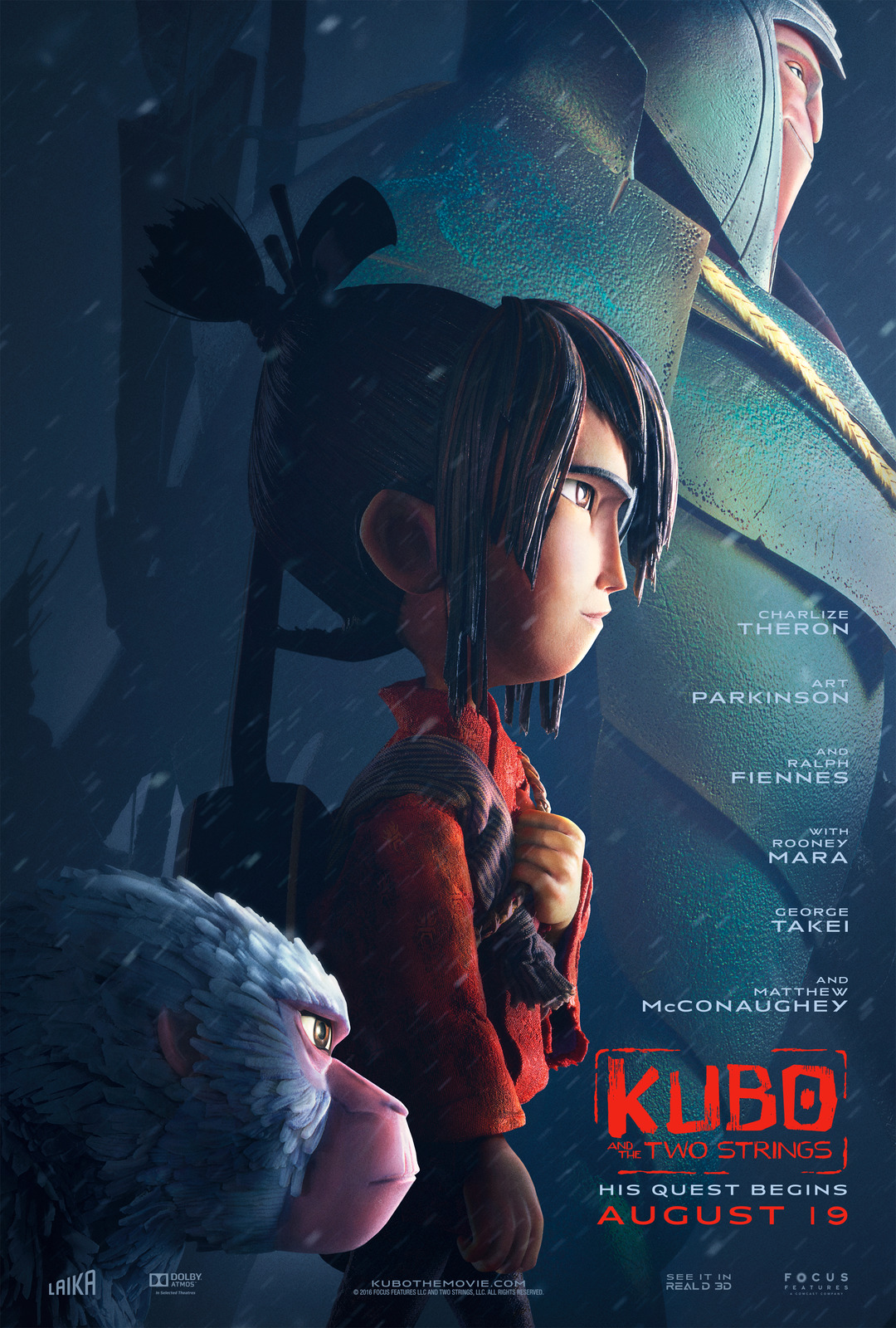
“Kubo and the Two Strings” movie review

kuboAbsolutely beautiful! A dazzling display of the best that cinema can be! Laika and Focus Features’ Kubo and the Two Strings is truly a testament to the art of motion pictures! Brilliantly animated in an eye-catching stylistic way, this film provides audiences with a simple and intimate journey through a dynamically epic world of adventure, laughter, and tears. Directed by Travis Knight, from the opening to the final fade to black, Kubo is arguably the best animated feature length film to hit theaters in a long time. It contains the incredible storytelling that few films, live-action or animated, strive for but often fail to accomplish. Rarely, do audiences witness a perfect film, but this one comes very close to being perfectly written, directed, acted, shot, edited, and produced. With an A-list of vocal talent behind the characters in this immaculately animated world, Kubo will surely impress all those who watch this fantastical story. In some ways, I could argue that this film displays signs of being self-aware. Self-aware in that this simple but effective visual story is all about the very concept of storytelling. Cecil B. DeMille said, “the greatest art is the art of storytelling;” and this film proves that, in a world of high concept blockbusters that are produced to simply generate revenue at the sacrifice of storytelling, there are films with beautiful imagery, writing, and even a great message that hold true to the very idea what launched more than 100 years of cinema.

Following a daring escape from an unknown enemy across a treacherous ocean of tsunami sized waves, a young women survives a nearly fatal crash and washes upon the shore of a beach in the shadow of an imposing mountain with her infant. Many years later, Kubo (Art Parkinson) has grown up to be a young man with a passion for storytelling that he learned from his mother. Never having fully recovered from the accident, so many years ago, Kubo has the responsibility to take care of his mother. Harnessing his talent for magical origami, a stringed instrument, and storytelling, Kubo makes a little money each day for him and his mother. Little did Kubo know that his mother’s warning to not stay outside of their home after dark was for good reason. Soon, Kubo will find himself on an epic journey to unlock a secret legacy that he could have only dreamed of. Along his journey, he meets up with a monkey (Charlize Theron) and a man-beetle (Matthew McConaughey) who protect and teach him along the way. Don’t blink, even for one second, because you may very well miss something of grave importance.

The first thing you will observe in this movie is the exquisite and stylistic combination of two different animation methods. Claymation, which most are familiar with, and the lesser used papermation. Although typically used by themselves to tell an animated story, the brilliant combination of both methods to concurrently tell this epic story will leave a lasting impression upon you. There is a beauty in this film unmatched by any other in recent times. In many ways, the visual appeal of this movie reminds me of the early Walt Disney and Pixar animated films. Audiences can easily witness the absolute passion in every movement, detail, and landscape. I was completely sucked into Kobo’s fantastic world of Japanese influence. In addition to outstanding technical achievements in animation, lighting, and cinematography, Kubo is a film that is equally outstanding in its ability to tell a simple but inspirational story. It is the epitome of an ideal relationship between artists and engineers. This film successfully combines an artisan handcrafted charm with the precision of sophisticated visual storytelling technologies in a dazzling display of cinematic art that will surely be cherished for a lifetime.

Simple. The plot is so simple but yet very much profound. While so many studios are cranking out franchises, adaptations, complex plots, and young adult dramas, the Laika production company chose a different route. It chose a route that proves that the mastery of visual storytelling that showcases the art of cinema is still alive. In a world of the business of moviemaking, Kubo returns us to the art of filmmaking. Not confined to art house theaters in Greenwich Village or West Hollywood, this film is evidence that truly artistic masterpieces are still desired by the American audience. “The art of making art, is putting it together” (Sunday in the Park with George). Knowing that just the leaf ship sequence at the turning point between the first and second acts took 19 months to create, design, and produce, it is clearly apparent that a tremendous amount of time, love, and energy went into every frame of this stunning movie. As someone who has a passion for the very concept of storytelling, this film brought tears to my eyes because of the sheer beauty of the film and the experience of watching it on the big screen. Although it is an endearing film filled with love and adventure, it is also quite scary during some of the intense conflict between Kubo and those who wish to do him harm. From Kobo’s magical origami birds and samurai warrior to the playful banter between Monkey and Beetle, I was awestruck at the brilliance of the film in both writing and visuals.

I highly recommend this film for those who have not seen it yet. I only wish I had made it to the movie before last night. After hearing what others have said and written about this movie, I have come to the same conclusion that many have voiced: this film is exceptional by any known measurable means of evaluating a film. If any animated film this year is destined for an Oscar nomination or win, this one is it.

Ryan teaches screenwriting at the University of Tampa. If you like this article, check out the others and FOLLOW this blog! Interested in Ryan making a guest appearance on your podcast or contributing to your website? Send him a DM on Twitter or email him at RLTerry1@gmail.com! You can catch Ryan most weeks at Studio Movie Grill Tampa, so if you’re in the area, feel free to catch a movie with him!

Follow him!

Twitter: RLTerry1

Instagram: RL_Terry