“The Girl on the Train” movie review

girlonthetrainA tastes great, less filling, David Fincher-esque flick. DreamWorks Pictures and Reliance Entertainment’s The Girl on the Train directed by Tate Taylor and starring Emily Blunt is the much anticipated film adaptation of the best-selling novel of the same name written by Paula Hawkins. With a slow windup and quick delivery, the suspense thriller plays off as a knockoff combination of Alfred Hitchcock’s Rear Window, Fincher’s Gone Girl, and George Cukor’s Gaslight. Despite the wild success of the novel, this film adaptation appears to have jumped the tracks. In fact, fans of the novel may find that this translation from page to screen is a bumpy ride. The film is not without its high points; the plot is certainly intriguing and Blunt’s portrayal of the protagonist is excellent; however, her outstanding performance is simply not enough to carry the weight of an otherwise flawed film. The film fails to truly create that sense of dread and heighten the anxiety levels of the audience. There were many missed opportunities to tighten up the writing during the windup and spend more time on a successful nail-biting punch during the third act. It’s one of those films that feels like Act I is 2/3 of the movie with Acts II/III being 1/6 each. Lots of verbal exposition when exposition through showing would have been more effective. Don’t get me wrong; it was a fun suspense thriller and the plot twist and turning point from Act II to III was quite the shocker; but, the film just never seemed to move beyond the surface level.

Rachel Watson (Emily Blunt) is not adapting to life as a divorcee very well. She has a pronounced drinking problem and cannot seem to hold a job. Rides the train into New York City from the countryside everyday, passing her old neighborhood. Starring into not only her old house but the house of a couple she feels are the embodiment of love, Rachel develops an unhealthy obsession with the characters that appear outside of the window as sh narrates their lives. When she learns that the young woman who lives in the house two doors up from where she used to live, has gone missing, she place herself in the midst of the investigation. Not having dealt with her own sordid past, Rachel begins to obsess over the mystery because of the empathy she feels for the missing girl. Once the authorities feel that Rachel has crossed the line too many times, they begin to look her direction. Determined to solve the case of the missing girl, Rachel must put together puzzle pieces that she never thought she would have to face again.

If I had to sum up the film adaption of The Girl on the Train, I would concisely put it this way: under-developed. From the locations themselves to the writing (screenplay) to the plot and characters, this mystery-thriller-suspense movie fails to impact the audience and truly elicit a strong emotional response. Tapping into emotions and affecting anxiety levels is paramount for suspense-thrillers. After such a long, drawn-out wind up and the rushed showdown, this film does not live up to the hype that the novel generated. Having not read the novel, I cannot comment on differences or even how the movie could have been done better; but screenwriter Erin Cressida Wilson could have done a better of job of creative a cinematic story fit for the silver screen. The flaws of the film so not stop with the writing, but director Tate Taylor’s vision, for the best-seller, should be checked because it appears as though he may need glasses. If it was not for Blunt’s commitment to the character of Rachel, the film would have had very little entertainment value. This is one of those films that was saved by attaching excellent talent.

This film falls into the same sub-genre as Gone Girl. But, what made Gone Girl so successful was the exceptional direction from David Fincher and simply the fact that author Gillian Flynn also wrote the screenplay. If an author can be trained to write the screenplay of the film adaption of their literary work, then that is always the best approach because they know the characters and plot better than anyone. Fincher also includes many WTF moments and treats the camera more than lens through which to witness a visual story but creates magic that takes the audience out of the threats and transports them into the movie. The Girl on the Train has a great premise and intriguing plot. The foundation IS there for a great movie adaptation. The writing not only doesn’t do the book justice, from what I have read, but fails to create a cinematic experience as well.

Other than Rachel, the rest of the cheaters are two-dimensional. We are given just enough information to make them mildly interesting, but the character development just isn’t there. Much like the detective in Gone Girl was as interesting to follow as the main cast, Detective Riley should have been just as well developed for this film. Rachel’s ex-husband, his wife, their nanny, and the nanny’s husband have the makings of a cast of characters filled with lies, deceit, betrayal, dark secrets, and intrigue (and to some extent, that comes across in the movie); however, all those elements are touched on but never truly fleshed out. Do those elements have a place in the plot of the film? Yes. But, do they play a dynamic a role as they could have? Not particularly. Most everything in the film is very surface level. All the makings are there for a film that could be nearly as thrilling as Gone Girl, but it’s all superficial. When location scouting for a film that relies upon houses, transportation, and proximity that are intricate to the plot, it is important to treat them AS cast. The two main houses and the train in this movie almost feel like they were selected out of convenience. Nothing about the locations or train grabbed me or generated a significant emotional response. However, I liked the proximity of the train to the houses and how the lake is on one side and the neighborhood on the other.

If you’re looking for a fun suspense-thriller to watch this weekend, then this one may fit the bill. But, you won’t get nearly the ‘train’ ride that you experienced in Gone Girl. Emily Bunt demonstrates a dynamic acting prowess compared to other characters that she has brought to life. Whether you choose to watch this film in a local cinema near you or wait for it to be on iTunes, Google Play, Amazon Prime, or HBO, the experience will be the same. At the end of the day, it’s a good movie but a poor film.
“Miss Peregrine’s Home for Peculiar Children” movie review

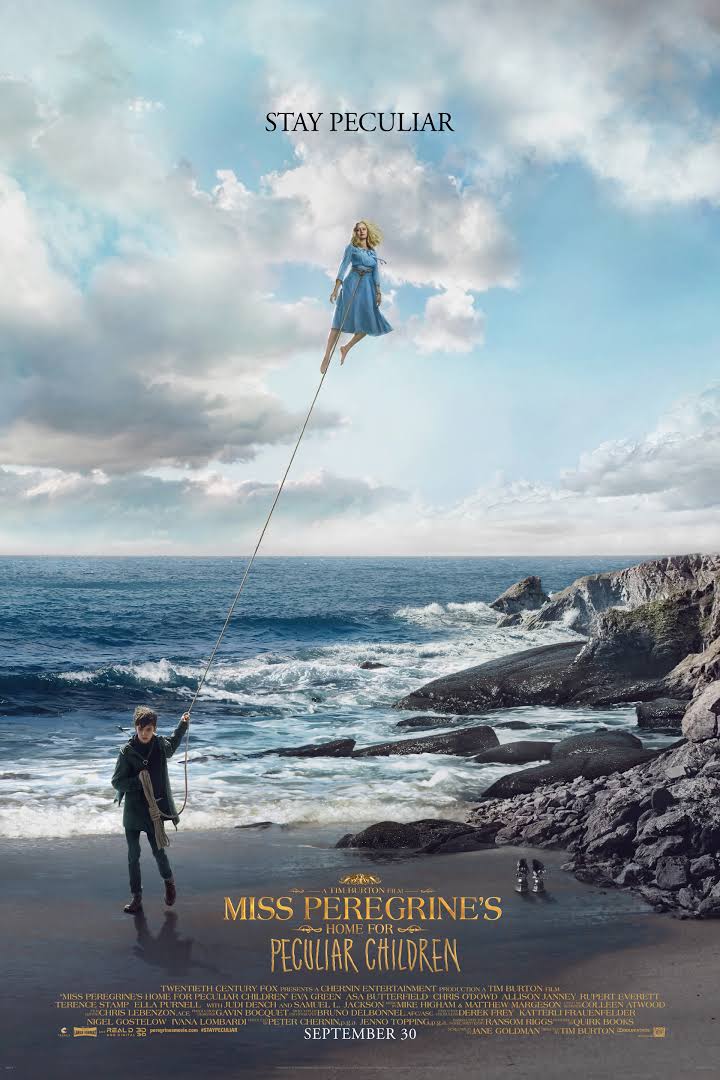
missperegrinneSurprisingly exciting! Twentieth Century Fox brings another YA novel to the screen. Tim Burton’s Miss Peregrine’s Home for Peculiar Children (from here on out noted at Miss Peregrine) is both a fish out of water story combined with a magical adventure that mildly comments on the human condition. Of all the YA movies that have been produced over the last few years, this one provides a much more dynamic experience than many of the others. Burton delights audiences with the classic Burton style that many of us have grown up with. In more recent years, I have often commented that he is essentially a parody of himself–a.k.a. Burt Porn (as coined by my friend Leon in Germany)–not true with Miss Peregrine. Get ready for a return to the class Burton that brought us timeless movies such as A Nightmare Before Christmas and Edward Scissorhands. The great cast is supported by the appearances of Samuel L Jackson and Dame Judi Dench. From Florida to Wales, this movie is sure to whisk you away to daring adventures requiring rather peculiar abilities to defeat those who would seek to take what isn’t theirs to have.

All Jake (Asa Butterfield) knew was his ordinary life. He had a rather blah home life, an eccentric grandfather, and a job that he hated. Until one day, something peculiar happened. In his grandfather’s dying breath he told Jake to find the island. With his parents finding his sports of what he saw at his grandmother’s death to be quite bizarre, they forced hi to visit a psychiatrist. Upon finding a mysterious letter, Jake is determined to find the home in which his grandfather grew up. Accompanied by his cynical father, Jake returns to the island where his grandfather grew up. Only he could never have expected the adventure and run of this life that he will soon find himself. Stumbling across the children’s home ran by Miss Peregrine (Eva Green), Jake teams up with the most unusual but fascinating people who are in a rush against time to defeat those who are out to destroy them.

If I had to name one takeaway from this film, it would be that it reminds me of the 1980s/90s Tim Burton before he “went down the rabbit hole.” It combines his surreal and gothic filmmaking style juxtaposed against his flare for the colorful and bizarre. Although it is not an original concept by any means, if you’re a fan of Fox’s film adaptations of or the animated series X-Men, then you will likely enjoy this movie! Not having read the book, I cannot comment on the film’s alignment and commitment to the literary work written by Ransom Riggs; but, from what I have read online–even the author himself–is pleased with Burton’s translation from page to screen. Very few directors would have been so successful at bringing this story to life more than Burton.  Despite an apparent successful translation from book to movie, the film suffers from an overload of mythology, exposition through dialog, and lacks the thrills to completely balance out the former two elements. Although this movie may feel like one that you have seen before, it does offer a glimpse into Burton’s prime years and perhaps offers a hope that the acclaimed visionary director can once again impress us with his fantastical but highly effective cinematic storytelling.

One of the most successful elements to the X-Men’s plight as individuals born with peculiar abilities is the fact that they are human. They hold onto their humanity (the good guys anyway). Miss Peregrine’s children do not appear to offer the same level of humanity as their X-Men counterparts. The impact of the X-Men’s abilities is felt not only by the X-Men themselves but by the community at large. For the most part, Miss Peregrine’s children’s abilities largely leaves no impact upon themselves or others. Almost plays off more as a convenient plot device than character attributes. Hugo‘s Asa Butterfield’s fake American accent does not really suit his character of Jake. In a world of fantastical dynamics and depth, he plays off as a boring, flat character. In screenwriting, it is vitally important for the writer to cause the reader/audience to love the protagonist and/or love to hate the antagonist. I found it hard to love Jake or truly hate Barron (Jackson).

So, the movie may not have the amazing principle cast that we are accustomed to in a Burton movie; but, it does still contain Burton magic and some exciting and beautiful visuals. It is also a lot of fun to watch! In addition to being fun to watch, it contains some rather disturbing imagery and cringeworthy moments. But that’s par for the course with classic Burton. One of my favorite parts in the movie is the action-packed climactic sequence accompanied by dark humor. It’s a great combination of humor and visceral conflict. If you’re looking for a fun movie to watch this weekend, then this one is a solid pick! Furthermore, if you desire to get a glimpse into a more classical Burton film, then you’ll find utter delight in this one as well.

“Snowden” movie review

snowdenA political docudrama that only Stone could pull off so effectively! Once again, acclaimed director Oliver Stone brings another socio-political issue and figure to the screen. Whether you’re of the school of thought that Edward Snowden should be charged with espionage or heralded as a hero, this film will definitely challenge your point of view. But, isn’t that what Stone is known for??? More than a docudrama of the life of Snowden, Stone’s film is a dramatization of the state of government surveillance. One could argue that surveillance is the star of the film, not Snowden. The intent of the film is not to cast blame on either Snowden or the U.S. Government, but to cast doubt. The simple placement of doubt can be far more powerful than blatantly passing judgment or blame. If there was any ‘doubt’ that Stone is one of the most important filmmakers covering modern historic events, then this film will cast aside any remaining doubt. Few directors, have been so successful in taking cold, hard facts and transforming them into a story fit for cinema. The success of this film is attributed to the incredible lead talent. Joseph Gordon-Levitt and Shailene Woodley have excellent chemistry on screen. Accompanied by a strong cast of supporting players such as Zachary Quinto, Nicholas Cage, Scott Eastwood, Tom Wilkinson, and Melissa Leo, this film’s cast will have your attention until the final fade to black.

Oliver Stone’s Snowden takes you on a journey through the significant events of Snowden’s life from 2006 to 2013 when he was finally granted temporary asylum in Russia. The reason why his name is so famous or infamous–that depends on which school of thought you are from–is not new and even blasé at this point; but, the events of his professional and personal life that culminated in the leak and disclosure of NSA (National Security Administration) surveillance secrets and programs are not as widely known. Disillusioned with his career as a highly sought after top digital media and intelligence contractor, Edward Snowden (Gordon-Levitt) begins to wrestle with being able to justify and reconcile the rampant surveillance data that the NSA is collecting and how it affects both private citizens as well as those who are being hunted for crimes against humanity and the U.S. After deciding that it was best to go public with the information, he is then on the run of his life. A traitor to some and a hero to others, this film will prompt you to perhaps rethink the actions of Snowden.

Although this film has slow pacing, for those who are interested in the life of the–to borrow from J. Jonah Jameson–hero or menace, Stone’s docudrama will successfully hook you and draw you into this world of intelligenceSnowden is a particularly interesting docudrama because this film essentially contains three smaller movies–a three legged stool if you will. There is the most dominant story of Snowden discovering the copious amount of secret government surveillance data being collected by his software. Next, we have the personal romantic story of the ups and downs of his relationship with the liberal, artistic, amateur photographer Lindsay Mills (Shailene Woodley) and how his professional life gently affected their relationship. And finally, the story that made Snowden a household name: his leaking and dissemination of top secret NSA surveillance methods and everything else Snowden knew about questionable NSA methods of collection. For most people, that third story is all anyone knows. But, in order to truly get an idea of the pressure Snowden must have been feeling, it is imprint to take the other two stories into account. That is precisely what Stone did with this film. Stone’s version of the life and times of Snowden takes the other Snowden film Citizen Four a step further to truly be able to analyze all the known elements.

There are many excellent qualities in the writing and visual storytelling in this film, but there are two areas that appear to falter or suffer in the translation of these now historic events. The focus of the movie is definitely on what led Snowden to leak the NSA secrets, but there is a significant amount of time spent on the relationship between Snowden and Mills. One could argue that the strain of his relationship with Mills contributed to his eventual disclosure of the NSA secrets. Cinematically speaking, the strategic placement of the personal life of Snowden is important because the audience needs a break from the flat panel displays, computer code, and “geek-speak.” Unfortunately, Stone and his co-writer Kieran Fitzgerald did not carefully contract and craft the personal dialog as well as they did the info tech and military dialog. In many ways, the forced personal story of the relationship between Snowden and Mills comes off as a forced element from producers to make the film more relatable to those who are not AS interested in the military side of the story and more interested in the outside/personal influences that affected Snowden’s actions. It’s not unlike fans wanting to know the personal details of a celebrity’s life. Unfortunately, this human interest subplot does not play out as well as the two dominant stories at the forefront of this film. That being said, both Gordon-Levitt and Woodley are extremely committed to the characters/historic figures they are portraying. I cannot think of two other actors who could have been better suited to play these roles. Gordon-Levitt nailed Snowden’s voice, body language, and nuances.

The other area of this film that appears to suffer is the structure–the map, if you will. Any first year film student can tell you that flashback movies can be dangerous. Often times, the flashback is used as a copout plot device that simply plays off as lazy writing. From a technical perspective, a movie that uses the flashback as a means to tell the story is referred to as a nonlinear film. Now, I am not stating that Stone’s movie is lazily written and structured; however, I do not feel that the constant back and forth between the past and then-present were handled delicately or strategically enough. Most of the time, one of the comments I have about movies that rely upon the flashback as a plot device to tell the story is ‘Why is there a need for a flashback? Just let the main story BE the main story.’ The flashback concept works for some films like The NotebookFried Green Tomatoes, or IT; but it does not work for others such as Ladder 49 or The Weight of Water. Most of the time, a flashback is used out of convenience to fill runtime; meanwhile, the audience usually doesn’t care about the past as much as what is going to happen next in the present. Stone and Fitzgerald are mostly successful as keeping the audience entertained, caring about, and longing for what happens next in BOTH the past and present; however, I found the movie to go between both the present and past too much, almost to the point that it was a little confusing. Opening with Snowden and the small group of journalists was a great way to begin, but I feel that the story of Snowden would have been a little more gripping if we were able to watch the events from 2006 to 2013 unfold without present-day interruptions. Still, the ending that was selected for the film was both effective and strategic.

Oliver Stone’s Snowden is not a film for everyone. For those who enjoy socio-political movies or docudramas of historic figures, then you will likely enjoy it! If you are looking for an action-packed spy thriller, then is this not for you. Unlike some movies that truly ARE better experienced on the big screen, this is one that is equally experienced as well on the big or small screen.

“The Secret Life of Pets” movie review

SecretLifePetsWhen well-developed setups lead to brilliantly executed gags, throw in some adorable house pets and endearing street animals and you get Universal Pictures and Illumination Entertainment’s answer to what toys do when the owners aren’t around, The Secret Life of Pets. More precisely, this movie could be described as Toy Story meets Oliver and Company meets Homeward Bound. Backed by an exquisitely talented cast of voice actors and excellent writing, The Secret Life of Pets could be what ushers Illumination Entertainment (an NBCU company) into the ring with Disney-Pixar. Prior to this movie, Illumination/Universal certainly created some fantastic animated films including The LoraxDespicable Me, and others; but this film is the first to really be on par with the Disney-Pixar quality that many of us have come to love and expect. Fast-paced and comedically timed very well, this movie is sure to entertain and warm the hearts of anyone who sits down to watch it. Is it quite as endearing as Toy Story? Not exactly; but it is very close and serves as evidence that we should come to expect this quality and higher of animation from Universal/Illumination. Although the movie is marketed to kids and teenagers, there is certainly enough comedic subtext, easter eggs, and nods to films that adults will greatly appreciate as well. One of my personal favorites is in the Millions short film before the feature. One of the minions is wearing a hat that states “let it grow” while he’s cutting the grass.

When Max (Louis C.K.), a spoiled terrier living in a New York City apartment building with a beautiful view meets his new roommate, his perfect world is rocked. New roommate Duke (Eric Stonestreet), a giant rambunctious dog, mixes as well with Max as oil does with water. They are complete opposites in nearly every way. Max soon gets the idea to set Duke up for failure by sabotaging the house. Unfortunately that idea backfires and just serves to stoke the fire of animosity. After a prank in the park takes a turn for the worst, both Max and Duke are lost in the seedy underbelly of New York City. One step forward and two steps back is exactly the pace of the journey home for both canines. Following a run-in with a street gang led by the ferocious but cute bunny Snowball (Kevin Hart), Max and Duke find themselves in Brooklyn after escaping the hoard of animals bent on their destruction. Along the journey home, Max and Duke are forced to work together and support one another in order to have any hope of returning to their comfy apartment.

The Secret Life of Pets‘ success is in-part due to the successful setup and payoff of gags. This can be a dangerous platform on which to build an animated comedy because there is a high risk of the narrative primarily resting upon the gags instead of the gags enhancing the diegesis. Fortunately for audiences, this film successfully pairs a well-developed and paced narrative that will keep your attention and deliver laughs for the entire runtime. Sometimes comedies, whether animated or live action, can spend too much time in the development of gags rather than on the visual storytelling. For instance, some movies write the gags first and then try to integrate a story that attempts to tie all of them together. What I appreciate about The Secret Life of Pets is the strong story inclusive of sight gags and double entendre humor to satisfy a diverse audience from different backgrounds and ages. In addition to the writing, the vocal talents are also instrumental in the success of this animated feature. Leading the “pack” are of course comedians Louis C.K. and Kevin Hart, but the entire cast is perfectly pairs with his or her animated persona. For the cat lovers out there (and yes, I am one of them), there are deftly come good comedic jabs at dogs. But the dogs also get in some good ones on the cats. Haha.

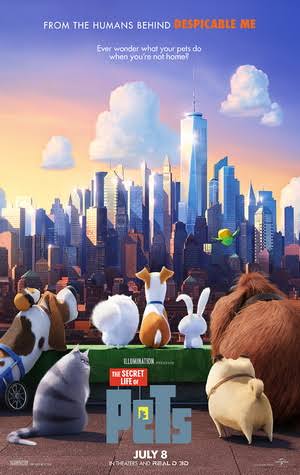
The setting of the movie is New York City, or an idealistic surreal New York City slightly augmented to fit the pacing, genre, and feeling of the film. I’d like to know what job Katie has to be able to live by herself in an apartment with such a beautiful view. But I suppose it’s just as well that we don’t since the focus is on the dogs. On the view from the apartment, though. Much like the view from Frasier’s upscale urban trend-setting apartment in Seattle faced a view of the Seattle skyline that doesn’t actually exist, unless you are looking at downtown from the surrounding mountains and hills, I am not entirely sure the view from Katie’s Manhattan apartment exists either. The view of the city seen from Frasier’s apartment was selected in order for the Space Needle to have a prominent placement in the skyline. In the same vein, I believe that the unrealistic view from Katie’s apartment was selected in order for the Freedom Tower to have a strong presence. I know, I am analyzing an element that doesn’t really have an affect upon the film; but since the film is actually very well done, I thought it would be fun to look at the setting of the movie.

Although I can almost guarantee you that his film won’t see an Oscar nom in the animated feature category, much less a win, since the Academy believes that only Pixar can create Oscar-worthy animated films, I find The Secret Life of Pets to be a fantastic animated feature filled with action, adventure, comedy, and some touching moments as well. All around, it is enjoyable for the whole family and will cause many owners to wonder what their pet does while he or she is away at work. One of my favorite parts of the movie is the musical sequence at the sausage factory. So much symbolism to discuss. Haha. So, yes. This movie even includes a musical number worthy of–I am sure–many memes to come over the next few months.

“Finding Dory” movie review

Finding_DoryA cute but ultimately emotionally static sequel to a beloved animated film. Disney-Pixar’s highly anticipated sequel Finding Dory makes a splash this week. Following the critically acclaimed success and continued popularity of Finding NemoFinding Dory hopes to find a place in your heart as well. Unfortunately, this film struggles to leave as lasting an impact as the first movie. Many film and Disney enthusiasts, approaching this film, knew that it was most likely going to be either a Cars 2 or a Toy Story 2; it falls somewhere between the two, but closer to the former. Not straying too far from from the plot of its predecessor, Finding Dory‘s message about disabilities turned strengths get a little lost in the emotionally static feel and somewhat forced turning points and dialog. The film certainly has its moments of laughter and surprise, but those are few and far between. Using its predecessor as an example, it is highly unlikely that Ellen DeGeneres could have been replaced by any other voice actor and the character of Dory still remain as endearing; however, honestly in this film, not just Ellen, but any of the other voice actors could have been replaced and the characters and plot play out just the same. A film needs to be a roller coaster of sorts–have its ups and downs–but Finding Dory pretty well stays rather somber the entire time. But yes, it does have some funny and pull-at-your-heart-strings moments. All in all, this movie feels like a forced sequel that wasn’t entirely necessary but produced in response to the high demand for a return to the world of Dory, Marlin, Nemo, and their friends.

Many years before Dory (Ellen DeGeneres) and Marlin (Albert Brooks) bumped into each other, Dory was just a baby fish with two loving parents. Struggling with short-term memory loss from an early age, Dory’s parents worked with her everyday to learn and grow. One day, she found herself all alone and couldn’t find her parents. And over the course of years searching, she found her way to the reef where she encountered a frantic dad searching for his son; and well, the rest is history. Moving up to present day. With an inability to shake the feeling that she keeps forgetting something really important, Dory finally remembers that she lost her parents. Although the memories are vague and spotty, she knows for certain that she needs to find them. After begging Marlin to go on another adventure out past the drop off, Marlin and Nemo agree to partner with Dory in search of her parents. From one side of the ocean to the other, nothing will stop Dory from locating her long lost parents to reunite as a family.

Like with Zootopia as well as other Disney films, there is usually a message in the subtext of its animated features and shorts. Finding Dory clearly has a message about perceived disabilities. Perceived in that, what is otherwise a physical or emotional disability, can be used to develop strengths. Most of the characters that you will encounter in this movie have some kind of disability. Dory and her memory is the main one, but there are definitely others. I don’t want to give much away, so we’ll just leave it at that. Although I feel the approach to writing this message into the diegesis of the film was a bit forced or heavy-handed, it doesn’t take away from the fact that it was handled very well and is mostly seamlessly integrated into the plot and mild character development. The two characters who offer the audience the most, in terms of character arc and development are Dory and her septopus friend Hank (Ed O’Neill). What’s a septopus? Just watch the film and find out. Both characters are mildly entertaining but lack that magical spark that was so much a part of Finding Nemo. One area that sequins sometimes find themselves in, is pulling from the first movie so much that you leave the sequel wondering why it was even necessary. Thankfully, that really isn’t the case with Finding Dory. But you’ll be happy to know that you will see some familiar faces from the first one, including everyone’s favorite sea turtle and stingray. Among the new characters in the movie, my absolute favorite was Becky!! Such a hot mess and quite possibly a little disturbing. Those eyes, though. She was so instrumental in my enjoyment of the movie!

I had the fortune of screening the film with one of the lead vocalists from Disney’s Animal Kingdom’s Finding Nemo the Musical. And I won’t disclose who it was, but he “totally” eats, breaths, and sleeps Nemo and his friends. This was a fantastic opportunity to include an analysis of, not only my point of view on the film, but someone else’s who has a lot of time and energy vested in this property. I half expected him to disagree with me after the movie ended when we began discussing it. But, it turns out that he feels very much the same as I do. He was able to point out some elements that were actually taken from the show at Animal Kingdom, which was really cool! It’s a show that I watch fairly often as well, as I am a former Cast Member myself and current Annual Passholder. Having the ability to discuss Finding Dory in regards to how it fits in with not only its predecessor but the live show was fantastic! He echoes many my same opinions on the movie, but also adds that the kid behind us told their mom that it was amazing. So, in terms of how well this film plays out for children, it does a great job. Many of the young people are about the same age I was when I saw the first one. I think what I missed most in Finding Dory as opposed to Finding Nemo is the lack of comedy. There is definitely some funny moments in the film but the comedic timing and structure simply doesn’t hold a candle to its predecessor. Reminds me of a quality just above a straight to DVD/BluRay or a commercial-free Disney Channel Original Movie. Let’s remember this: Toy Story 2 was also a fairly week sequel–albeit entertaining and heartwarming–and then it came back with the phenomenal tear-jerker Toy Story 3, so it is entirely possible that the Nemo property will go through the same evolution.

Competing against Central Intelligence and a handful of limited releases, Finding Dory is sure to beat out the competition this weekend. And for what it’s worth, it is a fun movie that warms those of us in our 20s and 30s with childlike nostalgia of when we first saw Nemo. Is this destined to be the next great Disney-Pixar film? Probably not. However, that doesn’t mean that you cannot enjoy it with your friends or family. Certainly, it is a wonderful movie to be enjoyed with those who love seeing familiar characters and meeting new ones. I just wouldn’t go into the movie looking for an excellent and dynamic story.