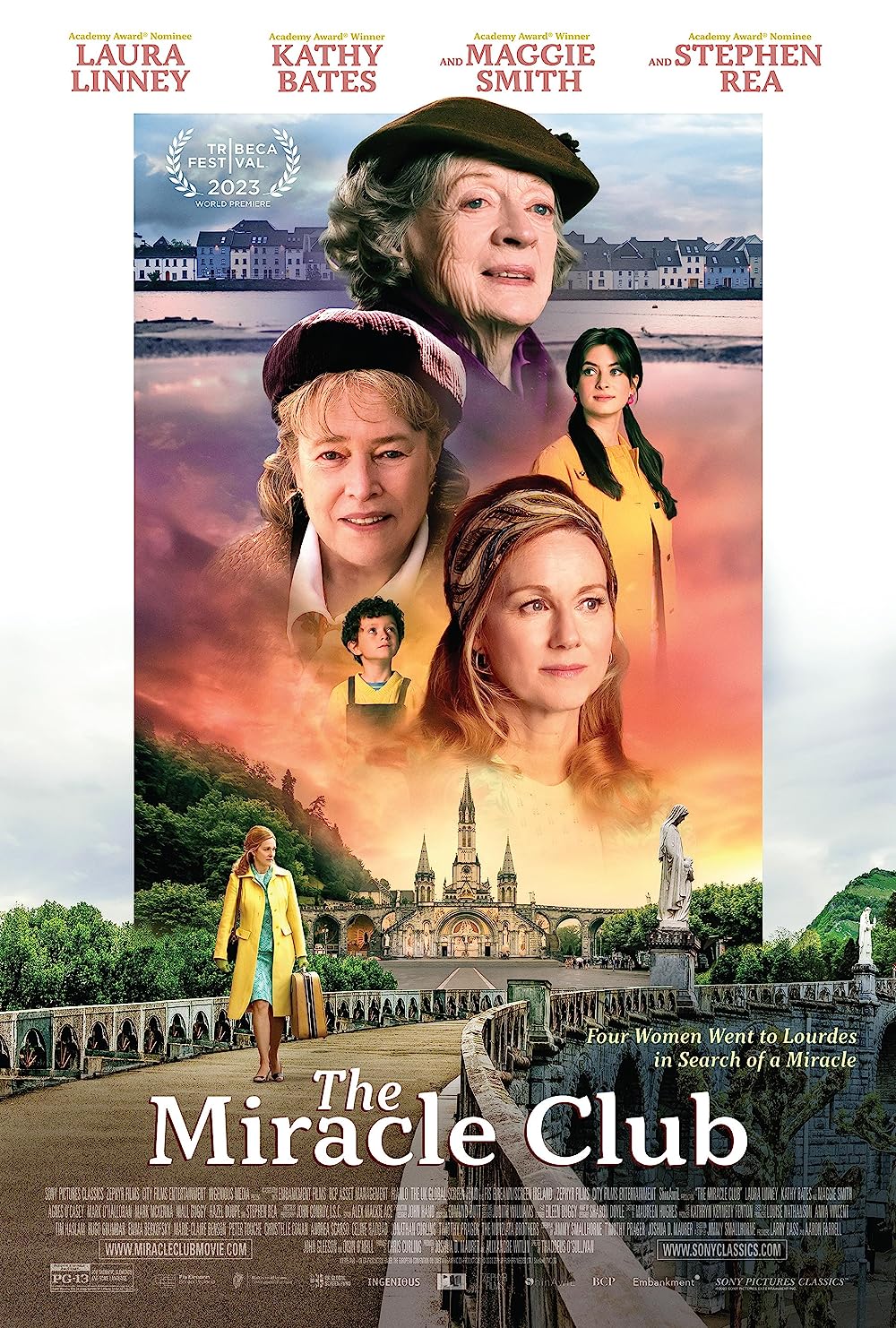
THE MIRACLE CLUB movie review

Charming. The Miracle Club is an intimate portrait of the importance and catharsis of the painful act of forgiveness, both asking for and granting. If miracles were recurring, they’d be called regulars, as it stands, miracles are real but rare. Moreover, sometimes the smallest of, what we may characterize as, miracles, is the most transformative.

There’s just one dream for the women of Ballygar to taste freedom: to win a pilgrimage to the sacred French town of Lourdes. With a little benevolent interference from their local priest, a group of close friends get their ticket of a lifetime.

The plot is simple, but the characters incredibly complex. And thanks to the outstanding performances of the lead cast Dame Maggie Smith, Kathy Bates, Laura Linney, and Agnes O’Casey, this character-driven story will capture your mind and soul. Both believers and skeptics will find the characters authentic, lacking in any pretense.

Each character demonstrates the type of vulnerability that draws us in to connect with one or more of them, as we share many of the same questions, fears, anxieties, strengths, and weaknesses. From a character that was estranged from their family and hometown to a character harboring regret and resentment to one that feels they made a decision that potentially harmed their child, there is quite the portrait of traumas, sages of grief, and regret on display to inquire conversations following the close of the film.

Taking place in the picturesque town of Lourdes, the film transports audiences to stunning landscapes populated with gothic architecture. Never does it feel like a travelogue, but the setting itself is a character, in a manner of speaking.

This review is relatively short, because much of what there is to analyze is spiritual and philosophical in nature, and you have to see it to truly understand. Suffice it to say, wherever one falls on the spiritual spectrum, there is so much that is relatable in this film.

Ryan teaches Film Studies and Screenwriting at the University of Tampa and is a member of the Critics Association of Central Florida and Indie Film Critics of America. If you like this article, check out the others and FOLLOW this blog! Interested in Ryan making a guest appearance on your podcast or contributing to your website? Send him a DM on Twitter. If you’re ever in Tampa or Orlando, feel free to catch a movie with him.

Follow him on Twitter: RLTerry1 and LetterBoxd: RLTerry

SOUND OF FREEDOM movie review

Aleatoric. (Music theory folks will get it). Sound of Freedom is like Taken meets Argo, but the compelling true story ultimately falls slightly flat because of poor pacing. However, the film delivers on both technical merit and casting. While some outlets have described Sound of Freedom as a faith-based film from the same studio that produces the successful television series The Chosen, that is an inaccurate reading at best and an attempt to disparage the film’s quality at worst. Because this movie most definitely delivers on high production value and casting; but unfortunately, the performative dimension and screenplay are underwhelming. Feeling more like a visualization of the Wikipedia entry or Congressional testimony, Sound of Freedom‘s ambition is tapered by screenplay mechanics.

After rescuing a boy from ruthless child traffickers, Tim Ballard (Jim Caviezel), a federal agent, sets out on a dangerous mission to locate and free the boy’s sister, along with other children caught up in the nightmare of sex trafficking. With time running out, he quits his job and journeys deep into the Colombian jungle, putting his life on the line to free her from a fate worse than death.

There is certainly a compelling, gripping, gritty screenplay based on the true story of Tim Ballard’s mission to free children caught up in sex trafficking, but the plotting and pacing of the screenplay hold the film back from achieving the potential is so clearly demonstrates. While the screenwriting lacks finesse, there is no doubt that this film forces the world to face the nightmarish and closeness of the reality of human (specifically, child in this film) slavery and sex trafficking. Most acknowledge the importance of fighting human trafficking, but few realize how close to our own country this subject matter hits.

We often think of human trafficking as something that happens in foreign lands, but most of those that pay for such reprehensible services are operating out of the United States. Sound of Freedom is a grim reminder of the real war that is being waged in which innocent people are bought, sold, and traded as disposable commodities.

Visually, the film looks fantastic! Clearly, there was immense thought placed into the quality of image. Moreover, this same level of thought is witnessed in the settings and even in the casting. This film reminds me of the type of motion picture that we often see from Annapurna productions. In terms of the visual tone, it falls between arthouse and mainstream, which is to the film’s detriment, because had it stuck to either the look/feel of Taken or Argo, then the film would have been more surefooted. On the plus side, though, clearly Angel Studios has show the world that they are capable of releasing high quality motion pictures that can compete with the larger Hollywood studios.

Clocking in at around 2.25 hours, the film’s second act feels incredibly drawn out. I’ve written before about the litmus test I give myself, which evaluates pacing, and to that end, I did look at my watch about 1.5 hours into the film. Structurally, the first and third acts work sufficiently well, but the second act is augmented to needlessly extend the runtime. As this interpretation of the true story has it, there is enough plot for about 1.5-1.75 hours, meaning there is about 30-minutes that could have been cut out to streamline the motion picture.

I mentioned my observation that many outlets and other critics are referring to Sound of Freedom as a faith-based film, and there is little evidence to support that reading since there lacks any type of salvation or proselytizing message in the film. Because I’m sure we can all agree that God’s children are not for sale. If there is a message in the film, that is it. A universal truth that is applicable to and relatable by all.

Ryan teaches Film Studies and Screenwriting at the University of Tampa and is a member of the Critics Association of Central Florida and Indie Film Critics of America. If you like this article, check out the others and FOLLOW this blog! Interested in Ryan making a guest appearance on your podcast or contributing to your website? Send him a DM on Twitter. If you’re ever in Tampa or Orlando, feel free to catch a movie with him.

Follow him on Twitter: RLTerry1 and LetterBoxd: RLTerry
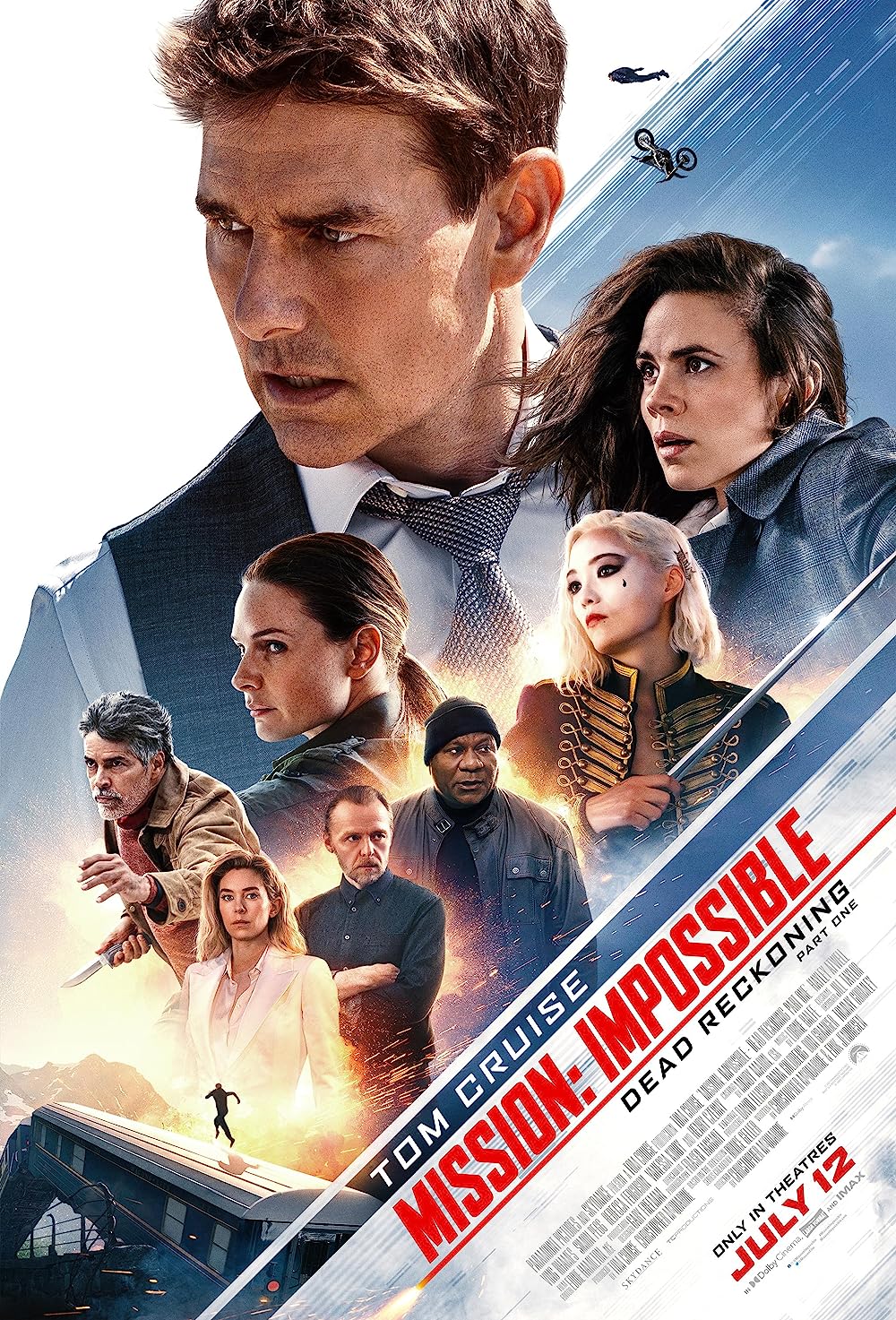
MISSION: IMPOSSIBLE–DEAD RECKONING PART 1 movie review

Exhilarating! Pure, unadulterated cinema! Tom Cruise and the whole Mission Impossible team deliver what is likely the most epic movie of the year!! It’s thrilling, funny, and suspenseful from beginning to explosive ending! Part 1 is both a complete story and sets up Part 2 exceptionally well. If I am to be objective, Mission: Impossible III delivers the best story; however, audiences are still going to love this movie because feels like cinema in every measurable way. Move over James Cameron, Christopher Nolan, and yes even Martin Scorsese, for it is Tom Cruise whom knows how to deliver cinema to audiences.

Ethan Hunt (Cruise) and the IMF team must track down a terrifying new weapon that threatens all of humanity if it falls into the wrong hands. With control of the future and the fate of the world at stake, a deadly race around the globe begins. Confronted by a mysterious, all-powerful enemy, Ethan is forced to consider that nothing can matter more than the mission — not even the lives of those he cares about most.

After the massive success, both critically and financially, of Top Gun: Maverick I was curious to witness whether or not Cruise would pull off another cinematic hit. Suffice it to say, he did just that! The last remaining movie star, in the classical sense, Tom Cruise continues to deliver entertaining and thoughtful cinema. In an era overridden by form over function motion pictures (though, there is certainly a place for those stylistic films), Mission Impossible: Dead Reckoning Part 1 (MI7) proves that cinema is should generally concern itself with both the form and function equally. By sticking to foundational screenwriting conventions, pairing it with sequences that make the most of every square inch of that big silver screen, the entire MI team demonstrate why cinema is not only about the art of the narrative but also in a larger-than-life experience.

The entire auditorium was electric at the screening I attended. I don’t think I felt the level of kinetic energy at the cinema since Top Gun: Maverick. It even surpassed the high-energy of the more recent The Flash. Perhaps it is the combination of classical espionage/action plotting and epic-sized set pieces and locations. While MI7 feels very much contemporary, it also never forgets its roots in both the previous MI movies or in the original TV show. Of course there are those that will overly critique the dialogue, more specifically its lack of subtext, but I argue that it is on brand with and perfectly appropriate for this genre movie. Does that mean writers and directors should simply aim for status quo? No, MI3 proved that MI movies can be exciting and full of heart, complete with characters rich with dimension. But the dialogue should not significantly impact the overall experience of this movie.

Without getting into spoilers, the mission, should you choose to accept it, is to stop the character of opposition from unleashing a destructive artificial intelligence (AI) on the world. Talk about timely social and tech commentary. The film broaches topics such as truth (subjective/interpretive truth) and truth (as in universal truth). By extension, this same idea is carried over into fact vs opinion and predictive decisions (in the vein of Minority Report). In short, the crisis that Ethan is attempting to prevent is one that would completely disrupt, retcon, and violate the very informational fabric of life. Think Skynet. While I wouldn’t characterize MI7 as being inordinately deep or thoughtful, concerning truth and AI, it does posit these questions and subjects, which provides opportunities for more discerning audiences to discuss the advantages and disadvantages of AI. More specifically, the dangers of AI falling into the wrong hands.

The set pieces and locations are cinematic in both scale and scope. From the beginning of the movie on a submarine in the Bearing Sea to the Alpine vistas of Austria, the best way to experience this motion picture is in a premium format at your local cinema. Moreover, the biggest screen with best sound possible will make the car chases and Tom Cruise’s stunts all the more outstanding! Even though we’ve all seen that stunt in which Cruise launches himself off the mountain on a motorcycle in various promotional content for this movie, watching it in the third act of the film was still so incredibly impressive!

While Cruise performing most of his own death-defying stunts is unparalleled and impressive enough, what makes these car chases and stunts even more adrenaline-pumping is the fact so little CGI is used. Tom Cruise is literally launching himself off a mountain, and he (and others) are literally driving cars through the streets of Rome. The lack of overt CGI or relying upon it to take the real danger out of the stunt sequences removes just that–the danger. These stunt sequences are all the more exciting because they are real–there is little to no simulation employed. Not to over simplify, but the dimension of real beats the flat, lifeless CGI sequences every time. Real>artificial.

And that’s precisely what we have here real cinema! On a personal note, I am so incredibly grateful for Tom Cruise keeping cinema alive! He has demonstrated through Maverick and now with MI7 that he understands what it means to craft cinematic stories for the silver screen! Before you @ me, I am fully aware that cinema takes various forms, form intimate character studies to the avant-garde, but the power of a genre movie that follows screenwriting conventions should never be devalued. Genre movies are what helped build cinema, and folkslike Tom Cruise keep them coming to entertain and thrill us.

Ryan teaches Film Studies and Screenwriting at the University of Tampa and is a member of the Critics Association of Central Florida and Indie Film Critics of America. If you like this article, check out the others and FOLLOW this blog! Interested in Ryan making a guest appearance on your podcast or contributing to your website? Send him a DM on Twitter. If you’re ever in Tampa or Orlando, feel free to catch a movie with him.

Follow him on Twitter: RLTerry1 and LetterBoxd: RLTerry
NO HARD FEELINGS movie review

A clever inversion of The Taming of the Shrew that delivers some laughs and heart, but is ultimately a mediocre comedy. If you were to take 10 Things I Hate About You, Never Been Kissed, and Shakespeare’s Taming of the Shrew, invert the plot, then you’d have No Hard Feelings.

On the brink of losing her childhood home, a desperate woman (Lawrence) agrees to date a wealthy couple’s introverted and awkward 19-year-old son (Feldman) before he leaves for college.

The outside/action story is well-written, but the subplots are left to aimless wander throughout the movie. The central plot is well-structured, and the audience will be hooked, but the screenplay introduces ancillary characters and subplots that do nothing to advance the story in substance or form. Disappointingly, there is one particular subplot in the life of Maddie that is introduced but never truly revisited or resolved. Moreover, this event afforded the movie to provide thoughtful social commentary on how harboring unforgiveness is like drinking poison hoping that it hurts the other person, but fails to explore this timeless life lesson and theme. Likewise, there is a subplot introduced in the life of Percy that is expressed through an ancillary character, but it feels incredibly out of place and forced.

Another prominent theme and subplot in the movie is the idea of gentrification or being metaphorically and literally pushed out of your home because it’s been deemed highly desirable by the elite. We revisit this subplot throughout the movie, but it’s never truly explored. Such a fantastic opportunity to comment on resilience and serve as a cautionary tale of what happens when neighborhoods are wiped off the map, but it only serves as a shallow plot device.

What the movie lacks in thoughtful social commentary in the subplots and themes, it makes up for in the excellent chemistry between Jennifer Lawrence (Maddie) and Andrew Feldman (Percy). The strength of this subversive romcom can be found in the vulnerability and rawness of the central characters of Maddie and Percy; moreover, both Lawrence and Feldman bring an infectious, entertaining energy to their respective characters caught up in one of Shakespeare’s more endearing and thought-provoking plots. While the movie won’t likely find itself one that will be revisited for years to come, it is sufficiently funny and heartfelt for a weekend afternoon at the cinema or for an evening at home.

If you want to laugh, this movie will do the trick! Clearly the lead characters are having fun with their respective roles, and that enthusiasm is felt by the audience.

Ryan teaches Film Studies and Screenwriting at the University of Tampa and is a member of the Critics Association of Central Florida and Indie Film Critics of America. If you like this article, check out the others and FOLLOW this blog! Interested in Ryan making a guest appearance on your podcast or contributing to your website? Send him a DM on Twitter. If you’re ever in Tampa or Orlando, feel free to catch a movie with him.

Follow him on Twitter: RLTerry1 and LetterBoxd: RLTerry

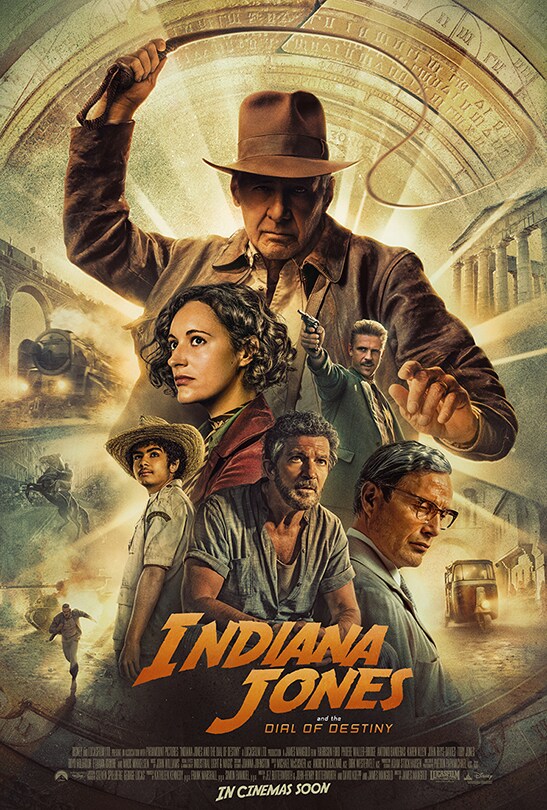
INDIANA JONES: AND THE DIAL OF DESTINY movie review

And the dial of mediocrity. While the movie’s charm lies in the classical action-adventure premise and tone, Harrison Ford’s final performance as the titular adventurous scholar ends with a forgettable movie devoid of the humor, tension, scale and scope of the first three Indiana Jones movies. Moreover, the screenplay suffers from poor pacing and lack of character-building. However, it’d be unfair to characterize the movie as being completely uninteresting. In fact, Indiana Jones: and the Dial of Destiny is a fun enough throwback movie for the whole family to enjoy.

Daredevil archaeologist Indiana Jones races against time to retrieve a legendary dial that can change the course of history. Accompanied by his goddaughter, he soon finds himself squaring off against Jürgen Voller, a former Nazi who works for NASA.

The James Mangold helmed fifth and final installment in the Indiana Jones franchise is neither bad nor good enough to be memorable. Moreover, neither does the movie deliver in setting nor technical achievement.

Speaking of technical achievement, any overly negative reports of the de-aging of Ford, in the protracted prologue, are greatly exaggerated, nor does the CGI in the rest of the movie feel obtuse or too overt. On the contrary, I was greatly concerned for the exchange of practical effects for CGI on the levels of being distracting. While I noticed here and there, it wasn’t what I would characterize as highly conspicuous.

Gone is the grand scale and scope of the first three Indiana Jones movies in exchange for a world that feels as if it could fit in a space the size of Guam. For an action-adventure movie, it struggles to deliver on either. If we boil it down to its storytelling DNA, does it check off the basic requirements of an action-adventure movie? Sure. I won’t take that away from the movie. But does it excel at any one of those elements? Aside from remaining clean enough for the whole family to enjoy, no, it does not. While it is certainly a better story than Crystal Skull, unfortunately, Crystal Skull is more memorable than this installment (albeit, for all the wrong reasons). Dial of Destiny certainly feels way closer to the first three Jones movies than Crystal Skull ever will. It is of the same DNA, but not expressed nearly as thoughtfully or charismatically as the original trilogy.

As I’ve stated countless times before, (except for rare occasions) when a movie’s writer (or editor) and director are the same person(s), then there fails to be a sufficient check and balance system narratively. Mangold has shown that he is capable of both, I cite Logan, but that was perhaps the exception while Dial is the rule. There is a good story in this movie, but nothing was executed by storytellers that truly cared. I was shocked to see David Koepp’s name attached to this movie, because he took Michael Crichton’s original Jurassic Park screenplay and shaped it into the masterful story we’ve been enjoying for three decades. Crichton provided the novel and screenplay bones and circulatory system, but Koepp crafted the muscle and skin. Dial of Destiny does not feel like a Koepp screenplay, but perhaps Mangold flexed his directorial muscles too much and Koepp’s genius was lost.

Oh, as an aside, no Helena, that’s just called stealing. Perhaps go back to school and take an economics class. Come to think of it, that would have been a funny Jones line in the movie. And the movie was in desperate need of comedic relief.

The movie opens with plundering Nazis, in classic Jones fashion, and we are introduced to a 30, 40-something Dr. Henry Jones Jr. The prologue (which makes up most of Act I) delivers all the trappings of a classic Indiana Jones movie, but it goes on, and on, and on for nearly a half-hour. And it wouldn’t’ be so bad if this half-an-hour significantly impacted events in Acts II and III, but it ultimately sets up very little. Is it a fun and somewhat exciting method for returning audiences to the 1930s and 40s world of Indiana Jones, definitely. But does it fail to justify its protracted sequence of events? Also yes. The movie’s pacing would have beeb greatly helped by cutting the prologue down to 10–15-minutes. Think: opening of Indiana Jones: and the Last Crusade. I’ve a feeling that’s what Mangold was going for in this movie.

There is one plot device that this prologue does foreshadow, and if you think it’s never going to go there, guess again. I’ll leave it at that to avoid spoilers.

I’d be remiss not to comment on the charm of the movie. While it may suffer from many problems that hold it back from reaching beyond mediocrity, there is no doubt that it delivers the throwback premise and tone we love about these classical action-adventure movies. I just wish it had more action and adventure in the storytelling mix. I appreciate the movie for remaining true to form (in its most simplistic form, but form nevertheless), and not increasing adult visual content or language in order to be perceived as with it. Increased adult content is not the mark of a franchise maturing over time, in fact, it’s a cheap gimmick that devalues. There are certainly times and places for it, but an Indiana Jones. movie was not it. So it can be praised for keeping the content, tone, and form of classical action-adventure alive–on life support–but alive.

Not sure why Disney is releasing this for the week of July the 4th, because it works much better as a Father’s Day movie.

Ryan teaches Film Studies and Screenwriting at the University of Tampa and is a member of the Critics Association of Central Florida and Indie Film Critics of America. If you like this article, check out the others and FOLLOW this blog! Interested in Ryan making a guest appearance on your podcast or contributing to your website? Send him a DM on Twitter. If you’re ever in Tampa or Orlando, feel free to catch a movie with him.

Follow him on Twitter: RLTerry1 and LetterBoxd: RLTerry