Christmas Arrives at Disney’s Hollywood Studios

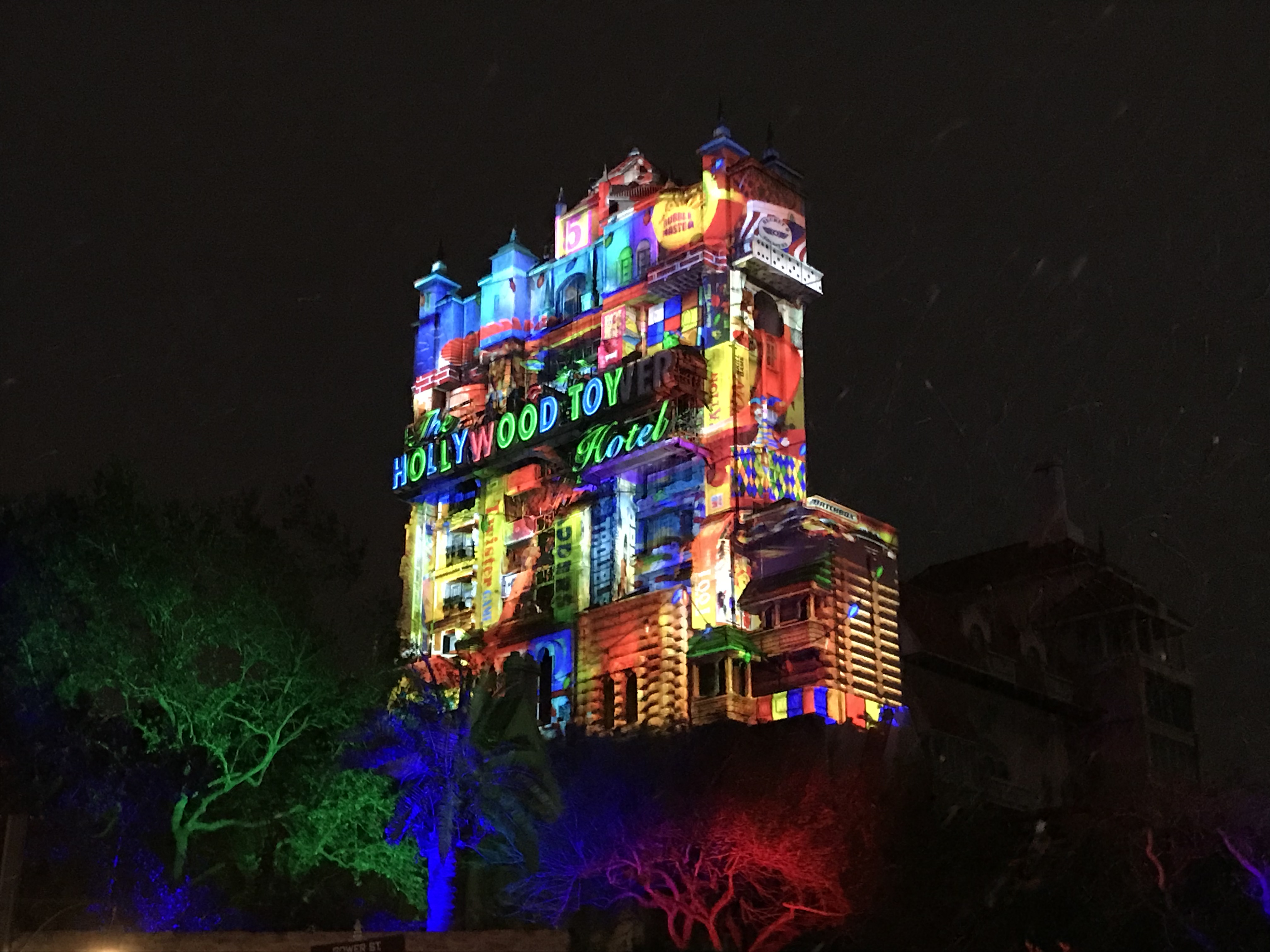
The Holiday season is in full swing at Disney’s Hollywood Studios! Sunset Seasons Greetings debuted last week along with the return of Jingle Bell Jingle BAM. Accompanied by snow flurries surrounding you on Hollywood and Sunset Boulevards, you will be energized by the joy and cheer of crowds of guests singing some of your favorite Christmas songs–you’ll definitely want to join in. Although the park still feels empty at Christmastime without the late Osborne Family Spectacle of Dancing Lights, the seasonal offerings at the park do help to fill the void. The present shows still fall short of the immersive experience of the incredible brilliance and beauty of the famous dancing light show. But I digress. My friend Dani and I had a fun time watching the two nighttime Christmas spectaculars….(more)

Sunset Seasons Greetings is Hollywood Studios’ newest seasonal offering for Christmastime that takes place on the Hollywood Tower Hotel (a-k-a The Tower of Terror). Initial impressions of the show leave me with the evaluation that it’s a cute show. Like so many other Disney nighttime shows these days, it relies upon mapped projection technology instead of precisely choreographed dancing Christmas lights. There are four different animation sequences and they repeat until 8pm. Between each roughly minute-long map projection animation transforming the Tower of Terror into a colorful array of images and shapes, there is a transitional animation on the Fantasmic billboard (note: Fantasmic is now sponsored by Pop Secret–not sure that’s the brand you want associated with your show) that highlights a different aspect to the Holiday season. My favorite sequence on the billboard was the one featuring clips from Mickey’s Christmas Carol. Each mapped projection show on the Tower features different music and imagery–each unique. To watch the show from start to finish takes 10-12mins. Since this is a show throughout the evening that rotates, it definitely alleviates any concerns of overcrowding on along Sunset Blvd.

Returning for its second year is Jingle Bell Jingle BAM. For a full review of the show, please see my article from last year. After experiencing the changes that Disney World made to the show, I must say that it feels a lot more Christmassy than it did last year. Last year, I was left wondering where all the Holiday spirit was. Perhaps others felt as strongly as I did that this “Christmas” show lacked Christmas, and Hollywood Studios decided to integrate more of a holiday feel to make it feel like a special seasonal offering. I especially appreciated the singalong of It’s the Most Wonderful Time of the Year as well as other Christmas standards. There truly is a little something for everyone at this new iteration of the infant show. After the show, my friend Dani and I still remarked that everything we experienced throughout the evening still does not feel as magical as the Osborne Family Spectacle of Dancing Lights, but we still had a great time!

If you are planning to visit Disney World this holiday season, don’t miss these seasonal nighttime spectacular offerings at Hollywood Studios.

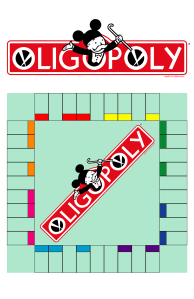
Don’t Pass GO, Don’t Collect Your Oscar

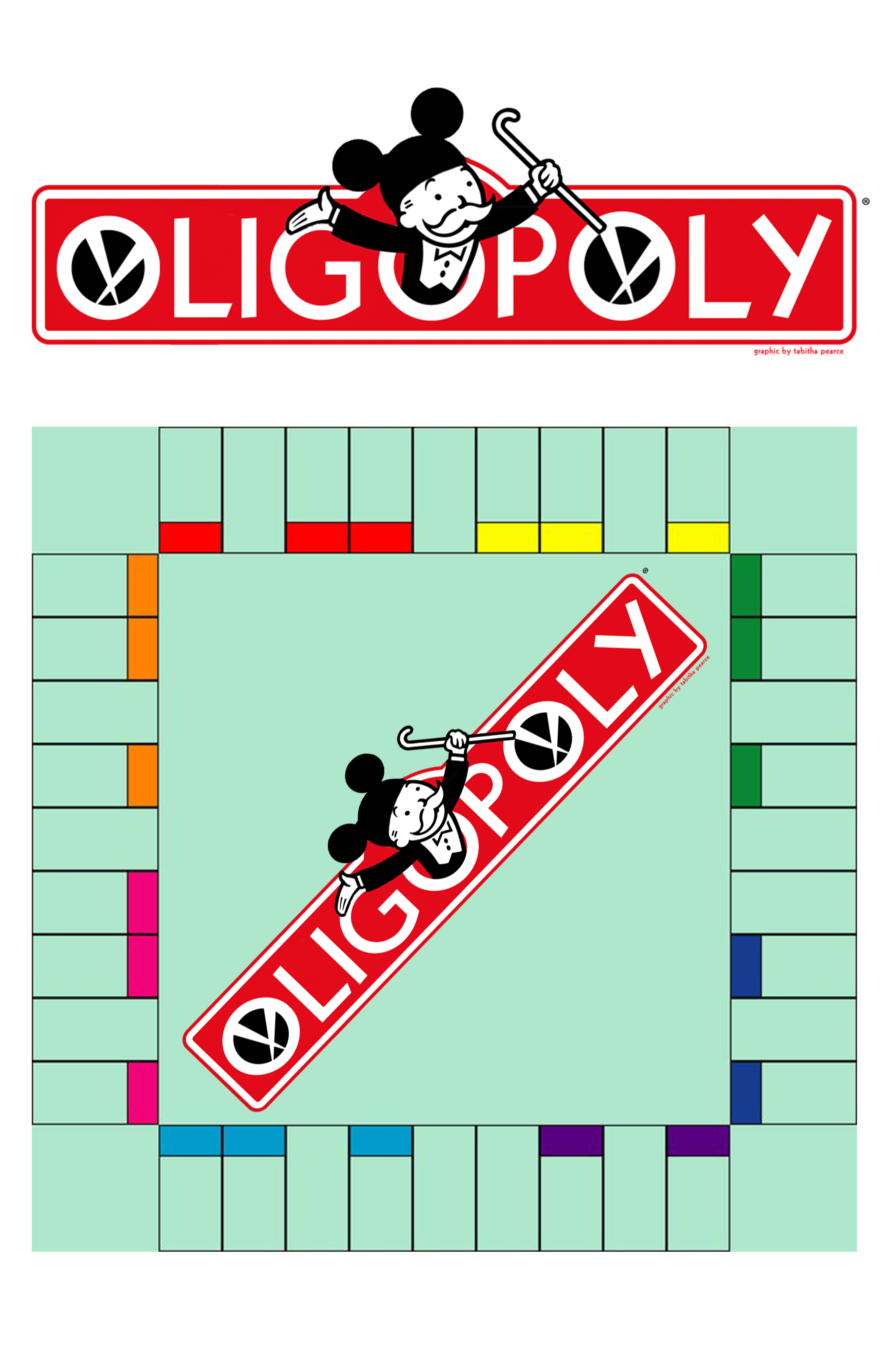
Corporate monopoly is the enemy of creativity and variety. The biggest news in entertainment this week was the talks between Disney and Fox to sell most of 21st Century Fox to The Walt Disney Company. Whether the talks are still going on behind closed doors or not presents a fascinating topic to discuss! This deal, which would be the biggest film/media deal ever, has far reaching effects upon the industry. Some may even argue that it has danger written all over it. If there wasn’t already a rigid oligopoly amongst the studio/distribution companies, there will be if this goes through. Should this go through without the government swooping in to save the day with monopoly claims in the vein of the historic Paramount Decision, the lion’s share of the cinematic marketplace would be controlled by Disney, TimeWarner (Warner Bros.), and Comcast (Universal), with Sony (Columbia) and Viacom (Paramount) bringing up the rear. Five. That’s right. Five companies would essentially determine the future of the industry, and control the majority of the motion pictures released in theaters and the content on cable television (and the streaming services that access it). It’s a mirror image of the 1940s. Instead of The Big Five and The Little Three, we have The BIG Three and the Little Two.

From the big screen to the small screen, you will notice the effects in the programs you watch. When one company controls the majority of any marketplace, it usually spells disaster for the consumer; furthermore, it means that there will be a primary gatekeeper in future artists getting his or her work out there. Not to mention that the programming on FX and other Fox (non-broadcast) subsidiaries could begin to gradually feel and look more like ABC programming. Could this put shows like The Simpsons and Family Guy on an endangered species list of sorts? Not right now. The deal, in off-and-on talks, would sell off 21st Century Fox (movie studios) and not Fox or Fox Sports (an acquisition of that sort would not be permitted because it WOULD be illegal). So, even if this buyout were to happen, The Walt Disney Company would still continue to be the brunt of many jokes on The Simpsons and Family Guy. A buyout could mean, however, that program options will seem less varied and just more of the same ABC-schlock that already pervades the bandwidth. The two companies that have the most TV programming are Fox and Disney, with Sony (CBS), Viacom (non-broadcast Nickelodeon), Comcast (NBC), and TimeWarner (CW) trailing in original programming. That being said, TimeWarner has done very well with The CW, and I hope it continues to churn out programs such as Vampire Diaries, Supernatural, Riverdale, etc.

Beyond the negative impacts on content, which, in all honestly, can be quite subjective in nature, are there legal or ethical implications here? Is there perhaps a past precedent that could be used in the courts to stop such a buyout (or sellout rather–Fox)? Let’s look at the most famous suit brought against the major motion picture studios: The Paramount Decision [(U.S. V. PARAMOUNT PICTURES, INC., 334 U.S. 131 (1948)]. Prior to the Paramount Decision, the motion picture industry was controlled by a few companies that were heavily vertically integrated. The Studio owned the facilities, production companies, staff (under long-term contracts), the films themselves, distribution channels, and the movie theaters. When the studios were growing so large that they began infringing upon the free marketplace, the US Government forced the (then) eight major/minor studio players to end the practice of block booking (meaning, films would now be sold on an individual basis), divest themselves of their respective theatre chains (sell them off), and modify the practice of long-term employee contracts (though, this would continue until the 1960s). This marked the beginning of the end of the Studio System, AKA Hollywood’s decentralization. There are many similarities between the situation in the late 1940s and today. In fact, it’s a little worse today because the industry is mostly controlled by five (instead of eight) companies, and these companies have heavy investments in streaming and television programming.

The problem with the current state of capitalism in the Unites States isn’t worries of monopolies but oligopolies (monopolistic practices between a few firms that essentially control a market). Certainly the state of the film industry already lends itself to an oligopoly because of the few companies; but the buyout of 21st Century Fox by The Disney Company would greatly increase this issue of a blatant oligopoly. If a monopolist (in many other industries) did what Disney is doing, neither the public nor the government would stand for it; but because it’s Disney, and because it’s the film industry, most of the general public is unaware of the negative consequences of such a buyout. Technically speaking, oligopolies are not illegal nor is monopolistic competition; however, this can be a slippery slope towards stifling creativity or making is increasingly difficult to break into any given industry as a newly emerging competitor. Incidentally, monopolistic competition causes the variety or level of differentiation of similar products (i.e. moves and TV shows) to become less heterogeneous and nearly come across as homogenous. For many, it will feel like there are only two primary companies controlling the majority of programming on TV and a few companies controlling a large portion of the movies that get released in movie theaters.

When a strong oligopoly exists within a specialized industry (for our purposes, media & entertainment), one of the side effects is a concept known as parallel exclusion. This concept can be described as the collective efforts of the few industry leaders who essentially act as the main gatekeepers to prevent or make it difficult for would-be newcomers to enter the arena. Parallel exclusion is nothing new, and has been in the news as recently as the last 2-3 decades within the airline and credit card industries. Throughout the eighties and nineties, Visa and MasterCard essentially blacklisted any bank that set out to do business with AmEx. Thankfully, the U.S. Justice Department stepped in when the manner in which the exclusionary rules were written crossed legal, fair trade boundaries. There were similar issues within the airline industry as well. When a few companies control the content or services in the marketplace, antitrust issues are raised.

Although we are not facing a technical monopoly with the possible acquisition of Fox by Disney, we are looking at an abuse of power that leads to anticompetitive conduct. If nothing else, the consumer should be worried about having fewer options for programming. Not that the number of programs or movies will shrink, but there will be little difference between what is released under the Disney banner and the Fox name (if it’s still even called that). In a deal like this, it’s the consumer who gets the short end of the stick. The consumer would be wise not to give Disney a pass just because there are a small group of big film studios instead of just one. While Marvel fans may be excited that the X-Men can join the MCU (Marvel Cinematic Universe), there is the possibility of a lack of competition between brands thus mitigating innovation and ingenuity. Competition is the mother of innovation just as necessity is the mother of invention.

Because the Walt Disney Company is primarily focussed on producing the biggest movies possible (after all, they made five of the 10 most successful films last year), the mid-budget dramas and comedies that used to thrive in Hollywood–you know, the ones that cause you to cry and laugh–would dwindle in number–there would be little room for them to make their respective ways into theaters in a predominantly Disney controlled industry. What we are essentially talking about here is a corporate cinematic monolith, the likes of which, has never been seen before.

Written by R.L. Terry

Graphic by Tabitha Pearce

“Thor Ragnarok” movie review

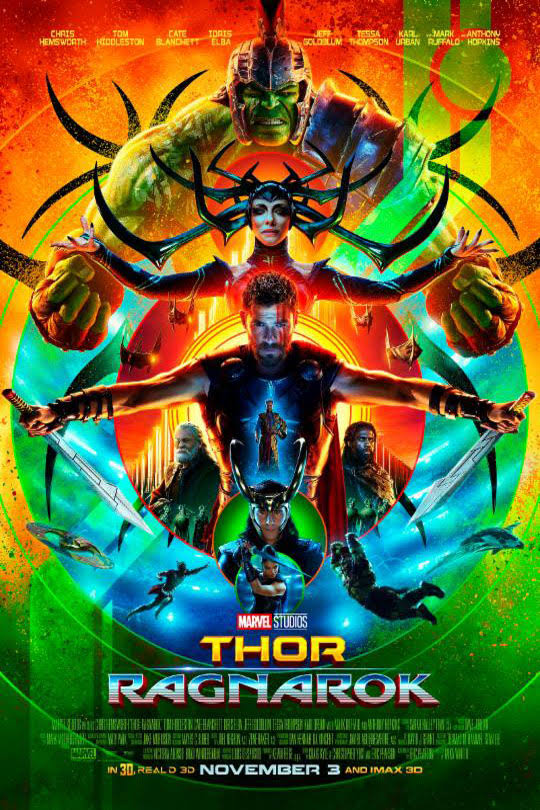
Norse mythology meets Gladiator meets 80s vintage video game in this non-stop adrenaline pumping action film. Suffice it to say, everything you’ve heard about Thor Ragnarok from your friends is true. It is an incredibly fun movie that is equally well written and directed. For anyone who follows my blog, it is no secret that I typically do not like the Disney-Marvel films (and for good reason), but the focus of this review is on THIS particular film. I state that because, honestly, I very much enjoyed this film! So, it comes from liking the structure, characters, plot etc. not just from being a fan boy, or lack thereof in this case. Not only an excellent third sequel, but this movie can easily stand on its own. Whether you have watched the other MCU (Marvel Cinematic Universe) films or not, you can rest assured that you can enjoy this superhero movie. With the way the initial trailers were cut, I thought that this was MCU’s way of jumping onto the 80s nostalgia band wagon–not so. Oh, there is definitely an 80s video game vibe about the film, but the focus is on the characters and storytelling, not the nostalgia. There is also a self-aware element of this film. Not to the extent Deadpool is self-aware, but Chris Hemsworth’s Thor has a twinkle about his eye that winks at the audience so that we know that he is aware of the corniness and ridiculousness of the characters and plot. But the magic of this film is just how well balanced the content of the film is. There were many times that the plot lended itself to falling apart, but the solid cast held the film together and provided audiences with one of the best movies in the MCU.

When Thor learns of a dark, hidden family secret, he must confront the deadliest enemy he has ever faced off with in his life. But the legendary hero encounters far more than he ever expected. The mighty Thor finds himself imprisoned on a faraway planet and forced to battle in gladiator-style games. Little does he know that the winningest challenger on the planet is his former ally The Hulk. Thor must survive the deadly gladiator-like battles in order to build his team to defeat Hela, the Asgardian goddess of death who is destroying his home world.

One of the principle themes in this film that enables this one to be more and deeper than other MCU films is just how similar it is to a conventional war picture. There are hints of courts of intrigue as well. The complex plot provides a comprehensive foundation upon which a more superficial story can be developed in order to appeal to wide audiences, with few appreciating the deeper themes and subtext. But it takes more than effective and well-developed writing to build such a solid movie, it takes multi-dimensional characters portrayed by impeccable screen talent. You’ll find all of that in Thor Ragnarok. Although his screen time is brief, Anthony Hopkins’ Odin commands the screen with confidence, wisdom, and sincerity. Few actor’s can take a few minutes of screen time and put more cinematic magic in it than Hopkins. After all, he won his Oscar for Silence of the Lambs for his collectively few minutes on screen. Joining the cast are Jurassic Park’s Jeff Goldblum and the beautiful, talented Cate Blanchette. Goldblum’s Grandmaster of Sakkar is hilarious and brilliant. As you’d expect a Goldblum character in a film like this to be: detached intellectually from that which is seen as conventional, smart-alecky; yet, he is also petty, sadistic, and relentless. Blanchette’s Hela is elegant, sadistic, and intelligent. She is perfectly able to be the comic book-esque villain she needs to be, all while bringing about a pedigreed acting to it.

All the technical elements of the film works excellently together. The most memorable of those elements is the music, for me, followed by the visual effects. I absolutely loved the nod to Willy Wonka and the Chocolate Factory during Thor’s transport to through Sakkar. This works because (1) the scene it shot and edited similarly to the boat scene in the aforementioned movie and (2) Goldblum’s Grandmaster is a Willy Wonka type. Throughout the film, there are 80s video game sound effects and a score that could fit into a nostalgic 8bit video game. However, the nods to Willy Wonka and video games do not overpower the more conventional score. Whereas the visual effects could have gone overboard and made the film play off as a video game, the video game like effects where carefully integrated in order for the film to maintain a high show quality.

The film was initially sold as a funky, colorful, comedic MCU film. And there are times that the film also encroaches upon that animated feel, but it never crosses that line–thankfully. The more serious aspects to the film balance out the slapstick moments. All of this works together to execute perfect pacing and plot/character development. Like with most MCU films, the more adventurous parts of the film are not quite adventurous enough to be an adventure film and there is typically a predictable nature about the film. I find that this film is not as predictable as previous MCU movies, but there is still that experience with this one. There is one particular part to the showdown of the film that prohibits this from falling victim to another cliche MCU ending with an epic battle, bodies flying through the air, and cities on fire, but I cannot reveal that without giving away the ending.

Looking for a fun movie to watch with your friends? Then this is a solid choice. Although the film has its diegetic flaws, the ways it succeeds outweighs the shortcomings. You also do not have to have seen the other Thor movies and really don’t even need to have seen the previous Avengers films, albeit helpful to understand some of the minor plot points. It’s definitely one that has re-watchabbility.

Of Mice and Movies

Twitter is a’buzz with the latest from the 2017 D23 Expo. Not to be outdone, Facebook, Instagram, and the theme park blogosphere are all but fully consumed with the big announcements for Walt Disney World out of D23 in Anaheim. BIG changes are coming, and will radically modify the existing attraction offerings at Epcot and Disney’s Hollywood Studios (DHS). While there were many announcements, the biggest ones are arguably the detailed look at the new Star Wars Land, the update on Toy Story Land (opening next summer), Ellen’s Energy Adventure (Epcot) getting replaced by Guardians of the Galaxy. Lastly, the final big announcement that will really hit close to home for many who have been going to DHS for a large portion of his or her life–the announcement of the closure of The Great Movie Ride (GMR) to make way for Mickey and Minnie’s first [dark] ride at Walt Disney World. And it’s that last announcement that speaks volumes regarding the direction that the Walt Disney Company is moving.

Although it’s been fairly common knowledge that the Ellen attraction was going to be replaced with something more contemporary and relevant, the announcement of the closure of GMR came as a shock to many (note: this change WAS hinted at within the last few months). Fortunately, the Grauman’s Chinese Theatre facade is slated to be largely untouched, so it will remain the icon of the park; however, GMR will go by way of The Streets of America. On the plus side, this change paves the way for Mickey and Minnie’s first [dark] ride in the parks period. That’s right. Neither Mickey nor Minnie had a ride based off their respective characters. Strange, right? Since “it all started with a Mouse.” Yes, Mickey has been included in other attractions (i.e. Philharmagic, Fantasmic, etc), but this presents the first time that he will have an actual ride in the parks. Of all the changes coming to Walt Disney World, this represents the most symbolic, and some might argue, the most significant. In order to understand just why this particular change is so important, and to many controversial, we have to look back at a brief history of The Great Movie Ride and by extension DHS itself. If you have read my article entitled A Theme Park in Flux, published back in September 2016, you may be familiar with the following. For all others, let’s hop in the wayback machine!

It’s the mid 1980s. And Disney Imagineers are pictching the idea to add an attraction that explores iconic films to Epcot’s Wonders of Life pavilion. The name of that attraction: The Great Movie Ride. At the same time, Disney is working with MGM/UA to build movie and television production facilities to be the Florida counterparts to the California operations. Concurrent to Disney, Universal Studios and Nickelodeon are doing the same thing just up the road from Disney. Anyway. Led by Michael Eisner at the time, he made the executive decision to–instead of adding a movie-based attraction to Epcot–to build an entire theme park with a filmmaking or film industry theme. Long story short, in 1989 then Disney-MGM Studios opened up with facility tours and two attractions: GMR and the former Studio Backlot Tour inclusive of Streets of America and Residential Street. After the licensing deal with MGM was ended, the park changed its name to Disney’s Hollywood Studios in 2008 and removed all the MGM branding. Shortly thereafter, Residential Street was removed and Lights Motors Action was added. Since that time, all attractions in that area of the park have been closed to make way for Star Wars and Toy Story Lands.

Speeding up to present day. The decision to remove GMR from DHS represents the end of an era. With the closure of that iconic attraction, the park’s original concept, original idea, the very soul of the park is being rewritten. What was once material for waxing nostalgic at the parks–nostalgia being a significant draw to theme parks–will now merely be a distant memory. It’s not that theme parks should avoid evolving to remain relevant–quite the contrary. They need to! But to remove an attraction that represents the original identity of the park, stirs up quite a lot of emotions. Many might argue that this is the equivalent of closing Epcot’s iconic Spaceship Earth because Epcot’s direction has shifted from an educational component to food and thrills. More than riding the movies, DHS (much like Universal Studios) was a park that immersed park guests into filmmaking itself. Granted, the filmmaking process is not as magical as it once was, given that most of the magic exists within a computer and is comprised of 0s and 1s; still, there was a magic to the whole thing that park guests found fascinating, and enjoyed approaching films from a different perspective. If GMR isn’t safe, if the tides of time wash this park-opener attraction off the maps, then is any attraction safe???

Keeping roots in the original concept of a park is truly important, but it seems the powers that be do not feel that any connection to the soul of the park, the history of the park, is important. Not that I don’t think Mickey and Minnie deserve a ride. Of course they do! And there are likely other places where their new attraction could have gone. Take One Man’s Dream for instance. If you’ve been to DHS, you know this as the Walt Disney museum with a focus his early filmmaking days as well as the plans for Disneyland and Walt Disney World. It’s a biographical museum, of sorts. Great attraction. Does it need to be at DHS? No. It’s an example of an attraction that can be moved to another location without a negative impact left by its absence. Disney Springs would be a great location for the museum, and would probably see more guests than it does now. The present One Man’s Dream location could be retrofitted and remodeled for a new attraction. In fact, that area of the park is referred to as the Animation Courtyard. Therefore, it’s best suited for a new attraction where Mickey and Minnie are the stars! For years, I’ve thought that GMR needed to be refurbished. So, I am fully aware that many of the scenes lack sufficient relevance to the kids and teens today–even some young adults. But, because the attraction needed a massive refurbishment does not mean that it should be removed altogether.

It is clear from the announcements at D23 that Disney’s Hollywood Studios will see a complete departure from its founding theme and concept–old Hollywood and the magic of the movies–and move to a sort of diegetic immersion. Instead of learning about the movies, the guests will feel as if they are IN the movies. Instead of celebrating movies, Star Wars and Toy Story will provide guests with a complete escape from the outside world and into the world of these popular franchises. The addition of these properties and lands is exciting! They look beautiful and will offer some fascinating attractions; but, I wish it had not come at the expense of losing the very foundational idea that inspired Disney’s Hollywood Studios.

The best laid plans…

“Pirates of the Caribbean: Dead Men Tell No Tales” movie review

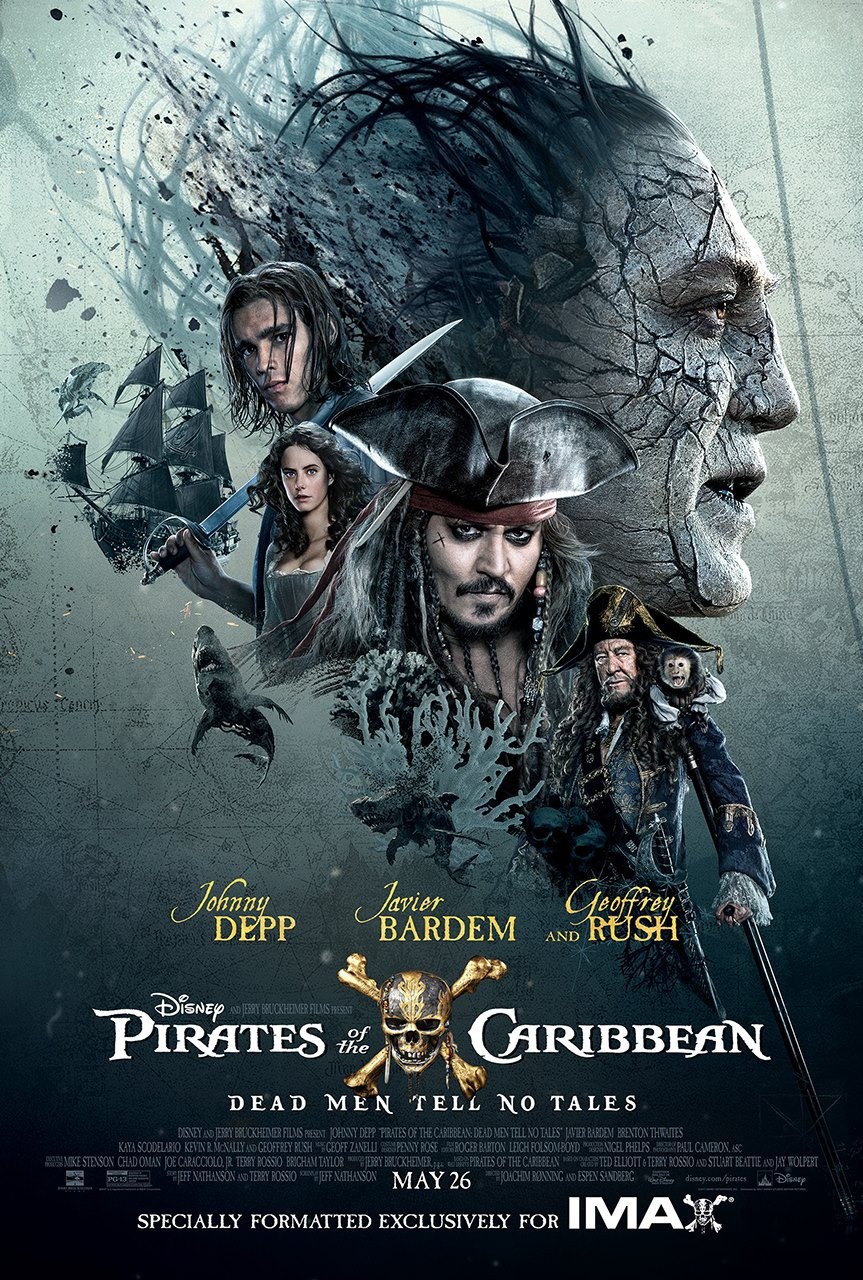
Of all the tales that the depths of the ocean contain, this one is quite shallow. Disney’s latest installment in the swashbuckling franchise Pirates of the Caribbean: Dead Men Tell no Tales proves that neither changing directors, writers, nor the inclusion of an undead Javier Bardem, can bail enough water out of a sinking ship. No doubt the next chapter in the life and times of Jack Sparrow was one to be anticipated by fans, but sadly the writing was not strong or developed enough to carry the waning film series. This film reminds me of the Child’s Play franchise. What??? That is likely what you’re saying. But hear me out. After the first two Chucky films, the studio realized that the series was not working as a hard horror film, so the studio went the camp route and capitalized on the ridiculousness of the characters and the situations. Dead Men Tell No Tales contains many camp elements such as completely ludicrous antics and escapes that are even too much for a Mission Impossible movie. Although there is an attempt at some closure between characters at the end of the film, it plays out as forced and on-the-nose. Still, there are moments that will mildly tug at your heartstrings during the showdown, but it’s not enough to add any dimension to this flat tale. One thing that this Pirates movie has going for it is the impressive visual effects. Both the editing and score are pretty outstanding, and certainly add to the experience of the film. However, if you watch the movie in 3D, as I did because there wasn’t a 2D option at the earliest showing, some of the magic of the undead pirates will be lost due to noticeability of editing. Over all, Disney’s Pirates of the Caribbean: Dead Men Tell No Tales is a great popcorn movie and a fun one to watch with friends or the family. Be sure to stay after the credits for a sneak peek at the next (and hopefully last) one.

Return to the swashbuckling world of the franchise inspired by the iconic Pirates of the Caribbean attraction at Disney Parks! Many years after the encounter with Davy Jones, Jack Sparrow (Depp) is being sought out by a young Henry Turner (Brenton Thwaites)–yes, that Turner. After witnessing his entire ship’s compliment slaughtered by ghost pirates led by Captain Salazar (Bardem), Turner is even more determined to find Captain Jack. Unbeknownst to Turner, Jack Sparrow’s fortune is not what it used to be. With his luck turned sour, Sparrow is captured and Turner must free him if the ghost pirates are to be stopped and the curse of Davy Jones lifted. By sheer happenstance, Sparrow is sentenced to die alongside an accused witch named Carina (Kaya Scodelario). If that wasn’t bad enough, Captain Barbosa (Rush) has been cornered by Salazar into leading him to Sparrow as well. Other than a need to find Jack, Turner, Salazar, and Carina all share a common interest in locating the trident of Poseidon. That trident is the key to unlocking the power of the ocean and breaking curses.

Like so many franchises that have come before, Disney’s Pirates of the Caribbean appears to have suffered the same fate. Although this can’t be said of every franchise, the area that fairly consistently fails to deliver is strong writing inclusive of plot and character development. Often times it seems that story is exchanged for merchandising, impressive visual effects, or pandering in longstanding franchises. After an outstanding opening sequence that instantly hooks you, the rest of the movie just plays out so paint-by-the-numbers that it becomes nearly predictable and lacks any real substance. Sometimes franchises fall into the trap of realizing that it can no longer take itself seriously and allows the camp factor to increase significantly. That is the one word that pretty much sums up this film: camp. Whether you are talking the perpetually drunk Jack Sparrow (yes, even more than usual), unbelievable escapes that defy all logic and past precedents set is previous films, or the supernatural playing off more as a joke than a serious plot device, there are many elements in this film that attempt to cover up poor writing by going for the flash in a pan approach.

One of the down sides to the recent Guardians of the Galaxy I found was the film only focusing on Acts I and III, leaving out the chunk of story development typically found in Act II. By the same token, Dead Men Tell No Tales spends most of the time in Act II, leaving Act I and again Act III to be rushed through. The common variable in both scenarios is a weak third act. To explain where I feel that this movie should have ended and the next one begin would give away a plot spoiler, so I won’t mention it. However, there is a place in this film in which there is a great opportunity to end this story on a high note of anticipation of what is to come but it just rushes through the rest of the story. Had more time been spent on developing a solid story, then this Pirates movie would definitely have turned out much better. Sadly, it seems like more time was spent in post-production and scoring the film. Certainly, the talent behind the lead characters is excellent. Perhaps the writing is poor and the screenplay was weak, but with a lead cast of Depp, Rush, and Bardem, the movie is fun to watch. And sometimes that’s all you want–a good popcorn movie.

If you ARE looking for a good popcorn movie to watch with your family or friends over the holiday weekend, then checkout Disney’s Pirates of the Caribbean: Dead Men Tell No Tales. Can’t promise that you will enjoy the story as much as the original, but you’ll still have a good time. Perhaps the sequel to this film will be stronger and pick up where this one failed to deliver.

Written by R.L. Terry

Edited by J.M. Wead