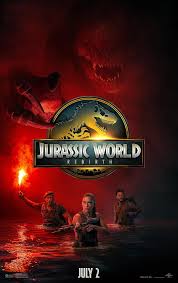
JURASSIC WORLD: REBIRTH movie review

Possesses dino DNA, but missing strands and sequences, leaving an uneven and forgettable movie. Jurassic World: Rebirth begins with an intriguing enough premise, but the characters are poorly written, which is then amplified by way of a subplot that only serves to clutter the story. After a rough first two acts–except for a thrilling and fantastically written T-Rex chase scene (that was part of Crichton’s original novel and script for Jurassic Park)–the third act is surprisingly exciting and suspenseful, and at times terrifying.

Zora Bennett (Scarlet Johansson) leads a team of skilled operatives to the most dangerous place on Earth, an island research facility for Jurassic World. Their mission is to secure genetic material from dinosaurs whose DNA can provide life-saving benefits to mankind. As the top-secret expedition becomes more and more risky, they soon make a sinister, shocking discovery that’s been hidden from the world for decades.

Perhaps Koepp’s screenwriting works best when the original version of a script is written by the novel’s author (which, I know wasn’t possible for this movie in more ways than one), and he then crafts the original version to be more effective for the screen. To put it simply, no one knows what is going on or when/where they are. Harsh? Not really, when the movie opens with lazy exposition through on screen text describing an event that happened 17 years ago…keep that in mind, 17 years (placing it in line with Jurassic World not Jurassic Park). But then the characters talk about the research and development facility as if it was connected to the original park–not possible. Even popcorn movies should adhere to the logic of their own world building. It’s as if no one thought about the events that unfold in this movie, and how they relate to the previous movies. Kind of basic storytelling logic.

There are many elements of this movie that fail to make any logical sense (and again, that is the logic setup by the movie itself) or are setup, and never developed or connected to any motivation or stakes. To go into them, would take too much time.

Aside from logic problems, the movie is plagued by poorly written characters, an extraneous, shoehorned subplot, and weak first and second acts (with one exception in the second act that was thrilling). While I appreciate the minimalistic cast of characters compared to the cast of characters in all the Jurassic World movies, there are two competing groups that are pretty much independent of one another and could have each been in their own movie altogether. Yet, somehow, they are sloppily fused together in this movie. For argument’s sake, we’ll call them the Mercenaries and the Family. The Mercenaries and their outside/action plot are fine–I’d even go so far as to say ‘that’ story is sufficiently interesting. The Family and their plot felt extraneous and ultimately of little importance to anything that happened. It’s as if there were two different movie ideas (1) centered on the Harvesters and (2) the Family. And I think either by itself would have made for a better movie than putting them together. These decisions left the movie feeling muddled and crowded.

There is a T-Rex sequence in the second act that is fantastic! It very much harkens back to the sci-fi horror-adjacency of the original movie. Of course it helps that Crichton’s original Jurassic Park novel and screenplay thereof contained a similar sequence. Fun fact: this sequence in the novel and original Crichton screenplay served as the inspiration for Jurassic Park: The Ride at Universal Studios parks. It plays out wonderfully in this movie, like a short film in and of itself, because it’s setup well, developed strategically, and resolved thrillingly.

Even though there are a couple of characters that are almost fun or compelling to watch (almost), the rest are more disposable than a red solo cup at a frat party. You’ll find yourself rooting for the dinosaurs to win. Of all the characters, there is one particularly so annoying and deplorably behaved, that you’ll want the first dinosaur you see to pick him off, (and question why on earth his girlfriend would be with him and why the dad would let the boyfriend walk all over him–answer, bad writing). Other characters are one-dimensional or the casting choice never sells the character. All around, there are many character and casting problems, resulting in a movie wherein you’ll hope the next dino attack happens soon–and preferably ends with one less character.

Where the movie “finds a way” to leave you on a high note, is in the third act. Despite the slapdash screenwriting throughout the first and second acts, the third act is wildly entertaining and even at times, terrifying! It almost compensates for the first hour and forty-five minutes. The (weird) dinos are “monsters” again, and the various chase sequences each offer something different (even though one is a recreation of the Kitchen Scene from the original movie). The stakes are raised and the level of terror leaps off the screen. So often, movies start well and fail to stick the landing; with this one, it fails to stick the launch but definitely sticks the landing.

SUffice it to say, if you took the first two acts from The Lost World: Jurassic Park, and paired them with the third act from Jurassic World: Rebirth, then you’d actually have a pretty good, memorable movie.

As an OG Jurassic Park fan (and Lost World apologist, except for the third act), I hate having to write reviews such as this one for a franchise installment. But, the more I thought about this movie, the more stupid it became. I suppose it’ll make for a fun enough 4th of July weekend watch, but doesn’t do much beyond that.

Perhaps, these movies will “find a way” back to greatness one day–doubtful as it seems.
Ryan is the general manager for 90.7 WKGC Public Media in Panama City and host of the public radio show ReelTalk “where you can join the cinematic conversations frame by frame each week.” Additionally, he is the author of the upcoming film studies book titled Monsters, Madness, and Mayhem: Why People Love Horror. After teaching film studies for over eight years at the University of Tampa, he transitioned from the classroom to public media. He is a member of the Critics Association of Central Florida and Indie Film Critics of America. If you like this article, check out the others and FOLLOW this blog! Follow him on Twitter: RLTerry1 and LetterBoxd: RLTerry
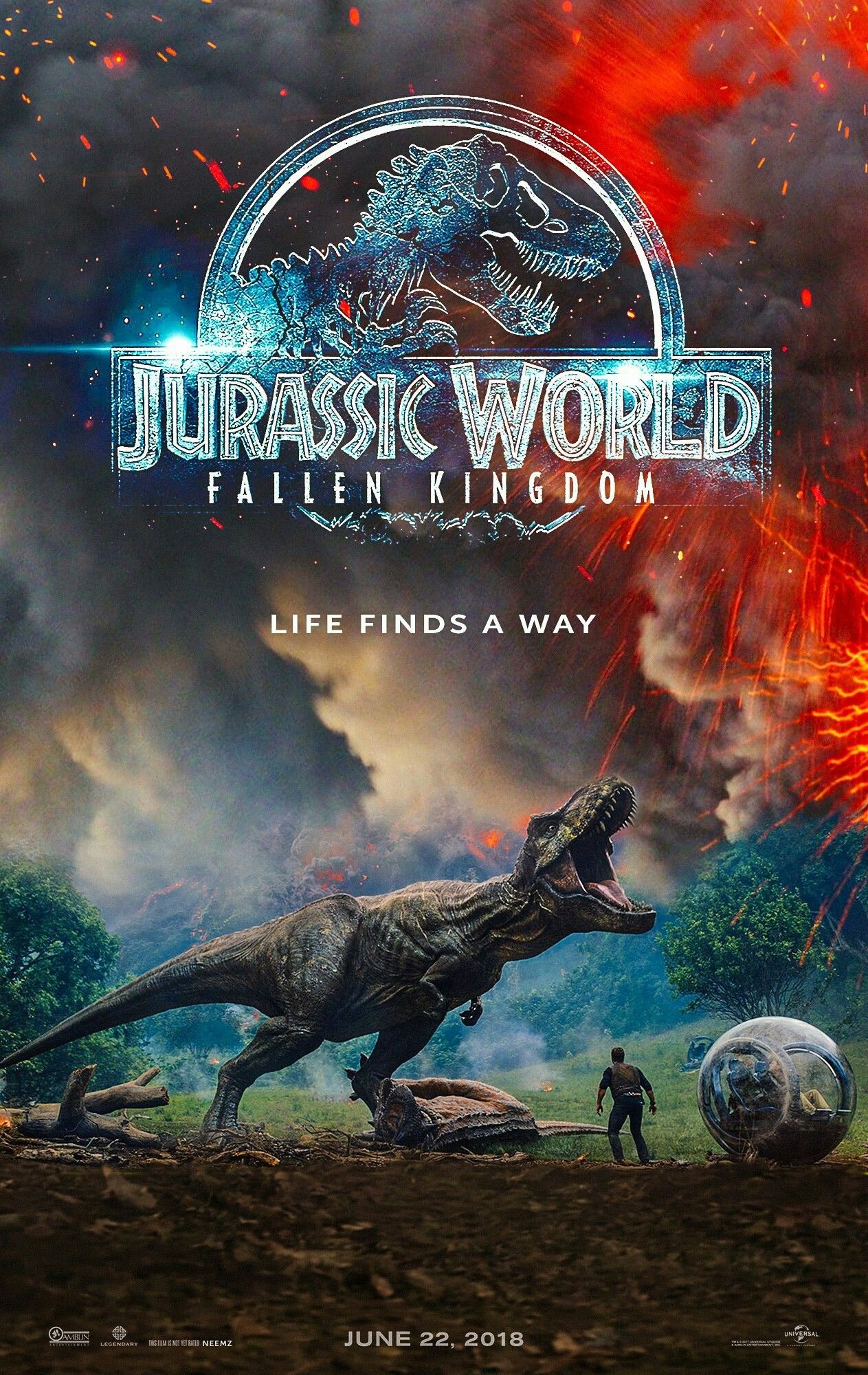
“Jurassic World Fallen Kingdom” movie review

“Your (executives) were so pre-occupied with whether or not could, they didn’t stop to think if they should.” Ironic, isn’t it. A haunting but accurate assessment by Dr. Ian Malcolm. Let me say first, Jurassic Park is my favorite movie of all time, followed closely by Sunset Boulevard and Psycho, so it’s difficult to separate fanboy me from critic me. However, I shall do my best to keep my personal bias in check. As a longtime fan of the franchise that captured my imagination as a kid and with the original filled with depth, irony, tragedy, and more, I was excited as I sat down in the theatre last night to watch Jurassic World Fallen Kingdom (JWFK). And suffice it to say, my friends and I enjoyed our time and felt entertained; however, it’s simply not a great movie. And it pains me to write those words. At the end of the day, the movie suffers from a poorly written screenplay. Some may even describe the screenplay as a generic, vapid paint-by-the-numbers summer popcorn crunching blockbuster movie. The movie is not without its thrills, but I wish more attention was paid to the plot. Director J.A. Bayona takes suspension of disbelief to far reaching levels. The life of this franchise is in the balance; how I hope it finds a way to overcome the weak sequels since the strong original in 1993 that still holds up (and I’m not talking about the technology). Reasons for why it holds up could be entire articles in and of themselves (a lot has to do with the screenplay), but we are here to talk about JWFK.

Three years after the destruction of the Jurassic World theme park, Owen Grady and Claire Dearing return to the island of Isla Nublar to save the remaining dinosaurs from a volcano that’s about to erupt. When the search and transport operation meets with capitalistic opposition, the mission takes them to an underground arms market, they must stop the demented auction from placing humanity it mortal danger. During their covert operation, they encounter terrifying new breeds of gigantic dinosaurs, while uncovering a conspiracy that threatens the entire planet.

Unlike the soft opening of Jurassic World, the sequel begins with an opening scene similar to the tone of the opening of Jurassic Park. Encouraging, right? It’s dark, filled with tension, and ends with a kill. All this, and it doesn’t feel overstuffed with dinosaurs. Like a screenplay should, it hooks the audience without lots of gimmicks. The focus is on the drama, and not simply “look what we can do with dinos.” After this scene, I was looking forward to the rest of the movie. And even in the senate hearing with Dr. Ian Malcolm, this could’ve been used as a great setup for a dynamic ethics debate but it was not followed through. Like other ideas of Colin Trevorrow’s, many turning points, characters, and events are introduced but not developed. These elements often play off as mere plot devices to hurriedly cause something to be able to happen without having to truly develop it. Every character is flat. No dimension to anyone or anything, really. I cannot help but take note of the many opportunities that Trevorrow had to truly craft a cinematic story, and ostensibly ignored it. In an effort to help the vapid screenplay, J.A. Bayona attempted to add dimension to the flat plot but only so much can be done to fix a flawed story.

Examples of characters as mere plot devises are systems analyst Franklin and paleo-veterinarian Zia. Both were setup to be developed further beyond their main skill, but were abandoned. They exist only so two important actions can happen, but that is the extent of their respective development. Such wonderful opportunities to include strong characters, buy they are left as flat as the plot, lacking in any subplot or goals of their own. There is also a fantastic opportunity to provide some exposition on the days before John Hammond’s innovative theme park resort destination. We meet his former partner Benjamin Lockwood, and he explains how the first DNA was extracted in a state of the art lab in the basement of his mansion. There is also a nostalgic shot of a model of the original park’s Visitors Center, complete with Jungle Explorers and the famous gate. Although we have lost Sir Richard Attenborough, there is certainly ways of crafting a flashback to the first time DNA was extracted or even just a few moments of exposition through dialogue to learn about the early days and ultimately why Hammond and Lockwood split. We are given a reason that likely led to the split, but I imagine there was more to it, including the direction to go with the dinosaurs. Again, this is another example of exposition and dimension lost. Could’ve been used as character building and development time.

On the topic of nostalgia, there is plenty of fan service in the movie. Lockwood delivers a line taken directly from Hammond at the end of Lost World and we get to revisit the site of the Jungle Explorer that T-Rex pushed over the retaining wall in the original. There are other moments as well that remind me of the raptor kitchen and more. Furthermore, there are moments in the movie that act as a mirror to the original. Instead of seeking to lock the dinosaurs up, the goal is to free them. But I won’t get into details.

Whatever Universal and Amblin are doing presently, they need to stop and throw out the playbook from Jurassic Park III, Jurassic World, and now JWFK. I liked Jurassic World well enough but I thought the next installment was going to be more gripping, thrilling, exciting, but it went out with a whimper. I was cautiously optimistic when I heard it was going to be darker, closer to the horror that was the original 1993 blockbuster, but it wasn’t terrifying at all. And what parts were creepy, were already shown in the trailer (but that’s the marketing company’s fault, not the director or writer). Crichton is likely rolling over in his grave right about now, rest his soul. The next writer in the Jurassic franchise needs to be someone who understands what it takes to create a great story that CAN sell tickets and reach blockbuster status while holding up years down the road. Take the iconic Tim Burton Batman and Batman Returns, for examples. The reason why these, especially Returns, hold up so well is because Returns is a classic Tim Burton film that happens to have Batman characters, whereas the original is a Batman movie directed by Burton. So, the third installment in the Jurassic franchise needs to attach a writer and/or director who can write/direct a science-fiction horror movie that happens to have dinosaurs and legacy Jurassic Park characters.

While many critics are calling for this franchise to go extinct, this film scholar believes strongly that it can be saved. Much like Claire and Owen are determined to save the cloned dinos from a second extinction, Universal and Amblin need to go back to the beginning and study WHY the first one worked well. The short answer is the screenplay, followed by casting, and lastly the directing. An approach could be to write the screenplay without dinosaurs; write a solid, compelling narrative. Make sure there is a clearly defined goal with clearly defined opposition to the goal, simple plot, and complex characters. Then find places to add in the dinosaurs as anti-heroes. It’s far more effective to retroactively add dinos in and modify the screenplay than write it with a focus on seeing dinosaurs and write a story around them. The former is narrative-heavy with supporting, terrifying action sequences whereas the latter is spectacle heavy with a one-dimensional narrative. Subtext, subplot, and theme need to be infused back into the Jurassic franchise.

At the end of the day, I enjoyed myself. I did not feel as if my time was wasted. You know what, I had fun. And for that, I appreciate the movie. It may not have truly memorable characters or scenes, but it was a fun watch. If more fans speak up, perhaps the next film will go back to its DNA and deliver a sequel that would make the original proud.

For my review of Jurassic World click here.

Ryan is a screenwriting professor at the University of Tampa. If you like this article, check out the others and FOLLOW this blog!

Follow him!

Twitter: RLTerry1

Instagram: RL_Terry

Thrillz (theme parks): Thrillz.co