
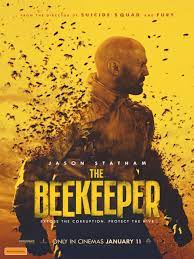
THE BEEKEEPER action movie review

UnBEElievably good! Jason Statham absolutely kills it in this explosive, roller coaster of an action movie! And like any good, balanced beehive, this movie balances high octane action with plenty of humor. And it’s not without its scathing commentary on crimes against the most vulnerable in society. The Beekeeper is here to save you from the January movie doldrums and one to catch on the BIG SCREEN!

One man’s brutal campaign for vengeance takes on national stakes after it’s revealed he’s a former operative of a powerful and clandestine organization known as Beekeepers.

Genre films are the foundation upon which so many other movies are built and by which they are inspired. And the action movie is one of those that is part of the periodic table of film elements. David Ayer’s latest demonstrates why genre movies should not be undervalued because they work! There is beauty in simplicity (regardless of genre), and what we have here is a classical 80s style action movie set in the present day. Furthermore, Statham delivers what he does best, fantastical fight sequences, gritty, sardonic humor, and unstoppable action.

Beyond genre itself, The Beekeeper also demonstrates the importance of crafting a movie around a movie star. We have so few movie stars anymore–Tom Cruise is the last true one–but there are others that are very much star-like–and Jason Statham is one of those. But the truth is, movie stars are dying.

For as long as cinema has been around, audiences have been drawn to that which is familiar–they already know what to expect. Delivering that which is familiar but in a new way, is the magic formula for cinema at its finest (and by extension TV, music, theatre, etc). And the classical star system of the studio system era was one of the man mechanisms for generating excitement and buzz surrounding the movie. Without going down a tangential road on why the death of the movie start is one of the reasons why cinema is dying, the long and short of it is that movie stars are a brand, moreover there were directors that were a brand, branding was a huge part of cinema for the longest time. And with the rise of franchises comes the fall of the movie star.

Why bring any of this up when talking about The Beekeeper? Because this movie shows the power of a genre film crafted around a movie star-like actor. We know what to expect with Statham, and we love the humor and action that Statham brings to most of his movies. He goes full Statham in The Beekeeper, and we are wildly entertained because of that! This movie woudl simply not work with anyone else. Much like without Bruce Willis and Allan Rickman, Die Hard would not be half as fun and timeless as it is, The Beekeeper would not be half as entertaining without the charisma of Jason Statham.

Amidst all the fantastically choreographed action sequences and explosions, is a surprisingly thoughtful core. Not only does The Beekeeper deliver on gritty impact, but it also delivers sufficiently enough on commentary spotlighting how the most vulnerable in our society are preyed upon by big tech, including toxic, criminal data mining. My sister and brother-in-law experienced a situation very similar to the big event that sets Adam Clay on his relentless rage against the machine that doesn’t stop until he reaches the Queen of the beehive.

Since it’s in the trailer, it’s not a spoiler. The big event consists of a kindly older lady whom has taken care of Adam Clay (Statham) and provided him with space to care for his beehives and make exquisite honey. Her computer is taken hostage by malware, and the support team she contacts is actually a criminal data mining company that steals money by way of a victim screensharing their computer and the company stealing/copying identity and password information. One the data mining company has some key information, then they are able to wipe out a victim’s entire finances. But the tragedy doesn’t stop there. When Adam’s hive has been attached, he stops at nothing to avenge his kindly neighbor.

I appreciate how the movie spotlights this real tragedy that truly impacts lives of the most vulnerable in our society. It also shows how deep the corruption goes and where it leads. Those at the very top may just be those that seem untouchable by the law and systems of justice. Perhaps this situation is exaggerated for purposes of making a movie, but it wouldn’t’ surprise me to learn that what we witness in the movie is similar to what truly happens in our real world.

The Beekeeper is a highly entertaining action movie that will completely thrill you! Between the electric fight sequences and Statham’s gritty charm, you are guaranteed to have a fantastic time at the cinema!
Ryan teaches Film Studies and Screenwriting at the University of Tampa and is a member of the Critics Association of Central Florida and Indie Film Critics of America. If you like this article, check out the others and FOLLOW this blog! Interested in Ryan making a guest appearance on your podcast or contributing to your website? Send him a DM on Twitter. If you’re ever in Tampa or Orlando, feel free to catch a movie with him.
Follow him on Twitter: RLTerry1 and LetterBoxd: RLTerry

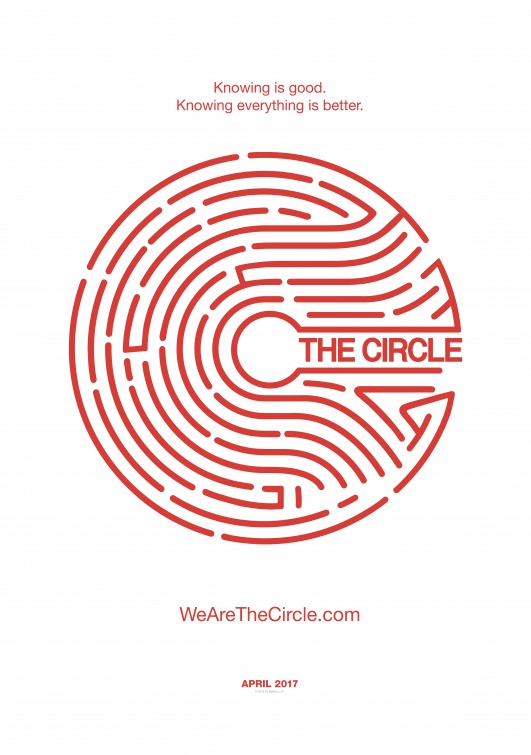
“The Circle” movie review

Tries for a perfect circle, but winds up more like an oval. Full of endless circular logic and irony, director James Ponsoldt’s The Circle depicts the story of a not-so-distant future, or perhaps an alternative present, in which one company dominates digital media, data gathering, and surveillance services. Based upon the four-year-old novel by author Dave Eggers, you’ll notice some stark similarities between this motion picture narrative and the smash hit TV series Black Mirror. The biggest difference between the two is that The Circle is fast-faced and poorly written whereas Black Mirror is a slow-burning but well-written anthology series. In addition to the similarities between the aforementioned, there are certainly elements of The Truman Show in this movie as well. With a powerhouse cast, brilliant composer (Danny Elfman), and excellent editing, The Circle appears to have what a blockbuster needs; however, the hollow characters, poor character development, fractured subplots, and overall diegesis hold the film back from reaching the impact that it could have had. Having taken a digital media and privacy class in graduate school, and published a few articles, this is a film that I was looking forward to in order to analyze how the social commentary or commentary on the human condition regarding reasonable expectations of privacy and big data were integrated into the plot. Sadly, the screenplay was not strong or developed significantly enough to provide big data and privacy discussions.

Mae Holland (Emma Watson) hates her job at the water company, so she is incredibly excited when her friend Annie (Karen Gillan) lands Mae an interview at The Circle, the world’s most powerful technology and social media company. Mae’s fear of unfulfilled potential impresses the recruiters at The Circle and she lands the opportunity of a lifetime. After Mae puts herself into harm’s way but rescued, thanks to The Circle’s newest surveillance and data gathering system, she is encouraged by the company founder Eamon Bailey (Tom Hanks) to take a more active role in technology development by participating in an experiment that puts Mae’s life on display for the world (in the vein of The Truman Show) to see. Once Mae turns on that camera, she has more “friends” than she ever imagined and becomes an instant online celebrity. Unfortunately, this decision will affect those closest to Mae and the negative ramifications will reach far beyond her inner circle and begin to impact humanity at large. Sometimes, people just don’t want to be found or be “social.”

For all The Circle has going for it, the weak screenplay keeps it from being the blockbuster that it so desperately wants to be. A great movie typically begins with solid writing, and that is what’s missing here. After five minutes (or so it seems) of opening title logos, perhaps that is indirect evidence that there were just too many hands in the pot, each trying to take the movie’s narrative in a different direction. Much like Frozen plays off like two different movies crudely sewn together, The Circle appears to be one movie for the first two acts, but takes an unexpected and unfulfilling turn in the third. A couple of conspicuous unanswered questions come after Mae meets TrueYou designer and founder Ty (John Boyega). He designed the platform that launched The Circle. At one point he asks Mae to meet him in a secret tunnel (where all the servers are stored) and tells her that “it’s worse than I thought.” Great opportunity to introduce intrigue, suspense, and more. The problem is that the audience is never told what Ty finds or what happens with what he found. You can remove that whole subplot and the movie remains the same. There are other subplots that are nicely introduced, but never carried out as well. Any or all of them can be removed and the film proceeds the same. Not good. If you can remove several subplots or unfulfilled turning points and the film’s diegesis remain largely untouched, then you have poor writing. The third act in and of itself leaves audiences with a hurried ending that does little to provide closure to the narrative; however, it does support the film’s circular logic and irony. Hardly satisfying.

In terms of the allegory here, The Circle is a Google-like company with Apple’s technology. Eamon Bailey is a Steve Jobs type innovator with characteristics of Mark Zuckerberg and Google’s Eric Schmidt. Thankfully, The Circle does not represent any one company, but rather combines all the most notable innovations and technological achievements of Google, Apple, Facebook, Instagram, and more into one globally dominating company. Antitrust issues are introduced early on, but again, that’s never fully developed. The movie highlights many issues faced by private citizens, governments, and digital data driven companies today; therefore, it sets the foundation for a movie that could have been thought-provoking, but the writing hinders that ability. The irony in the movie is for every digital answer to streamlining services or bolstering conveniences, a little privacy is eroded each time. Pretty soon, if one shares enough information, the idea of privacy is extinct. Privacy was central to the plot, but it just wasn’t handled in the most effective way. Concepts such as “off the grid,” self-proclaimed “celebrity,” and “calls to action” are displayed and discussed in the film, connecting this augmented reality to real-world issues each of us encounter or think about. One particularly interesting theme in the movie is deep friendship. Unfortunately, this was not fully fleshed as is the case with most of the movie; but still, it does get touched upon.

Exploring digital media and privacy is something I have written on within the last couple years. More specifically, I explore how entertainment media companies collect big data, and the privacy issues faced therein. In 2016, I published a short series of articles on the Walt Disney World Magic Bands entitled “Magical Data Collection.” You can read those articles by clicking HERE.

If you were hoping for another film like the brilliant Social Network, then you will undoubtedly be disappointed. Films such as The Circle should be memorable, but unfortunately this one is very much forgettable. Coincidentally, the movie itself is as hollow as the plot and characters.

Written by R.L. Terry

Edited by J.M. Wead