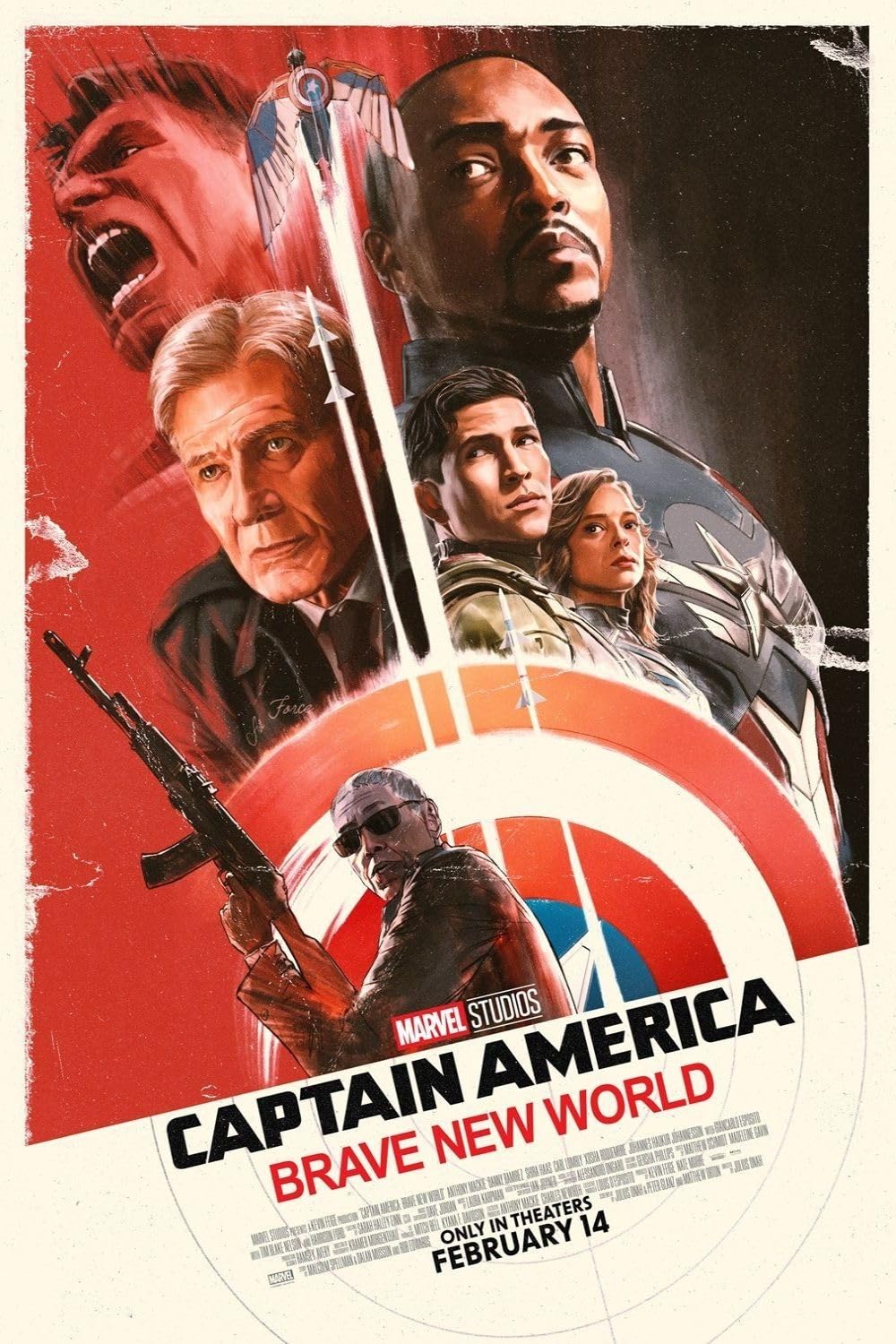
Disney+: the Movie. The latest installment in the MCU feels like a Disney+ episode or show idea that was artificially inflated into a feature film. Captain America: Brave New World neither has the intrigue of an espionage thriller nor the excitement of a superhero movie. The plotting unfolds in a manner reminiscent of a serialized television series, evidenced by disjointed scenes that could very well function as individual episodes respectively. The movie is also plagued with gross levels of slapdash, uninspiring CGI that take an already vapid story and reinforce the one-dimensional delivery. From beginning to end, the pacing issues are evidenced by the diegetic momentum that ramps up then fizzles repeatedly causing any modicum of suspense or urgency to diminish as soon as it forms, resulting in a mitigation any potential of a cinematic spectacular.
Sam finds himself in the middle of an international incident after meeting with President Thaddeus Ross. He must soon discover the reason behind a nefarious global plot before the true mastermind has the entire world seeing red.
Captain America: Brave New World exemplifies the trend of blurring the lines between television and cinema. The long and short of it is: the significant influence the MCU TV shows have had upon the theatrical releases. This observation is two-fold (1) screenwriting and (2) technical achievement. While the former is the more significant problem, the latter is the easiest to identify. Specifically, the movie’s color grading, shot composition, and digital effects are nearly indistinguishable from MCU streaming series on Disney+. Unfortunately, this blurring of the lines between cinema and television results in a lack of the grandeur typically associated with MCU theatrical releases.
The latter could be more forgivable is the former was of a higher caliber. While writer Rob Edwards has certainly demonstrated his gift for screenwriting in previous Disney films (the Academy Award nominated Treasure Planet, being one), the other two writers have primarily worked in Disney+ television–and it shows–in spades. The plotting, pacing, character development (or lack thereof, as it were) is straight out of Disney+. The lack of urgency and stakes are also problematic, as well as the near absence of the “fun” factor. I will be the first to acknowledge that I don’t typically care for comic book or superhero movies; that said, even I will admit that the the first two phases of the MCU were (mostly, anyway) fun popcorn movies. Not the case with this latest installment. If the movie wasn’t going to be fun, then it should’ve been intriguing or spellbinding–not the case either. It’s pretty average all the way around.
I will forever be a champion for practical effects–even practical effects that are supplemented with CGI. But this movie screams TV-budget CGI the whole time. This is particularly true in the rather anticlimactic showdown. You cannot replace the way real light bounces off real objects into the camera lens, and this movie demonstrates the danger in relying heavily on CGI in an attempt to wow the audience. The strength of a picture should be in the plotting, subtext, and character development–not in the CGI. Since the movie was not going to lean into the fun factor, the CGI should’ve been dialed way back.
Even though it was wonderful to see Harrison Ford on the big screen again, he appeared to have been experience little fun while making this movie; furthermore, the performance was pretty well phoned in. Likewise, Anthony Mackie was not himself as Sam. This Sam was greatly lacking in charisma and wit. While his performance may not have been as phoned-in as Ford’s, there was still a flatness to the performative dimension. Danny Ramirez, however, did appear to be having fun on this movie, and I would’ve liked to have seen him given more to do in order to draw me into the story.
Captain America: Brave New World struggles to distinguish itself as a cinematic experience, with its disjoined plot, production quality, and lack of meaningful character development, resulting in a movie that appears to have far more in common with a Disney+ television series than with a feature motion picture.
Ryan is the general manager for 90.7 WKGC Public Media in Panama City and host of the public radio show ReelTalk about all things cinema. Additionally, he is the author of the upcoming film studies book titled Monsters, Madness, and Mayhem: Why People Love Horror. After teaching film studies for over eight years at the University of Tampa, he transitioned from the classroom to public media. He is a member of the Critics Association of Central Florida and Indie Film Critics of America. If you like this article, check out the others and FOLLOW this blog! Follow him on Twitter: RLTerry1 and LetterBoxd: RLTerry
 R.L. Terry ReelView