WICKED: FOR GOOD movie musical review

Some movies soar on broomsticks; this one never quite gets off the ground.
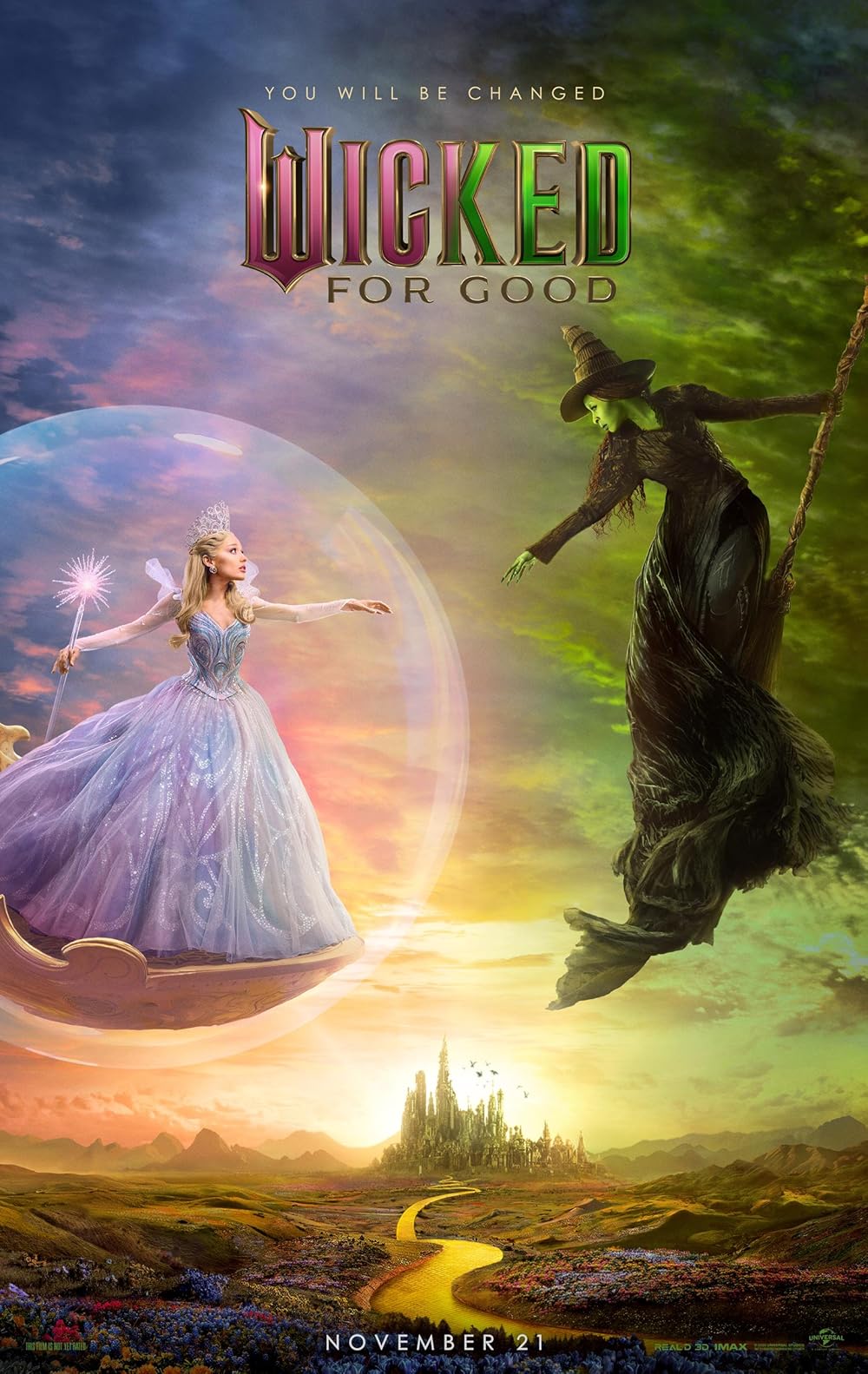
Wicked: For Good arrives with sky-high expectations, a beloved Broadway pedigree, and a cinematic world forever shaped by the 1939 Wizard of Oz. And while the heart for the material is undeniably present—director Jon M. Chu’s affection radiates through nearly every frame—the execution is fraught with problems that prevent the film from casting the spell it so eagerly attempts. It’s a movie overloaded with spectacle yet starved of narrative discipline, regrettably proving that sometimes a production can have all the right ingredients and still mix the potion incorrectly. There’s no question Jon M. Chu loves this material—his enthusiasm is evident. But passion alone isn’t enough. The film desperately needed stronger producing and organizational forces to ground the project, refine its pacing, and balance its emotional register. Instead, we get a production that feels at once over-managed and under-shaped.

Now demonized as the Wicked Witch of the West, Elphaba lives in exile in the Ozian forest, while Glinda resides at the palace in Emerald City, reveling in the perks of fame and popularity. As an angry mob rises against the Wicked Witch, she’ll need to reunite with Glinda to transform herself, and all of Oz, for good.

The most glaring issue in this movie is the pacing. This story never needed to be two movies. One Broadway show, one complete screen adaptation—simple math. Instead, Wicked and Wicked: For Good, collectively, feel like a single narrative forcibly stretched and compressed simultaneously. Scenes either end abruptly or linger with self-importance, giving the whole film a stop-and-start rhythm that betrays any emotional momentum. Moments that should breathe are suffocated, while others that should be tightened sprawl endlessly. Narratively, the film leans heavily on contrivances rather than character and plot development. Plot turns feel telegraphed or unearned, creating a sense that events are happening because the script demands it—not because the characters have earned the journey. Emotional beats are pushed rather than developed; the film tugs at heartstrings it hasn’t taken the time to weave. Many sequences feel manipulative instead of meaningful, leaving the viewer aware of the strings being pulled rather than swept up in the melody.

The film maintains the emotional equivalent of flooring the accelerator from beginning to end. Everything is heightened, everything is urgent, everything is presented at maximum volume. Without quieter resets, the story becomes exhausting rather than exhilarating. The lack of modulation leaves little room for nuance, making even potentially impactful moments blur together into one extended crescendo.

And then there’s the Oz problem itself–it was bad enough in the first movie, but this one amplifies all the flaws in this picture. From the opening Universal logo and Wicked title card, both stylized to resemble their 1930s counterparts, it’s clear the film wants to position itself adjacent to the classic Wizard of Oz. (And yes, I am aware that the Broadway show is based on books and not the 1939 classic, but this is a screen adaptation that is going to by default be connected spiritually and literally to the events, imagery, and characterizations of the original movie, but I digress). Whenever Wicked intersects with that iconic imagery, the visual and narrative disconnect is jarring. Tonally, textually, and aesthetically, nothing matches. Two of the most egregious examples are the Wicked Witch of the West’s castle, a location fundamentally misaligned with its 1939 counterpart in both history and design, and Glinda’s bubble. Hello??? She is clearly a magical being and travels by a magical bubble. To rob her of those elements is to rob her original characterization. For a film so eager to evoke some level of nostalgia, its disregard for consistency with cinema’s most beloved fantasy feels baffling.

The editing is among the film’s most distracting flaws—awkwardly timed transitions, uneven scene construction, and moments that feel spliced for convenience rather than cohesion. The cinematography dazzles with color and movement but contributes little to storytelling. It’s all flash, no narrative substance: beautiful images that ultimately amount to little more than digital confetti. And we cannot talk editing without addressing teh cringe CGI–the kind of digital spectacle that feels less like movie magic and more like a rough animatic accidentally exported at full resolution. Emerald City looks less like a tangible place and more like a high-end screensaver—everything polished to a rubbery sheen, with no texture, grit, or atmospheric depth. Characters often appear detached from their surroundings, as if composited into a digital diorama rather than inhabiting a lived-in world. Instead of mixing practical sets with digital enhancements, the film leans heavily on full-CG environments and even characters, resulting in octane-fueled and intimate moments feeling artificial. It’s like looking upon a world of fantasy that feels more like a giant animated backdrop with actors placed within versus a world that feels tangible.

Not even the presence of Michelle Yeoh is enough to elevate the film’s sense of class or gravitas. Although, it’s hard to blame her, given that she’s phoning in a performance built on scraps of narrative substance. In this second installment, her character is little more than an ornament of prestige, offering neither meaningful development nor any real impact on the story. Jeff Goldblum, likewise, delivers a surprisingly muted turn, coasting on his trademark charisma without ever fully engaging. When two performers known for commanding the screen seem this disengaged, it speaks less to their abilities and more to a film that gives them virtually nothing with which to work.

Wicked: For Good reaches for greatness but ultimately fails to stick the landing. It’s a film overflowing with heart yet undercut by structural missteps, contrived plotting, mismatched continuity, and a visual approach that prizes spectacle over substance. For a story about defying gravity, it’s ironic that this adaptation never quite lifts off the ground.
Ryan is the general manager for 90.7 WKGC Public Media and host of the show ReelTalk “where you can join the cinematic conversations frame by frame each week.” Additionally, he is the author of the upcoming film studies book titled Monsters, Madness, and Mayhem: Why People Love Horror. After teaching film studies for over eight years at the University of Tampa, he transitioned from the classroom to public media. He is a member of the Critics Association of Central Florida and Indie Film Critics of America. If you like this article, check out the others and FOLLOW this blog! Follow him on Twitter: RLTerry1 and LetterBoxd: RLTerry
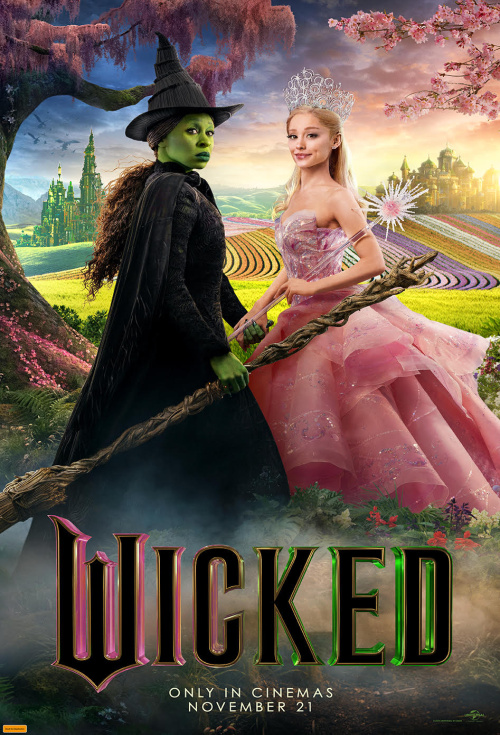
WICKED movie musical review

By Kurt Feigelis

“A true cinematic spectacle!”

Dear Journal,

It’s been so long since we talked it honestly feels like the first time. Well it happened the Wicked movie finally came out–well partly. I was lucky enough to attend the Press Screening in Tampa. The beloved musical from Broadway has been turned into a film (or more correctly two film installments), and everything leading up to this movie makes you think it wouldn’t work. But surprisingly it did.

I know you know the show, but just in case you forgot. This is the story of the Witches of Oz, of The Wizard of Oz, and boy did a lot happen before Dorothy dropped in. It follows Elphaba (Cynthia Erivo), while at Shiz University and her inevitable journey in becoming the Wicked Witch of the West. Alongside her roommate Glinda (Ariana Grande), an unlikely friendship grows. The themes of being an outsider and yearning to belong rings true in this adaptation. 

Everything leading up to this release makes you think that it should not have worked. Split into two films, Part 1 is too long, the cast has “too many stars”, and has been in development hell for over a decade. Rumors of a movie have been online for about as long as the musical has been on Broadway. Cast rumors include everyone from the original Broadway Cast, to Lea Michele and Amy Adams. But the core of the team was the producers, some of the same names you will find from the original Broadway show, and I think that is why the film works. The rare exception where the producing team delaying the movie for the right cast and director worked. Maybe development hell isn’t always a bad thing.

Wicked Part 1 sings with the feel of classic cinema. I think that came down to the Direction of Jon M. Chu (Crazy Rich AsiansIn the Heights). With a focus on real and large 360° sets, practical FX, live singing, and stunts. There is this feeling of realism to this fantastical world. The attention to detail and to do as much on camera as possible captures a live energy most movie musicals do not. Chu has a history of work in music videos, musical films, and large ensemble casts. This properly prepared him for this piece. 

Erivo is just wonderful as Elphaba. This roll is so well known with productions of the show playing all over the world in six different languages. But this is what the magic of what film does. In the theatre you got to play big, to the back of the house. Here, she is able to play it small, the little moments and movements play big for the screen. You get a closer connection to Elphaba you cannot get from the stage.  

Grande shines as well, and you know me, this was the role I was most concerned about. Grande is a very talented performer but many times it is Ariana Grande singing, when she is acting it’s always Ariana, not her character. I am happy to say she truly disappears into Glinda, the (very) Good Witch of the North. This is a testament to her work with vocal and acting coaches she started using even before she auditioned for the part. The comedic role is so often overlooked, but Grande brings something deep to Glinda in this adaptation. Erivo and Grande together, their friendship, is the heart of the movie. The rest of the supporting cast are as wonderful as you would expect with the names listed. There honestly wasn’t a surprise there. 

The musical numbers are pure entertainment. Usually in a movie musical the song and dance just doesn’t seem natural but Wicked does it right. The songs are already well know but they are modified and changed just enough to make them truly cinematic. The Wizard and IPopularDancing Through Life, and the film’s finale Defying Gravity are highlights for sure. 

If you want to nitpick some issues, the sound mixing was unbalanced throughout the movie. Between some of the musical numbers and dialogue scenes, there is an inconsistency. I don’t know if it was the theatre I was in, or the film itself. But, I feel it was the film. There are times when the score is overpowering the vocals. A film this long is always a bit intimidating, especially when trying to bring in a new audience.   But somehow the pacing works. The film doesn’t feel long while watching it. The extra moments with the characters and being brought into this world is much needed. There was not much added into this half of the story. But when transitioning from the stage to the screen. We need extra time for the camera to bring us into the world, to sit and connect to the characters. That is the reason for the additional time. Like Kill Bill, it feels more organic than forced or a money grab like other movies that get split into two.

Live musicals and Broadway adaptations are still a hard sell for audiences, even more so after Joker 2. I think the movie will do well, but with Gladiator II and Moana 2, there is stiff competition, Universal knows this which is why they upped the release date. It feels as though if a movie doesn’t make $1 Billion, it’s not a success to producers or the zeitgeist. Wicked Part 1 will do well with those who love the musical already, but I don’t know if new audiences will be pulled into this one. Which is a shame because it is a good film on its own. I’m curious what newcomers will say about the story and its quirkiness. 

The fandom of Wicked have been talking rumors for over ten years for this film. Then picking apart every visual and audio clip, still, and poster leading up to the premier. Sometimes the fandom does a disservice to what they love. Because of this I think the studio is nervous about the movie, releasing multiple interviews, behind the scenes and clips of the movie online leading up the premier. But out of context these clips are splitting its audience already familiar with the show. The reality is, the film does work. But remember this an adaptation not a remake or recreation of the stage show. Cinema has the power to expand the storytelling and that is what Wicked Part 1 is doing here.

Journal, in the end we need to remember what this movie is. It is the long awaited film adaption of a beloved Broadway Musical. To those that have seen the show I think they will love this movie without taking anything away from what they can see on stage. For a new audience, I think like Chicago, this will breathe new life into an existing phenomenon. People familiar with the show and The Wizard of Oz will see homages to both throughout the film. 

Part 2 comes out sometime in 2025, probably in November as well. We don’t know the run time of the follow up, or any details at all really, but until then we have this film to enjoy. What comes next is all the speculation, rumors and judgments for Part 2 that we had with Part 1. There is something about judging something or someone before getting to know it (or see it) that is unsettling given the story we are all here for. I think Elphaba might have something to say to us about this, but she wouldn’t be surprised.

You’re Movie Buddy,
Kurt Feigelis
R.L. Terry ReelView contributor

“Widows” full review

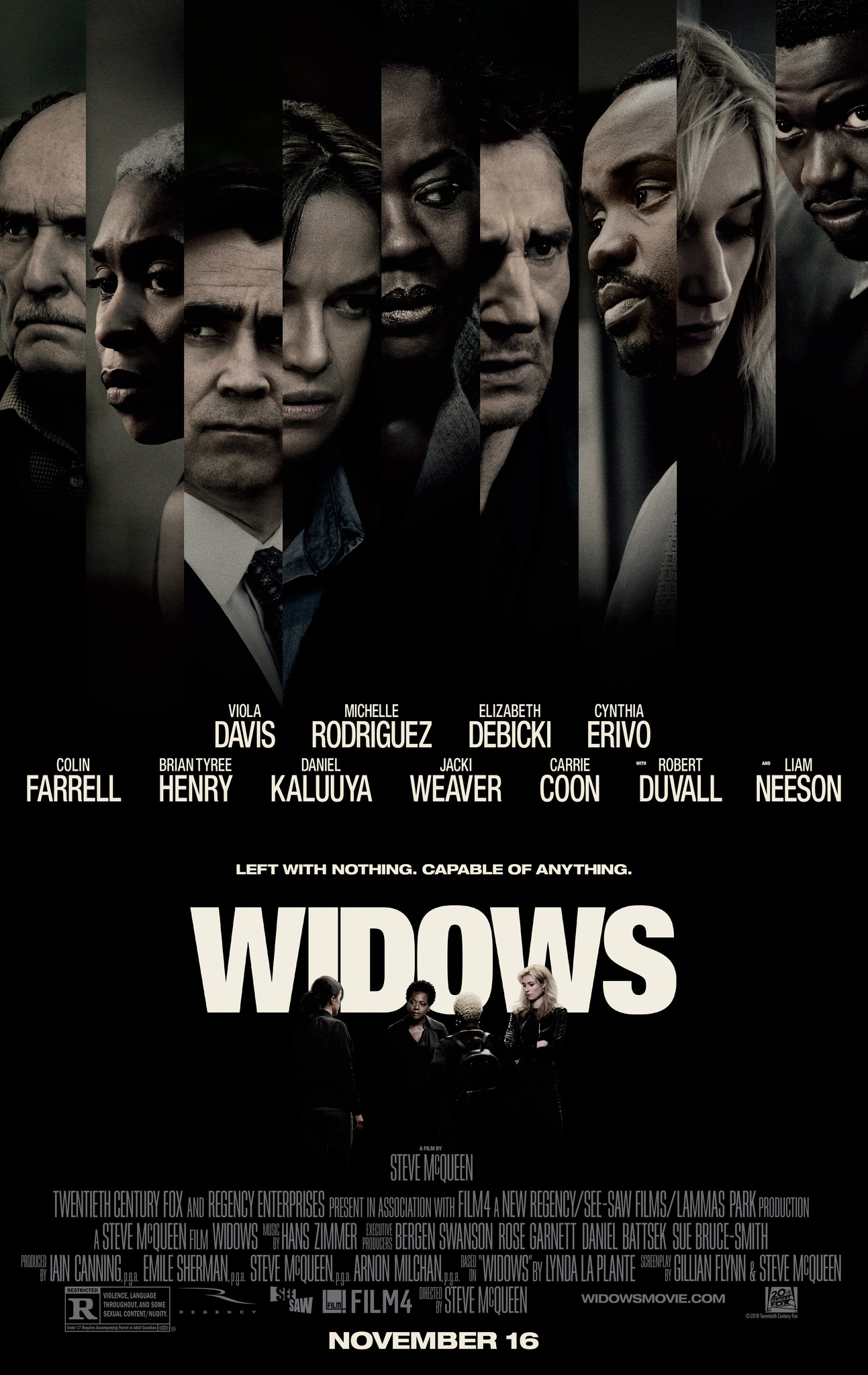
Intelligent, emotional, thrilling. Steve McQueen’s Widows is more than a thriller about a heist, it’s a stylish cinematic exercise full of social commentary on racial and social injustice within a city built upon political and business corruption. In a world that is completely exhausted from injustice, McQueen’s masterful direction brings Gillian Flynn’s multi-dimensional screenplay to life. Widows is brilliant in part because the film works on multiple levels simultaneously whilst delivering an edge-of-your-seat drama full of conflict. Not your typical action-packed film, the focus is truly on the central characters and the worlds from which they each come–worlds that collide after a robbery goes terribly wrong. It’s a brutal story with the highest of stakes. Witness a genre that is often not thought of as much more than a good popcorn movie, mature, grow, and exceed what society dictates this genre should be. While the characters themselves break through that glass ceiling, this film parallels the narrative by shattering expectations to create a thought-provoking work of cinema. Whereas a film in this genre seldom tackles such tough topics; and in general, many films that do seek to provoke discussions on race, social injustice, and gender roles come off as preachy, Widows never crosses that line from motion picture to sermon. The visually impactful story hooks you from the opening scene, and delivers command performances that force you to empathize and ask whether or not you would go to such lengths to forge a working relationship with people completely different from you in order save your very lives. What would you do when you are thrust into a situation in which you are way over your head and unprepared? Widows is as entertaining as it is thoughtful.

A heist goes terribly wrong. Very, very wrong. The result leaves four women widows. Four women that have no idea who one another are, or even the extent of their respective husbands dealings within the world of organized crime. These women are left with a debt owed to some powerful people who have a total disregard for human life, and only value money and influence. When Veronica (Viola Davis) is approached by a crooked politician for the $2mil her husband owes, she must devise a plan to deliver the money because her very life is in immediate danger. In order to get the money that she needs, Veronica blindly contacts the other widows in order to pull off the next heist her husband was planning. “The best-laid plans of mice and men often go awry. No matter how carefully a project is planned, something may still go wrong with it.” With little time to train, Veronica and her newly forged partners work tirelessly to plan and pull off the heist with a booty of $5mil.

After listening to the recent Mike Mike and Oscar (MMO) review of this movie, I am determined now more than ever to persuade them to my side of the argument that this is a great movie, and one worthy of the critical and general audience acclaim. There are so many layers to this story that it is difficult to know precisely where to begin my analysis. Before tackling the plot itself, the area where MMO and I agree is the cinematography and editing. McQueens stylistic direction is witnessed clearly in the phenomenal movement of the camera and editing. There are times that the camera feels like a character in and of itself. Without giving any spoilers away, there is one particular scene that was so brilliantly blocked and choreographed that I was legitimately wowed by the cinematography. And that is the gripping opening scene. The camera never misses a beat, and the editing is razor sharp. There are moments that the camera moves so exceptionally that I truly feel like a fly on the wall of the getaway van. Beyond the stellar cinematography and editing in the opening scene explosive action, the camera often lingers on reactions or reveals subtext in other scenes. While the characters may be talking about something innocuous or delivering a expositional dump, the camera is focussed on something entirely different.

The story of Widows is less about the heist as it is a character study on three incredibly interesting women who are forced to work together to achieve a common goal. An external goal of the theft of $5mil because of a mess left by their respective late husbands paired with the internal need to survive. And it in these characters and the conflict experienced by each that the film truly shines as taking this action genre to substantive levels. Much like a screenplay itself is build upon the three act structure, and individual scenes also embrace the idea of a “mini 3-act movie” within each act, the film provides three fascinating characters upon which the conflict and drama are build. Whether short or feature, films contain three acts, each with a specific diegetic purpose. Paralleling this concept of 3s is the central ensemble cast of Veronica, Linda, and Alice. Amanda is also left a widow by the police shootout, but does not play as active a role. Veronica is a character who lives on the wealth of her husband, but turns a blind eye to what he does. She is grieved and frightened of how she is going to cope with life, especially after having buried a teenage son. Linda is an entrepreneurial spirit who trusts that her husband is taking care of the logistics of opening a store but does not make sure bills are getting paid. She is unaware of his habitual gambling and penchant for unethical business ventures. Alice is a timid, shy person as a result of being abused as a child and by her husband. She demonstrates an unspoken relief that her abusive husband is gone, but reluctant to become an escort even though her mother trained her that she only has her looks and nothing else. We don’t learn as much about Amanda except the fact she is a new mother and doesn’t want to be involved in anything. All three of these woman are thrust into a situation in which they are over their heads and rise to the occasion to overcome the fear of impending death to take control of fate to forge their own futures. It requires them to drop walls, cooperate, and use each of their talents to combine together to create a formidable team. Alone, each of them did not have what was necessary to pull off the job, but together they become a solid team.

The stark differences between the three women are important because it allows the story to explore the socio-political and inter-personal affects the conflict has upon them. On the surface level, Widows is a heist movie; but ultimately, the heist itself is irrelevant, little more than a glorified plot device. Steve McQueen took a high concept film and made it low concept, gave it substance and meaning. Crafting this meaningful film out of a popcorn concept demonstrates McQueen’s ability to create something that is incredibly entertaining but never sacrifices character, the cinematic experience, or the important themes and subtext found therein. This is very much a #MeToo era film. It provides a platform for strong female characters to turn the tables on their oppressors, those who take advantage of them, and take back their dignity, self-respect, ambition, and independence. Thematically, the film is incredibly rich. Each of the central women are saddled with burdens of various kinds and to varying degrees however, the common denominator is dictation of place in society. This dictation is accomplished differently for each women, but the result is the same. They are all controlled by the men in their personal and vocational lives. Veronica must shed her codependence on her late husband and even her dog (a metaphor for her dependence on the external in order to function) and successfully cope with and overcome grief. Alice must realize that she is intelligent, has intrinsic value, does not need to rely on her body to generate income, and does require a man in order to survive. Linda is challenged with rising above having her passion business ripped out from underneath her because of a mess her husband left, and provide her children with a quality life while never forgetting her own needs and desires. All of these women are the victims of messes created by men, and leaving the women in their lives to clean up.

McQueen’s Widows gives a voice to the oppressed and downtrodden. Although the central characters are our three women, there are other characters in the film representing different kinds of real people out there who are selfishly creating messes and keeping those who aren’t wealthily, white, privileged on the bottom of the ladder and dependent upon the upper class. This is where different depictions of corruption enter the story. We have political corruption, business corruption, and even corrupted leaders of religious congregations. So much to talk about! It’s in these subplots that the film spends time highlighting and commenting on racism and gender roles. McQueen delivers a white ethnocentric political family who stops at nothing to keep minorities out of city government in order to hold all the control in the longstanding dynasties. Gender roles are analyzed by the manner in which the various women are treated by their male counterparts. Although much of these subplots are conveyed through exposition, there are some brilliant shots with the camera. One particularly powerful scene in which Jack Milligan (Colin Farrell) is driving home from his campaign stop in a predominantly black, poverty-stricken neighborhood to his whitewashed wealthy neighborhood. The distance is a matter of a few blocks, but the stark contrast between the neighborhoods is astounding. Whereas the conversation between Mulligan and his assistant could have been a boring expositional dump, it was dramatized by the setting and the reactions of the black chauffeur. This scene calls out the great divide that we see in our country. A few in power keep others oppressed and in their dictated places. Powerful material.

Gillian Flynn’s screenplay is tight, focussed, and deep. It wastes no moment to advance the plot and develop the central characters who all have well-defined external goals supported by well-defined internal needs. The big event of the heist gone wrong has a wide ripple effect that puts the very lives of the innocent in harm’s way, harm they may even mean eventual death. And it’s not a film that paints the “white male” as the only unscrupulous, unethical, power-hungry entity, it also takes the opportunity to show a black male politician who is just as unethical, power-hungry, and unscrupulous, even to committing murders. The lesson here is just how corrupt business and politics is. Even down to strong arming the religious community. Of course, this also shows that the leader of a religious congregation is not immune to picking up a racket and joining the game. Without ever feeling too preachy, Flynn’s screenplay uses visual juxtaposition to truly drive these points home. While the pacing of her screenplay may be slow compared to an action-driven plot, it is perfectly paced for this character-driven story. To be honest, I do not feel that this screenplay is as brilliant as Gone Girl, it’s still a powerful screenplay that balances the action components against the character ones in order to successfully experiment with the heist genre. For all its cleverness and excitement, of the three acts, the first two are definitely the strongest with a weaker third act closing out the film. Will the third act be what keeps this film from receiving a best adapted screenplay nomination? We will just have to wait and see.

There is so much to like about McQueen’s Widows! Make sure to go in with the right expectations though. If you go into the film seeking the next great heist movie, then you my be disappointed (as was the case with Movie Drone Podcast). Mike Mike and Oscar certainly stick by their impression that it’s just an okay movie all the way around and not the Oscar contender than many Tweeps and Podcasters are saying. After watching it for myself, listening and reading to reviews on both ends of the spectrum, I still feel strongly that this movie is fantastic! It’s a timely movie that gives voices and platforms to those who are often sidelined. From writing to directing and performances, you are in for a thrilling time with Widows.

Ryan is a screenwriting professor at the University of Tampa. If you like this article, check out the others and FOLLOW this blog!

Follow him!

Twitter: RLTerry1

Instagram: RL_Terry

Thrillz (theme parks): Thrillz.co