
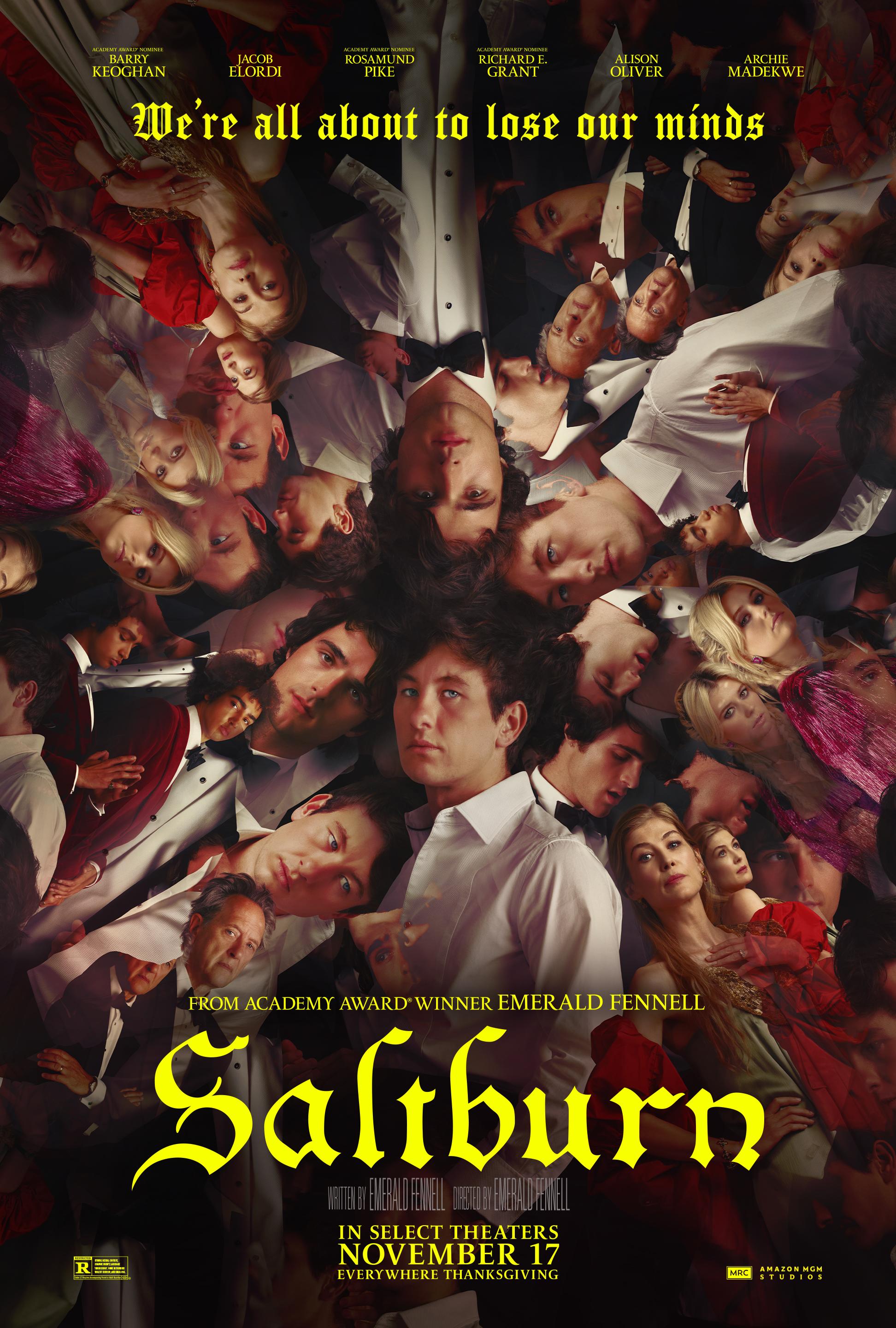
SALTBURN film review

An intoxicating and provocative neo-gothic film that is tonally all over the place. Heathers meets Cruel Intentions meets Flashdance(?) in a film that is incredibly stylistic but lacks any lasting entertainment value, except for the very end. Emerald Fennel (Promising Young Woman) delivers a sensory explosion critique on the facades we project through a story of the shifting balances of power, obsession, and deception. Is it a dark comedy? Is it a psychological thriller? Answer: it’s both and neither, and to that end, it’s potential for motion picture excellence is hampered. The tone of the film is incredibly uneven; and not one single character is likable. Saltburn presented many opportunities for effective, intentional camp, but chose to go the more serious route and play it straight.

Oliver (Barry Keoghan), a freshman at Oxford, is invited by classmate Felix’s (Jacob Elordi) family’s country estate for an exciting summer, but things are not what they seem and soon the fantastical estate falls victim to deception and manipulation.

The aforementioned movie examples in the opening paragraph each feature an aspect of this film; but each of those three examples offers a great deal more in entertainment value, not to mention lasting impact upon popular culture. Even though the central character’s external goal doesn’t become clear until the end, it is a thoughtfully plotted film that you wish you had enjoyed more in order to watch it again. However, the very last scene of the film is one that takes direct inspiration from Flashdance, and will be what is likely talked about for years to come. Too bad the rest of the film wasn’t as fun and entertaining as the final scene. Saltburn is neither an uplifting story nor is it a cautionary tale; it’s uncomfortably somewhere in the middle.

Clearly Emerald Fennell has a fantastic eye for shot composition and a demonstrable talent for crafting environments that stimulate the senses and emote. And that is to be commended. Few directors have a gift for creating and capturing settings and environments that communicate a discernible mood, tone, or emotion. We witness this in German Expressionism, which is at the root of gothic and many horror films. No surprise then that this film is incredibly neo-gothic in story and setting. Saltburn embodies uses both the technical and performative dimensions of the mise-en-scene to challenge audience perceptions; moreover, gothic films concern themselves with sexuality and audience response thereto. The collective imagery in this film generate a kind of spectacle for the audience to draw us into a heightened state of unease or fear. Fennell’s Saltburn is an exemplary motion picture for the art of drawing the audience into the world inhabited by the characters, and beckons you to join them.

Sounds great, right? If there were any characters worth caring about, then Saltburn could indeed be the masterpiece that many have claimed it to be. Fennell nailed the neo-gothic aesthetic and further stimulated our senses with the film’s intoxicating sexuality, but there isn’t a single character that you care enough about whether they live or die. These characters will both attract and repulse you, but more repulsive than attractive. No doubt that Oliver will become the stuff of erotic fan fiction and dreams, but even he isn’t likable in the end. And when delivering a melodrama about facades, pretenses, obsession, and deception, whether the film ends on a high or low note, there should always be at least one character the audience can root for, can truly care whether they live or die.

The story of Saltburn is inspired by the narratives of both Heathers and Cruel Intentions. And I don’t mention this to in any way suggest that Saltburn is derivative–it’s not–but to draw parallels to similar films. While I feel that both of these movies are much more rewatchable than Saltburn, if you like those two movies, you will likely enjoy it, even if you watch it one time. Where Heathers and Cruel Intentions succeed and Saltburn fails is in the entertainment value and tonal consistency. It’s as if Fennell was so concerned with provoking and sensually stimulating the audience that she forgot that the film should still be entertaining. Just because a film contains dark comedy or scathing social commentary doesn’t mean that it’s excused from providing entertainment for the audience.

What I will remember most is the ending of the film, which I cannot talk much about because of spoilers; however, I know that Fennell must love Flashdance because the final scene of the film is clearly inspired by the audition and triumph scene when Alex (and the dancers portraying her, haha) dance to Flashdance…What a Feeling! by the late Irene Cara. Even though we love Flashdance, we all know the plot is honestly not very good, but what saves the movie that literally defined the music, dance, and fashion of the 1980s is the uplifting, inspirational story and the high degree of entertainment value, not to mention one of the best jukebox soundtracks of all time (it won both an Oscar and Grammy for best original song).

Even though the tone may be inconsistent and characters unlikeable, the film certainly delivers on immersive atmosphere and a spider-like web of deception and manipulation with a great cast.
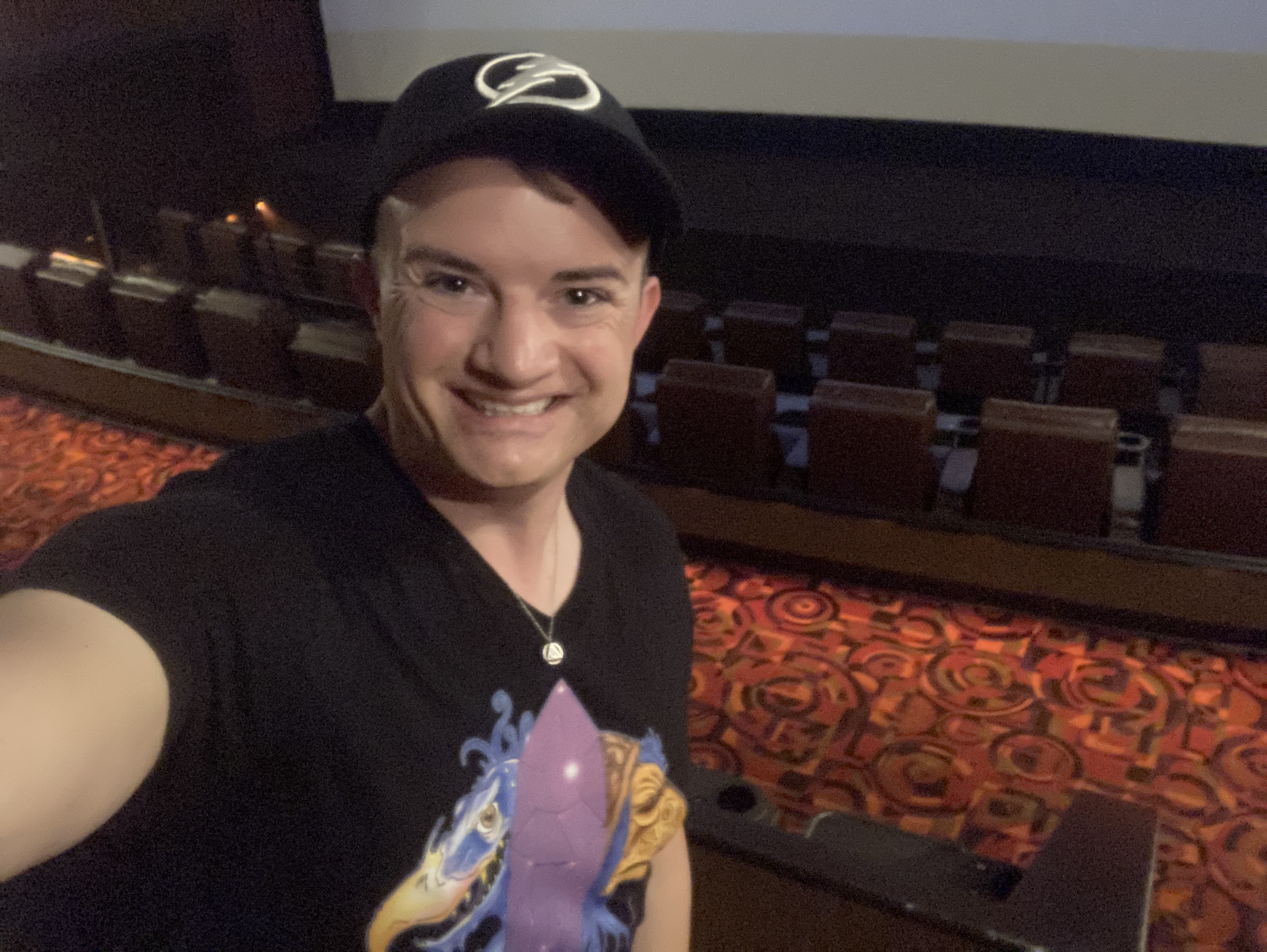
Ryan teaches Film Studies and Screenwriting at the University of Tampa and is a member of the Critics Association of Central Florida and Indie Film Critics of America. If you like this article, check out the others and FOLLOW this blog! Interested in Ryan making a guest appearance on your podcast or contributing to your website? Send him a DM on Twitter. If you’re ever in Tampa or Orlando, feel free to catch a movie with him.
Follow him on Twitter: RLTerry1 and LetterBoxd: RLTerry

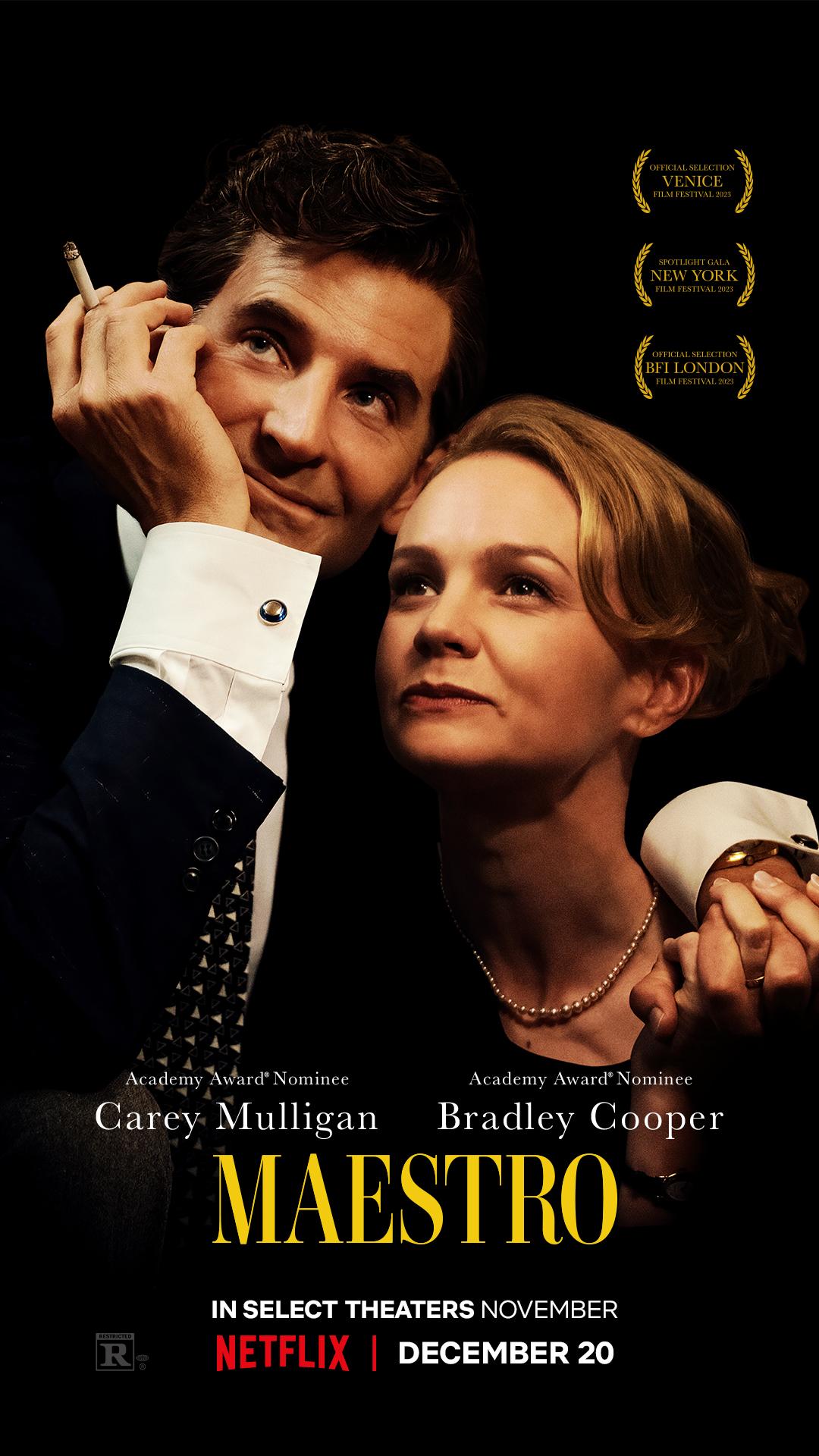
MAESTRO film review

Maestro‘s reach exceeds its grasp. Bradley Cooper’s biopic on Leonard Bernstein is an exemplary motion picture in many respects, but ultimately its potential for excellence is hampered by a disjointed screenplay. The performative dimension of the film is impressive, as is the emotive apparatus of the film itself. Furthermore, Cooper’s talent for the director’s chair is witnessed beautifully in most areas of the film except for the storytelling mechanics–not the story itself–but rather how the story is told. Another example of the dangers of being both writer and director (and in this case producer too). Most films need the checks and balances that come from having a different individual at the helm of writing, directing, and producing. If most of what you know of Bernstein’s legendary career comes from West Side Story, then you should read up on his accomplishments prior to watching the film, as it feels very inside baseball. There is a great story in this film, but the screenwriting mechanics hold it back from being truly outstanding.

Maestro tells the complex love story of Leonard and Felicia, a story that spans over 30 years-from the time they met in 1946 at a party and continuing through two engagements. It also chronicles the prolific and influential career of one of the greatest composers and conductors in American history.

The most striking dimension of the film is the apparatus of the film itself, the mechanics employed to visually craft the method of telling this story. The film starts in then-present day with an on-camera interview in color and widescreen, then as the film jumps back to the 1940s, it changes to a 4:3 ratio and is in grayscale (with a blue tint). As the story unfolds, the film transitions from 4:3 grayscale to 4:3 color to eventually 16:9 (if you will) color. To the casual observer, this was to signify time jumps alone–and to stop there would be limiting the art and affects of this tool. More than signifying chronology, it was used to spotlight the emotive dimension of the film as it evolves (or devolves, depending on how you look at it) from an old Hollywood conventional romance to post-modern subversive romance.

Bernstein goes from being in love with people to being in love with his music, but always in need of muses and people around him. He was almost never alone–he was scared of being alone. The irony in that is he simultaneously brought people together with his music but drove them away because his first love was his music. Beyond the montage of the film, this emotive apparatus incudes a complete score by Bernstein, and the inclusion of Bernstein’s music to accompany audiences along this journey was a brilliant choice to increase the intimacy of the story for audiences both familiar and unfamiliar with his library of compositions. Cooper’s use of a cinematic storytelling apparatus such as this, elevated mere storytelling montage for cause/effect chronology to that which communicates emotion and introspection.

Both Bradley Cooper and Carey Mulligan shine in their respective roles; moreover, Mulligan’s Felicia Montealegre-Bernstein is truly the heart and soul of this film. Not mere impersonations, both Cooper and Mulligan completely transform into the real-life characters they are portraying. The performances were so incredibly intimate and personal that the authenticity leaped off the screen. When they hurt, we hurt, and when they were joyous, we were joyous. While Leonard is the title role, the character with whom most in the audience will identify is Felicia. She is the conduit through which we experience most of this biopic. Furthermore, she is the character that feel the most human, because Leonard’s level of talent was so out-of-the-world that it is hard to connect with him to the same degree most in the audience connect with the unconventional romance of Felicia and Leonard.

On a more personal note, I found myself connecting with Leonard the most because there is a line from Bernstein in the movie that goes something to the effect of (and I am paraphrasing) “I am so many things, but society only wants me to be one thing. I cannot be that one thing because I am all these things, and to not be any one of them would be to deny who I am.” Despite the fact I feel that Cooper is as much a screenwriter as Sorkin is a director, this line is representative of the central theme in the film and one with which I identify greatly. For I too am so many things, but society wants me to pick (and be successful) at just one of them, but I cannot because I am all these things. I am a professor, academic writer, event planner, film critic, and public speaker. For me to not do any one of these things would be to deny who I am. On that level, this film felt incredibly personal.

With all these wonderful elements going for this motion picture, the film’s reach exceeds its grasp due to the disjointed screenwriting. I’ve said it before, and I will say it again, most directors are not screenwriters (and the inverse is also true). Very few writer-directors can do both jobs equally well. If for no other reason, a film built upon a writer-director lacks sufficient checks and balances to ensure the narrative mechanics are adequate for translating a story from the mind of a screenwriter to the screen of a director. And this is where I draw the inside baseball analogy I mentioned earlier. The full potential of this film requires audiences to be knowledgable in the career of Bernstein beyond West Side Story and Our Town.

The screenplay fails to start on common ground before its deep dive into the career and romances of Bernstein. For example, unless you are a student of music, it is doubtful that you were aware of his work outside of West Side Story and Our Town. Therefore, since that is most people, the screenplay should have established a common connection between Bernstein’s work and general audience members early on in the film. Then, once common ground was established, take audiences on the journey through his personal and professional life. His contributions to Broadway are little more than one-off mentions during the film. The pacing of the story also plagues the film as it provides few, if any, transitional scenes and simply jumps from time period to time period. The stylized editing and cinematography mentioned earlier in the review help to communicate chronology, but there is more to telling a biographical story than time and place.

Alfred Hitchcock stated to start every scene in a film as close to the end of the scene as possible and end the scene as soon as possible all while ensuring that something dramatic happens at the end of the scene (in screenwriting terms a button) that sets up the proceeding scene. Nothing should happen in scene B that wasn’t setup in scene A and every scene should in some way point to the end of the film. It is basic screenwriting conventions that are ignored in hopes that the stylistic apparatus and performative dimensions of the film will make up for the lack of care in the how the story is being told. Screenwriting is more than a narrative to be delivered on the silver screen, it’s more than dramatize don’t tell, it’s all of that plus how story is being told even before the first shot is filmed. Screenwriting mechanics (inclusive of conventions and guidelines) are important because they work.

Bradley Cooper’s Maestro is a beautiful-looking motion picture that attempts to capture the gravitas of the professional and personal life of one of the greatest composers and conductors in American history. While it’s no Amadeus or Mr. Holland’s Opus, it is a solid film that students and fans of his career will thoroughly enjoy. For those that may only know him from his contributions to Broadway, the film will still be interesting enough, but may not be as impactful without more in-depth knowledge of his career and life.

Ryan teaches Film Studies and Screenwriting at the University of Tampa and is a member of the Critics Association of Central Florida and Indie Film Critics of America. If you like this article, check out the others and FOLLOW this blog! Interested in Ryan making a guest appearance on your podcast or contributing to your website? Send him a DM on Twitter. If you’re ever in Tampa or Orlando, feel free to catch a movie with him.

Follow him on Twitter: RLTerry1 and LetterBoxd: RLTerry

“Promising Young Woman” film review

An intriguing story on a timely topic with lots of promise; however, it ultimately leaves little room for redemption. But hey, Mulligan’s performance was truly outstanding! After being away from the cinema for over a month in the wake of my grandmother’s passing just before Christmas, I returned to the Universal Cinemark. Usually, I am on top of new theatrical releases, but I was unable to attend the cinema while out of town. So I am just now getting to Promising Young Woman. As such, I’ve been able to read tweets, read blogs, and listen to reviews of this film. Needless to say, I was expecting one of the best films of 2020; unfortunately, that is not the case. While the film showcases an exceptional performance by Carey Mulligan, and even a solid performance by Bo Burnham, the film fails to follow some basic narrative conventions. There was such a fantastic opportunity to comment on toxic college culture, including the epidemic of higher education covering-up sexual assault, the rationalization of not taking responsibility for one’s actions, and (this is where the film fails its audience) the ability for one to have a redemption arc. Where is the redemption in the film? Nowhere to be found. However, we have an excellent example of what happens when one refuses to forgive. Unforgiveness is like a poison that eats away at the mind and soul. Forgiveness does not equal forgetting nor pretending that everything is okay. For a film that was full of promising teachable moments, it succumbs to the narrative trap of an inability to acknowledge that change is possible. If Scrooge can be redeemed, so can we all.

Synopsis: Nothing in Cassie’s (Carey Mulligan) life is what it appears to be — she’s wickedly smart, tantalizingly cunning, and she’s living a secret double life by night. Now, an unexpected encounter with a former colleague Ryan (Bo Burnham), she sees this as a chance to right the wrongs from the past.

Before I get into the issues I take with the message, plot, and narrative, I want to highlight what the film delivered well. Standing out, is the phenomenal performance by Mulligan. While my personal principle of only watching/reviewing films that have an exclusive theatrical run limit the scope of what I can cover, from the 2020 films that I did see, her performance is certainly a standout from the year. This showcase performance is likely to land her a Best Actress in a Leading Role nomination at the Oscars and Globes. I greatly appreciate how the character of Cassie is both colorful, and glossy one moment, and dark and terrifying the next. Even simultaneously conveying the complexities of a character suffering from a personal hell brought on by unresolved trauma. The other performance of note is Bo Burnham’s as Ryan. While not as notable a performance as Mulligan’s, there is still a lot to be admired in this role, which is largely a departure from the majority of the roles from his past. This film serves as a conduit for him to showcase his acting chops in a more serious role. Even though his performance may not land him on any awards lists, it’s still a performance that will undoubtedly land him future leading roles. And hopefully one of those future roles will give him a more complex character to portray.

Despite my reservations with the plot, I cannot not acknowledge this directorial accomplishment by Emerald Fennell. Clearly, Fennell’s penchant for direction is witnessed in this film. While she has been nominated for her television screenwriting, where she shines in this film is in her role as director. Each scene is directed skillfully, and thoughtfully. Of all the great scenes, the one that stands out the most is the showdown between Cassie and Al Monroe at the bachelor party. Clearly, Fennell understands the power of nuance, and can communicate that throughout the film. Screenplays need writers who care, and films need directors who care. And Fennell inarguably cares about how each scene is executed and the characters therein.

Representation vs reality. There is a grand discussion topic; one that is core to film studies. In fact, just today, I was lecturing to my film studies students at the University of Tampa on representation vs reality. Whether or not the subjects on screen (people, places, things) exist within our reality, they are certainly representative of that which is real. And Fennell certainly leans heavily into representation of her version of reality. Unfortunately, in her warped version of reality, no one is written with an ability to acknowledge or take responsibility for past/current sins and then CHANGE, to experience a redemption arc. Instead, our central character of Cassie is written as a narcissistic, self-righteous young woman that goes through life as judge, jury, and executioner; she is prohibited from changing her worldview; likewise, the character of Ryan is prohibited from changing for the better, and is viewed through the lens of his reckless youth.

Most individuals, male or female, from Cassie’s past, are depicted as exhibiting deplorable behavior. The men of Promising Young Woman are especially depicted as reprehensible people. Even the likable character of Ryan, who is supposed to represent the actual “good guy” is sent to the metaphoric gallows for his past, despite the fact that he had demonstrably changed since college and had healthy, genuine romantic feelings for Cassie. The fact of the matter is, observational and statistical evidence shows that most men are NOT like the ones at the bar or in that video footage of the shameful, contemptible, disgusting sexual assault in college. Yes, some are, and they need to be held accountable for their egregious actions by law enforcement. And the leadership at universities needs to be held accountable for covering up these sexual assault crimes. Where the film excels is confronting both the dean of the college and the lawyer that protected Al Monroe from prosecution; these scenes are particularly powerful and provide commentary on a real problem that needs to be dealt with. Even the showdown between Cassie and Monroe provides thoughtful content to discuss and provide a wakeup call for those that engage in sexually criminal behavior as college students. Furthermore, the film does a brilliant job at exploring just how those that commit “drunken” sexual assault can rationalize why they aren’t actually responsible for their actions. Terrifying, but true.

The films does the characters of Cassie and Ryan a gross disservice. We’ll start with Ryan. While he was certainly complacent in the sexual assault against Nina, and should be confronted, he changed since his college days. He should’ve been given the opportunity to acknowledge his past, and demonstrate how he has experienced a personal redemption arc. That doesn’t mean that there aren’t still consequences, but people CAN change. He could’ve also been an example of the fact that there are actual good guys out there. This would’ve shown Cassie that she cannot assume that all men are despicable, despite the narrative she has experienced; thus acknowledging the error in judgement of her worldview. She isn’t without blemishes on her own record either; therefore, she cannot personally go around condemning all those she deems unworthy of forgiveness. Ryan is a relatable character because he is the most human out of all of them. He isn’t perfect, and he certainly doesn’t pretend to be. He has made mistakes, just like all of us. Granted, his mistake in being complacent during and after the sexual assault he was witness was a terrible one; but he certainly changed in the years following the tragic crime.

And now for Cassie. When we refuse to forgive someone that has wronged us (whether that wrong is mostly harmless or criminally abominable), it’s important to forgive as to not become a prisoner of our mind. Now, forgiveness does NOT mean forgetting, nor does it mean that everything is as it was before. Trust is still broken, lives are still lost, trauma is still experienced. Unforgiveness is like drinking poison; it’s like constructing a personal prison because it’s a toxic mindset that still allows the wrong-doer to have power over the life of the individual that was wronged. To the film’s credit, this toxic behavior is depicted quite well in the character of Cassie, as her refusal to forgive, to release herself from the prison of her mind, ultimately leads to her destruction. Much like the plot does not allow Ryan to be forgiven after his demonstrable change, the film also does a disservice to its central character, because Cassie never changes. There is a glimmer of change, but is quickly shattered. In this film, there were great teachable opportunities (1) to illustrate that there are good guys out there even if their past isn’t spotless (2) that Cassie’s lack of forgiveness is toxic, and prevents her from experiencing a healthy mind and spirit and (3) Ryan could’ve acknowledged and dealt with the idea that complacency contributes to the larger institutional problem of sexual assault in college. This film paints a portrait that change and redemption are impossible concepts.

For all the promise that this film had for a comprehensive approach to teen and college sexual assault, and the cover-up thereof, it fails to provide any avenues for redemption, which hinders the narrative from having the emotional impact it should’ve had. It ultimately falls victim to its own narcissistic self-righteous central character in a revenge plot that leaves no room for redemption. But, this film is a great exercise in the emotional and psychological affects that the lack of forgiveness has upon the mind and soul that ultimately leads to a toxic self-prison.

Ryan teaches screenwriting and film studies at the University of Tampa. If you like this article, check out the others and FOLLOW this blog! Interested in Ryan making a guest appearance on your podcast or contributing to your website? Send him a DM on Twitter or email him at RLTerry1@gmail.com! If you’re ever in Tampa or Orlando, feel free to catch a movie with or meet him in the theme parks!

Follow him on Twitter: RLTerry1