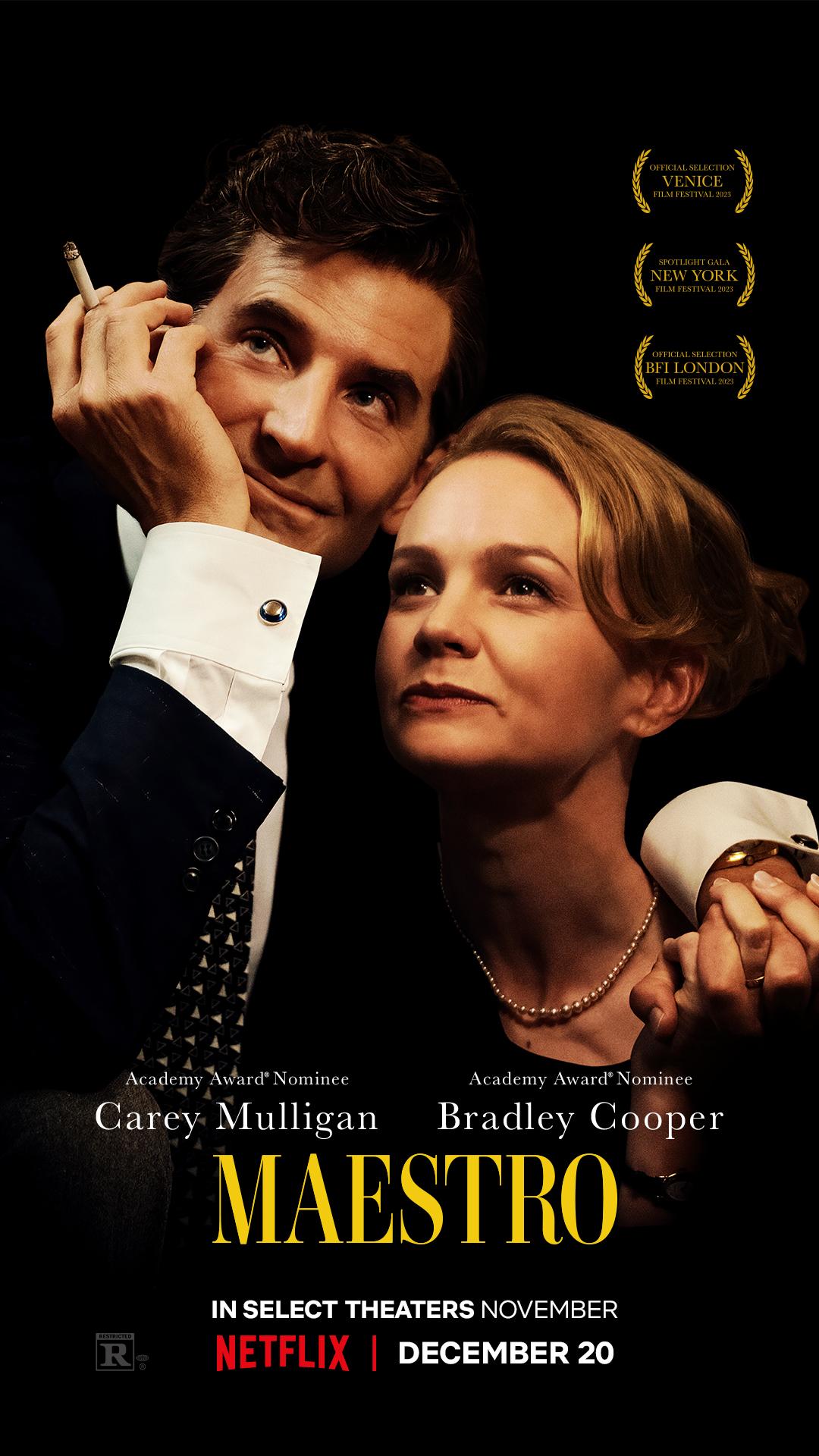
Maestro‘s reach exceeds its grasp. Bradley Cooper’s biopic on Leonard Bernstein is an exemplary motion picture in many respects, but ultimately its potential for excellence is hampered by a disjointed screenplay. The performative dimension of the film is impressive, as is the emotive apparatus of the film itself. Furthermore, Cooper’s talent for the director’s chair is witnessed beautifully in most areas of the film except for the storytelling mechanics–not the story itself–but rather how the story is told. Another example of the dangers of being both writer and director (and in this case producer too). Most films need the checks and balances that come from having a different individual at the helm of writing, directing, and producing. If most of what you know of Bernstein’s legendary career comes from West Side Story, then you should read up on his accomplishments prior to watching the film, as it feels very inside baseball. There is a great story in this film, but the screenwriting mechanics hold it back from being truly outstanding.
Maestro tells the complex love story of Leonard and Felicia, a story that spans over 30 years-from the time they met in 1946 at a party and continuing through two engagements. It also chronicles the prolific and influential career of one of the greatest composers and conductors in American history.
The most striking dimension of the film is the apparatus of the film itself, the mechanics employed to visually craft the method of telling this story. The film starts in then-present day with an on-camera interview in color and widescreen, then as the film jumps back to the 1940s, it changes to a 4:3 ratio and is in grayscale (with a blue tint). As the story unfolds, the film transitions from 4:3 grayscale to 4:3 color to eventually 16:9 (if you will) color. To the casual observer, this was to signify time jumps alone–and to stop there would be limiting the art and affects of this tool. More than signifying chronology, it was used to spotlight the emotive dimension of the film as it evolves (or devolves, depending on how you look at it) from an old Hollywood conventional romance to post-modern subversive romance.
Bernstein goes from being in love with people to being in love with his music, but always in need of muses and people around him. He was almost never alone–he was scared of being alone. The irony in that is he simultaneously brought people together with his music but drove them away because his first love was his music. Beyond the montage of the film, this emotive apparatus incudes a complete score by Bernstein, and the inclusion of Bernstein’s music to accompany audiences along this journey was a brilliant choice to increase the intimacy of the story for audiences both familiar and unfamiliar with his library of compositions. Cooper’s use of a cinematic storytelling apparatus such as this, elevated mere storytelling montage for cause/effect chronology to that which communicates emotion and introspection.
Both Bradley Cooper and Carey Mulligan shine in their respective roles; moreover, Mulligan’s Felicia Montealegre-Bernstein is truly the heart and soul of this film. Not mere impersonations, both Cooper and Mulligan completely transform into the real-life characters they are portraying. The performances were so incredibly intimate and personal that the authenticity leaped off the screen. When they hurt, we hurt, and when they were joyous, we were joyous. While Leonard is the title role, the character with whom most in the audience will identify is Felicia. She is the conduit through which we experience most of this biopic. Furthermore, she is the character that feel the most human, because Leonard’s level of talent was so out-of-the-world that it is hard to connect with him to the same degree most in the audience connect with the unconventional romance of Felicia and Leonard.
On a more personal note, I found myself connecting with Leonard the most because there is a line from Bernstein in the movie that goes something to the effect of (and I am paraphrasing) “I am so many things, but society only wants me to be one thing. I cannot be that one thing because I am all these things, and to not be any one of them would be to deny who I am.” Despite the fact I feel that Cooper is as much a screenwriter as Sorkin is a director, this line is representative of the central theme in the film and one with which I identify greatly. For I too am so many things, but society wants me to pick (and be successful) at just one of them, but I cannot because I am all these things. I am a professor, academic writer, event planner, film critic, and public speaker. For me to not do any one of these things would be to deny who I am. On that level, this film felt incredibly personal.
With all these wonderful elements going for this motion picture, the film’s reach exceeds its grasp due to the disjointed screenwriting. I’ve said it before, and I will say it again, most directors are not screenwriters (and the inverse is also true). Very few writer-directors can do both jobs equally well. If for no other reason, a film built upon a writer-director lacks sufficient checks and balances to ensure the narrative mechanics are adequate for translating a story from the mind of a screenwriter to the screen of a director. And this is where I draw the inside baseball analogy I mentioned earlier. The full potential of this film requires audiences to be knowledgable in the career of Bernstein beyond West Side Story and Our Town.
The screenplay fails to start on common ground before its deep dive into the career and romances of Bernstein. For example, unless you are a student of music, it is doubtful that you were aware of his work outside of West Side Story and Our Town. Therefore, since that is most people, the screenplay should have established a common connection between Bernstein’s work and general audience members early on in the film. Then, once common ground was established, take audiences on the journey through his personal and professional life. His contributions to Broadway are little more than one-off mentions during the film. The pacing of the story also plagues the film as it provides few, if any, transitional scenes and simply jumps from time period to time period. The stylized editing and cinematography mentioned earlier in the review help to communicate chronology, but there is more to telling a biographical story than time and place.
Alfred Hitchcock stated to start every scene in a film as close to the end of the scene as possible and end the scene as soon as possible all while ensuring that something dramatic happens at the end of the scene (in screenwriting terms a button) that sets up the proceeding scene. Nothing should happen in scene B that wasn’t setup in scene A and every scene should in some way point to the end of the film. It is basic screenwriting conventions that are ignored in hopes that the stylistic apparatus and performative dimensions of the film will make up for the lack of care in the how the story is being told. Screenwriting is more than a narrative to be delivered on the silver screen, it’s more than dramatize don’t tell, it’s all of that plus how story is being told even before the first shot is filmed. Screenwriting mechanics (inclusive of conventions and guidelines) are important because they work.
Bradley Cooper’s Maestro is a beautiful-looking motion picture that attempts to capture the gravitas of the professional and personal life of one of the greatest composers and conductors in American history. While it’s no Amadeus or Mr. Holland’s Opus, it is a solid film that students and fans of his career will thoroughly enjoy. For those that may only know him from his contributions to Broadway, the film will still be interesting enough, but may not be as impactful without more in-depth knowledge of his career and life.
Ryan teaches Film Studies and Screenwriting at the University of Tampa and is a member of the Critics Association of Central Florida and Indie Film Critics of America. If you like this article, check out the others and FOLLOW this blog! Interested in Ryan making a guest appearance on your podcast or contributing to your website? Send him a DM on Twitter. If you’re ever in Tampa or Orlando, feel free to catch a movie with him.

 R.L. Terry ReelView