
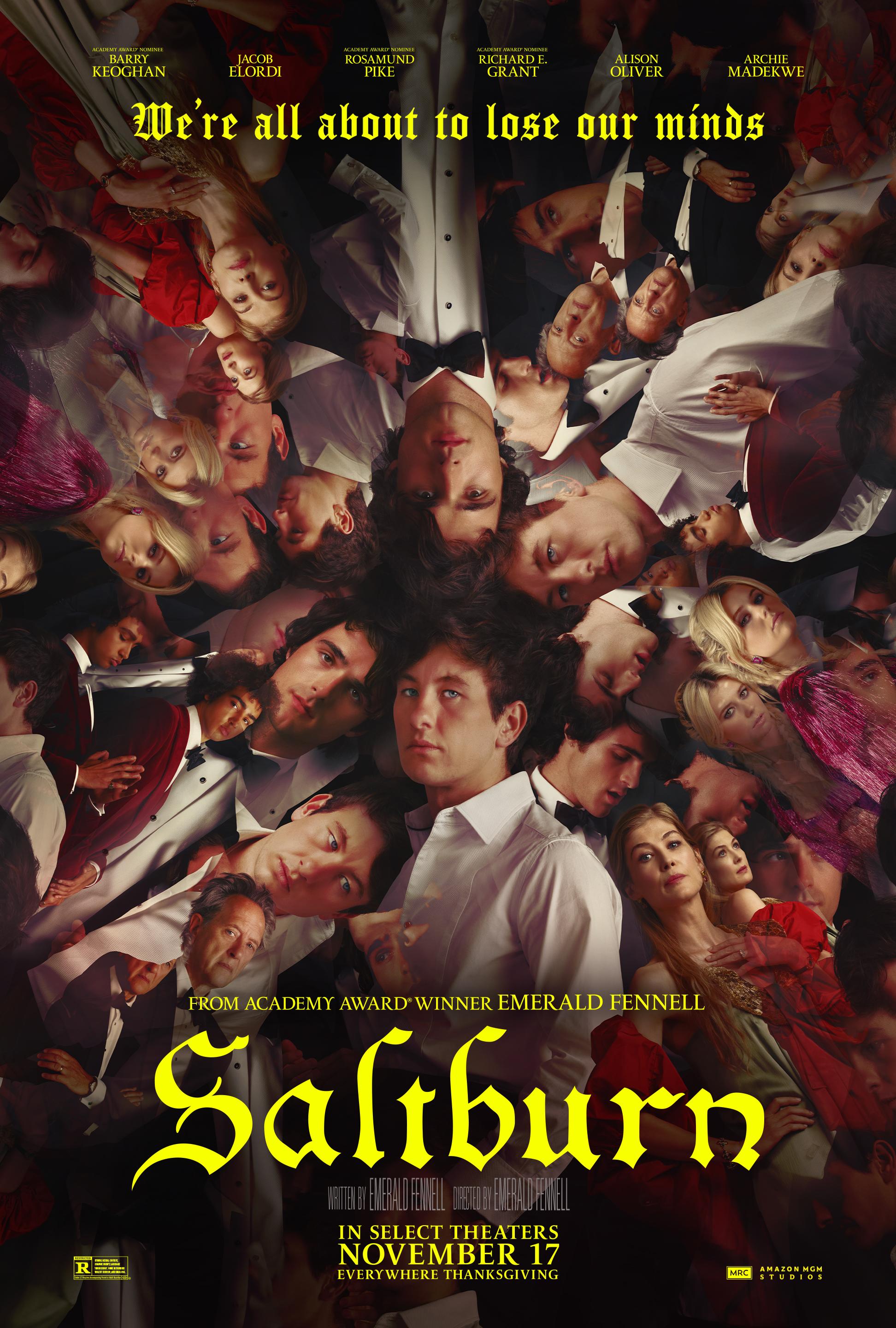
SALTBURN film review

An intoxicating and provocative neo-gothic film that is tonally all over the place. Heathers meets Cruel Intentions meets Flashdance(?) in a film that is incredibly stylistic but lacks any lasting entertainment value, except for the very end. Emerald Fennel (Promising Young Woman) delivers a sensory explosion critique on the facades we project through a story of the shifting balances of power, obsession, and deception. Is it a dark comedy? Is it a psychological thriller? Answer: it’s both and neither, and to that end, it’s potential for motion picture excellence is hampered. The tone of the film is incredibly uneven; and not one single character is likable. Saltburn presented many opportunities for effective, intentional camp, but chose to go the more serious route and play it straight.

Oliver (Barry Keoghan), a freshman at Oxford, is invited by classmate Felix’s (Jacob Elordi) family’s country estate for an exciting summer, but things are not what they seem and soon the fantastical estate falls victim to deception and manipulation.

The aforementioned movie examples in the opening paragraph each feature an aspect of this film; but each of those three examples offers a great deal more in entertainment value, not to mention lasting impact upon popular culture. Even though the central character’s external goal doesn’t become clear until the end, it is a thoughtfully plotted film that you wish you had enjoyed more in order to watch it again. However, the very last scene of the film is one that takes direct inspiration from Flashdance, and will be what is likely talked about for years to come. Too bad the rest of the film wasn’t as fun and entertaining as the final scene. Saltburn is neither an uplifting story nor is it a cautionary tale; it’s uncomfortably somewhere in the middle.

Clearly Emerald Fennell has a fantastic eye for shot composition and a demonstrable talent for crafting environments that stimulate the senses and emote. And that is to be commended. Few directors have a gift for creating and capturing settings and environments that communicate a discernible mood, tone, or emotion. We witness this in German Expressionism, which is at the root of gothic and many horror films. No surprise then that this film is incredibly neo-gothic in story and setting. Saltburn embodies uses both the technical and performative dimensions of the mise-en-scene to challenge audience perceptions; moreover, gothic films concern themselves with sexuality and audience response thereto. The collective imagery in this film generate a kind of spectacle for the audience to draw us into a heightened state of unease or fear. Fennell’s Saltburn is an exemplary motion picture for the art of drawing the audience into the world inhabited by the characters, and beckons you to join them.

Sounds great, right? If there were any characters worth caring about, then Saltburn could indeed be the masterpiece that many have claimed it to be. Fennell nailed the neo-gothic aesthetic and further stimulated our senses with the film’s intoxicating sexuality, but there isn’t a single character that you care enough about whether they live or die. These characters will both attract and repulse you, but more repulsive than attractive. No doubt that Oliver will become the stuff of erotic fan fiction and dreams, but even he isn’t likable in the end. And when delivering a melodrama about facades, pretenses, obsession, and deception, whether the film ends on a high or low note, there should always be at least one character the audience can root for, can truly care whether they live or die.

The story of Saltburn is inspired by the narratives of both Heathers and Cruel Intentions. And I don’t mention this to in any way suggest that Saltburn is derivative–it’s not–but to draw parallels to similar films. While I feel that both of these movies are much more rewatchable than Saltburn, if you like those two movies, you will likely enjoy it, even if you watch it one time. Where Heathers and Cruel Intentions succeed and Saltburn fails is in the entertainment value and tonal consistency. It’s as if Fennell was so concerned with provoking and sensually stimulating the audience that she forgot that the film should still be entertaining. Just because a film contains dark comedy or scathing social commentary doesn’t mean that it’s excused from providing entertainment for the audience.

What I will remember most is the ending of the film, which I cannot talk much about because of spoilers; however, I know that Fennell must love Flashdance because the final scene of the film is clearly inspired by the audition and triumph scene when Alex (and the dancers portraying her, haha) dance to Flashdance…What a Feeling! by the late Irene Cara. Even though we love Flashdance, we all know the plot is honestly not very good, but what saves the movie that literally defined the music, dance, and fashion of the 1980s is the uplifting, inspirational story and the high degree of entertainment value, not to mention one of the best jukebox soundtracks of all time (it won both an Oscar and Grammy for best original song).

Even though the tone may be inconsistent and characters unlikeable, the film certainly delivers on immersive atmosphere and a spider-like web of deception and manipulation with a great cast.
Ryan teaches Film Studies and Screenwriting at the University of Tampa and is a member of the Critics Association of Central Florida and Indie Film Critics of America. If you like this article, check out the others and FOLLOW this blog! Interested in Ryan making a guest appearance on your podcast or contributing to your website? Send him a DM on Twitter. If you’re ever in Tampa or Orlando, feel free to catch a movie with him.

Follow him on Twitter: RLTerry1 and LetterBoxd: RLTerry

THE BANSHEES OF INISHERIN film mini-review

Thoughtful exterior, vapid soul. A gorgeous-looking film that fails to deliver any substantive meaning or motivation behind anything that occurs in this ominous snoozefest. The Banshees of Inisherin is another 2020s cinema example of what happens when filmmakers fail to follow screenwriting conventions like a clearly defined external goal for the central character, supported by an internal need or motivation, and clearly defined opposition to the external goal. Furthermore, “a [day] in the life of…” is neither a plot nor a goal. The first act of the film holds hostage nearly half the screentime. And when something finally happens, the motivation behind it lacks any logic or rational reasoning. The outside/action story is nearly non-existent. Filmmakers should remember that a film can have depth, dimension, and deeper meaning BUT those layers should never take the place of a clearly defined linear or nonlinear plot map. Diegetic accessibility is important, even in more thoughtful films. Undoubtedly, this will become one of those films that pretentious cinephiles defend by the cliche “you just didn’t get it.” While the film looks gorgeous and the attempt to parallel the civil war between two (former) friends to the real-world Irish Civil War of the 1920s is intriguing, writer-director Martin McDonagh struggles to establish a plot to support the story he wants to tell. None of the characters are likable nor are the performances exceptional. Extreme/manic behavior does not a compelling character make. In many ways, this film reminds me of a more coherent The Lighthouse. So, if you enjoyed The Lighthouse, then you may enjoy this movie. The Banshees of Inisherin feels like a vanity project that means something to the filmmaker, but holds little value or meaning for the audience. Contrary to the accolade associated with this film, it is one of the most boring break-up movies ever made.

Ryan teaches Film Studies and Screenwriting at the University of Tampa and is a member of the Critics Association of Central Florida. If you like this article, check out the others and FOLLOW this blog! Interested in Ryan making a guest appearance on your podcast or contributing to your website? Send him a DM on Twitter. If you’re ever in Tampa or Orlando, feel free to catch a movie with him.

Follow him on Twitter: RLTerry1

ETERNALS movie review

An ambitious departure from the previous paint-by-numbers MCU films, but while it will attempt to distract you with impressive visuals (other than the Deviants), it’s a soulless film with a convoluted plot full of neo-liberal woke-pandering. Chloe Zhao’s The ETERNALS is the result of a writer/director concerning themselves far more with satisfying the rubric of check-boxes associated with toxic woke culture than telling a thoughtful or entertaining story. This is MARVEL Studios’ movie to demonstrate, through superficial virtue signaling, that they are onboard the Woke Express. Perhaps the idea of this movie sounded innovative in the echo-chamber meetings, but the execution leaves much to be desired. Diegetically, the prolific world building, MCU connectivity, and character development this movie needed to do, even the more than 2.5hr runtime isn’t sufficient, and ultimately feels like a DCEU-style rush job. Between the chaotic plotting, bad CG (those Deviants look like something right off the SyFy Channel), cosplay uniforms, dialogue lacking in any subtext, and the gross neglect for any nuance to the storytelling whatsoever, this movie is the product of an assortment of post-modern critical theories and not the imagination of a filmmaker. Clearly Zhao has an eye for cinematic composition, but her skills as a storyteller are not nearly as fine-tuned–certainly not for such a gargantuan superhero spectacle.

The Eternals, a race of immortal beings with superhuman powers who have secretly lived on Earth for thousands of years, reunite to battle the evil Deviants.

Dramatize don’t tell. This is the No.1 principle I teach in my film studies and screenwriting classes. And this important convention is broken at the very beginning of The Eternals. Very few movies have demonstrated that scrolling text in a prologue can pay off dramatically (i.e. Star Wars). It works in Star Wars because that is how the world was first introduced to the mammoth intellectual property, therefore, it becomes part of its branding (and is missed when it doesn’t happen). Moreover, there was no frame of reference prior to A New Hope; and since we were being plunged into the middle of the action, it was necessary to preface the story that was about to unfold. Audiences aren’t being introduced to the MCU–they’ve been in the MCU ostensibly since Paramount’s Iron Man. Therefore, this demonstrates a lazy approach to providing exposition that could have otherwise been integrated more thoughtfully into the main action story. Furthermore, this lack of dramatic exposition is problematic, not only at the beginning, but throughout the movie.

If there was a social media campaign or outcry about it in the last few years, you will find that box checked off in this movie. As I watched this movie (in IMAX, btw), I couldn’t help but envision a rubric, not unlike the kind many professors use for grading papers. Personally, I don’t use a rubric in my classes because satisfying requirements in that fashion does not tell me how you can apply what you learn in class to your topic; but rather, that you know the bare minimum you need to do in order to get the point(s). Think of it as a typical test. A typical test only demonstrates to the professor how much you can remember NOT how much you know or your level of wisdom (the application of knowledge). It’s as if Zhao held meetings with MARVEL Studios executives and staff to outline every woke box that needed to be checked in this progressive movie. I won’t go into all the examples because that would take up a paragraph in and of itself, but if there has been a push for representation, then you will find it here. And all those characters in one place means that most are not developed sufficiently and feel more like one-dimensional tokens than characters crafted by a writer who cares. That’s the problem here. Increased representation across the spectrum of humanity in cinema is very important, but not when it comes at the expense of the integrity of the characters themselves.

One of the hottest topics of discussion to come out of this movie is the inclusion of a PG-13 sex scene, which is long overdue in a cinematic universe such as this one, which is filled with HOT male and female characters in form-fitting uniforms. More than demonstrating to audiences that the MCU movies have grown up with their initial audience of teens and 20-somethings, this scene is important because it shows that these immortal beings have some humanity in them. Superheroes and supervillains are often not thought of as human, and even though we learn that these immortal beings aren’t exactly human, they do take on many characteristics of humans, and this scene is a refreshing reminder that superheroes have erotic passions just like the rest of us. There is a vulnerability about them.

Because of all the piping that is being laid in this movie (enough for at least two or three movies), the story feels incredibly rushed. It reminded of how the DCEU tried to complete with MARVEL, years after MARVEL had been in the MCU. The result was hurried world building. It took MARVEL years to build the MCU, but the DCEU tried to accomplish the same in a year or two. We have five stories here (1) its creation myth and early Mesopotamia (2) the time in Babylonian Empire (3) the time in the Aztec Empire (4) the Greco-Roman Empire, and (5) the present-day story. Each of these is incredibly important to the main action plot of The Eternals, and yet these otherwise rich settings are reduced to flashback fodder. There are easily three thoughtful movies that could have come out of the five aforementioned stories. The result is a single plot that cannot possibly accomplish everything that it needs to in order to effectively tell the story and do it justice. I’m still not entirely sure why the Deviants were attacking the Eternals; oh it was sort of explained, but like with much of the rest of the film, it wasn’t thoughtfully developed either.

If you are familiar with Middle Eastern or Greek mythology, you will enjoy the integration of some of the mythological stories with which you are likely familiar. From the Epic of Gilgamesh to Ikaros to Athena, you will learn that it’s the Eternals that inspired these stories. While we may never know precisely what inspired these stories in real life, they were likely inspired by real individuals, much like legends and lore are to this day. So, knowing that these powerful, immortal beings have been secretly living on earth makes since, and can be appreciated both through a historic lens and through the backstory of the main action plot of the movie.

There are two end-credit scenes, each setting up a new characters. I won’t spoil it (but don’t look at the IMDb either). One scene in at the beginning of the credits and the other is a post-credit scene.

Ryan teaches American and World Cinema at the University of Tampa. If you like this article, check out the others and FOLLOW this blog! Interested in Ryan making a guest appearance on your podcast or contributing to your website? Send him a DM on Twitter or email him at RLTerry1@gmail.com! If you’re ever in Tampa or Orlando, feel free to catch a movie with him.
Follow him on Twitter: RLTerry1