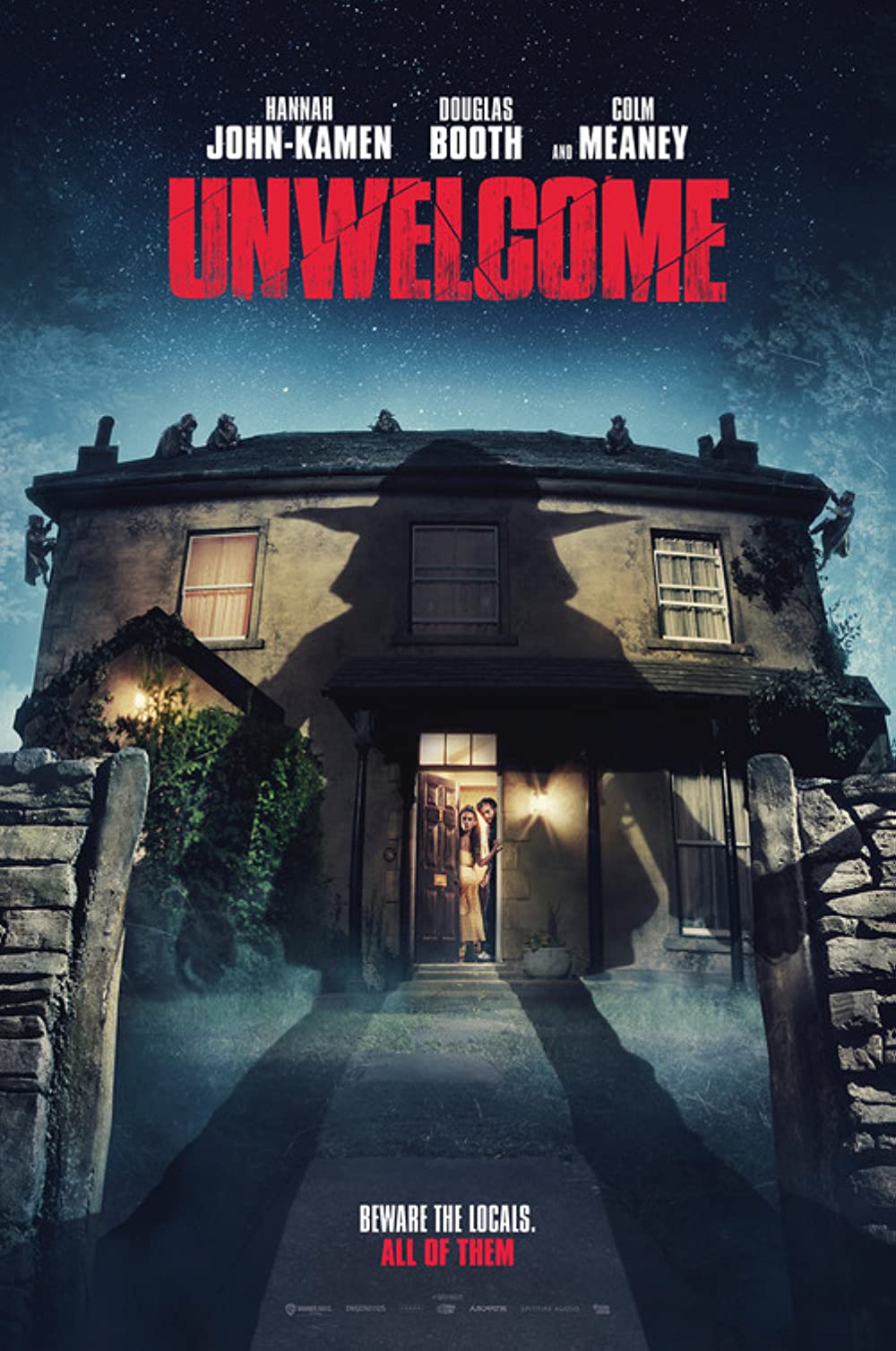
Whimsical and creepy. Jon Wright’s Unwelcome is a dark fantasy steeped in Irish folklore, but with a sinister spin. While the first act is a bit clunky, after the intense prologue that is, once the second act kicks into gear, the movie delivers on thrills and kills—and cheers for practical effects!! Fellow Trekkies will also enjoy the cameo from Star Trek’s Chief O’Brien.
A couple escape their urban nightmare to the tranquility of rural Ireland, only to hear stories of mysterious creatures who live in the gnarled, ancient woods at the foot of their garden. As warned by their new neighbors, the creatures come when called to help souls in dire need of rescue, but it’s crucial to remember that there’s always a dear price to pay for their aid.
Unwelcome draws audiences in with its immersive atmosphere and chilling mythos, but falters in pacing. After a gripping prologue, the first act struggles to find its footing to keep the pacing suitable for the rest of the setup. Often times this screenwriting problem occurs when the writer and/or director attempts to add greater gravitas to the story than is required or needed. Moreover, there is time spent with side characters and establishing setting that delays the transition to the development stage of the story, which would have benefitted the overall pacing of this quasi-methodical horror film. Once audiences are launched into the second act, the remainder of the film unfolds nicely.
Even though this is in-part a dark fantasy, when the kills hit, they hit! Wright (along with cowriter Mark Stay) strike a fantastic balance between horror and fantasy, simultaneously satisfying the expectations for both. While the kills may not be inordinately creative, they are sufficiently entertaining. By relying on practical effects, the experience of the film increases in dimension significantly. And I’m not just talking about the kills, but the excellent puppetry, makeup effects, and prosthetics of the little people. Over all, Unwelcome is a decent horror film that deserves a watch if you enjoy folklore-based stories that are familiar yet still find ways of surprising you.
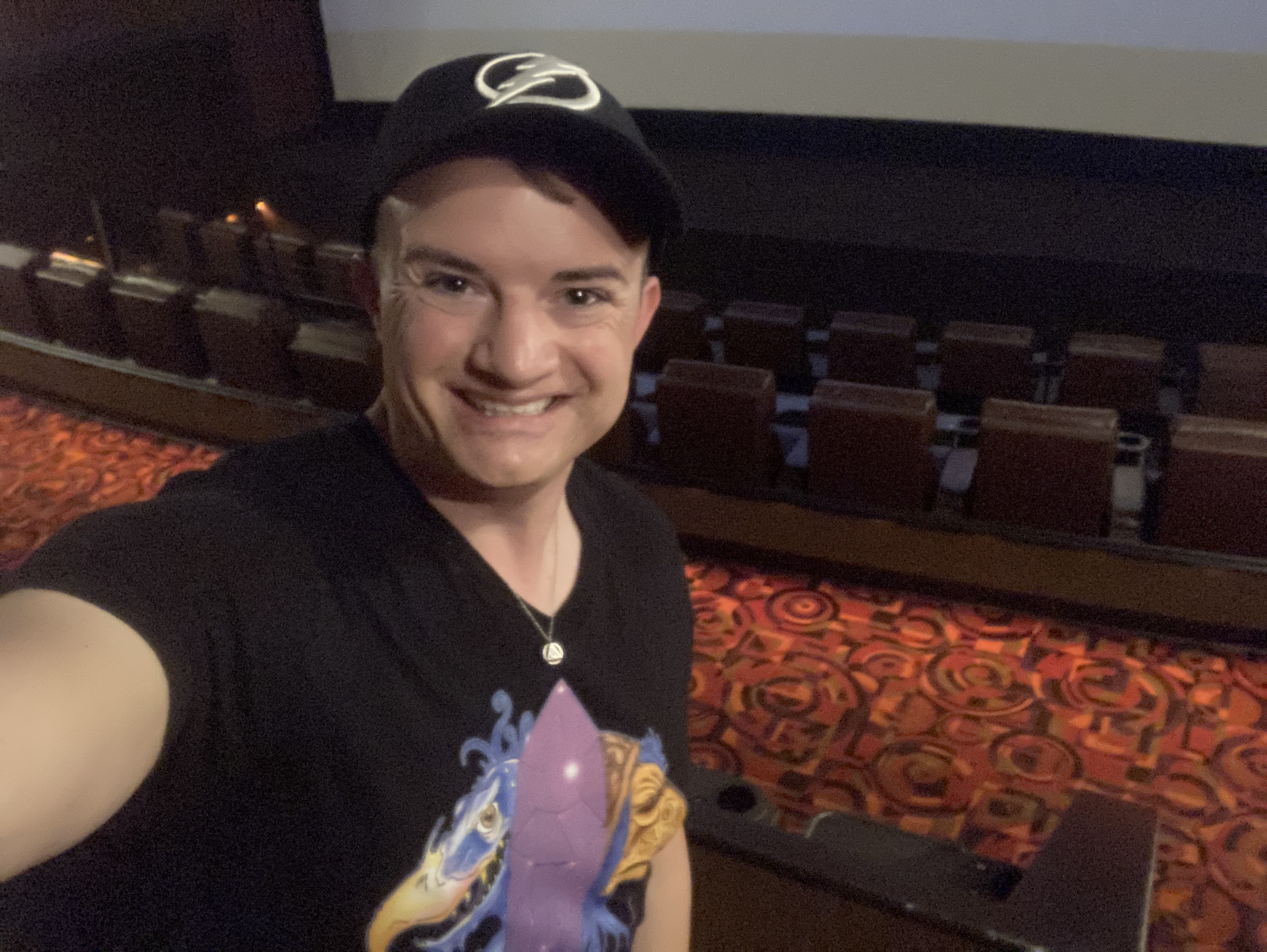
Ryan teaches Film Studies and Screenwriting at the University of Tampa and is a member of the Critics Association of Central Florida and Indie Film Critics of America. If you like this article, check out the others and FOLLOW this blog! Interested in Ryan making a guest appearance on your podcast or contributing to your website? Send him a DM on Twitter. If you’re ever in Tampa or Orlando, feel free to catch a movie with him.
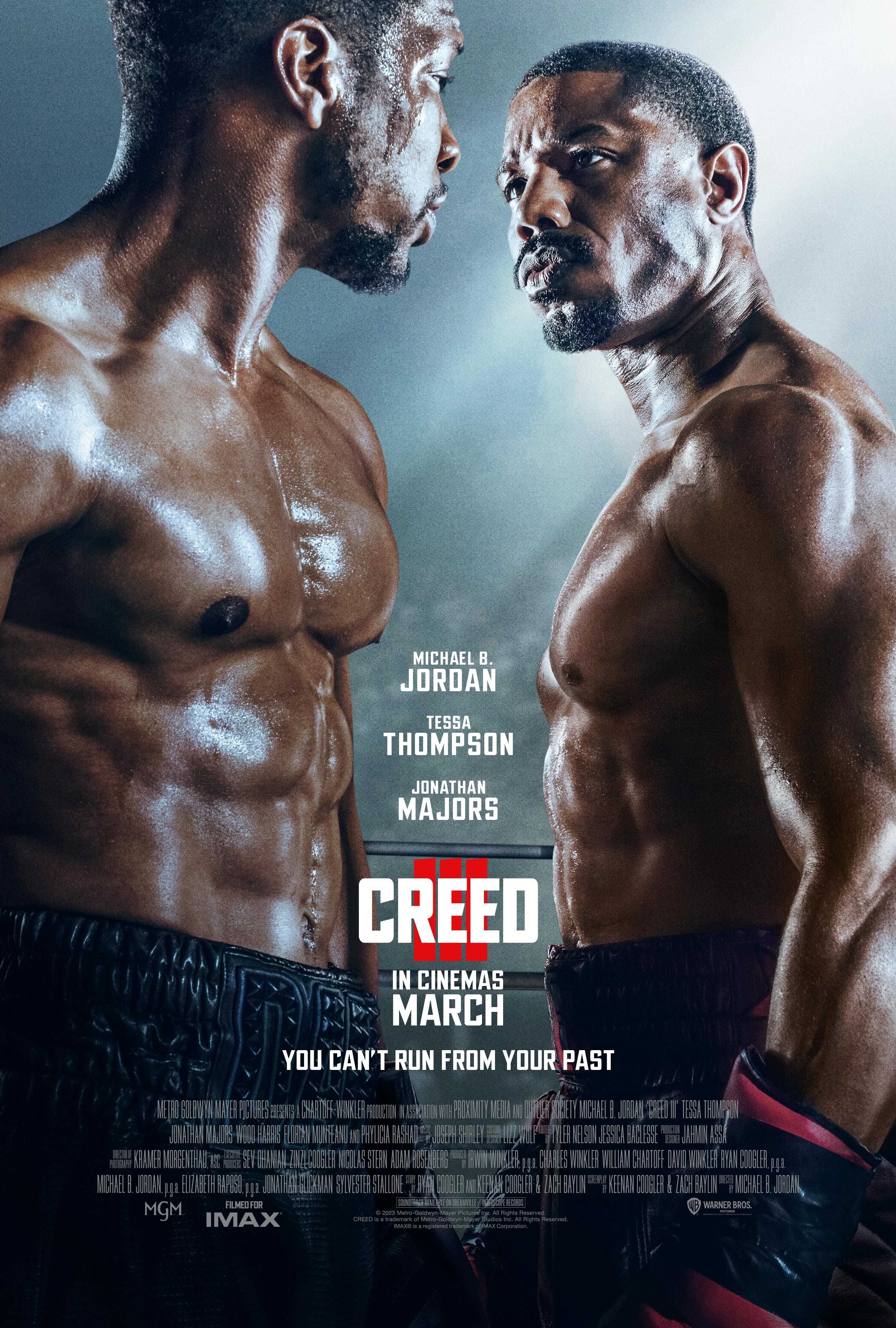
Heart pounding! Michael B. Jordan’s CREED III is an excellent, gripping motion picture! Quite possibly the best in the now-trilogy. Moreover, it is the first Best Picture contender in 2023. Reminds us that movies that focus on simple plots with complex characters are often times make for the best stories. The tertiary installment in the Creed series is a revenge story on the backdrop of the power the past can have over us if we fail to face it in the ring. This moving story is certain to stir up the feels! Ryan and Keenan Coogler’s story paired with Jordan’s directing and the iconic Sylvester Stallone’s producing combine to craft a story that is both visually and emotionally driven. Add in the A-list cast, and Creed III becomes one film that you do not want to miss seeing on the big screen, and preferably in a premium format. Audiences will feel as though they are in both the boxing ring that we can see and the psychological fighting ring that we must feel. Like with the previous Creed (and even Rocky movies), it’s not about the boxing, it’s not about the athletics, it’s about the characters; however, the setting and backdrop of a boxing match and physical endurance training is the conduit through which the story unfolds. While some critics have negatively reacted to the simple plot, need I remind my contemporaries that conventional storytelling is never to be undervalued. For it is when the plot is accessible that the complexities of character dynamics and thoughtful subplots work in tandem to support excellence in storytelling.
Still dominating the boxing world, Adonis Creed is thriving in his career and family life. When Damian, a childhood friend and former boxing prodigy resurfaces after serving time in prison, he’s eager to prove that he deserves his shot in the ring. The face-off between former friends is more than just a fight. To settle the score, Adonis must put his future on the line to battle Damian — a fighter who has nothing to lose.
Five years removed from Creed II, I was wondering if this next installment would be on par with the previous two outstanding movies, and suffice it to say, it most definitely is. In fact, I may even go onto say that this is my favorite of the series. And why is that? It’s the characters. Yes, most of the characters are ones with which we are already familiar, but the addition of an old, estranged friend of Adonis’ is the injection of emotional and physiological complexities that this film needed to force our hero of Adonis Creed to continue to grow as a person, a father, and as a professional. His Journey parallels Damian’s (Dame) journey as they are both fighting the demons of their respective pasts. Each of them express or deal with their pasts in their own ways, yielding vastly different results. And it is the divergent path both these fighters took after a fateful encounter one night that set Adonis on the path to forget the past and Dame on a self-destructive past that would lead him to seeking revenge on the man he claims lived his life.
While the outside-action story is expressed through a boxing match and simple revenge plot, the inside-emotional story concerns itself with a greater degree of introspection as expressed through the respective emotional journeys and fights with the past. Suffice it to say, Adonis and Dane are two sides of the same coin. Both characters react to the events of the past divergently. Wherein the audience will relate most is the idea of battling the past to move on, and failing to confront the past, no matter how painful, can lead to being held prisoner of past events that fester as time goes on.
Each of us has a past that we either tried to escape or allow to define us; either way, that gives the past immense power over our lives and decisions, even affecting those around us. The action plot of the boxing match is a manifestation or personification, if you will, of the battle raging inside both Adonis and Dame. Adonis expressed this influence of the past through a facade of overcoming and resillence, while Dame expressed this influence though unforgiveness (which is like you drinking poison hoping it’ll harm the other person) and resentment. Through the catharsis of the boxing match, Adonis and Dame confront the past with both links and separates the estranged friends.
Creed III is exciting and well-paced. Audiences will be on the edge of their seats as the story unfolds. Yes, there are moments of predicability, as this is a type of story that has been told before, but don’t allow that to dissuade you from making your way to the movie theatre to catch this future best picture contender. Are aspects of this story cliche (or paint by numbers), yes; however, as Patrick DeWitt reminds us in The French Exit through the timeless Michelle Pfeiffer, never forget that a cliche is “a story so fine and thrilling that it’s grown old in its hopeful retelling.” And Creed III is certainly thrilling!
Ryan teaches Film Studies and Screenwriting at the University of Tampa and is a member of the Critics Association of Central Florida and Indie Film Critics of America. If you like this article, check out the others and FOLLOW this blog! Interested in Ryan making a guest appearance on your podcast or contributing to your website? Send him a DM on Twitter. If you’re ever in Tampa or Orlando, feel free to catch a movie with him.
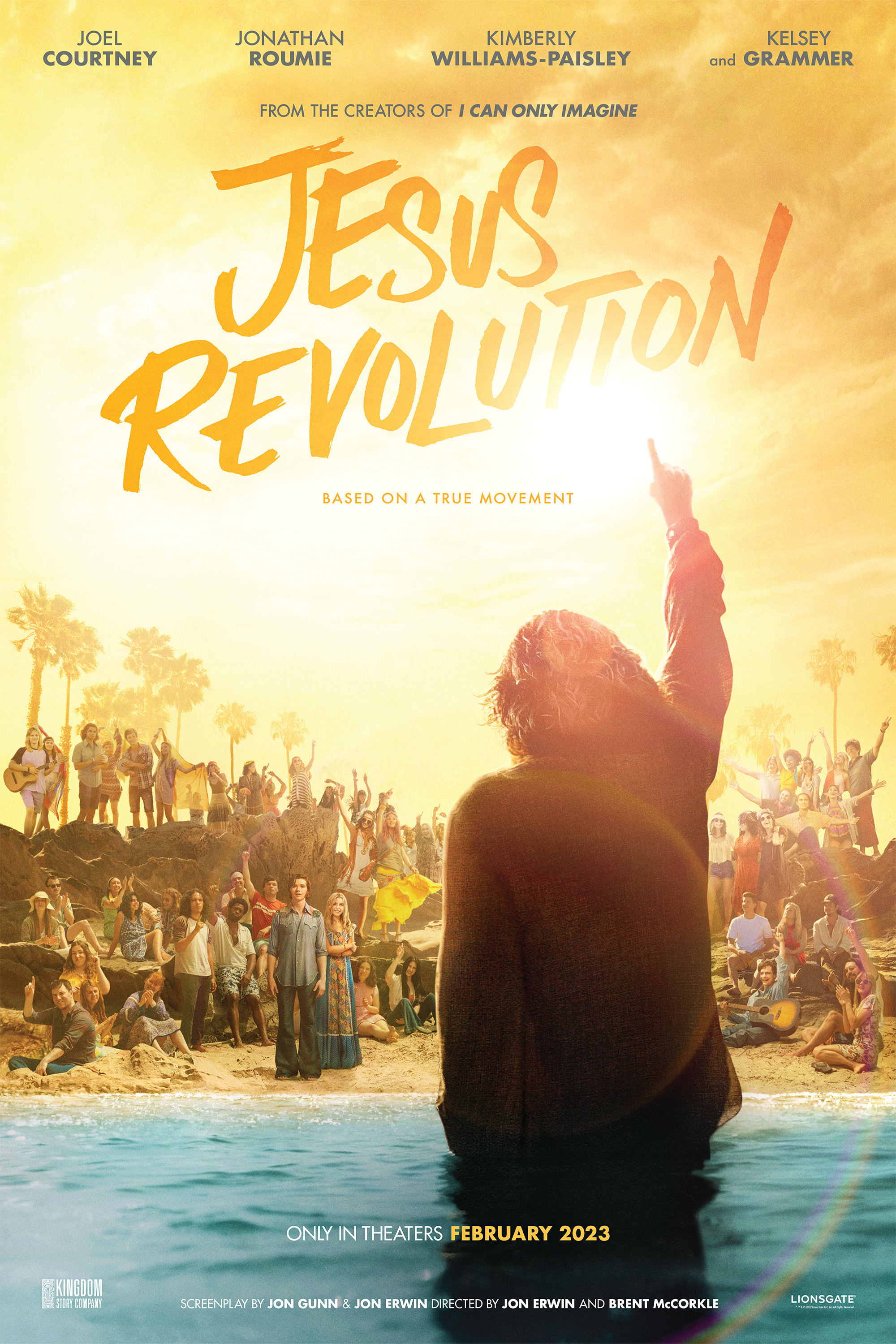
Healing and uplifting. Jesus Revolution is a biographical drama that simultaneously depicts the past whilst critiquing the present. Based on a true story about the radical search for truth, comes a motion picture that is simultaneously concerned with critiquing our present world as much as it is depicting historical events. Through exploring the past, the journey’s true value is not merely a better understanding of the past, but the impact on our present world. The real power of this motion picture is the ability for it to use a story from the past as a provocative lens through which to understand the current state of affairs in both popular culture and the Church.
In the late 1960s and early 1970s, Greg Laurie and a sea of young people descend on sunny Southern California to redefine truth through all means of liberation. Inadvertently, Laurie meets a charismatic street preacher and a pastor who open the doors to a church to a stream of wandering youth. What unfolds is a counterculture movement that becomes the greatest spiritual awakening in American history.
Directors Jon Erwin and Brent McCorkle demonstrate that they are just as concerned about the story itself as they are the methodology of crafting a film. Moreover, Jesus Revolution is the first faith-based film (that isn’t a sword and sandal epic) to take itself seriously as a motion picture. Believe me, I was as shocked as critic to find that the cinematography and editing are quite good! Not to mention the excellent lead cast. Cowriting the screenplay with Erwin is the central figure in the film Greg Laurie. Which does give me pause, because individuals writing a biographical drama based on them or major events in which they were a central figure often leads to a lack of authenticity. However, the screenplay is helped by Erwin and Jon Gunn, which is probably why the film feels as honest as it does.
The variety of characters portrayed in the film gives audiences someone with whom to connect. Which isn’t to say that the character with whom you connect is always a positive reaction; perhaps the character with whom you connect is one that is more concerned with ritual, image, and piety than with people and relationships. At the end of the day, this is a film about radical love, and how we need to concern ourselves with not what divides us but with what brings us together.
The biggest draw in the cast is Frasier himself! Kelsey Grammer plays Chuck Smith, the pastor of a dying church, whom is confronted with his own prejudgments about young people and hippie culture. It takes the radical street preacher Lonnie Frisbee and his skeptical-of-Christianity daughter to transform his world view. While Grammer is not the central character in Jesus Revolution, he is the one that you may be coming to see, especially with the highly anticipated revival of his smash hit Frasier. Suffice it to say, Grammer is the best actor in the movie, but he is surrounded by a solid lead cast that shows that faith-based films can deliver quality performances. Through candid arguments and authentic portrayals of raw conflict and reactions, this character-driven motion picture will hold up a mirror to your face and ask you which of these characters you are.
Both the cinematography and editing are on point. There are some absolutely gorgeous shot sequences and even some stylistic editing choices that exponentially increase the quality of this picture compared to most other faith-based films. Where most faith-based films fail is in the ART and SCIENCE of what it takes to craft a compelling picture. More than an objective eye to capture the outside-action plot, the camera is used in the same way an author uses a pen to write a novel. In cinematic terms we call this the camera stylo. There is certainly an auteur quality to this film that is just as concerned with how the story is being presented, and not just what is being presented to audiences.
What I appreciate more than the technical achievement of the film is the fact it doesn’t shy away from how awful christians can be to one another and to outsiders. One thing this faith-based film is not, is an echo chamber for those that already believe. The film is sure to make some people feel uncomfortable; and you know what, it’s not non-believers that this film seeks to make the most uncomfortable (although there is certainly a proselytizing message in the film), the those that are made the most uncomfortable with themselves are judgey christians that care way more about their club than for a hurting world in search for truth and in need of the kind of radical love that Jesus was all about.
Ryan teaches Film Studies and Screenwriting at the University of Tampa and is a member of the Critics Association of Central Florida and Indie Film Critics of America. If you like this article, check out the others and FOLLOW this blog! Interested in Ryan making a guest appearance on your podcast or contributing to your website? Send him a DM on Twitter. If you’re ever in Tampa or Orlando, feel free to catch a movie with him.
Bonkers fun! Cocaine Bear is just what you imagine it to be: no holds barred carnage meets slapstick campy comedy. Inspired by the true story of a drug run gone wrong, this movie will keep you laughing from beginning to end. When it comes to the bear carnage, it’s delivers in spades; but, suffice it to say, the human characters are mostly annoyingly flat and uninteresting, save discount Officer Winslow. That’s not to say that you’ll be underwhelmed–quite the contrary–I’ve little doubt that you won’t laugh as much as I did! If you’re a fan of horror comedies, you’ll likely find Cocaine Bear to be in the vein of the brilliant Tucker and Dale vs Evil, but ultimately less cleverly written.
After a 500-pound black bear consumes a significant amount of cocaine and embarks on a drug-fueled rampage, an eccentric gathering of cops, criminals, tourists, and teenagers assemble in a Georgia forest.
Directed by Elizabeth Banks and written by Jimmy Warden, audiences will encounter a movie wherein the bear scenes were written first, and received the most care, while the human characters and stories mostly received demonstrably less care and attention. Fortunately, there are a couple of human characters that were crafted with more care, but most of them are flat and lifeless. Moreover, few of the characters will prompt you to care enough about their survival, and you’ll mostly be rooting for the bear.
If you’re interested in the true story upon which this movie is based, in real life, the bear OD’d after consuming the massive amounts of cocaine. That’s it. In fact, you can see the bear, wearing a hat, on display in a Kentucky mall. This presents the best possible setup for this movie, because the inciting incident is true, while everything else is completely fictionalized. This vast creative latitude is the perfect canvas on which to paint this wild and crazy movie! Cocaine Bear may not be one that earn the rewatchability that Tucker and Dale does, but it’s certainly one to watch on the BIG SCREEN with a group of friends, and just turn you brains off to enjoy the highly entertaining spectacle.
Come for the ridiculous setup and stay for the hilarious kills! From the moment the movie opens, you are queued into the story and antics you are about to encounter in the wild. But this movie would not be nearly as entertaining if it wasn’t for the heavy dose of comedy to act as an emotional reset between the kills. Everything about this movie’s plot is utterly ludicrous. And the character mix is equally bonkers. Wherein the movie could’ve be stronger is in the various character subplots and dialogue, and the human characters could have been more interesting.
But all in all, it’s a fun movie that will make you laugh and even jump!
Ryan teaches Film Studies and Screenwriting at the University of Tampa and is a member of the Critics Association of Central Florida and Indie Film Critics of America. If you like this article, check out the others and FOLLOW this blog! Interested in Ryan making a guest appearance on your podcast or contributing to your website? Send him a DM on Twitter. If you’re ever in Tampa or Orlando, feel free to catch a movie with him.
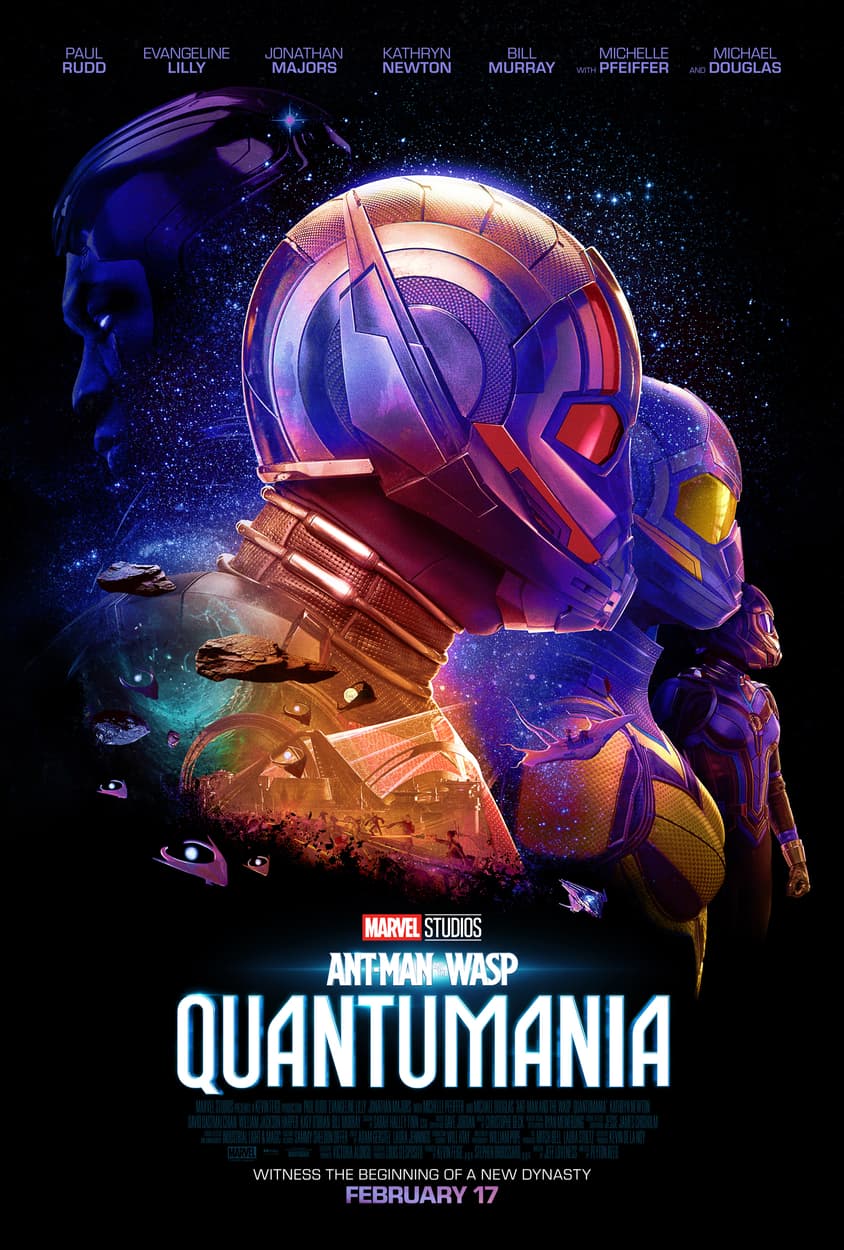
Entertaining and world-building. Phase 5 of the Marvel Cinematic Universe launches with Disney-Marvel’s Ant-Man and the Wasp: Quantumania (AWQ). This (paint-by-numbers) adventure of epic proportions benefits from a small central cast, which allows for effective character arcs and development. Furthermore, the central cast is elevated to near purrrrrrfection with the incomparable Michelle Pfeiffer’s significant screen presence as the original Wasp Janet Van Dyne. For someone that can take or leave the MCU, simply knowing that Michelle Pfeiffer is in a pivotal role, is enough to get me to watch. Perhaps that is also like you. While this is not her first time returning to the superhero genre (first did it in Ant-Man and the Wasp), this is the first time that she is front and center, giving hope that we may yet still see Pfeiffer return to her career-defining role as the definitive Catwoman.
Ant-Man and the Wasp find themselves exploring the Quantum Realm, interacting with strange new creatures and embarking on an adventure that pushes them beyond the limits of what they thought was possible.
The latest installment in the MCU mostly functions as a standalone movie, but there is clearly world building to lay the piping for Phase 5. Now, I do not follow the comics nor have seen any of the TV shows, and I was able to follow sufficiently enough, which means that anyone that has seen the MCU theatrical movies will have sufficient knowledge to follow the journey. Yes, the visual effects are expertly generated by graphics engineers, but I am seldom impressed by entire worlds that exist within the confines of a computer. There is very little real set design, which mitigates the ability to become immersed in the Quantum realm. AWQ represents what happens when a single media conglomerate owns both Marvel and Star Wars because this movie feel like the combination of Star Wars and Avengers. There is even a scene right out of the cantina on Tatooine. To the superhero movie’s credit, the plot is simple and the characters complex, so it receives high marks for screenwriting mechanics.
Par for the Disney course these days, there cannot possibly be a movie released without a dose of the cynical worldview of applied postmodernism. For AWQ, this dose comes in the first sequence of scenes following the prologue. Cassie is in jail for antagonizing law enforcement that (we are told) launched tear gas into a (we are told) peaceful protest. This serves little to no purpose, and most certainly has no bearing on the plot; therefore, it was in there simply to check off a virtue signaling box. I can see what they were trying to do–trying to show that Cassie has the early signs of going down her father’s path of delinquent behavior. If Disney-Marvel wanted this to be more poetic and elicit greater empathy from the audience, then Cassie should have been shown engaging in petty crime not activism. This would have demonstrated that Scott’s lack of engagement as a parents (due to his personal brand and professional pursuits) has had a negative impact on Cassie’s development. Furthermore, this would have provided for a greater character arc when she in instrumental in saving the universe.
What a fantastic cast!! Cast highlights include (as mentioned earlier) Michelle Pfeiffer, Michael Douglas, and a surprise cameo from Bill Murray! This otherwise paint-by-numbers superhero movie is elevated by the contributions of these exemplary actors. Even if you don’t see all the MCU movies, I highly recommend the Ant-Man movies because they are far more character-driven than the others, and the small central cast benefits from time and attention paid to their respective interpersonal journeys that provide depth to the high concept plot. For the most part, the running theme of the Ant-Man movies generally revolves around the idea of fatherhood and (by extension) parenting.
If MCU fans were looking for their next big bad, then they will find the new archenemy bent on the destruction of the known universe, without going into spoilerific details, I can say that this new villain makes Thanos look like Bowser from the Mario games, with King Koopa being our newest main villain. Be sure to stay for both the mid and post-credit scenes as they raise the stakes to exponential levels.
If you’re looking for a fun movie that you can just kick back and enjoy, then this may be your ticket. I highly recommend watching it in a premium format (such as IMAX, Dolby, or XD) because the CGI sets will shine best with the best sound and screen at your local movie theatre.
Ryan teaches Film Studies and Screenwriting at the University of Tampa and is a member of the Critics Association of Central Florida and Indie Film Critics of America. If you like this article, check out the others and FOLLOW this blog! Interested in Ryan making a guest appearance on your podcast or contributing to your website? Send him a DM on Twitter. If you’re ever in Tampa or Orlando, feel free to catch a movie with him.


 R.L. Terry ReelView