
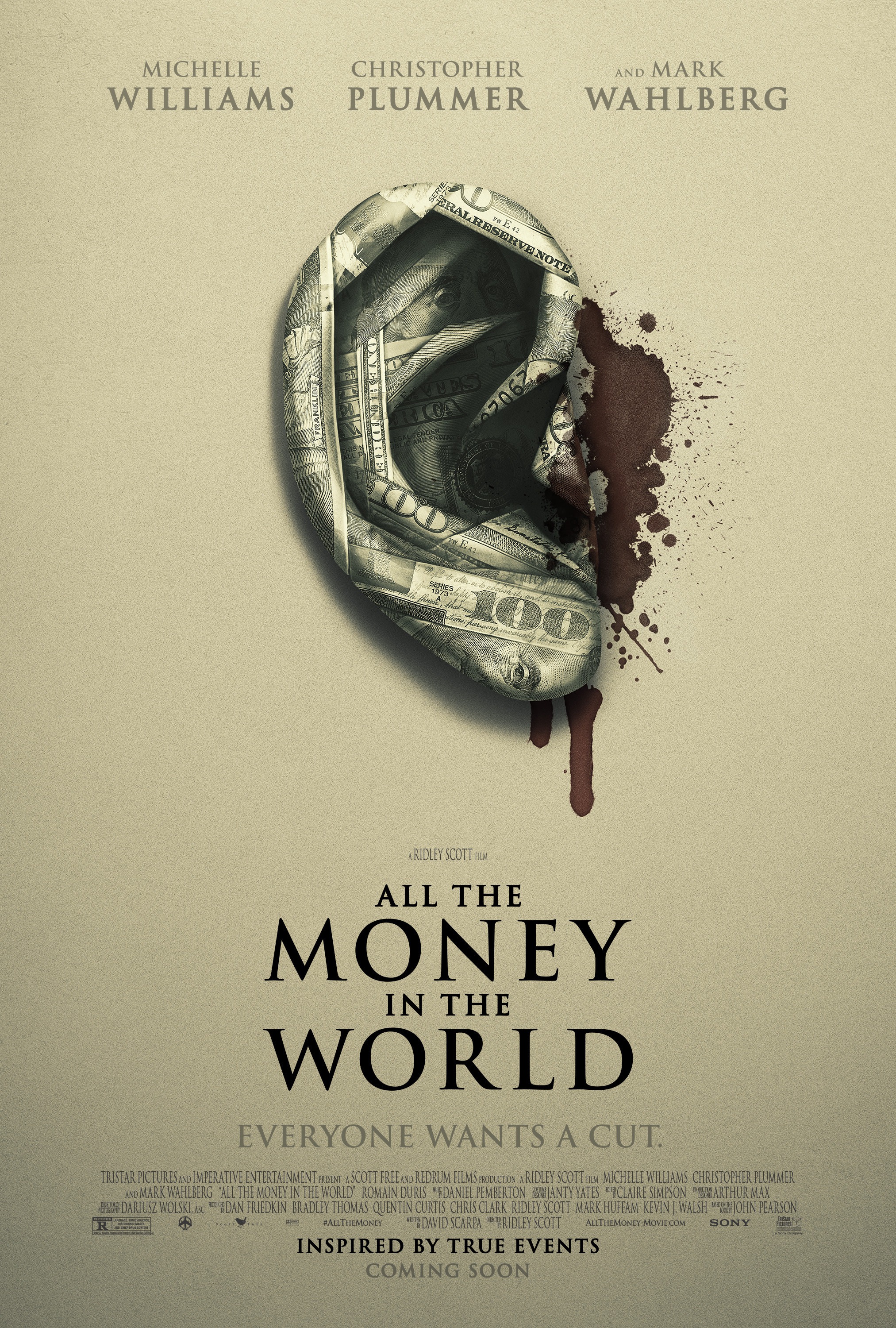
 A spellbinding thriller that will hold hostage your attention. Ridley Scott’s highly anticipated historical neo-noir drama depicting the infamous kidnapping of the favorite grandson of oil tycoon J. Paul Getty All the Money in the World is an incredibly suspenseful drama that is every bit as good as you’ve been hearing. Probably the highest profile Christmas season motion picture release after the–quite literal–last minute recasting of living legend Christopher Plummer as J. Paul Getty I, this film is a non-stop search and rescue of epic proportions. The most notable element of the film is the aforementioned casting; however, there is so much more to this movie than the role played by Plummer. This film has an incredibly organic feel to it–all the way down to the practical blood effects. Although many of the roles in the film are one-dimensional, don’t let that dissuade you from buying your ticket to see it on the big screen. Each and every character in the film is played with excellence by the respective actors. No slowing down in this film, the pacing is incredibly quick but works brilliantly for this nail-biting drama that will have your attention for the entire runtime of the movie. If there was ever a real-life Scrooge, J. Paul Getty would be a contender for the famed Dickensian character. Witness the lengths a mother will go to find and free her son despite being cut off from her father-in-law’s unparalleled fortune. Love, logic, and profit are at war in this fantastic motion picture that is sure to grab the attention of the Academy of Motion Picture Arts and Sciences.
A king’s ransom. That’s what J. Paul Getty III (grandson of J. Paul Getty I) demand of the Getty family. All the Money in the World follows Paul’s mother Gail (Michelle Williams) and ex-CIA special operations Fletcher Chase (Mark Wahlberg) on their perilous journey to locate and retrieve Paul. Only one small problem, Gail’s ex-father-in-law is oil tycoon and ruthless J. Paul Getty, and he refuses to pay the ransom demanded by his favorite grandson’s kidnappers. With Paul’s very life in danger, Gail and Chase, otherwise unlikely allies because of his ties to J. Paul Getty I, are forced to team up in order to locate Paul and secure the ransom money from her former father-in-law who refuses to do anything with his money and time unless there is some sort of monetary profit in it. After Paul’s ear is found in the mail, Gail realizes that her only hope is to get J. Paul Getty to somehow agree to pay the ransom for his grandson.
From a storytelling perspective, the most notable aspect of this motion picture is the aggressively nonlinear storytelling. We begin in (then) present-day, go back to Paul’s early impoverished childhood, fast-forward to him a little older, then to the months prior to his kidnapping, back to the present-day again. We also take a look back at J. Paul Getty I in the early days of his oil business in the middle east. Although I am not typically a fan of flashbacks, it works very well for this story in order to truly understand the dysfunctional family dynamics. While his children live a life that barely gets by financially, J. Paul Getty I lives the life of the wealthiest man the modern world had ever seen. Still, J. Paul is also the embodiment of Ebeneezer Scrooge in every way shape and form. Every moment moves the story forward. Never once will you feel that the more than two-hour film is stagnated or treading water just to fill time. You will also encounter some of the most gruesome moments that Scott has ever put on screen. The diegesis of the film is constructed with extreme precision, and it creates an overarching exemplary work of how powerful a historic crime drama/thriller can be.
But what kind of film is this? Is it a crime drama? Historic drama? Thriller? Or even classically structured and shot film noir? Often times, when writers or directors set out to create a hybrid film (meaning, more than one genre) run into the problem of the film being in a state of identity crisis. Each main genre has certain pillars and structural supports that need to be met in order to tell the genre story effectively. That doesn’t mean that you cannot have a film that has elements of more than one genre but it does mean that the more genre elements that you have, the more difficult it is to weave them all seamlessly together. Fortunately, Scott’s All the Money in the World written by David Scarpa is a masterpiece! Scarpa showcases his ability to utilize the best of the genre tropes that are in this film to tell a completely new story with a unique experience. If I were to select a genre that this film is best suited for, it would be film noir, in the vein of my review’s opening lines. For all its other elements, All the Money in the World is most closely aligned with film noir because our main character of Gail is in over her head, the non-linear storytelling, dark places and themes, Gail’s exquisite attire, and it’s a story filled with gloom, ill-fated characters, fear, and betrayal.
For those who have been to the famous Getty Museum in Los Angeles (I went a few years ago, and still remember it vividly), you will have a better understanding of how he acquired all those artifacts and art pieces, and how the museum came to be. Perhaps, much like The Founder may have caused you to call into question whether or not you want to support such an infamous legacy, you may also debate whether or not to support the museum that bears his name. Even though J. Paul Getty was a ruthless man, he did provide treasures for the American people and visitors to the states to enjoy for all time. For those who enjoy further reading after watching a historical drama, you’ll find that the Getty family continued to suffer and Paul never recovered from his kidnapping tragedy. His life was cut short after a drug overdose. This is the kind of film that you will want to watch again because of the powerful philosophical punch that pits love against money.
 R.L. Terry ReelView