
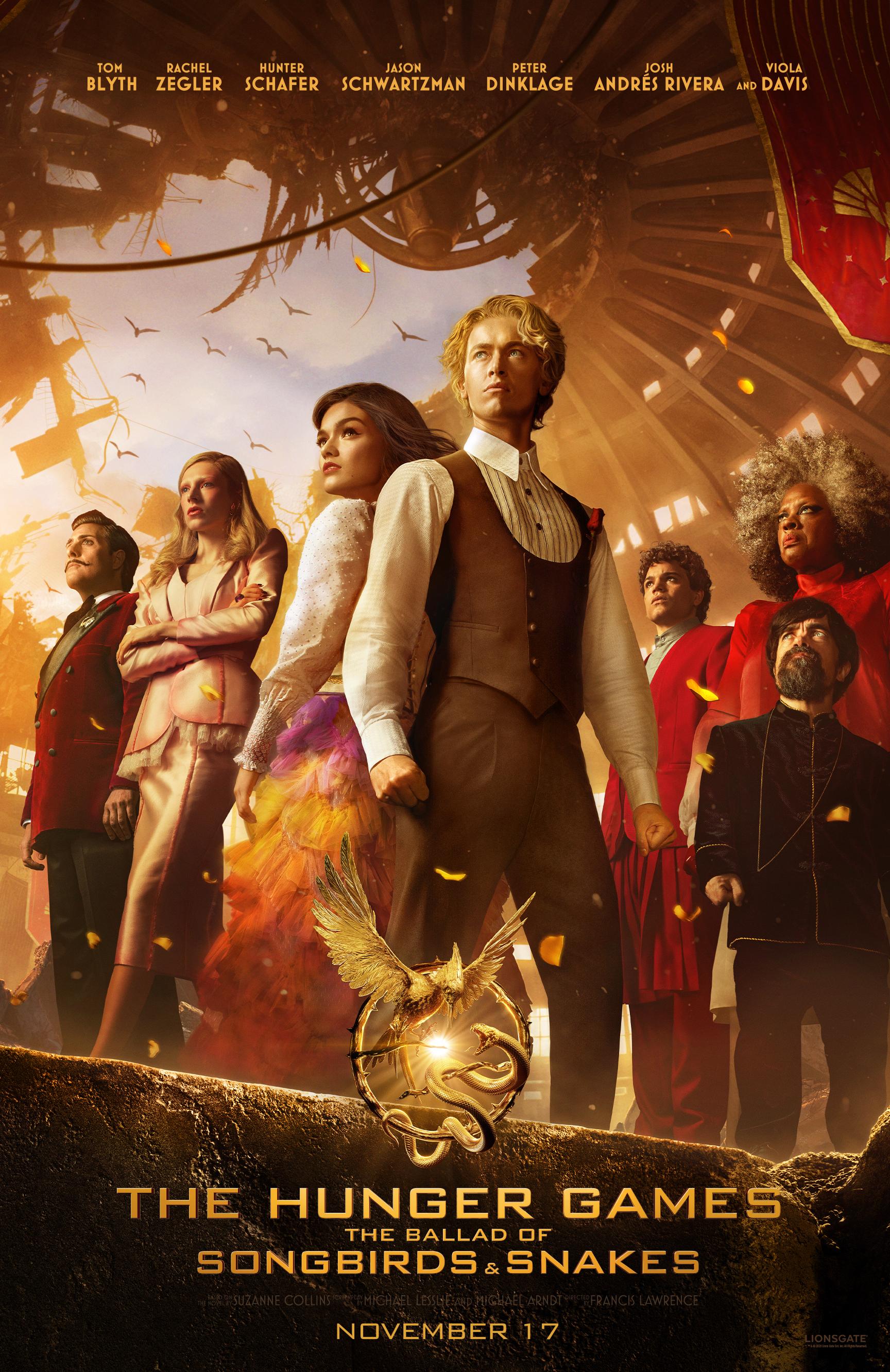
Starts strong, ends off-key. Return to the gritty world of Panem in The Ballad of Songbirds & Snakes. What we have here is too much story crammed into a single movie, which results in poor pacing and forced character and plot development. Despite the uneven screenwriting, there is no doubt that you will be completely enthralled by Rachel Zegler’s (West Side Story) charismatic and courageous Lucy Gray! Moreover, you will also be charmed by her excellent chemistry with Tom Blyth’s (future President) Snow. But the performance that stands out the most is Viola Davis’ campy, delightfully ruthless Dr. Gaul (Game Maker)! In contrast to the struggling third act, the first two acts are well-written, but the third act desperately tries to keep your attention. Ultimately, there is enough material both presented and hinted at, in the film, to support two or even three films. Perhaps audiences were hungry for more Panem, but this movie leaves audiences feeling overstuffed, with little room to breathe and digest the story.
Years before he becomes the tyrannical president of Panem, 18-year-old Coriolanus Snow remains the last hope for his fading lineage. With the 10th annual Hunger Games fast approaching, the young Snow becomes alarmed when he’s assigned to mentor Lucy Gray Baird from District 12. Uniting their instincts for showmanship and political savvy, they race against time to ultimately reveal who’s a songbird and who’s a snake.
Come for the event-like movie, but stay for Davis’ and Zegler’s performances. I don’t know if Zegler’s Lucy Gray felt like she came from District 12 or not, but her command of the character is fantastic! And how could Zegler be cast in the Hunger Games and not take advantage of her beautiful voice? If she ever wants to switch careers or add to her entertainer resume, she can add country singer to it, because her country singing should be opening for the likes of Dolly, Reba, or Shania. I am confident that she could own that country stage for an entire set, and audiences would be ecstatic! Beyond the singing, her Lucy Gray feels human. And by that, I mean both strong and vulnerable, with deep convictions for how she treats others. While many will be drawn to her character’s confidence and independence, I am drawn more to her flaws and vulnerabilities, because it is that with which we struggle that makes us most human.
Viola Davis’ Dr. Gaul steals every scene in which she appears. I cannot think of this role belonging to any other actor after witnessing her bring this sinister character to life. I know nothing of this character from the book, as I have not read it, but it feels like a role that was written for Davis. Even though there is a significant element of camp in her performance and physical appearance, she isn’t always over the top–in fact–there is a great deal of emotive nuance to her character. And that’s in part of what makes her character great–she strikes a perfect balance between camp and playing it straight. As diabolical as President Snow is in the original trilogy, her character is far more terrifying and dangerously sly. She doesn’t simply enjoy the Hunger Games, she is the Hunger Games. Suffice it to say, she slays with this role, and the film benefits greatly from her immense screen presence.
Not to be overlooked, Blyth’s Coriolanus Snow is a complex character, with whom the audience will empathize. Granted, the character isn’t quite as likable as he should have been, to achieve the full effect of the struggle of empathizing with him now with the foreknowledge of whom he becomes, but he does connect with the audience. Blyth’s performance is mildly uneven, but not so much so that it isn’t sufficiently compelling. It’s really in the third act that the performance is hit or miss, but that blame is partly laid upon the poor screenwriting in the last act. When he is on screen with Zegler or Davis, his performances shines best. The chemistry he shows with Zegler is solid, as is his interactions with his closest friend.
Since we are familiar with the games from the original trilogy, this movie is more of a character study and origin story for future President Snow than it is about the history of the games. After the prologue, which takes place one year before the first Hunger Games, the rest of the movie takes place during the tenth anniversary of the games. Ever since Disney’s Maleficent, there has been a trend to give villains origin stories so we can understand why they are how they are. And I am on the fence about this, as I believe that some people are born predisposed to sociopathy or psychopathy; and some system is not to blame, but rather it is a heart and mind struggle within that individual. But I digress. It is established that Snow comes from a once proud, well-to-do Capital family, but in the wake of his General father’s death, the family struggles to keep their house and food on the table. Coriolanus Snow struggles with needing to provide a future for his cousin and grandmother, but not lose his humanity in the process. Unfortunately, we’ve seen the original trilogy, so we know what happens. Lucy Gray and Dr. Gaul may steal steal the scene, but no mistaking it, this story is about the emotional and psychological development of future President Snow.
And I’d be remiss not to mention that it was a treat to see that Peter Dinklage still “drinks and knows things” (for my fellow Game of Thrones fans).
If you’re interested in returning to Panem, definitely catch The Hunger Games: the Ballad of Songbirds & Snakes on the big screen. I saw it in Dolby Cinema at the screening. As I honestly, could take or leave the exhausting YA genre, I do feel there could be another movie or two in this Hunger Games saga. I’d like to see more of Dr. Gaul and future President Snow.
Ryan teaches Film Studies and Screenwriting at the University of Tampa and is a member of the Critics Association of Central Florida and Indie Film Critics of America. If you like this article, check out the others and FOLLOW this blog! Interested in Ryan making a guest appearance on your podcast or contributing to your website? Send him a DM on Twitter. If you’re ever in Tampa or Orlando, feel free to catch a movie with him.

 R.L. Terry ReelView