
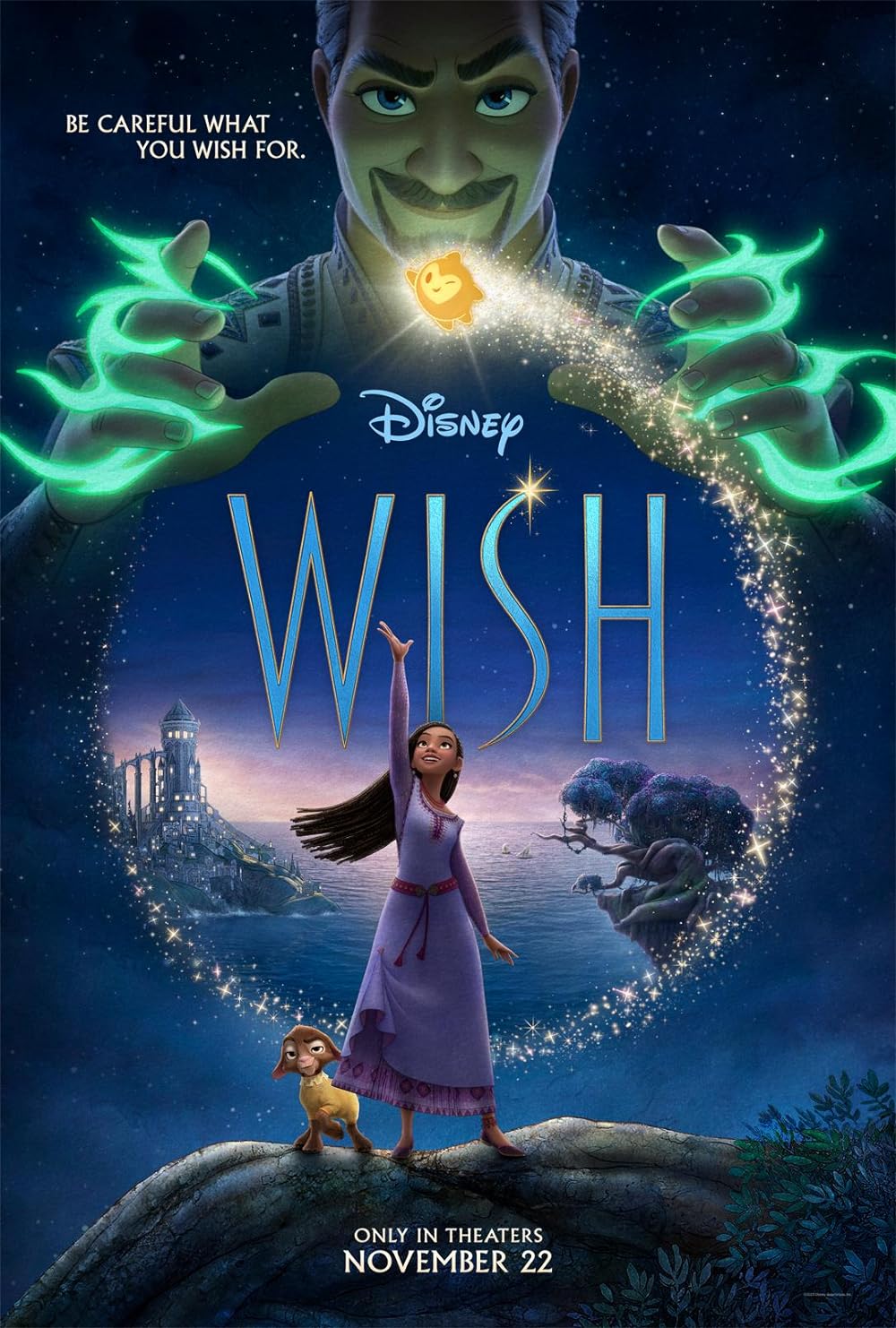
Disney should’ve wished upon a star for a better screenplay. But hey, at least we have an actual villain again! Wish attempts to be a return to the classic Disney animated feature form, but it fails to recapture the magic. Still, there are glimpses of that former Disney magic that are encouraging, and perhaps it’s a sign of what is to come in the next few years. And I am talking about the hand-drawn inspired matte-like backgrounds. Unfortunately, the CG cast and foreground elements detract from the magic of that classic Disney animation. Suffice it to say, the dichotomy of animation styles is distracting. Wish doesn’t have so much a story idea problem as it does a plotting and story execution problem, which plagues this movie. Moreover, what the movie lacks in thoughtful plotting, it strives to make up for in the musical numbers–forgettable as they may be. Most likely, the movie won’t be remembered for its story per se, but rather for the setups for future animated classic remakes as Wish is the origin story for the Disney wishing star. To that end, there are a couple of hidden Mickeys and moderately subtle nods to other Disney characters; and these nods are tastefully handled until they are not–and incredibly overt to the point of being obnoxious.
Young Asha makes a wish so powerful that it’s answered by a cosmic force, a little ball of boundless energy called Star. With Star’s help, Asha must save her kingdom from King Magnifico and prove that when the will of one courageous human connects with the magic of the stars, wondrous things can happen.
Even though I have many reservations in the execution of this movie, I admire it for the originality in creating an origin story for THE Disney wishing star, which we first witness in Disney’s Pinocchio. And the rest is history. This same star guides Peter Pan to Never Never Land, Cinderella wishes upon it, and so many more characters. To the screenwriters’ credit, the idea for Wish is a refreshing turn from the direction Disney movies (live action and animated) have been going for years now. All the building blocks for a great story and plot are there, but it’s as if the builders of the story didn’t follow the architect’s plans as closely as they should have. Suffice it to say: great idea, poorly executed. The result is rushed character and plot development.
Something that Wish does mostly well: it represents the return of the classically-inspired Disney villain. And while Magnifico can’t hold a candle to Ursula, Maleficent, the Horned King, or even Yzma (my personal favorite Disney villain), he does fill the vacancy that has been present since after The Princess and the Frog (2009) and Tangled (2010). For thirteen years, we’ve needed a villain, and Magnifico has shown us why. Nevermind that he isn’t nearly as memorable as the aforementioned villains, but he demonstrates why it’s important for a movie to have a villain. Yes, I am aware that (1) it’s more accurately described as a character of opposition and (2) the villain needn’t be the bad guy. But, I digress.
We love villains that we love to hate, or villains that are the flip side of the coin to our central character. In fact the best villains have many of the same attributes as our hero, and maybe even some of the same goals, but their methods of achieving these warped goals are twisted. At its most basic level, a well-written movie has a central character, that central character has an external goal motivated by an internal need, and there is a character standing between the central character and his or her goal.
The plotting may be weak, but the subtext and theming are quite strong! The movie provides commentary on ideas such as socialism, censorship, and authoritarianism. Unfortunately, I cannot get into all the supporting material without venturing into spoiler territory, but I want to spotlight the commentary, because it works well. The movie clearly demonstrates that the censorship of ideas can lead to a loss of uniqueness and individuality. And even the ability to learn and grow as unique individuals. This parallels the tyrannical banning of books in our public schools being experienced by some states in our country, including the one from which I write this review. One thing that the history of the world has taught us is that anytime mass censorship (often government or other large institution-based) is exerted upon a people, the society becomes a prison for those that live in it. They, in essence, become entrapped in Plato’s Cave allegory.
It’s difficult to get into all the details of how the movie provides a negative critique on socialism, but this theme can be read in the dark side of lofty promises of government-provided housing, occupational, food, and other resources. For there is a cost–and a great one at that. In the movie, this cost is expressed through wishes and Magnifico’s reign over the Kingdom of Rosas. Even though all the characters were enjoying the freely available resources of Rosas, in the end, they realize that nanny-like state took away individualism and freedom of choice. In a movie landscape that is ever-so-more-regularly advocating the advantages of socialism, this movie is a testament to “be care what you wish for” because everything in life does come at a cost. For the Kingdom of Rosas, it was wishes, for you, it maybe something entirely different but no less important to your individuality and freedom of choice.
Lastly, I want to touch on the magic of those hand-drawn-inspired backgrounds. There are so many scenes in which the background looks straight-up like a matte painting, and I love it! I wish the entire movie looked hand-drawn; it wouldn’t fix the story execution or screenwriting issues, but it would have given the movie a more magical, almost tangible quality. Hand-drawn animation (and I will include stop-motion animation in this critique) has real dimension. With stop-motion animation, the dimension is in the objects and the lighting thereof; with hand-drawn animation, the magic is in the imperfections and motion.
Specifically looking at Golden Age through The Black Cauldron, the hand-drawn animation had literal depth because of Walt’s patented multiplane camera. Artists would draw onto glass panes, layer and space them, and the camera would shoot the linear image, giving the two-dimensional image depth of field. The hand-drawn-inspired backgrounds of Wish are encouraging because this may be a sign of what is to come for Disney animation. Unfortunately, the magic gets lost in this movie because of the distracting dichotomy of animation styles. It’s removes the characters from the background, from the world in which they live, and you never quite buy these characters are part of the setting.
Perhaps Wish suffers from story execution problems, but there is hope that Disney animation may be making a turn for the better.
Ryan teaches Film Studies and Screenwriting at the University of Tampa and is a member of the Critics Association of Central Florida and Indie Film Critics of America. If you like this article, check out the others and FOLLOW this blog! Interested in Ryan making a guest appearance on your podcast or contributing to your website? Send him a DM on Twitter. If you’re ever in Tampa or Orlando, feel free to catch a movie with him.
 R.L. Terry ReelView