
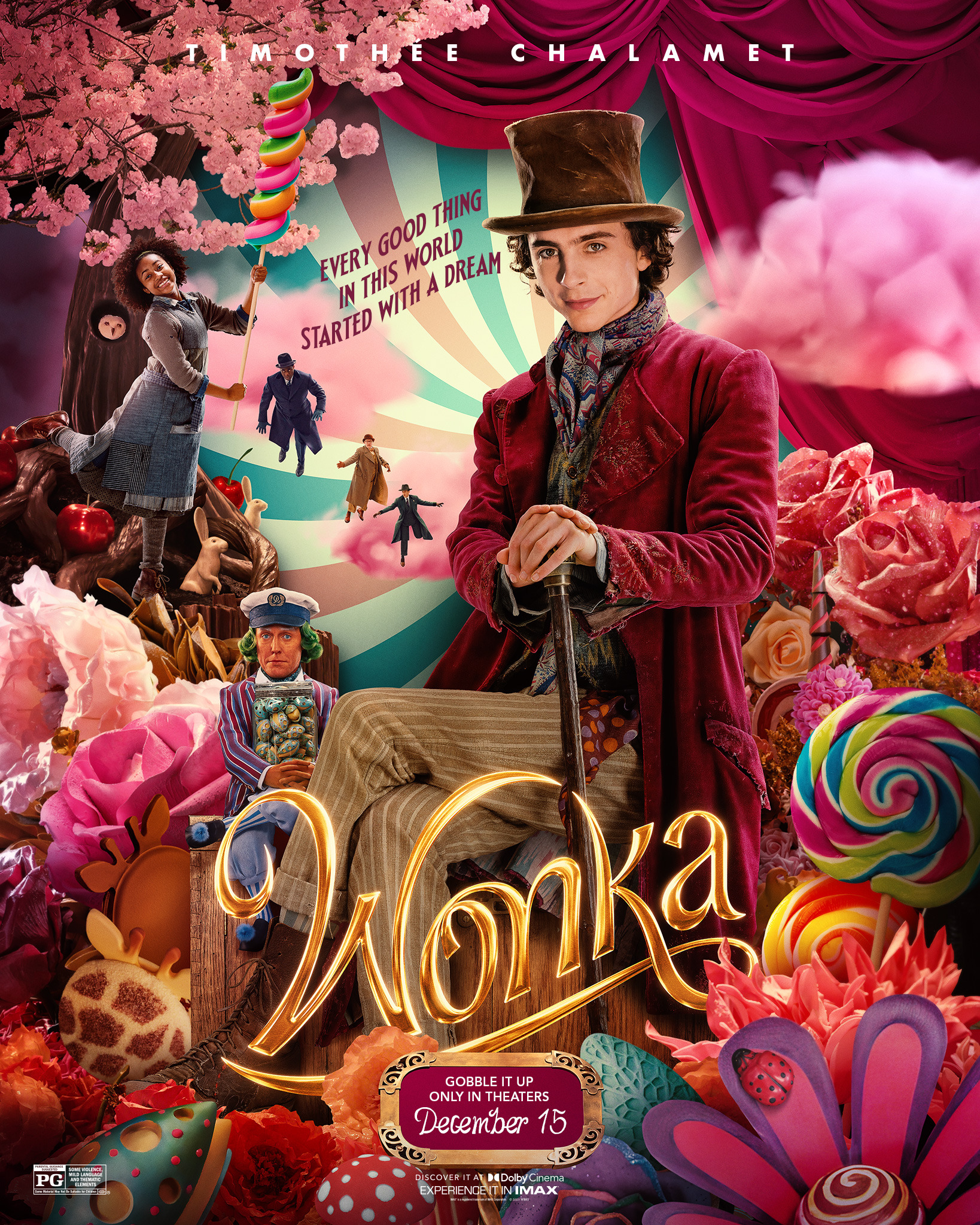
Charming but forgettable. Wonka is like a rich piece of candy, tasty in small amounts, but less appetizing the more you consume. However, the sufficiently charming musical will keep you entertained. But, it’s missing the moments of horror adjacency and the commentary on greed, pride, gluttony, etc. that gave the OG Willy Wonka and the Chocolate Factory some real bite! While it may not deliver the depth or quality of storytelling of the original, Wonka still delivers an entertaining diversion from the stressors of life with its whimsical world of chocolate and magic. The standout musical number is the Scrub Scrub number that is the G-rated answer to Chicago‘s infectious Cellblock Tango. Over all, Wonka will delight audiences with a throwback style musical that tastes best if not much thought is placed into the quality of ingredients.
Armed with nothing but a hatful of dreams, young chocolatier Willy Wonka manages to change the world, one delectable bite at a time.
Gone is the clever commentary on gluttony, pride, greed, sloth, lust, envy, and wrath as represented by the children and Wonka in the original book and film, but what this Wonka origin story lacks in thoughtfulness it makes up for in–well–the candy-like nature of this throwback style movie musical. It’s not deep and the quality of ingredients may be average, but it’s still sufficiently entertaining for the duration of the movie.
The casting is mostly solid! Despite his popularity, I find Chalamet to be an average actor–neither inordinately good or bad–just average; however, he was perfectly cast in this film even though there are plenty of moments that he looks like he’s phoning in his performance. He has the right look and energy for Wonka, so his casting works well. The other standout performance is Olivia Coleman as Ms. Scrubbit–she’s a great villain! And while it was great to see Sally Hawkins, she has little more than a cameo in the movie. We are treated to a brief performance by Rowan Atkinson, but he is also little more than a cameo. The rest of the actors play their respective roles sufficiently well, and each has some moments of hilarity. But the comedic stylings of Keegan Michael Key as the chief of police went grossly underutilized.
It isn’t so much the cast or music that are the true stars of this film as much as it is the outstanding production design and costuming. The whimsical production design and creative costuming are the highlights of the film. We are never told where the movie is taking place, but it’s most likely London; however, the imaginative set design creates an other-worldly sense about the movie that transports audiences from the auditorium to someplace magical that feels adjacent to our own. There is an expressionistic quality in the production design, externalizing the emotive dimension of the characters and story. It’s a combination of neo-Gothic and industrial revolution-inspired designs.
Despite its clear desire to be this year’s Greatest Showman, one of the biggest differences between the two movie musicals is the quality of original songs. Other than the Scrub Scrub number, none of the other songs are memorable. Scrub Scrub works very well, and I love how it’s clearly inspired by the Cellblock Tango from Chicago. The lyrics are rhythm are memorable and I foresee it being the material for many future GIFs. It’s a fun number along with it’s easy to sing. The rest of the songs are lacking in any degree of inspiration, and thus fall flat and forgettable. In the moment, they are fun and entertaining, but are soon forgotten. For fans of the original film, the memorable, beautiful song Pure Imagination is referenced in both score and lyric. The score for the timeless song is at the bedrock of much of the score for the film, and Wonka applies new lyrics to the music at the end, which acts as a fantastic nod to the original without feeling like it’s a vapid attempt to inject nostalgia to remind us of a better movie. It is tastefully done.
While the plotting for the A-story is good enough, there are ancillary B and C stories that are setup and resolved, but they lack any kind of development, and just come off as a lazy attempt to give the film some emotive depth. It would’ve been better to have taken the time it took to think-up the B and C stories and applied it to the A-story or the music. What the film is lacking is any meaningful subtext. One of the brilliant attributes of the original film is the commentary on the Seven Deadly Sins are represented by the kids and even Wonka. The film provides audiences with a cautionary tale of what can happen when any of those sins takes hold of the mind and body. Plus, we get those iconic Oompa-loompa musical lessons as a result of the kids’ missteps.
Wonka will provide a couple hours of laughter and glee during this Holiday season, which may come in handy if the stressors of the Holidays begin to pile up and family drama occurs while you’re home for Christmas. It may not be one that will earn near the rewatchability of the original, but as I’ve stated several times, it is sufficiently entertaining.
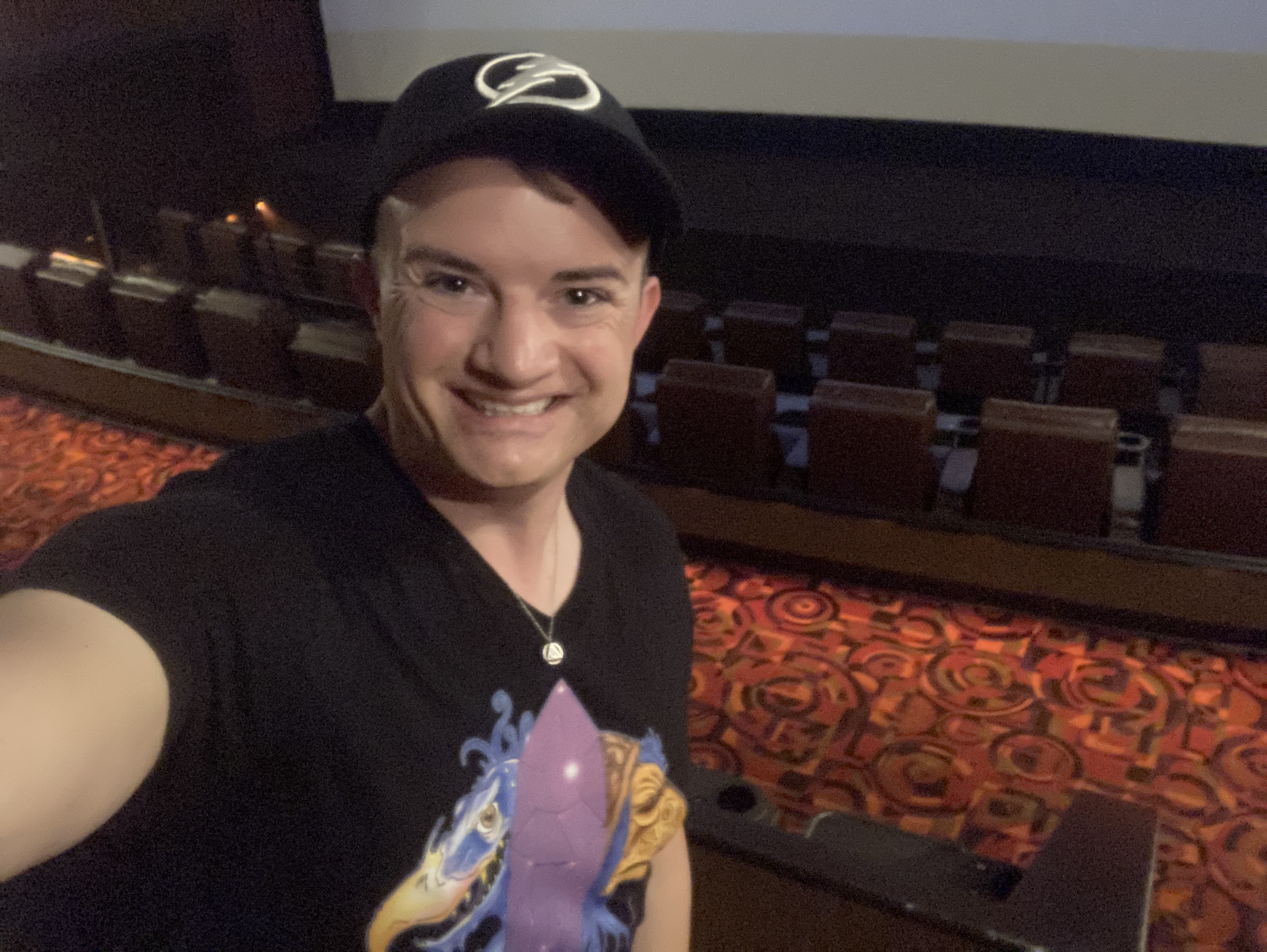
Ryan teaches Film Studies and Screenwriting at the University of Tampa and is a member of the Critics Association of Central Florida and Indie Film Critics of America. If you like this article, check out the others and FOLLOW this blog! Interested in Ryan making a guest appearance on your podcast or contributing to your website? Send him a DM on Twitter. If you’re ever in Tampa or Orlando, feel free to catch a movie with him.
 R.L. Terry ReelView