
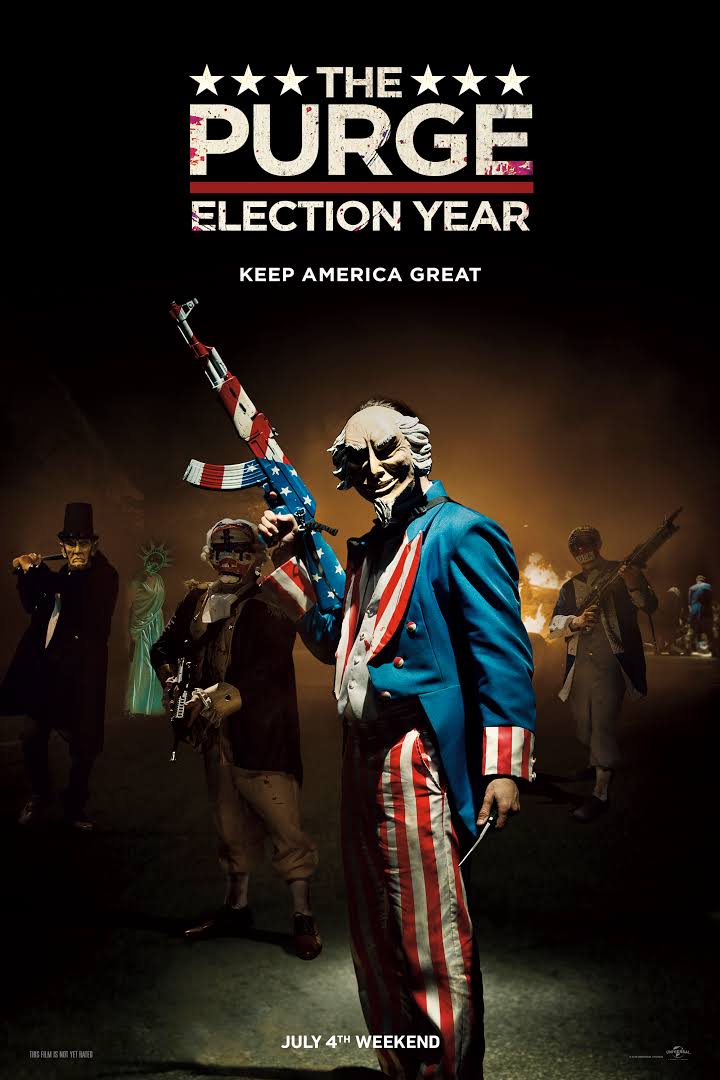
“The Purge: Election Year” movie review

PurgeElectionElection results are in! Get ready once again for this year’s annual purge. From Universal Pictures and Blumhouse, The Purge: Election Year is a cinematic rollercoaster of espionage, action, revenge, campaigns, and of course the trade mark unbridled violence. Horror is one of my favorite genres to discuss because this genre often includes fantastic themes and subtext that act as social commentary on gender, politics, religion, economics, sex, or technology. Going into this movie, I was already prepared for the political themes, but there are many more themes for one to discuss with this film. In many ways, I am not even sure how to proceed with analyzing it. Cinematically, or from a technical perspective, the movie is fantastic. Yeah, a little campy at times but that is par for the course. Contains just the right amount of comedy, albeit dark, to balance out the darker or heavier elements. The fact that this movie is truly prompting me to think about its content is fascinating. Often times, I have a good idea of how I am going review a movie while I am driving home from the theatre; but this one is definitely requiring me to think about it more than I typically need to. I suppose that entire articles could be written on any one theme in the movie, but I only have 1000-1500 words to analyze it. Haha. The biggest question is whether or not this movie is actually counterproductive.

Two ideas of how life should be in the United States are at war, or at least that’s how it plays out on the debate stage. Minister Edwidge Owens (Kyle Secor) and Senator Charlie Roan (Elizabeth Mitchell) are going head to head over the purpose and necessity of the annual purge as started and supported by the reigning New Founding Fathers of America (NFFA) regime. Just two days before the annual event, the NFFA makes the decision not to exempt anyone, not even government officials ranking 10 or higher, from this year’s purging. After an inside job threatens the life of Senator Roan in her own home, she and her trusted chief of security bodyguard Frank Grillo (Leo Barnes) must seek safety. With only Senator Roan standing in the way of the NFFA winning another election, the NFFA and hires assassins will stop at nothing until she is defeated. After a chance meeting with supporters of Roan, Frank and Senator Roan team up with the small band of rebels to survive the night at an attempt to end the chaos and win the election.

Although the first movie did not exactly have much in the way of social commentary themes beyond greed, Purge: Anarchy and this present installment are certainly drenched with rich themes that could fuel discussions for hours. One could surmise that the principle theme of the second installment in this thriller franchise was rich v poor. A very apropos theme considering the US economy was only-then emerging and beginning to grow from the worst financial crisis since the Great Depression. Walking into this movie, I was prepared for political themes; but politics was only a principle element in the plot by extension and used as a highway to get from beginning to end. Not even in subtext, but the predominant theme of Purge: Election Year is clearly white v black. I find this concept and theme is dangerously and carelessly carried out because it really serves to perpetuate the idea that there is a difference between whites and blacks in the Unites States. Instead of the movie showing audiences what could, albeit unlikely, happen in a future America if not challenged or changed, it serves to add fuel to the fire that there is a difference. Furthermore, I find that the movie is unfair to both whites and blacks. It’s unfair to whites because it shows most of them having a hatred from blacks and nearly unanimously in favor of the purge while it depicts the predominant demographic of violent offenders as blacks. Now, I am sure the intention of the movie is not to be counterproductive or perpetuating a negative idea, after all it is produced to be entertaining; however, it’s difficult to watch the movie without wondering if it really is counterproductive in message and theme.

Beyond the social commentary on white v black, the movie also spent a lot of time on the perversion of organized religion. Although the religious aspect to the NFFA was included in the previous installment on a minor level, Purge: Election Year spends a great deal of time connecting a perverted organized version of warped Christianity (very much Catholic or Anglican in structure) to the driving forces behind the NFFA’s passion for and dedication to the annual purge. Just like I feel that the producers and writers of this movie crossed the line with the white v black violence, I feel that this version of organized religion only serves to perpetuate the idea that those in organized relation (mostly Christianity) are hate mongers. Obviously, most people know that this isn’t the case; however, that idea is certainly out there because of differing views on some socio-political areas of community and life in general. Perhaps the movie is commenting on how different groups of people may perceive one another. If that is the case, then the groups of people depicted in the movie can gain a better understanding of how an opposing side views them. Sometimes seeing your actions through another’s eyes helps to ignite positive change. I think that is a beauty in a film like this. It can be read in so many different ways and dissected to support one theme or another.

Quite the antithesis of the U.S. holiday most will be celebrating in one way or another this weekend, The Purge: Election Year paints a picture of a fractured country. In light of the recent massacre at Pulse in Orlando and other massively violent acts around the world, I am not entirely sure how well this movie will do over the weekend. Certainly around here, it may not be well-attended since I live in the Central Florida area and have been there many times myself. Universal Studios Florida is even revisiting the inclusion of The Purge as a house at this year’s Halloween Horror Nights. If for no other reason, this movie stirs may emotions whether they are motivated by race religion, or socio-economics. Like with most horror movies, I suggest watching this one with a friend or two. That way you can have fun discussing it afterwards.

“Pawn Sacrifice” movie review

Pawn_SacrificeOf chess and men. Pawn Sacrifice is based on the true story of chess prodigy Robert “Bobby” Fischer and his quest to become the world’s greatest chess player. The game at the center of the movie takes place during the height of the cold war against the USSR. Director Edward Zwick crafts a gripping story complete with beautiful cinematography and a brilliant cast. Toby Maguire brings a neurotic charisma and acute anger to the infamous chess player that few could have done so successfully while staying true to the real life Bobby Fischer. Although watching a chess game sounds like it would make for a dreadfully boring and static story, screenwriter Steven Knight (et al) provides a screenplay reeling with intense psychological “chess” moves while remaining focussed on the game that “captured” the eyes of the world. Not surprisingly, the pretentious and unrevealing title kept general audiences from watching it, even though it was initially released during the autumn movie graveyard of September. If there was ever a mystery as to why Fischer’s mental stability greatly suffered as a result of the tournament, this movie sheds light on the obsessive compulsive struggles of a man who was focussed on beating the Soviets at their own game.

American and world-renown chess legend Bobby Fischer faces his greatest challenge yet: the world’s best chess grandmaster Soviet Boris Spassky. From the time he was 12 years old, Fischer began to capture the attention of the chess community of New York and soon the whole country. It was clear that Fischer was truly a prodigy who was destined for greatness in the strategic calculating game. In addition to having a brilliant mind for planning, predicting, and observation, he equally suffered because of his strength. Finding it nearly unbearable to tolerate anything that even slightly aggravated him, Fischer became as notorious as he was talented. Representing the United States, Fischer sees this as a strategic opportunity to outsmart and beat the Soviets, as the game is symbolic of the actual cold war that both countries were involved in. Follow his personal journey of triumph and defeat as he must play the most important game of his life with millions of people watching–some wanting him to succeed while others want him to fail.

The greatest strength in this bio pic is that it takes an otherwise boring game to watch; and creates an atmosphere of intrigue and suspense that parallels both the Cold War itself and the personal/interpersonal relationships between Fischer and his staff, family, and the public. What’s even more astonishing is that this somewhat fictional counterpart to the documentary on Bobby Fischer was able to be sourced for a feature-length narrative film. Unlike the documentary, Pawn Sacrifice goes back to the childhood and adolescent years of the prodigy in order for the audience to make a better connection with his character than can typically be done in a documentary. While the famous 21-match game takes up nearly half the screen time, there is still sufficient material, focussing on the development of Fischer, that it creates an atmosphere that draws you into the game in the latter half of the movie. Although the movie is about Fischer and chess, the degree to which Fischer shows dedication, immense passion, and uncompromising intellect can serve to make a connection with anyone who is passionate about a lifelong dream or aspiration.

One of the elements of Fisher’s upbringing that played a huge role in his anti-communistic paranoia is his mother’s communist activism. Sadly, that part of his life is merely touched upon and not explored very much. Spending more time on his mother’s activism and his hatred of anything remotely communistic could have provided more support for his bizarre behaviors during the tournament against the Soviets. While Fischer is at the center of the movie, he has two excellently written side kicks: (1) a patriotic attorney who attempts to keep Fischer on the right track as an American symbol and (2) a chess grandmaster priest who coached Fischer when he was younger and one of the only players to ever beat him. The character dynamics make the group intriguing to watch. Each so very different, but require the other in order to journey towards the chess world championship. It took amazing determination and long-suffering resilience to attempt to contain the unpredictable and extremely temperamental Bobby Fischer.

If you are looking for a movie to inspire you to be a better chess player, then you may be a little disappointed because you will see much more slapping of the time clocks than the movement of the pieces on the board; however, Zwick does cinematically work in some movements and strategy into the diegesis of the film. Thankfully the movie is shot beautifully and possesses an excellent pacing with strong diegetic structure. There is also some wonderful production and set design that will likely get overlooked since the game is really the focus and mostly occurs in very nondescript rooms. Pawn Sacrifice highlights one of the most famous chess games in all of modern history while getting a glimpse into the mind of a genius turned expat in the end.

“Huntsman: Winter’s War” movie review

HuntsmanWintersWar“Let it go” Universal, Disney already has dibs on the Snow Queen. Prepare for the unnecessary prequel/sequel Huntsman: Winter’s War this weekend. It won’t take long for you to realize that you have seen this story before. Albeit, a more family friendly and Disney’d version, but this plot nevertheless. However, after researching the actual Hans Christian Andersen fairly tale The Snow Queen, it is clear that Universal Pictures does a more accurate job of adapting the fairy tale’s words than Frozen did. The problem with this attempt is that it feels like it’s coming around a little too late. With one-dimensional characters and a predictable plot, Huntsman attempts to tell the “real” story of the Snow Queen that appeals to teens and adults, but it looks so incredibly “Frozen” that it leaves you feeling like you’ve done this all before. Although there are increased action and romance scenes in the film, the whole idea of close sisters having a falling out, the one heading to the frozen north, while the other remains in the south with the north creeping on its doorstep, and love melting frozen hearts, is the foundation of the narrative and feels like a bad case of deja vu with little to add.

Travel back to the land of Snow White, and come face to face with a little known story that has yet to be told. Before poison apples and dwarfs, Queen Ravenna (Charlize Theron) and her sister were running the kingdom after the death of the good king (Snow White’s father). Ravenna’s younger sister Freya (Emily Blunt) falls in love with a man promised to another woman but has come to bare his child. After Freya finds her lover having set fire to the nursery and the innocent child, Freya becomes acutely overcome with anger, grief, and hatred and suddenly displays powers of ice and snow. Unable to control her anger and power, Ravenna send her sister to the north to find a kingdom of her own. After having her child murdered, Freya decides to raise a kingdom by making love illegal and taking children from villages and raising them up as warriors known as huntsman. When she finds that two of the huntsman Brighton (Chris Hemsworth) and Sara (Jessica Chastain) have committed the unpardonable sin of falling in love, Freya steps in to put a stop to their forbidden love. Banished from the kingdom of the frozen north, Brighton is contacted by Snow White’s kingdom to retrieve the infamous mirror filled with dark magic before it falls into the wrong hands.

Every once in a while, I come across a movie that really doesn’t require a lengthy description of the critical elements of the film; and this is one of those. Just felt very much under-developed and forced. Anyone who has seen Frozenand let’s face it, that’s practically everyone whether they wanted to or not–will instantly pickup on the parallels between both movies. Huntsman: Winter’s War is definitely geared towards an adult audience but it still feels like it stole many elements from Frozen. Even the coloring and costuming are very similar. For those who have examined Frozen from a critical perspective and read up on the development of the blockbuster, you may be familiar with the evolution of the script: it starts out as an adaptation of The Snow Queen but then the writers scrapped that idea for more of a contemporary Disney animated feature story. But then the writers didn’t like that direction either, they essentially took the first half of the first draft of the script and spliced it together with the second half of the second draft, added in some catchy music and boom! You have FrozenHuntsman is similar to what you would have got in Frozen had the first draft been the produced movie.

On the plus side, this film contains some beautiful imagery and simple but stunning visual effects. The goblins are extremely well done–too bad you get so little time with them in a scene that is completely removable from the rest of the film. That scene and others were clearly under-budgeted and under-developed. Despite the fact that you can watch this movie in D-Box and IMAX, there is really no reason to spend the extra money. Watching it in a standard auditorium will suffice perfectly. If you want to get a better idea of the darkness of the original Hans Christian Andersen fairy tale before Elsa and Anna, then you may enjoy this movie. However, if you would rather wait for it to be on Amazon Prime or iTunes, then that works too.

“The Boss” movie review

TheBossA truly diversified portfolio of comedic stock! Last year Melissa McCarthy was a spy; and this year, she’s the boss. Over and over again, McCarthy proves that she is a brilliantly talented funny lady. And whereas some may see this movie as a sloppy pandering comedy, I see it as a fantastically entertaining movie with a pretty good plot filled with well-developed characters. No story exists without conflict, and comedy is no different. The best comedies are those full of conflict that ignites the hilarity and irony. Very much in the vein of other McCarthy comedies, The Boss is over the top. But, that’s perfectly acceptable because the movie certainly opens with a larger than life scene, and the movie never pretends to be something that it’s not. This type of comedy knows exactly what it is, and it rocks it! I always have more respect for movies that do not pretend to be anything other than what they are. It’s designed to provide an escape from the doldrums and mildly depressive lives many of us have and provide us with the best medicine–laughter. Is this new comedy on par with Bridesmaids or Spy? No. But, is it funny, filled with fun characters, conflict, and satire/parody? YES.

Universal Pictures’ The Boss is a slapstick comedy about media and economy mogul Michelle Darnell (McCarthy) who has pulled herself up from the tragic and challenging roots of her childhood to become the CEO of multiple Fortune 500 companies. But, like with all good things…after inside information, Michelle is found guilty of insider trading after a tipoff from a former friend turned enemy of hers. Having all her assets frozen, personal property confiscated, and losing her house, Michelle has no where to go after her short four-month stint in a white collar correctional facility. She has to turn to her former executive assistant Claire (Kristen Bell) for help. After driving Claire and her daughter crazy, Michelle is forced to start pulling her weight, which means taking Rachel, Claire’s daughter, to her Dandelions meeting (totally a parody of the Girl Scouts). That proverbial meeting proves to be just the catalyst Michelle needs to return to the top. However, she will soon come face to face with all new challenges in her business and personal life as she rises back to her previous epic heights.

At first glance, this movie appears to be another zany comedy that only McCarthy can pull off. Much in the same way Amy Poehler and Tina Fey are often type casted. But, a closer look at The Boss reveals a surprisingly well-developed and executed plot that is incredibly well-paced and includes impeccable comedic timing. Like with Poehler and Fey’s Sisters, this movie too has a heart-warming message throughout the narrative. You’ll just have to watch it to find out what that is. Like with the opening scene at Chicago’s United Center with Darnell descending to the stage on a fiery phoenix alive with pyrotechnics, Michelle herself is larger than life. Interestingly, this opening parallels the career or acting-style of McCarthy. She is the type of actor that has yet to prove a wide range of characters; but with the characters she plays, she is often the most dominant character whether among the supporting or leading cast. We expect her to provide us with that which we are accustomed to watching and enjoying. And in that respect, she has yet to fail her audience.

The phoenix at the beginning also symbolizes, as many of us know, the rising from ashes of defeat to become even more resilient and powerful than before. The character of Michele Darnell is very much a phoenix in this story. But is she the only phoenix? No. Michelle’s former assistant Claire is also a type of phoenix. Granted, she was not on top of the world and fell from splendor, but she also takes a journey similar to the phoenix. As Michelle’s assistant, she had a good job (although not paid nearly as well as she should have been)–let’s just go with the fact that she was employed. When Michelle lost her assets, she was no longer able to pay Claire and she was forced to take employment elsewhere. From riding around with Michelle in Cadillac Escalades to working in a cubical in a administrative pool, Claire fell from the glamour she was associated with by extension. After several turning points in the movie, which you will just have to see for yourself, Claire begins to rise up to achieve goals she never thought she would–personal and professional triumphs.

Unlike many comedies, this one has a dynamic range of dialog, physical antics, and high brow humor that is sure to keep you laughing during the movie. Furthermore, contrary to how many may perceive or expect of comedies, it is important that the audience not continuously laugh the entire time. If there is so much “funny” in the story structure, then the moments that should elicit the most laughter won’t succeed because they will just fall in line with the rest. It’s like Michelangelo’s famous Sistine Chapel ceiling fresco. Although I have never been, from others who have told me about their travels, the ceiling is not nearly as impressive as one may think it to be. Why is that? Because there are many painted ceilings throughout the chapel so Michelangelo’s masterpiece is fairly anti-climactic. Fortunately, The Boss strikes a pleasant balance and timing between the high comedic elements in plot and dialog. Another component of this movie that is sure to please the audience is the cameo by Kathy Bates! Thats right. Better known for her more serious roles, Kathy Bates is one of the most amazing actors because she can truly play a wide range of characters in film or television from the serious to the funny. It takes only the highest level of acting to be able to deliver brilliance in such a short amount of screen time. Plus, having Bates just classes up the film a little!

If you love Japanese katana fights, this movie has it! If you are a fan of McCarthy’s style of comedy? You won’t be disappointed. Having a bad week and just need to laugh for a while, then this movie is for you! There is little that I did not enjoy about this comedy. By no means to I argue that this is an amazing film–certainly that isn’t the case. But, is it s FUN movie that is actually well-produced, written, and acted? Yes it is.

“Hail, Caesar” movie review

HailCaesarA brilliant post-war self-reflexive commentary on the Hollywood studio system. Go inside classic showbiz! Before the decentralization of “Hollywood” filmmaking, the big studio was king. And Hail, Caesar captures the socio-economic mountains and pitfalls of the decline of the Golden Age of Hollywood perfectly, complete with a pure message about love, dedication, and highbrow humor along the way. You couldn’t have asked for a better cast. From the excellent writing to the impeccable acting, this film is sure to provide you with old-school style entertainment paired with plenty of topics of discussion–especially for cinema scholars and historians like myself. Return to the Hollywood that still inspires dreamers today and experience life in the studio system. This is one of the best self-reflexive films about Hollywood itself since Singin’ in the Rain. Although, the social-commentary is more or less a plot device that plays in the background while the main plot is the true focus of this exceptional narrative. Truly a remarkable film that will likely find its way into sociology and film studies classes alike.

Hail, Caesar takes place during the final days of filming of an adaptation of the story of the Christ. During a set break, Baird Whitlock (George Clooney) is drugged and kidnapped by a couple of extras and taken to a secluded beachside mansion in Malibu. Meanwhile, Eddie Mannix (Josh Brolin), head of physical production for Capital Pictures, is busy running the show–from personnel management to the shuffling around of actors. Early on, you learn that Mannix is being aggressively pursued by the Lockheed corporation and he must decide either to pursue a career that will allow him to be with his family more and retire early or remain in Tinseltown to head up production and develop motion pictures.

Where to begin?!? As a peer-reviewed published cinema [and themed entertainment] scholar and historian, there are are so many different ways of applying a critical analysis to this film. Leaving the cinema last night, I was perplexed as to how to write about it. Ordinarily, I have a general idea of the direction I will head in my review by the time the credits roll–not this time. There is definitely a subplot in the movie that would be great material to dissect and analyze but I don’t want to spoil that for you; although, I can say that is is very apropos for that period in 1940s/50s Hollywood.

In order to analyze the material that I found most interesting, I want to first spend a moment on the film itself. Even before watching it, you already know that it boasts a brilliant cast and thankfully everyone lives up to the expectation that comes with their respective talent. From the leading players down to the A list cameo appearances, all the actors bring a unique flavor to the overall recipe of the movie. One of the elements that stands out the most is the attention to detail in the classic Hollywood production design. Essentially, we are watching a movie containing the making of another movie. The matte backdrops and traditional rear projection doesn’t stop in the story of the film being made in Hail, Caesar, but the classic production styles and designs cross over into the production of the Hail, Caesar itself. From the color schemes to the wardrobe and makeup, the attention to detail is flawless. Although much more humorous and satirical than the epitome of self-reflexive post-war Hollywood films, Billy Wilder’s Sunset BoulevardHail, Caesar does a superb job of going inside the word of showbiz and highlighting positive and negative consequences of the former studio system.

The film opens up with Mannix pulling Gloria DeLamour (Natasha Bassett) from an unauthorized photoshoot because the image the studio has of her could be tainted. That is really the first glimpse into what life was like for stars who worked in the Hollywood Studio System. Not limited to the talent, Mannix even told directors who would star in the pictures that they were hired to direct. Capital Pictures pulled a cowboy off his motion picture to then star in a drawing room comedy. When you worked for the studio, you worked FOR the studio. From your image to the projects you worked on (whether talent or technical crew), your every move was managed by the studio heads. Sounds like the perfect setup for exploitation, doesn’t it? In many ways, yes. However, the studio system also provided a central hub for working in motion pictures. One of the scenes shows Mannix walking down a corridor of editing offices, and that is something that isn’t quite the same today. Studios had exponentially more full-time staff until the final collapse of the studio system in the late 1950s/early 1960s. You had a regular job Monday-Friday and were typically on a salary. You were provided meals and other amenities during the work day. Yes, many aspects of your career were managed–even down to who accompanied you to the premiere of the film you either worked or starred in. But, many more people were employed by the studio directly than today. Just something to think about.

The studio is aptly named Capital Pictures. And rightly so, because at the heart of the movie, the two-fold plot of the film contains socio-economic commentary. The counterpart to the socio-economic side is about being dedicated to one’s true passions. Mannix can easily represent anyone who has a job that they work hard at and are dedicated to but often drawn to opportunities that would be easier and make more money. Do you choose to follow your passion? Or, do you choose the easy way out that would be more profitable? You will have to see the movie in order to discover how Mannix dealt with that real-world conundrum. Although the story of the passion of Christ is a backdrop in the film, it actually plays quite an important role near the end of the third act. The message of love transcends the screenplay (being shot in the movie) and impacts the actors and studio leadership. There are so many wonderful elements to discuss in Hail, Caesar and I have just touched on a few of them. I encourage you to make your way to the cinema this weekend in order to experience it for yourself.