
TICKET TO PARADISE romcom movie review

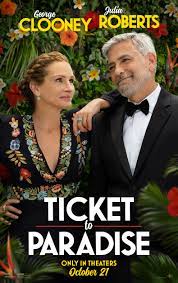
Refreshing and utterly delightful! George Clooney and Julia Roberts shine in Ticket to Paradise! Not only does this outstanding romantic comedy deliver a highly entertaining and heartfelt performative dimension, the script is solid! Excellent plotting for the familiar yet fresh story paired with dialogue that snaps, crackles, and pops! It’s an honest romcom featuring authentic true-to-life characters (albeit slightly exaggerated for dramatic purposes) that will resonate with audiences across the relationship spectrum. Whether you are a in new love, still in the honeymoon phase, or a cynic, you will find characters and predicaments that are inspired by real life. It’s been a long time since the romcom dominated cinemas, but Ticket to Ride is a great example of the classic romcom being reimagined for today’s audiences. And you know what? It’s fun for the whole family! Just goes to show that a comedy can be good, clean fun and still deliver laughs and heart. With a lean, mean script and brilliant casting in the lead and supporting roles, let this be your ticket to cinemas on your next date night!

A divorced couple teams up and travels to Bali to stop their daughter from making the same mistake they think they made 25 years ago.

Ticket to Paradise manages to seemingly do the impossible with an genre that sees few well-written directed, and acted examples nowadays, it simultaneously checks off the conventions and expectations audiences have of a romcom–yet–it delivers a story that will surprise you! Furthermore, this movie entertains audiences with a subject matter so seldom touched by romcoms–new love versus cynical love. Oh, there have been moves that have tried such as Love Actually, but this one strikes all the right tones. Over the last few years, we’ve seen some excellently written romcoms such as Last Christmas and I Want you Back. And if you enjoyed those two as much as I did, then you are sure to enjoy this one!

What’s better than a smartly written romcom with excellent casting? Well, one that takes place in an exotic landscape, of course! You may find yourself booking your next vacation to Bali after watching this movie, and for good reason, it looks like paradise. While there is nothing particularly remarkable about the cinematography, the setting serves as its own star. From sunrises to sunsets and all the crystal clear water in between, you will wish you had ordered a maitai to enjoy along with the movie. It’s easy to see why anyone would be tempted to fly to Bali on vacation and desire to stay. What I appreciate about the cinematography is that it could have so easily been distracting by increasing stylistic approaches to capturing the action and setting, but it never overshadows the story, which is why we go to the cinema, “the greatest art in the world is the art of storytelling” (C.B. DeMille).

Clooney and Roberts’ chemistry is uncanny! They’ve always played off each other so incredibly well. Such a natural couple, whether in love or fighting. And their relationship (or lack thereof) in this movie is completely believable. Of course it’s exaggerated for dramatic purposes, but this IS a romcom. Think of their relationship as real life, but edited. I’ve read some critics that have claimed the story is weak and the only redeeming dimension of this movie is the chemistry between Clooney and Roberts. Suffice it to say, that is an unfair evaluation, because the script gives them everything they need to deliver the laughs and a great story. Moreover, their respective characters have depth and dimension. Yes, there is an element of whimsy in their delivery and in the character mix, but again, this is a romantic comedy. We want to see a romanticized version of real life, but these characters and story work because they also exhibit human dimension, feelings, reactions, and flaws.

I highly recommend Ticket to Paradise! In a year that has had few stand-out movies, this is definitely one of them. Perhaps we will see more smartly written and cast romcoms return to the cinema, because as important as heavy films are, lighthearted ones are just as important because they provide an emotional balance.

Ryan teaches Film Studies and Screenwriting at the University of Tampa and is a member of the Critics Association of Central Florida. If you like this article, check out the others and FOLLOW this blog! Interested in Ryan making a guest appearance on your podcast or contributing to your website? Send him a DM on Twitter. If you’re ever in Tampa or Orlando, feel free to catch a movie with him.

Follow him on Twitter: RLTerry1
HALLOWEEN ENDS horror movie review

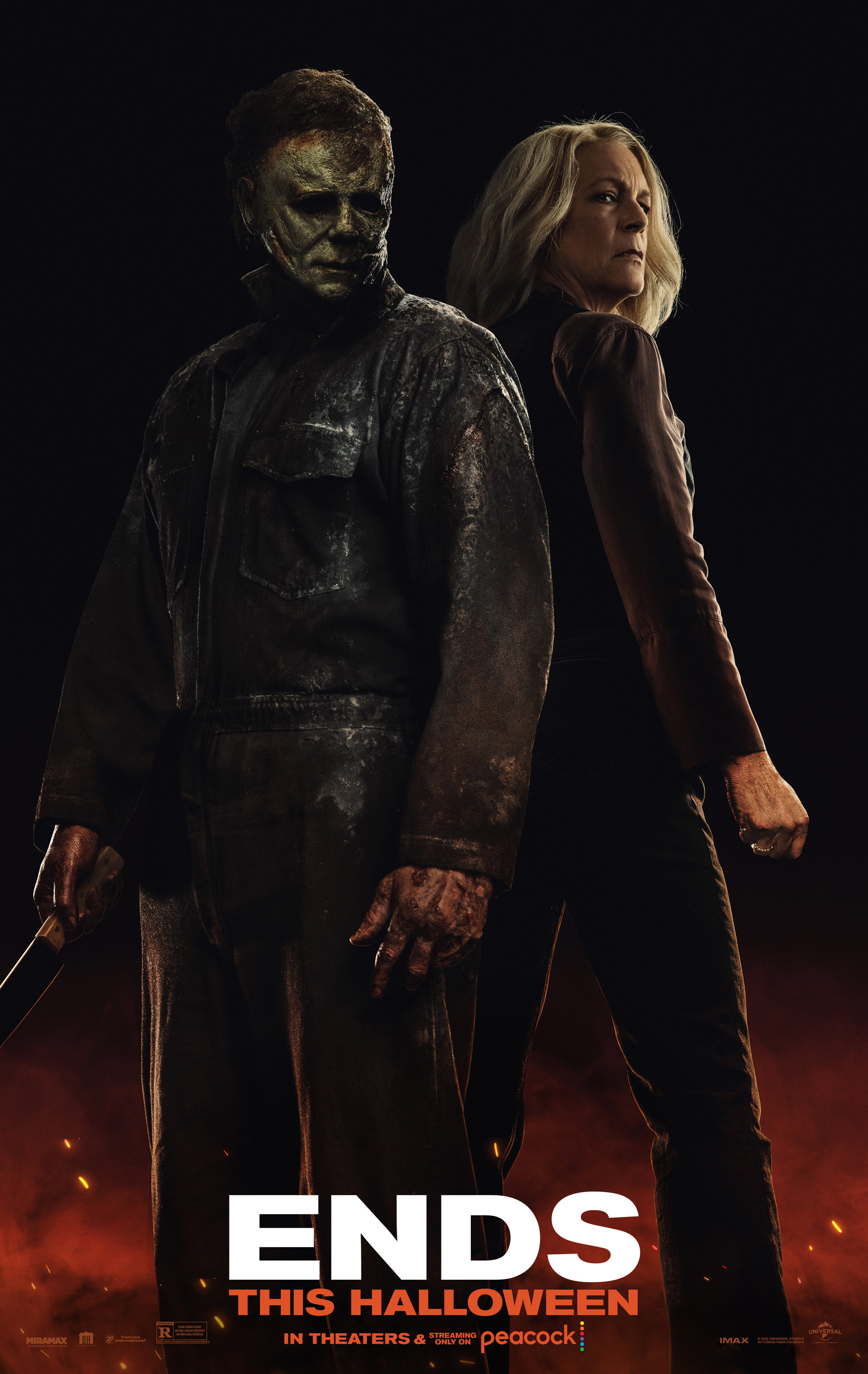
Well, it’s better than Kills. While Halloween Ends still struggles narratively, I appreciate what David Gordon Green attempted to do in order to add a thoughtfulness to the action plot and diegetic subtext. What we have here is a melodrama maskerading around as a slasher that delivers an insufficient amount of fun and genuine suspense. After the hugely disappointing and largely forgettable (except for how bad it was) Halloween Kills, expectations were set incredibly low for the final installment in Green’s take on the Laurie Strode/Michael story. Thankfully, the final chapter isn’t bad–that’s not to say it’s good–it’s more accurately described as watchable. As an added bonus, there is prolific exposition at the beginning that negates the need to watch Kills, so audiences can go from H40 to Ends and not miss anything, really. Even though there is one distinct kill inspired by, and some other shot compositions and camera movements that pay homage to the 1978 original, none of these moments feel like gross attempts at winning audiences over with pure nostalgia. Halloween Ends continues the trend for horror films, particularly the (what I like to call the) neo-slasher to focus so hard on atmosphere, social commentary, and melodrama that both the fun and suspense layers are so thin that they may as well be non-existent. From Halloween (1978) to SCREAM, the slasher delivered creative kills and icons but it also delivered highly entertaining movies in which we have found thoughtful subtext and social commentary in hindsight. Aside from the wandering narrative direction of Halloween Ends, it suffers from a lack of a demonstrable ability to generate a fun atmosphere for the audience.

Four years after her last encounter with masked killer Michael Myers, Laurie Strode is living with her granddaughter and trying to finish her memoir. Myers hasn’t been seen since, and Laurie finally decides to liberate herself from rage and fear and embrace life. However, when a young man stands accused of murdering a boy that he was babysitting, it ignites a cascade of violence and terror that forces Laurie to confront the evil she can’t control.

No spoilers.

The boogeyman, no more. “Was that the boogeyman?” –Laurie, “Yes, I believe it was.”–Dr. Loomis. Sorry, Sam, apparently not. In addition to sucking the fun out of the neo-slasher, filmmakers are also removing the boogeyman or monster factor from the killers. Instead of accepting that our killers are monsters that have evil running through their veins, filmmakers feel the need to explain why a monster isn’t a monster; rather, the killer is created by society. Up to Halloween Kills and Ends, you may have asked yourself “what makes Michael tick?” The short answer: we do not know enough–or at least we used to have an insufficient amount of knowledge about–his psychology, sociology, or physiology to know for sure. And that was a good thing! No longer is that the case.

Why? There no longer exists a mystery. Because now we do know too much about his mind and body; therefore, he ceases to be the boogeyman. Being the boogeyman (or a monster) was so important to, not only this franchise, but horror in general. That little bit of mystery and fantasy allowed him (and icons like Michael) to remain monsters that were to be feared and never truly understood or explained. That’s what made them scary–there was no explanation, which mitigates any control may feel we could achieve.

But since we are voyeurs who are obsessed with knowing, David Gordon Green decided that we needed to know why Michael (and those like him) was the way he was. What’s funny, is that in the original 1978 Halloween, the best sequel Halloween H20, and in H40, we can gather enough evidence to hint at what may make him tick, but at the end of the day, it’s fun speculation. Even before we had to have Michael’s behavior (directly or indirectly) explained to us, Michael likely suffered from and displayed signs of a combination of antisocial personality disorder, schizophrenia, and obsessive compulsive disorder. But none of that truly matters any longer because we now know that Michael and those that admire him are created by society’s negative impacts on their young, impressionable lives. True evil is does not exist.

Many fans of the Halloween franchise have a fondness or even love of the (seemingly) one-off Halloween III: Season of the Witch. And while I do not share a particular fondness for this installment, I can appreciate the creativity behind the expression of this tale of Halloween. And maybe if it wasn’t indirectly connected to Halloween, I may like it more. Anyway, I digress. I bring up Season of the Witch, because there are some shared elements between this Halloween movie and Jason Goes to Hell: the Final Friday and Halloween Ends, And I will leave it at that, as to avoid spoilers. If you’ve seen both of these movies I’ve referenced, then you may be able to make connections.

David Gordon Green and his team of writers inject a heaping helping of melodrama into Halloween Ends. Right up there with melodrama perfectly suited for–you fill in the blank–show on The CW or Freeform. Clearly, this was an attempt at adding some gravitas to this poor excuse for a slasher by spending time on dysfunctional family dynamics. After this trilogy, I am convinced that no family unit is healthy in Haddonfield. Bullies, manic and demanding moms, overbearing and weak fathers, nobody feels real in this town–all caricatures of what we don’t like about some people in society. There is no normal ever established. Establishing a sense of normalcy is important because it’s only then that the slasher can upset the order.

Even though this is the final chapter in the Michael/Laurie story, the movie does tip its hat to future Halloween movies. This is one of those movies that isn’t bad enough to warn people to spend their money and time elsewhere, but it’s also not good enough to where it needs to be seen at the cinema. While I firmly believe that horror movies are best experienced at the cinema in a crowded auditorium, the experience of this one will be good enough at home with some friends.

Ryan teaches Film Studies and Screenwriting at the University of Tampa and is a member of the Critics Association of Central Florida. If you like this article, check out the others and FOLLOW this blog! Interested in Ryan making a guest appearance on your podcast or contributing to your website? Send him a DM on Twitter. If you’re ever in Tampa or Orlando, feel free to catch a movie with him.

Follow him on Twitter: RLTerry1

WHY HORROR? (Preface)

My book exploring why we love horror so much is taking longer than I originally projected, but I thought I would share the preface with you. If you like the preface, then you’ll want to purchase the book when it releases! At the time of this posting, I am on Chapter 12.

PREFACE

“What’s your favorite scary movie?” (Ghost Face, Scream). There is something to be said about the measurable energy of an auditorium at the cinema when a crowd is energized for opening night of the latest horror film. Moreover, the same can be said about your own living rooms when gathered with friends to watch a horror movie on-demand or through a streaming service. We turn into quasi participants because of the strong physiological and emotional responses to the stimuli on screen. Best enjoyed in a group setting, these movies are the stuff of nightmares and fond memories!

The American horror film brings so many people of all ages together from a bevy of ethnic, cultural, religious, and socio-economic backgrounds unlike any other single film genre. Spawning conventions, theme park events, inspiring indie and pop artists, the fandom of horror is incredibly diverse and stratified. While the science-fiction/fantasy fandom is large and vocal, it does not often display the level and degree of diversity that horror does both presently, in our culture, and has for more than a century. From the dawn of cinema, horror has been a staple for big studios and small production companies alike.

By analyzing horror films, we can learn a lot about our past, our present, and even our future. While film is largely a reflection of life, horror is the best cinematic mirror of all because it forces us to face our fears. The monster in a horror film, may just be the manifestation of a force or idea in the real world delivered to us through a terrifying cautionary tale.

Even when a bad horror movie gets released in theatres, the auditoriums are usually full on opening night–even through the weekend–before the numbers fall off, and that title is available on-demand in a few weeks. The influence of horror on our society is witnessed throughout the decades. A great example of this is seeing fans from across four decades all gathering in one place to watch 2018’s Halloween.

Unlike other critical and box office successes in recent years, this particular franchise boasted a 40 year old legacy that brought fans and spectators of all ages together. I remember sitting there in my seat, simply in awe at the sea of people and feeling a kinetic energy surge through my mind and body, especially when the Halloween theme music began to play. What other genre generates this?!?

In order to best explore why horror brings so many people together, we need to first look what the formula is for the American horror film and then at why we are attracted to it. From there, we can travel through the decades to learn how and why the horror film developed in the manner that it did.

Understanding what comprises the American horror film will support our exploration because it will create a theoretical framework through which we can analyze the popularity and fandom of horror. When I lecture on horror to my film studies and screenwriting students at the University of Tampa, where I’ve taught since 2016, I describe the makeup of the American horror film this way:

(Art movements of) German Expressionism + French Surrealism = horror’s aesthetic

(Writings of) Sigmund Freud + Edgar Allan Poe = horror’s content

At its root, all genre horror films can be traced back to these aforementioned elements and formulas. This chapter will focus on horror’s aesthetic, while the next chapter will focus on its content. 

Ask anyone, and the single most famous scene in all of cinema is the famous shower scene from Hitchcock’s Psycho, widely regarded as the most pivotal horror film in all cinema history. The aforementioned scene gains a greater eerie feel upon the close of the movie when the audience realizes that Norman has little to no control over his mind and actions.

The studio responsible for solidifying the horror film as a popular genre, and you could say is the parent of the American horror film is Universal Pictures. Not only is horror the most bankable genre of film, generally speaking, it is also one of the most fascinating to analyze because many horror films written in the classical sense are social metaphors.

Throughout this book, you’ll learn about the current events that preceded a particular movement in horror, and how those fears and anxieties were explored through characters and plots. For example, it was the space race of the mid 20th century that inspired many of the alien movies of the 1950s. And with the space race, came a fear of what lies beyond our atmosphere.

Although the “modern” horror film began with Psycho, horror was an influential genre and box office draw from the dawn of cinema. In fact, many of the characters you enjoy watching today in horror films has their first appearance in the early 1900s.

“Oh no, don’t go into that house!” “Watch out! He’s right behind you.” Some of the most memorable movies of all time are the horror films. They draw our eye’s attention to that which would otherwise repulse us in real life. At the same time, our own eyes are being threatened with disturbing or bizarre imagery.

But why does that which would repulse us in real life and that which is terrifying to behold, bring us together? That is what we are here to explore together! So join me as I lead you on a journey to dive deep into why horror brings us together.

From Nosferatu to (my favorite icon) Freddy Krueger and beyond, the American horror film continues to leave a huge footprint in our collective zeitgeist.

Ryan teaches Film Studies and Screenwriting at the University of Tampa. If you like this article, check out the others and FOLLOW this blog! Interested in Ryan making a guest appearance on your podcast or contributing to your website? Send him a DM on Twitter or email him at RLTerry1@gmail.com! If you’re ever in Tampa or Orlando, feel free to catch a movie with him.

Follow him on Twitter: RLTerry1
THIRTEEN LIVES docudrama mini review

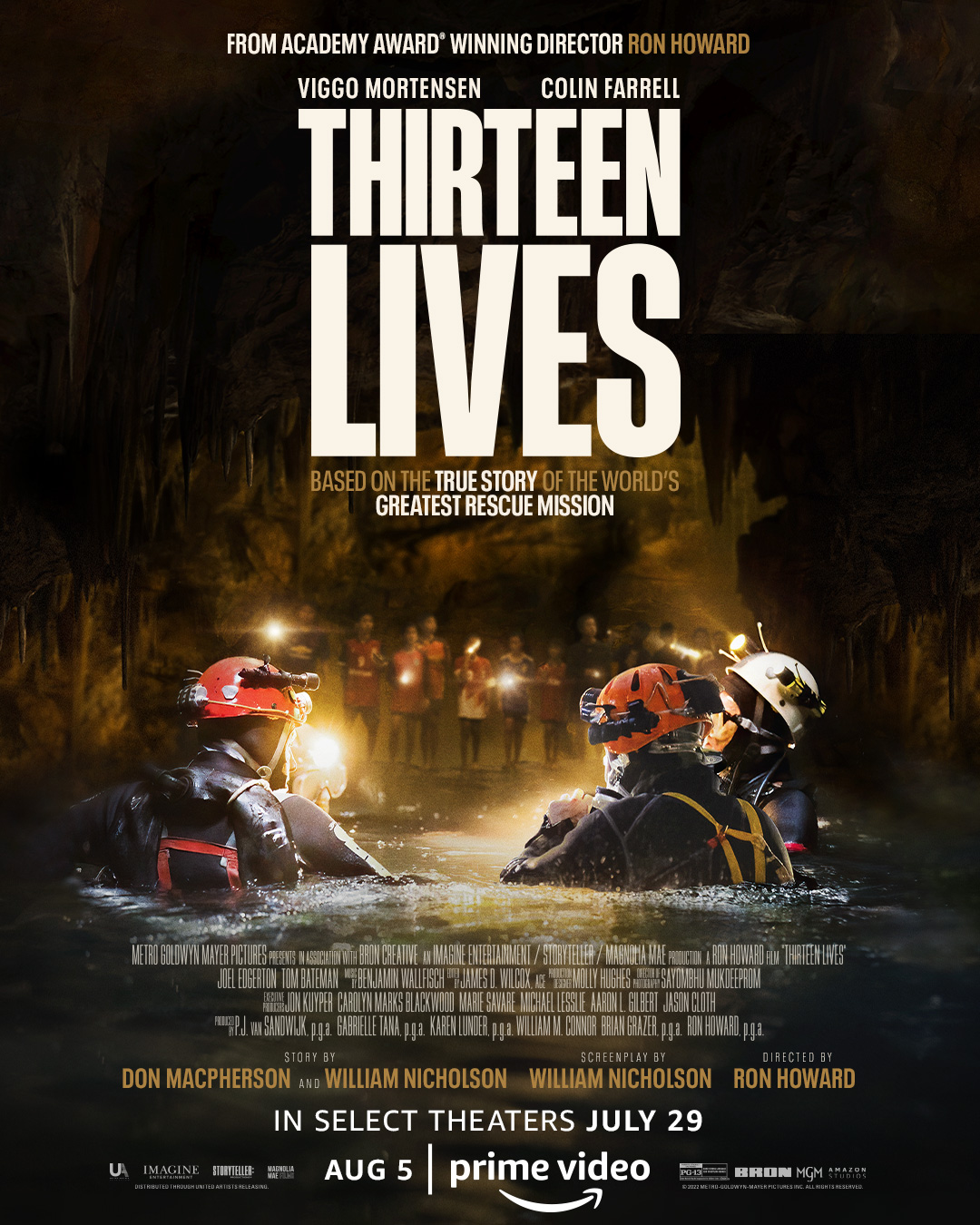
Interesting. Ron Howard’s big screen adaptation of the true story of the daring rescue of the Thai youth football (soccer) team from the flooded cave is faithful to the wikipedia page, but with an impressive addition of underwater cinematography. Thirteen Lives chronicles the seemingly impossible rescue that captured the attention of the entire world in summer 2018. While Howard’s docudrama is well-made all the way around, what audiences will find most fascinating is the mechanics of the rescue. It took thousands of volunteers in the labyrinth of caves, mountain peaks, and basecamps to bring all the boys and their coach to safety. Although none of the performances particularly stand out, the film delivers solid casting. Thirteen Lives is a different kind of “based on the true story” film, because it does not have particularly strong plotting to map-out the narrative. On one hand, it is a simple plot rescue the boys, but the film ultimately plays as a blow by blow description of what happened. Upon viewing the film, I thought to myself, why not just make a documentary instead; and then it occurred to me, that there would have been little to no footage of the inside of the caves. Therefore, docudrama was the way to go. There really isn’t much in the way of connective tissue between plot points; events just happen. That’s not to say that what we are watching isn’t terrifying in places–it certainly is–especially if you have kids; but at the same time, it doesn’t feel like a cinematic story in the conventional sense. Even though we all know how the true story ends, the film focuses on the steps that were taken in order to rescue the youth soccer team. Is it good? Well, it’s not bad. It just kind of is. Often we see based on a true story films that take so much dramatic license that it’s no longer a faithful big or small screen adaptation; sometimes, character or situational nuances or motivations are lost in translation. Thirteen Lives is so incredibly focuses on a dutiful adaptation, that it sometimes forgets that it’s also supposed to be finding the narrative amongst the facts. I wouldn’t wait to see this on the small screen, catch it during its limited theatrical run because the visuals are impressive.

Ryan teaches Film Studies and Screenwriting at the University of Tampa. If you like this article, check out the others and FOLLOW this blog! Interested in Ryan making a guest appearance on your podcast or contributing to your website? Send him a DM on Twitter or email him at RLTerry1@gmail.com! If you’re ever in Tampa or Orlando, feel free to catch a movie with him.

Follow him on Twitter: RLTerry1

NOPE horror film review

Nope, no plotting here. With a sensory explosion of stunning shot composition, outstanding sound design, and unnerving score–combine those with a refreshingly original expression of the classic monster movie–and you should have a great horror film, right? That was almost the case here, had it not been for the meandering narrative and thoughtless plotting. Brilliant idea, but poorly mapped out. There is so much to like about NOPE, but the full potential of this beautifully looking film is ultimately held back by screenwriting mechanics. Peele’s NOPE feels like a combination of The Birds, Close Encounters of the Third Kind, and Signs. Unfortunately, it lacks the structure and substance of any of those. Clearly, Peele had a wonderfully original idea for his latest feature film, but his idea fails to deliver narratively. The plotting is all over the place; there are scenes that simply do not pay off dramatically. Individually, each scene is meticulously crafted, but many are not connected methodically to the rest of the film. What we have here is a film, that clearly demonstrates a love for horror cinema and film history, that pushes experiential boundaries, but the plotting leaves much to be desired. Moreover, there is a disconnect between the performative element of the mise-en-scene and characterization. Fantastic performances; but the characters, as they are written, are not very well developed. The pretense of the film is one exuding cinematic gravitas, but the pretense is the equivalent of a beautiful house with a shaky foundation and infrastructure.

To go into why this film’s plotting does not work would be incredibly spoilerific, so I cannot go into many details. All throughout the film, I thought to myself “I can tell that this is supposed to mean something, perhaps subvert something, but those idea are not being communicated effectively.” What this film will likely become is one of those that a pretentious cinephile or armchair critic will respond to those that express difficulty in following the plot with “it’s not for everyone” or “you just don’t get it.” Whenever I hear those remarks in defense of films that objectively fail to deliver narratively (plot+story), it makes me want to vomit. They are copouts for explaining away why a film doesn’t have to follow established storytelling conventions; furthermore, the “you just didn’t get it” is a tool for the cinephile to establish intellectual superiority over the individual rightly questioning the screenwriting of a film.

Caretakers at a California horse ranch encounter a mysterious force that affects human and animal behavior.

Where the film excels is in the very concept of the film itself and the technical achievement! Upon watching it, I was reminded of great films such as The Birds, Signs, and Close Encounters of the Third Kind. Moreover, I was also reminded of the sci-fi/horror movies of the 1940s and 50s. Because I was reminded of those, that demonstrates Peele’s love for classic horror cinema! And I applaud him for attempting to craft something for modern audiences that feels familiar yet fresh. To the best of my knowledge, there has yet to be a film (classic or more contemporary) that expresses the alien plot in the manner that Peele does. Where the films to which he’s harkening surpass NOPE is in the plotting. Original ideas are very much needed in 21st century cinema, but these ideas need to be paired with coherent plots.

Peele’s eye for shot composition is exceptional. He knows precisely how to frame and shoot a scene dramatically, even when the shot is largely static. What makes his shot compositions work so well is that the shot is a direct extension of the emotion of the scene. The camera isn’t merely documenting the course of events, but is ostensibly an active participant in how the scene unfolds.

The brilliant sound design and unnerving score work in tandem to draw the audience into the film, especially when watching the film in Dolby Cinema (which is what I did). No sound effect or bar of score is wasted. Every sound, every note is intentionally selected as an extension of the action or emotion of a scene. Although a film should not rely upon a great score to carry the story, sound and music are two very important tools in a filmmakers tool belt to increase the sensory stimulation of the film.

Peele is such a gifted director, but I hope he chooses to work with other screenwriters in the future to take his original ideas and map them out methodically and chronologically (whether linear or nonlinear) more soundly. We need refreshing ideas such as his, but we also need them executed in more conventional ways. Have the thoughtful subplot and subtextual theming that will inspire discourses, but make the outside/action plot more accessible because it’s the vessel through which the subplot and theming is communicated.

Ryan teaches Film Studies and Screenwriting at the University of Tampa. If you like this article, check out the others and FOLLOW this blog! Interested in Ryan making a guest appearance on your podcast or contributing to your website? Send him a DM on Twitter or email him at RLTerry1@gmail.com! If you’re ever in Tampa or Orlando, feel free to catch a movie with him.

Follow him on Twitter: RLTerry1