CONCLAVE film review

Spellbinding and poignantly reflective! It’s like House of Cards but with Cardinals and Nuns. Truly captivating.

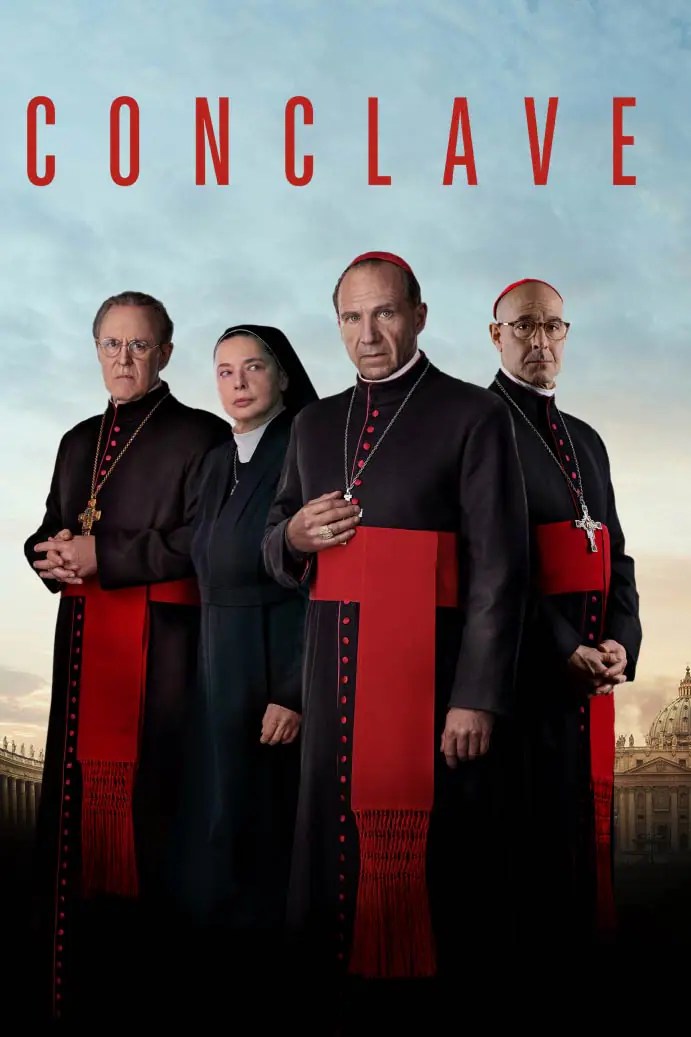
Cardinal Lawrence has one of the world’s most secretive and ancient events, participating in the selection of a new pope. Surrounded by powerful religious leaders in the halls of the Vatican, he soon uncovers a trail of deep secrets that could shake the very foundation of the Roman Catholic Church.

I feel the film strikes a delicate balance between reverence for the subject matter, yet provides us with a subtle critique of its institutional traditions. The story unfolds with deep respect for the gravity of the papal election. However, through its unfolding intrigue, the film also reminds us that faith should ultimately be centered on God rather than on rigid customs or political maneuvering. The narrative underscores how human ambition, secrecy, and tradition can sometimes cloud the true purpose of faith. And the plotting is meticulously structured. Every revelation is carefully placed, each character’s motivations are unraveled with precision, and the pacing ensures that the suspense never overshadows the film’s thoughtful meditation on spirituality and power. I also like how the screenplay both honors faith-based institutional traditions but challenges the audience to reflect on what truly matters in faith.

To me, the cast collectively delivers a compelling performative dimension that drives the captivating nature of this film. Feinnes, Rosselini, Tucci, Lithgow—what a powerhouse. The actors did a brilliant job of drawing audiences into the pomp, circumstance, and almost clandestine nature of the election of the Pope. Feinnes’ performance as Cardinal Lawrence was bold and convicting, yet incredibly nuanced at the same time. The other cast member I want to spotlight is Isabella Rossellini as Sister Agnes. And while the gravitas she brought to every scene, in which she was featured, allowed her to steel the spotlight, there were Amy moments—to my delight—that I could hear Lisle Von Rhouman from Death Becomes Her. 

I love how the characters are not merely realistic individuals vying for power within the Vatican but, a closer reading reveals something far more important in these characters: the key characters each represent broader themes of faith, morality, and human ambition. Each character serves as a symbolic force in the intricate balance between divine guidance and earthly maneuvering. Just to name a few: I see Feinnes’ Lawrence as the moral compass, Tucci’c Bellini as the political strategist, Lithgow’s Tremblay as the power seeker, and Rossellini’s Sister Agnes as the voice of reason or conscience. Each character represents different facets of power, faith, and human imperfection within religious institutions. Collectively, the characters offer audiences more than a quasi-political thriller, but a meditation on the true meaning of leadership.

The exquisite costuming and production design truly immerse us into the grandeur and secrecy of the Vatican. The costuming itself was a work of art that demonstrated careful attention to ecclesiastical tradition but also incorporated visual storytelling elements. The choice of fabrics, embroidery, and even the way the robes drape contribute to the film’s overall sense of realism and reverence, and serve as an extension of the setting and the personalities of the characters. As for the production design, every detail, from the richly embroidered vestments to the imposing architecture, reinforces the film’s solemn, high-stakes atmosphere. A key aspect of this visual achievement is the film’s use of Cinecittà Studios in Rome. Founded in 1937, it is one of the largest film studios in the world and has a rich, legendary even place in cinema history. Which I could go into for the rest of out time together. But suffice it to say, it was home to Liz Taylor’s Cleopatra and Isabelle Rossellini’s famous director father filmed at the storied studio. You can visit it, and its theme park today! 

I feel the film has a lot to say about a variety of topics. If I was to identify a few, I’d say there are themes and messages concerning faith and politics, which we witness in the actions of the cardinals, while ostensibly seeking to follow God’s will, we are reminded that they are humans influenced by personal beliefs, rivalries, and ambitions. While it’s a group of men in this film, in this situation, we can really extend this idea to any and everyone. I also like how the film explores the immense weight leadership brings with it. Probably what hit me the most was how the film was not so presumptuous as to posit answers or solutions, but rather more concerned about prompting introspection. It respects the sacred traditions of the Church while also questioning the imperfections of any human-led institution—which is all of them. The film suggests that true faith is not found in ceremony or power but in the individual’s relationships with God and his or her fellow man.

I love when a film transcends its premise. While the surface of a film can be intriguing, entertaining, funny, or scary, it’s what lies beneath the surface that offers a timeless cinematic richness. And Conclave is one of those films. It offers us a profound reflection on the world we live in, and the intricate dynamics that shape our daily lives. This film serves as a mirror to the struggles of leadership, morality, and power that permeate every institution—from politics to corporations, from religious organizations to personal relationships.
Ryan is the general manager for 90.7 WKGC Public Media in Panama City and host of the public radio show ReelTalk about all things cinema. Additionally, he is the author of the upcoming film studies book titled Monsters, Madness, and Mayhem: Why People Love Horror. After teaching film studies for over eight years at the University of Tampa, he transitioned from the classroom to public media. He is a member of the Critics Association of Central Florida and Indie Film Critics of America. If you like this article, check out the others and FOLLOW this blog! Follow him on Twitter: RLTerry1 and LetterBoxd: RLTerry

40 YEARS OF FLASHDANCE…What a Feeling! a retrospective review

What a feeling! Grab your leg warmers and can of Aqua Net as we hit the dance floor to celebrate the cultural phenomenon that was and still is Flashdance.

The Oscar (and Grammy) winning dance movie Flashdance turns 40 this year on April 15th. Can you believe it’s been four decades since the iconic movie defined the music, dance, and fashion of the 1980s??? Forty years of electrifying music and dance that dazzles the senses. Winning the late Irene Cara and legendary composer Giorgio Moroder the Best Original Song Oscar and Grammy for Flashdance…What a Feeling! (Moroder was also nominated in the same year for his Scarface score) and earning Michael Sembello an Oscar nomination for Maniac, the titular 80s movie Flashdance remains an icon of music and dance that has transcended the decades and continues to be emulated in other media today. This is not a movie to be taken seriously; it’s a movie to be felt and experienced. And to its credit, it has remained popular. Take your passion and make it happen!

In case you are new to planet earth, Flashdance tells the story of Alex Owens (Jennifer Beals), a beautiful young woman who works a day job in a steel mill in Pittsburgh and dances in a bar at night. When Alex discovers that her handsome boss, Nick Hurley (Michael Nouri), is both interested in her and supportive of her performing career, she renews her efforts to get accepted into a prestigious dance conservatory. Although Alex is frightened of failure, she is cheered on by Nick, as well as by her mentor, former ballet performer Hanna Long (Lilia Skala).

More than a cultural smash hit, it was a tremendous success at the box offie too, because Flashdance is the third highest grossing film of 1983 behind Return of the Jedi and Terms of Endearment. In retrospect, this movie is veritably responsible for reviving the modern movie musical with its sexy complex dance sequences, bold fashion, and use of popular music.

Not many films can be recognized by a single shot, this is expressly true with those that may not have even seen the film, but Flashdance is instantly recognized by Beals’ silhouette leaning back on the chair with water dousing her. That cinematic moment has been parodied and paid tribute to in dozens of movies and TV shows from Elvira: Mistress of the Dark to Family Guy and even Deadpool 2. From Beals’ off-the-shoulder grey sweatshirt in the famous bra-removal scene to her knee-high leg warmers, bikini bottoms, and taut physique, many scenes in this movie will forever be engrained in our minds. It’s remarkable how this cheesy, low-budget dance film influenced the culture of an entire decade and continues to reassert itself in popular culture to this day. The incomparable footprint left by this movie can be felt everywhere.

It’s funny, whenever critics and fans talk about Flashdance, it’s almost never about the plot. Is there anything inordinately wrong with the plot–no–but there is nothing particularly remarkable or subversive about it either. It’s a simple variation of the rags to riches story or simply realizing a dream despite obstacles. At the intersection of performance art and motion pictures is where this movie lies, and lies there incredibly comfortably and confidently.

Flashdance is a movie which uses a paper-thin plot to connect sequences of montages and dance numbers, one right after the other–yet–somehow audiences, for forty years, are raptured by the music and dance. I cannot think of another movie that defied the odds of success and became a legitimate classic in the way Flashdance did.

It’s as if Bruckheimer and Adrian Lyne studied the elements of what makes a movie successful in the box office (and in popular culture), and then took those basic elements and loosely connected them together. Catchy music, bold fashion, sexy or provocative dances, mild/brief nudity, and relatable characters, these are the elements that Bruckheimer and Lyne put together in order to create movie magic and fantastic success. Then cap it all off with pure, unfiltered triumph in front of those that once looked down upon, and were skeptical of the central character.

Never once do you buy that Alex is a welder; furthermore, in retrospect, it’s clear that there are multiple people serving as the dancing Alex (which is something that is film is widely known and yet rocks it!). But it doesn’t matter. Why? Because it’s nearly impossible to watch this movie and not get drawn into its glitzy fantasy! But while we are on the topic of the Alex’ dancing in the film, I feel it’s important to highlight the talent that brought the exotic dancing to life! Working as Beals’ dancing body-doubles were accomplished dancers Marine Jahan, Sharon Shapiro, and breakdancer Richard “Crazy Legs” Colón.

Despite the contrived plot, the movie is not without deeper meaning. Some of the themes that can be closely read in Flashdance concern ideas such as identity, class, and cultural norms/expectations whether or not there is any absolution. Without stooping to pedantic commentary, the movie provides thoughtful content for those that seek a greater understanding of what the film has to say about the human experience. “When you give up your dream, you die.” A bit cliche perhaps, but still serves as the reminder that we do need our dreams in order to have something toward which we strive. We may never experience or realize that dream, but it’s the pursuit that is most meaningful.

We witness that there are many layers to Alex; she is a complex individual with multiple interests. She is just as confident and comfortable on a dance floor as she is welding as she is at a fine dining restaurant. This is such an important message that continues to be relevant–if not even more so–today! Flashdance is a reminder that diversity within a given group is so very important. Often times, popular culture projects prejudices, behaviors, and expectations onto a given group of people (or onto an individual within a group). Diversity of groups of people should never mean uniformity of thought within that group, it means there are a variety of individuals within any given group of people that have their own fears, beliefs, goals, and dreams. Alex may be a woman, but she is by no means obligated to only behave like a typical woman. Neither does she disparage those that would behave more typically; this movie celebrates variety! Variety of dance, variety of music, variety of people.

The degree to which this movie influenced virtually every area of popular culture is incalculable. Even exercise videos changed overnight. I posit that it’s entirely possible that 80s and 90s aerobics videos wouldn’t be the same if it wasn’t for Flashdance. For example, the footprint of this movie can be seen in the music, movements, and fashion of those Jane Fonda style aerobics videos. Even descendants of this stylistic athletic fashion can be observed in nearly every downtown and suburban area today; but we now refer to it as athleisure apparel.

Flashdance is the very definition of a crowd-pleasing film that defied the expectations of critics in 1983 and continues to be beloved by contemporary critics and audiences of all walks of life. The legacy of this movie is felt throughout media of all kinds! Even those that have never seen the movie recognize it by the music or iconic water dance shot. It’s a light-hearted melodrama that you cannot help but love. Just close your eyes, and feel the timeless rhythm of Flashdance!

Ryan teaches Film Studies and Screenwriting at the University of Tampa and is a member of the Critics Association of Central Florida and Indie Film Critics of America. If you like this article, check out the others and FOLLOW this blog! Interested in Ryan making a guest appearance on your podcast or contributing to your website? Send him a DM on Twitter. If you’re ever in Tampa or Orlando, feel free to catch a movie with him.

Follow him on Twitter: RLTerry1 and LetterBoxd: RLTerry

Recipe for the Best Picture Oscar

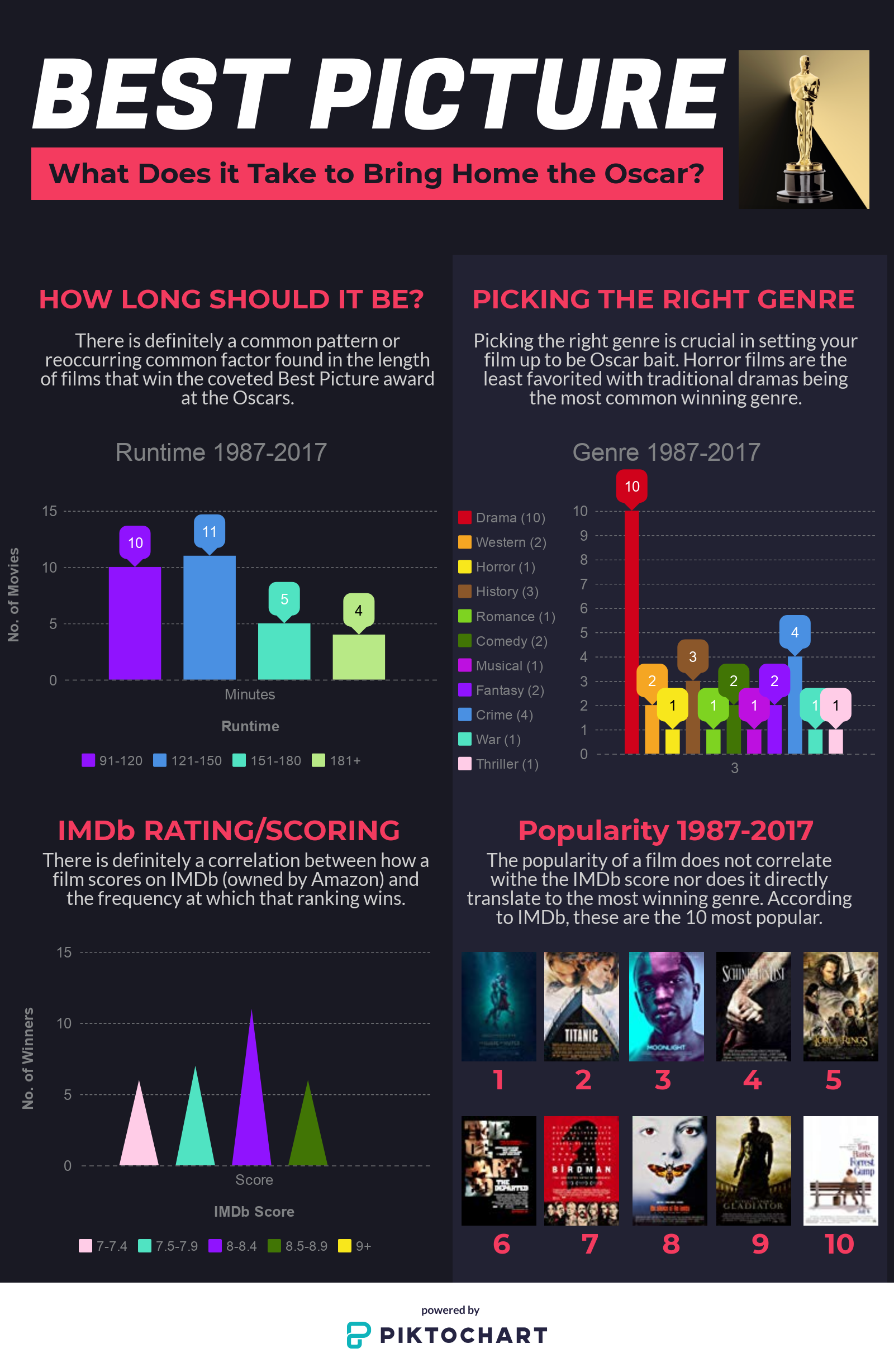
With the Academy Awards quickly approaching and the nominations announcement early tomorrow morning, I thought that it would be interesting to dive deep into what it takes to build a film that gets nominated and wins the most coveted film award in the United States, the Oscar for Best Picture. In order to explore this topic as objectively as possible, criteria from 1987-2017 has been analyzed and broken down into a chart. Although there are many artistic and technical merits that make a film, this article selected runtime, genre, IMDb score, and popularity. According to the empirical date, it is possible to produce a film that theoretically should get nominated and even win, but there are incalculable uncontrollable variables that range from makeup of the Academy, to number of films submitted, to release times, to the socio-political climate at the time, so it is NOT an exact science. However, looking at the data does paint a portrait of what are some correlations between winning and the various elements that make a motion picture. Depicting the criteria in the form of a chart is certainly helpful and measurable, but combining a qualitative analysis to the quantitative approach will aid in developing a comprehensive exploration of what it takes to bring home the gold.

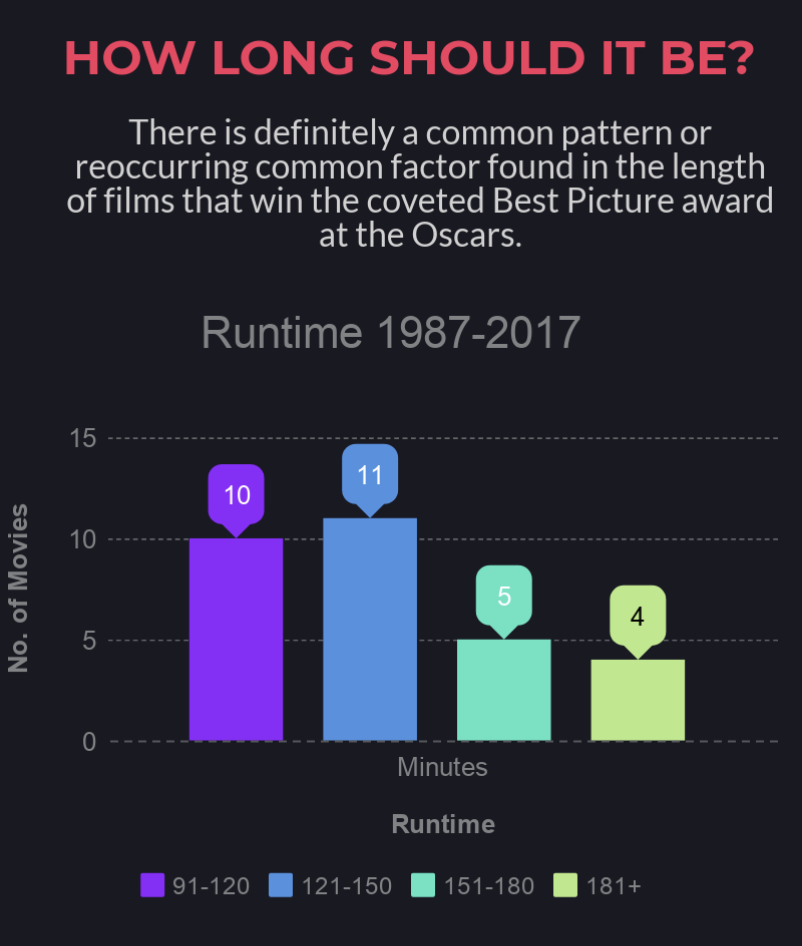
Films range from shorts to 3+ hour epics, and there is a correlation between runtime and winning the Best Picture Oscar. The sample of winners for this data is gathered from the Best Picture winners 1987-2017 (up to 2018 Oscars) totaling 31 films. According to the sample, 21/30 films ranged from 91 to 120 minutes with 11 of them ranging from 121 to 150 minutes. The shortest and longest films to win the Best Picture award are Driving Miss Daisy at 99mins and The Lord of the Rings: Return of the King at 201mins. There were zero films to win the Best Picture award released between 1987-2017 and the number after 150mins drop off significantly. The shortest film to ever win a Best Picture award is Marty at 90mins and the longest is Gone with the Wind at 238mins. Looking to the most recent winners of this most prestigious award, there is a measurable trend toward shorter feature length films. Looking to films such as Moonlight and Lady Bird, there is clearly an intentional effort to not exceed 2hrs but get close to it. Why is this? While you may think it may have to do with film budgets, that’s incidental. Yes, money and budgets are part of the equation, but it’s because movie theatre chains want to fit as many movies as possible into a daily schedule. Two hours is a solid time not to cross because a movie theatre can play the film every three hours in a single auditorium (and stagger it with multiple auditoriums). So if you are attempting to draft your Best Picture nominees or winners, look to the runtime for one of the correlating criteria for winning this award.

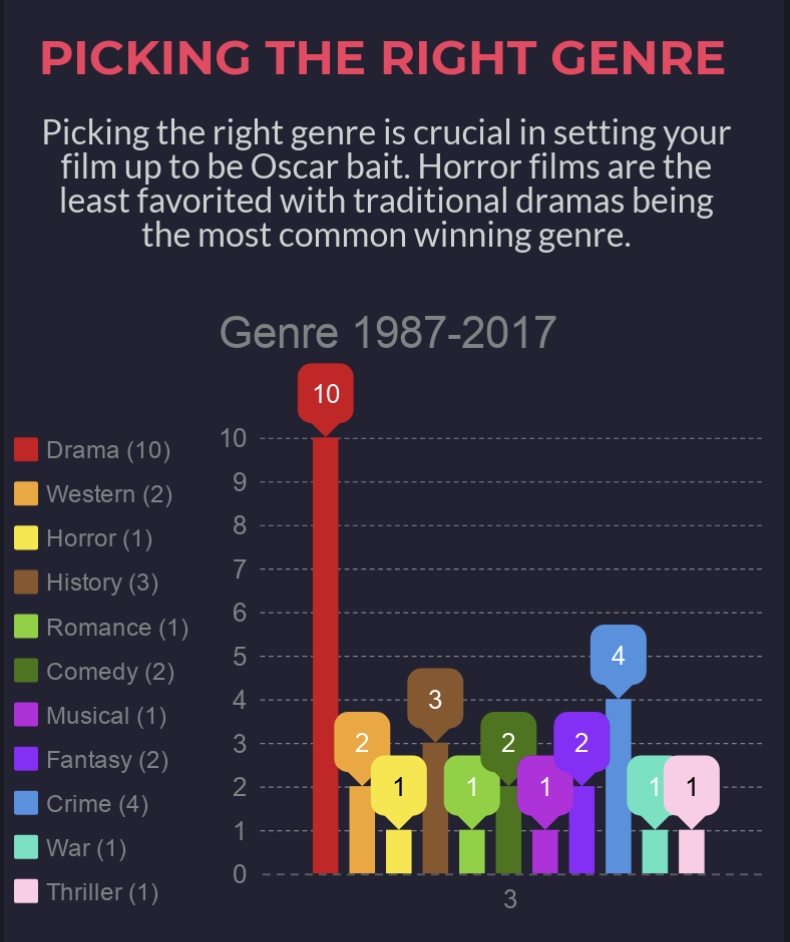
Genre films are certainly the favorite of the Academy. Rarely do we witness a film playing around or experimenting with genre get nominated much less win. Personally, I like it when a film plays around with genre in an innovative attempt to tell a new story or provide a new perspective on a previous one; however, the Academy likes their straight forward dramas most. Yes, drama is in every story; but this label specifically refers to the cut-and-dry serious narratives that lack a significant level of comedy, horror, romance, etc. From 1987-2017, ten drama films won Best Picture. The next highest winner is a significant drop at 4 with the crime genre. While drama wins the most, horror, thriller, war, musicals, and romance win the least. While many dramas certainly contain elements of the aforementioned, these genres refer to the films that are genre purest than crossovers. There are certainly high profile, memorable exceptions to this rule. And the biggest surprise on this list is the Best Picture win of The Silence of the Lambs. Not only did it win the Best Picture award, but it also won Best Director, Best Actor in a Leading Role, Best Actress in a Leading Role, Best Director, and Best Adapted Screenplay. No other film in the last 30 years has won the Big 5 Oscars. The win of The Silence of the Lambs is also the single win for the horror genre. Over the last few years, we have seen an increase in the general popularity and critical acclaim of horror films (Get Out is a great example) but the winningest genre still remains to be drama. Another exception to the rule is Chicago’s win! Perhaps big musicals once dominated the box office but not as much anymore. Last year’s La La Land came close to winning (that is an article in and of itself) but it came in second to a hard drama. Although there are other genres represented on this graph, that covers 1987-2017 released films, it is clear that you stand you best chances of winning by writing a straight-forward drama.

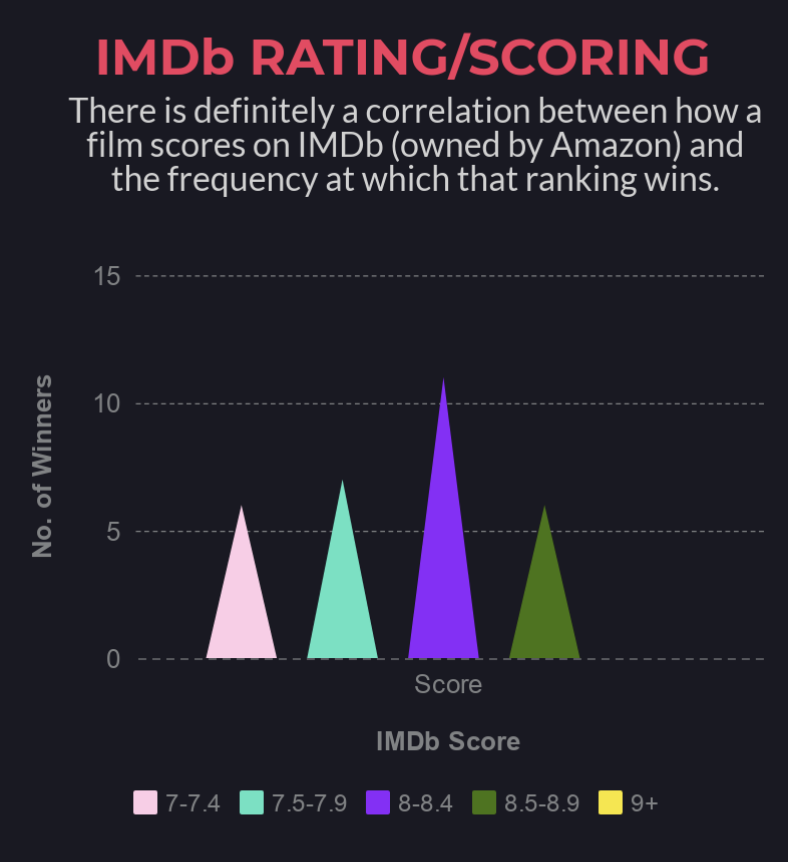
While genre can be debated on many films, IMDb scores are hard quantifiable evidence that is not subject to interpretation. Personally, I am a qualitative researcher but even in an analysis such as this, having the hard numbers is an important part. While you think it would be the films that score high 8s and 9s that would win the most, the evidence from 1987-2017 states that it’s the low 8s and high 7s that win the most often. Unlike genre and runtime, there is no way to predict your IMDb score; therefore, this evidence is most handy when trying to pick the nominees and winner. It’s like looking as a sports team’s stats going into the playoffs of the final big game of the season. Perhaps it’s not an ingredient in the same way genre and runtime are; but you can extrapolate from the aforementioned data what plots to consider when building your story and how long your movie should be. If you are one of those who are selecting which films are going to get nominated or which nominee will win, then you definitely need to look to the IMDb score for guidance.

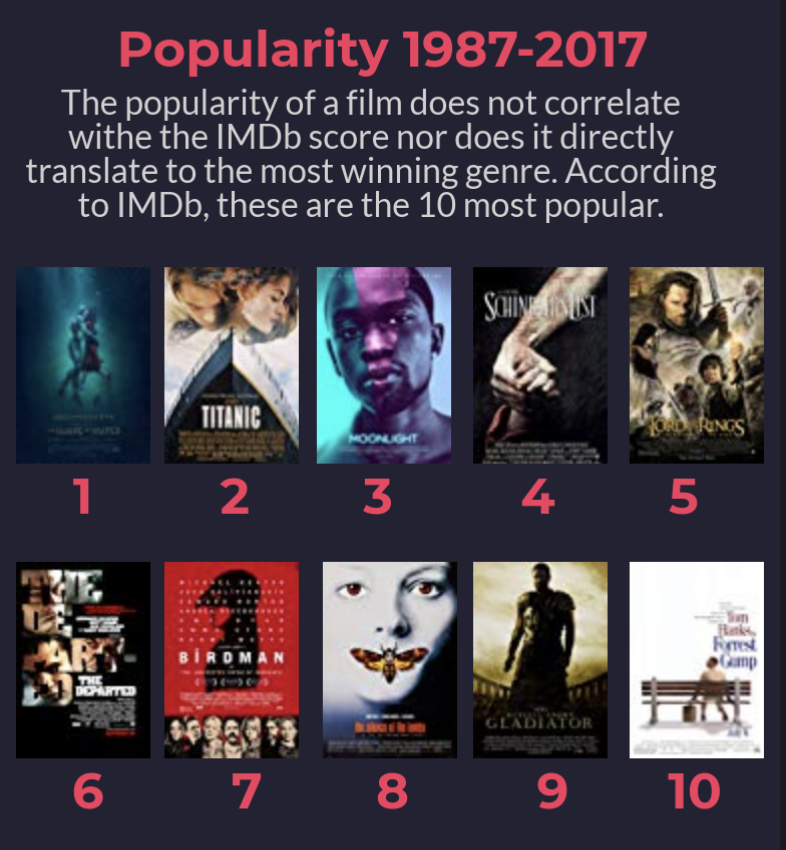
Lastly, let’s take a look at the ten most popular motion pictures to win the Best Picture award over the last 30 years. The graph referenced in this paragraph depicts the ten most popular films from 1987-2017 to win the Best Picture award. IMDb takes multiple values into account when developing this list from IMDb score, Metacritic, audience score, etc. So, this is the most subjective criteria on this list; however, since the popularity is based upon quantifiable data, it can be used as a reliable source of information. The most popular movie on this list is 2017’s The Shape of Water, directed by Guillermo del Toro, which IS an example of a film playing around with genre that won! It combines elements of science-fiction, drama, and romance. Taking the number 10 spot on this list is the Tom Hanks classic Forrest Gump. Interestingly, each of these winners is quite different from the rest. The only two to really share any similarities in plot are Silence of the Lambs and The Departed. Both of these films contain crime elements, with one skewing more towards thriller and the other more towards horror. Whereas these films differ in terms of plot, what they DO share in common is a strong lead cast. The top IMDb scorers on this list are Return of the King (8.9), Schindler’s List (8.9), Forrest Gump (8.8), Silence of the Lambs (8.6), and The Departed (8.5). All are 8.5 or higher. Beyond the IMDb score, runtime, and genre, what makes these films so popular is a compelling story comprised of a simple plot and complex characters. A superlative story begins with a screenplay, and the films on this list to also win Best Original or Best Adapted screenplay are BirdmanMoonlightThe DepartedThe Return of the KingForrest GumpSchindler’s List, and Silence of the Lambs. With 7/10 of these Best Picture winners also winning the best screenplay award, it is imperative that the film begin with strong writing.

For aspiring writers and directors, look at this data and take it into account if it is your intention to write or direct the next Best Picture nominee or winner. Following this data does in no way guarantee that you have an award winning film, but it does help to highlight some important and controllable elements to consider when crafting your story. With the new additions to the academy this year to include more women and other underrepresented groups amongst the Academy’s makeup, we may see a new pattern to observe over the next 5-10 years. There have been many changes to the landscape of motion pictures in the last few years with Netflix and Amazon throwing their respective hats in the ring, and with increased at-home viewing as opposed to watching first-run films in the cinema. It’s an exciting time to analyze the films that have a shot at winning the golden man, especially as the socio-political climate is becoming increasingly influential on the nominees and winners. What this data shows us is what we can observe over the last 30 years and apply that to the nominee predictions that are going on now and the eventual predictions for the winner in this category.

For more on the awards talk, you definitely want to follow #FilmTwitter on Twitter and the podcasts of Mike, Mike, and Oscar, Next Best Picture, and InSession Film. These are just a few of the great folks I follow, but ones that specialize in awards talk.

Ryan is a screenwriting professor at the University of Tampa. If you like this article, check out the others and FOLLOW this blog!

Follow him!

Twitter: RLTerry1

Instagram: RL_Terry

Thrillz (theme parks): Thrillz.co

“Creed II” Full Film Review

A truly heavyweight champion of cinema! Adonis Creed will hit you right in the feels. This brilliant installment in the Rocky/Creed franchise is an exemplary example of the power of cinematic storytelling. Creed II is a knockout! Sylvester Stallone and Michael B. Jordan’s respective performances are outstanding and Steven Caple’s direction is superb. Like with the original Rocky, this is not a film about boxing, it’s not about winning, it’s about going the distance supported by the inner drive to settle old scores, redemption, grief, loneliness, and the relationship between fathers and sons. Furthermore, it calls into question the reasons why we do what we do–the real reasons. So often we try to convince ourselves that we are determined to execute a plan for reasons other than the real ones, because the real reasons are too painful. The Rocky movies could so easily be about the sport of boxing, training, and winning; but they consistently include impactful, relatable, gritty themes that resonate with the audience. Whether you are familiar with boxing or not, this film will hit you with its powerful subtext and messages of redemption that we can all identify with. Whereas the original Creed did not feel highly connected to the Rocky cinematic universe, Creed II reminds us of the connection at every punch, block, and jab. The film also offers social commentary on the fickleness of glory and just how temporary and fleeting it can be. Sylvester Stallone and Cheo Hordari Coker’s screenplay follows the Rocky Way of doing things, much in the same way that Marvel has the well-known manner that Marvel stories are told. Even if you have not seen the Rocky movies or Creed, you will be moved and entertained by this film. Suspenseful, tense, and even comedic at times, Creed II is one to look for when Best Picture nominees are announced.

Recently crowned the heavyweight champion of the world, Adonis Creed (Michael B. Jordan) does the thing that makes him more nervous than the most intense fights–proposes to his girlfriend Bianca (Tessa Thompson). Encouraged by his coach, the former world champion Rocky Balboa (Sylvester Stallone), Adonis takes the leap and asks the love of his live to marry him. And upon a visit to his mother Mary Anne (Phylicia Rashad), Adonis and Bianca find out that they are pregnant. The family time and celebration are short-lived when the son of Ivan Drago challenges Adonis’ title to the fight of the century–the Creed/Drago rematch fight that the world is waiting for. Saddled with a new engagement and the pregnancy of his fiancee, Adonis must decide if he’s willing to risk his life to settle an old score because he knows what it’s like to grow up without a dad. Soon, this date with destiny becomes an obsession that invades Adonis’ every thought and action. Against the wishes of his mom, fiancee, and Rocky, Adonis accepts the challenge from Drago’s son who Rocky describes as a monster because he has nothing to lose, whereas Adonis has everything to lose.

For fans of the Rocky franchise, this is the sequel that you have been waiting for in the Rocky cinematic universe. I liken this sequel to the recent Halloween because it feels connected in every way to the original but provides us a new story within a familiar world told through gripping characters and conflict. Beneath the surface of this high-concept plot, beats the heart of a low-concept family drama that hooks you with its relatability and intense moments that consistently keeps you drawn into the story. Creed II has many heavy moments, and could have felt overwhelming if it wasn’t for the comedic relief provided by Sylvester Stallone’s legendary character of Rocky. There are certainly plenty of somber, heartwarming, and emotionally poignant moments, but Rocky injects a little lightheartedness when it is needed to keep the emotional roller coaster going. The themes of this film are dramatized and paralleled by the training and boxing matches. Heavyweight characters paralleling heavyweight themes. Adonis’ external goal is not to win; it’s to go the distance with Viktor Drago to prove that he is a champion in and outside of the rink and therefore worthy to be a father. But what drives Adonis and Ivan Drago’s son is their need to uphold a legacy–legacies of sons haunted by their fathers. Further subtext of the film suggests that both of fighters are seeking redemption in order to fill a hole in the heart left by varying degrees of loneliness and grief over loss of relationships. In addition to the goals of Adonis, Rocky is also on a journey that is driven by his involvement in the life and training of Adonis. Rocky’s goal is to reunite with his son whom he estranged. Lots of father and son relationship internal needs in this story.

The performances are incredibly authentic. All the way around. Michael B. Jordan is well-known to be a charismatic actor who has a wide range that makes him someone whom is fun to watch on screen. He can communicate so many emotions through his face. Talk about commitment to character. I was completely sold on his character of Adonis both in and out of the rink. Displaying genuine emotion, I cared deeply about his successes and failures. In many ways, I think of him as a superhero in the vein of Captain America. Perhaps he does not have “superpowers,” but he is a hero to his family and to his community. I cared about what happened to him. Interestingly, even Viktor Drago will tug at your heartstrings because of the circumstances from which he comes. He truly is the definition of underdog. While we are rooting for Adonis to win, we cannot help but empathize with Viktor due to his somewhat warped relationship with his father and being abandoned by his mother and the community after his father lost to Rocky. Despite his evil outward appearance and behavior, Viktor is ultimately trying to prove himself to his father, estranged mother, and the Russian people that he is a champion and worthy of their adoration and love. Rocky represents the loneliness and solitude of boxing. Beyond that, he is also the compelling moral compass of Adonis and the “wise old man” teaching our central character how to truly be a winner in both is professional and personal life. In one of the lighter, yet equally heartwarming scenes of the film, Rocky is sitting by Adrian’s grave, talking to her about how he feels like a “chunk of yesterday” who cannot reconnect with their son (and later we learn, grandson). Rocky, Adonis, and Viktor all have ghosts of their pasts that they are battling much like the fights in the rink.

The film is not without its strong female characters as well. In fact, we have two amazing women who provide so much substance to the story. Humanizing Adonis is his fiancee Bianca. Moreover, her role in this film can be likened to the one once filled by Rock’s Adrian. Her performance is excellent, and she steels a few of the scenes. Thompson delivers the same grit, gumption, and emotionally powerful performance that she gave in the original Creed. Thompson’s Bianca acts as the complement to Rocky’s moral compass. She and Rocky represent two different sides of Adonis that need coaching. Adding to the emotional baggage in Adonis and Bianca’s home, Bianca continues to lose her ability to hear and wonders if their new baby will suffer from the same physiological condition. She is a phenomenally strong character who refuses to let her encroaching hearing loss to affect her quality of life. The audience was extremely delighted–audibly so–when Phylicia Rashad appeared on the screen for the first time as Adonis’ mother. Her character never backs down to her son and the deathwish he has. Deathwish in that Ivan killed his father before he was born, leaving Mary Anne a widow and mother. So, death is a real possibility in this fight of the century. She is strong in principle and convictions, and stands up to what she feels is a poor decision. However, when Adonis makes the decision to fight Viktor, his mother is supportive as a mother is even when she disagrees or fears for her son’s life and now a negative outcome from the fight will effect his fiancee and newborn daughter. Her performance is exemplary; there are times that she steels the scene from Adonis. Mary Anne and Bianca deliver moments to the audience that remind us that this film is full of heart and there are moments worth audibly cheering for. Cheering is something that you will likely hear in the auditorium. The energy level was as high as it is likely at a real boxing match.

It’s not about a fight, the film is about what the fight represents in the lives of those affected by it. Beneath the fighting platform and behind the gloves are relatable conflicts and emotional burdens that serve as a foundation upon which the drama is build and plot is driven forward. On the surface, the plot may seem like something that has been done before, and to some extent, there is a lot of Rocky and Rocky IV in this film; but, this plot contains so much depth of character that truly allows the heroes journey to shine. Not all superheroes wear capes. If it was up to Edna Mode, none of them would. Triumphs, failures, and personal and interpersonal growth are experienced by Adonis and Rocky. While so many sequels fall victim to sequelitis, Creed II meets and exceeds expectations! It’s a compelling story that till have you hooked from bell to bell.

Ryan is a screenwriting professor at the University of Tampa. If you like this article, check out the others and FOLLOW this blog!

Follow him!

Twitter: RLTerry1

Instagram: RL_Terry

Thrillz (theme parks): Thrillz.co

Best Picture: What Does it Take to Bring Home the Oscar?

oscar_criteriaI created this infographic using Piktochart for the Media Writing class I teach at the University of Tampa. This infograph outlines some of the correlating criteria in respect to the films that win the Best Picture Oscar at the Academy Awards.