Bonkers fun! Cocaine Bear is just what you imagine it to be: no holds barred carnage meets slapstick campy comedy. Inspired by the true story of a drug run gone wrong, this movie will keep you laughing from beginning to end. When it comes to the bear carnage, it’s delivers in spades; but, suffice it to say, the human characters are mostly annoyingly flat and uninteresting, save discount Officer Winslow. That’s not to say that you’ll be underwhelmed–quite the contrary–I’ve little doubt that you won’t laugh as much as I did! If you’re a fan of horror comedies, you’ll likely find Cocaine Bear to be in the vein of the brilliant Tucker and Dale vs Evil, but ultimately less cleverly written.
After a 500-pound black bear consumes a significant amount of cocaine and embarks on a drug-fueled rampage, an eccentric gathering of cops, criminals, tourists, and teenagers assemble in a Georgia forest.
Directed by Elizabeth Banks and written by Jimmy Warden, audiences will encounter a movie wherein the bear scenes were written first, and received the most care, while the human characters and stories mostly received demonstrably less care and attention. Fortunately, there are a couple of human characters that were crafted with more care, but most of them are flat and lifeless. Moreover, few of the characters will prompt you to care enough about their survival, and you’ll mostly be rooting for the bear.
If you’re interested in the true story upon which this movie is based, in real life, the bear OD’d after consuming the massive amounts of cocaine. That’s it. In fact, you can see the bear, wearing a hat, on display in a Kentucky mall. This presents the best possible setup for this movie, because the inciting incident is true, while everything else is completely fictionalized. This vast creative latitude is the perfect canvas on which to paint this wild and crazy movie! Cocaine Bear may not be one that earn the rewatchability that Tucker and Dale does, but it’s certainly one to watch on the BIG SCREEN with a group of friends, and just turn you brains off to enjoy the highly entertaining spectacle.
Come for the ridiculous setup and stay for the hilarious kills! From the moment the movie opens, you are queued into the story and antics you are about to encounter in the wild. But this movie would not be nearly as entertaining if it wasn’t for the heavy dose of comedy to act as an emotional reset between the kills. Everything about this movie’s plot is utterly ludicrous. And the character mix is equally bonkers. Wherein the movie could’ve be stronger is in the various character subplots and dialogue, and the human characters could have been more interesting.
But all in all, it’s a fun movie that will make you laugh and even jump!
Ryan teaches Film Studies and Screenwriting at the University of Tampa and is a member of the Critics Association of Central Florida and Indie Film Critics of America. If you like this article, check out the others and FOLLOW this blog! Interested in Ryan making a guest appearance on your podcast or contributing to your website? Send him a DM on Twitter. If you’re ever in Tampa or Orlando, feel free to catch a movie with him.
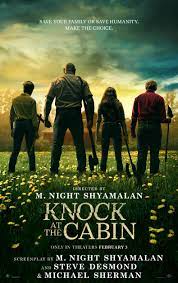
Knock on a different cabin. M.Night Shyamalan’s latest horror film Knock at the Cabin attempts to explore thoughtful themes but the storytelling is clunky due to the poor plotting and contrived character development. Moreover, this is a case wherein film form is employed as a tool to compensate for underdeveloped meaning and story structure. Where the film excels is in the characters and casting. Yes, the character development is contrived, but I appreciate Shyamalan’s character mix. In particular, it’s a refreshing mix because the fact the parents are a same-sex couple doesn’t factor heavily into the plot nor become a sermon, like it so often does. It simply is and that’s it. Furthermore, the casting of not only the central parental couple, but all of the characters shines because of the realistic representation of everyman. Bautista is provided a platform to portray a much different character than he has in the past, which is fantastic to witness! He is given an conduit through which he can more freely exercise his acting chops. Visually, the film is striking; there is an emotive dimension to the montage of the motion picture and the cinematography. Again, the film form is outstanding! Unfortunately, the screenplay is lacking the same degree of thought that was found in the technical approach to crafting this film.
While vacationing at a remote cabin in the woods, a young girl and her parents are taken hostage by four armed strangers who demand they make an unthinkable choice to avert the apocalypse. Confused, scared and with limited access to the outside world, the family must decide what they believe before all is lost.
Knock at the Cabin excels in montage and cinematography because of how the eye of the camera oscillates between subjective and objective placement, much in the same way our own eye (and mind’s eye) operates in real life. Treating the camera as our own eyes allows Shyamalan a brilliant opportunity to bring the audience into the narrative. Unfortunately, this is hampered by the clunky storytelling. However, because of the stylistic choices for camera placement and scene framing, the film is successful in delivering an unsettling mood and suspense with the camera (in a Hitchcockian manner). Furthermore, the film proves to be exemplary in the area of montage (or dramatic film assembly) demonstrated by the stylistic choices that provide the film with steady pacing and guiding our focus from character to character or scene to scene. While the story may be lacking refinement, the editing crafts a visual narrative that is lean and mean.
Struggling narratively, the film fails to sufficiently provide thoughtful critique (or commentary) on any area on which it concerns itself. I don’t mean to sound vague, but to discuss the themes, symbolism, or commentary would require me to divulge spoilers. What I can say, without getting into spoilers, is that there is an attempt to critique: preconceived opinions or judgments of people, willful disbelief in the face of evidence, and toxic ideologies. I appreciate what Shyamalan set out to accomplish; it’s clear that this film was supposed to be a vessel to foster conversations about the themes and subtext, but no single area of theme or subtext was setup or developed adequately. We receive glimpses in the dots Shyamalan attempted to connect, but they are glimpses at best. Flashbacks are used as a tool to provide clarity on present conflicts, but that (often abused) storytelling tool is wielded ineffectively and wastefully.
Ryan teaches Film Studies and Screenwriting at the University of Tampa and is a member of the Critics Association of Central Florida and Indie Film Critics of America. If you like this article, check out the others and FOLLOW this blog! Interested in Ryan making a guest appearance on your podcast or contributing to your website? Send him a DM on Twitter. If you’re ever in Tampa or Orlando, feel free to catch a movie with him.
Highly entertaining and hilarious! Better watch out burglars, Santa’s coming to town. Universal Pictures’ Violent Night hits theatres this week. And you don’t want to miss this fantastically fun horror-adjacent Christmas action movie, which is equal parts Die Hard and Home Alone with some Krampus thrown in for good measure–and it that still has plenty of Christmas spirit! Not since Krampus have we had such unconventional Christmas movie in cinemas. Not quite unsettling enough to be a horror movie, but gorier than a typical action movie, Violent Night sits comfortably in the middle (but a little closer to action). One of the things that makes both Gremlins and Krampus work so well is that the violence is played for laughs, and audiences will find that to also be true in this movie. Even though the violence is prolific, it is schlocky and even campy, at times. Despite the creative, gory kills and pulse-pounding action sequences, Violent Night takes times to impart valuable lessons in family, hope, and even redemption. It simultaneously acknowledges how hard the holidays can be on folks that have become disillusioned with Christmas and yet manages to show the importance of never losing hope in the magic of Christmastime. Even though we may not know how it works; it’s important not to allow cynicism of this world to overpower the optimism of hope the holidays bring. With a solid screenplay, effective direction, and entertaining kills, Violent Night is an instant modern classic that is sure to find its way onto annual watch-lists every December.
An elite team of mercenaries breaks into the Lightstone family compound on Christmas Eve, taking everyone hostage inside. However, they aren’t prepared for a surprise combatant: Santa Claus is on the grounds, and he’s about to show why this Nick is no saint.
I often remark that some of the best movies are those with a simple plot and complex character, and that is what we have here! On the surface, it may be a horror-adjacent heist movie, but beneath the creative kills and campy characters lies a movie that has a lot to say about the various feelings about Christmas (and the holidays in general).
Before you dismiss this movie as just a schlockfest, there is discernible depth to this story that will resonate with audiences of all walks of life and opinions on the magic of Christmas. The commentary on the Christmas season is witnessed in the characters, specifically Santa, Trudy, and Scrooge. By extension, other manifestations of holiday feelings are expressed through the rest of the cast of Lightstones and mercenaries. Santa has become a Christmas cynic himself, because of the rampant entitlement and greed of the world, Trudy holds true to the magic of Christmas despite the negative stressors of her family, and Scrooge represents the idea that Christmas is nonsensical and worthless. All real feelings. Furthermore, the film does not shy away from discussing the gross consumerism that is so often, yet unfortunately, at the forefront of Christmas.
A growing trend for films that aim to be character studies is to neglect the plot. Not true with Violent Night! Again, the surface is a gory action movie, but at its core, it is a character study on reactions to Christmas. Even character studies need to have a well-structured plot, because the outside/action story is a visualization of the inside/emotional story. We get both in this fantastically fun movie! Santa must reconcile his purpose with the state of the world, Trudy must reconcile her belief in the magic of Christmas within her dysfunctional family, and Scrooge (more specifically pre-Christmas Eve Scrooge) gets his just desserts for reining terror. Moreover, I appreciate how the movie provides thoughtful commentary on some of the worst people–and I am not talking about the mercenaries (tho they are deplorable people), but the Lighthouse family members represent people we know from our own lives.
Much like Krampus (but far more violent and a little less scary), Violent Night is a cautionary tale on the dangers of selfishness, greed, and toxic celebrity-ism. We’ve all been Santa, Trudy, or one of the other characters in the movie. Don’t miss the schlock, hijinks, and heart of the action-packed Violent Night this Christmas season.
Ryan teaches Film Studies and Screenwriting at the University of Tampa and is a member of the Critics Association of Central Florida. If you like this article, check out the others and FOLLOW this blog! Interested in Ryan making a guest appearance on your podcast or contributing to your website? Send him a DM on Twitter. If you’re ever in Tampa or Orlando, feel free to catch a movie with him.
Intriguing concept, poorly written. The highly anticipated film from director Luca Guadagnino (Call Me By Your Name) leaves a mediocre taste on the palate. Moreover, Bones and All represents another example of the result of concentrating more on atmosphere and technical elements than on strategic storytelling and proper plotting. “A day in the life of…” or simply “dealing with life” is not a goal; therefore, a plot it does not make. Vapid dialogue and lack of diegetic purpose plague this rather gothic romance. However, the gore is handled tastefully. The most pleasant surprise in the film is the cameo by veteran horror actress Jessica Harper of Suspiria fame! She may only be on screen for a few minutes, but her performance will captivate audiences! Unfortunately, the rest of the film is largely forgettable. In contrast to many other films this year that greatly exceed the two hour runtime, this one clocks in at a sluggishly paced two hours and ten minutes.
Love blossoms between Maren (Taylor Russell), a young woman on the margins of society, and Lee (Timotée Chalamet), a disenfranchised drifter as they embark on a 3,000-mile odyssey through the backroads of America. However, despite their best efforts, all roads lead back to their terrifying pasts and a final stand that will determine whether their love can survive their differences.
While the concept is interesting (although Warm Bodies did it better), the execution is sloppy. And I am not talking about the dining habits of our central characters. I’m talking about the disregard for screenwriting conventions. There are many refreshing ideas in the film, but the ideas are not fleshed out sufficiently. I applaud the film for delivering an original expression of an extension of the zombie genre, but I wish the story had been better paced and structured–oh yeah–an external goal for the central characters would’ve been nice too.
Although the film boasts solid casting choices (especially the Harper cameo), the visual aesthetic the central characters bring to the screen is not supported by compelling talent or character arcs. There simply wasn’t much to these characters; they are borderline one-dimensional. Lots of potential for depth, but the characters are largely the same at the end as they are at the beginning.
For all the potential for the film to serve as a social commentary on feeling alone in the world, the film never thematically lands on any particular ideology or observation of society. Extrapolating from the thematic evidence the audience is given, the film is most likely attempting to craft a story depicting when someone feels alone in the world, but surprised to find out that they are not. When relationships with your fellow man (be it platonic or romantic) are actually possible.
Despite the film taking place in the late 1980s (an era that is growing blasé as a setting for film and TV), it shares a lot in common with gothic romances because of the subject matter. Seems like every other movie releasing takes place in the 1980s, which is beginning to become tiresome and unimaginative. But, I suppose we have Stranger Things to thank for that. On the topic of visual aesthetics and production design, the film’s various midwest settings feel like a character in and of themselves. I appreciate design most when you can see the hand of the artist.
Perhaps Bones and All works better as a novel because it is overwhelmingly internally driven. Not having read the novel, I can merely infer what may have been lost in the novel to screen adaptation. Most likely what is lost is that which cannot be shown on screen, so I cannot fault the screenwriters for that. Where I do find fault is neglecting a proper outside/action story driven by a plot that points and builds to a climactic showdown and resolution. We have plenty of internal need (aka inside/emotional story), but simply dealing with life or finding love is not sufficient for purposes of compelling cinematic storytelling.
Ryan teaches Film Studies and Screenwriting at the University of Tampa and is a member of the Critics Association of Central Florida. If you like this article, check out the others and FOLLOW this blog! Interested in Ryan making a guest appearance on your podcast or contributing to your website? Send him a DM on Twitter. If you’re ever in Tampa or Orlando, feel free to catch a movie with him.
Well, it’s better than Kills. While Halloween Ends still struggles narratively, I appreciate what David Gordon Green attempted to do in order to add a thoughtfulness to the action plot and diegetic subtext. What we have here is a melodrama maskerading around as a slasher that delivers an insufficient amount of fun and genuine suspense. After the hugely disappointing and largely forgettable (except for how bad it was) Halloween Kills, expectations were set incredibly low for the final installment in Green’s take on the Laurie Strode/Michael story. Thankfully, the final chapter isn’t bad–that’s not to say it’s good–it’s more accurately described as watchable. As an added bonus, there is prolific exposition at the beginning that negates the need to watch Kills, so audiences can go from H40 to Ends and not miss anything, really. Even though there is one distinct kill inspired by, and some other shot compositions and camera movements that pay homage to the 1978 original, none of these moments feel like gross attempts at winning audiences over with pure nostalgia. Halloween Ends continues the trend for horror films, particularly the (what I like to call the) neo-slasher to focus so hard on atmosphere, social commentary, and melodrama that both the fun and suspense layers are so thin that they may as well be non-existent. From Halloween (1978) to SCREAM, the slasher delivered creative kills and icons but it also delivered highly entertaining movies in which we have found thoughtful subtext and social commentary in hindsight. Aside from the wandering narrative direction of Halloween Ends, it suffers from a lack of a demonstrable ability to generate a fun atmosphere for the audience.
Four years after her last encounter with masked killer Michael Myers, Laurie Strode is living with her granddaughter and trying to finish her memoir. Myers hasn’t been seen since, and Laurie finally decides to liberate herself from rage and fear and embrace life. However, when a young man stands accused of murdering a boy that he was babysitting, it ignites a cascade of violence and terror that forces Laurie to confront the evil she can’t control.
No spoilers.
The boogeyman, no more. “Was that the boogeyman?” –Laurie, “Yes, I believe it was.”–Dr. Loomis. Sorry, Sam, apparently not. In addition to sucking the fun out of the neo-slasher, filmmakers are also removing the boogeyman or monster factor from the killers. Instead of accepting that our killers are monsters that have evil running through their veins, filmmakers feel the need to explain why a monster isn’t a monster; rather, the killer is created by society. Up to Halloween Kills and Ends, you may have asked yourself “what makes Michael tick?” The short answer: we do not know enough–or at least we used to have an insufficient amount of knowledge about–his psychology, sociology, or physiology to know for sure. And that was a good thing! No longer is that the case.
Why? There no longer exists a mystery. Because now we do know too much about his mind and body; therefore, he ceases to be the boogeyman. Being the boogeyman (or a monster) was so important to, not only this franchise, but horror in general. That little bit of mystery and fantasy allowed him (and icons like Michael) to remain monsters that were to be feared and never truly understood or explained. That’s what made them scary–there was no explanation, which mitigates any control may feel we could achieve.
But since we are voyeurs who are obsessed with knowing, David Gordon Green decided that we needed to know why Michael (and those like him) was the way he was. What’s funny, is that in the original 1978 Halloween, the best sequel Halloween H20, and in H40, we can gather enough evidence to hint at what may make him tick, but at the end of the day, it’s fun speculation. Even before we had to have Michael’s behavior (directly or indirectly) explained to us, Michael likely suffered from and displayed signs of a combination of antisocial personality disorder, schizophrenia, and obsessive compulsive disorder. But none of that truly matters any longer because we now know that Michael and those that admire him are created by society’s negative impacts on their young, impressionable lives. True evil is does not exist.
Many fans of the Halloween franchise have a fondness or even love of the (seemingly) one-off Halloween III: Season of the Witch. And while I do not share a particular fondness for this installment, I can appreciate the creativity behind the expression of this tale of Halloween. And maybe if it wasn’t indirectly connected to Halloween, I may like it more. Anyway, I digress. I bring up Season of the Witch, because there are some shared elements between this Halloween movie and Jason Goes to Hell: the Final Friday and Halloween Ends, And I will leave it at that, as to avoid spoilers. If you’ve seen both of these movies I’ve referenced, then you may be able to make connections.
David Gordon Green and his team of writers inject a heaping helping of melodrama into Halloween Ends. Right up there with melodrama perfectly suited for–you fill in the blank–show on The CW or Freeform. Clearly, this was an attempt at adding some gravitas to this poor excuse for a slasher by spending time on dysfunctional family dynamics. After this trilogy, I am convinced that no family unit is healthy in Haddonfield. Bullies, manic and demanding moms, overbearing and weak fathers, nobody feels real in this town–all caricatures of what we don’t like about some people in society. There is no normal ever established. Establishing a sense of normalcy is important because it’s only then that the slasher can upset the order.
Even though this is the final chapter in the Michael/Laurie story, the movie does tip its hat to future Halloween movies. This is one of those movies that isn’t bad enough to warn people to spend their money and time elsewhere, but it’s also not good enough to where it needs to be seen at the cinema. While I firmly believe that horror movies are best experienced at the cinema in a crowded auditorium, the experience of this one will be good enough at home with some friends.
Ryan teaches Film Studies and Screenwriting at the University of Tampa and is a member of the Critics Association of Central Florida. If you like this article, check out the others and FOLLOW this blog! Interested in Ryan making a guest appearance on your podcast or contributing to your website? Send him a DM on Twitter. If you’re ever in Tampa or Orlando, feel free to catch a movie with him.