Candyman (2021) Review

Candyman (2021) - IMDb

Sweet on the outside, sour on the inside. A visually impressive attempt to provide a thoughtful exploration on duality and identity, is overshadowed by heavy-handed ideology. Nia DaCosta delivers audiences a spiritual sequel to the cult horror film Candyman (1992) that is grounded in much of the lore of the original, yet forges a new frontier that simultaneously serves as a vehicle for horror legend Tony Todd to pass the hook onto Yahya Abdul-Mateen II. DaCosta is joined by writer-producer Jordan Peele and screenwriter Win Rosenfeld to “tell everyone” who dares to look in a mirror and call out his name five times. Admit it, even in our most rational state, we are still a little apprehensive to stare at our reflection and call out Candyman, Candyman, Candyman, Candyman, Candym–. That’s the power of horror films! These fictional stories on screen have their mystical ways of affecting the collective conscious in such a manner that we change or question our behavior. Another great example of this effect is the iconic highway scene in Final Destination 2. And challenging audiences was certainly what the three screenwriters had in mind when writing the story for Candyman (2021). Unfortunately, the agenda-driven message steels the focus away from the stunning visuals, and ultimately fails to effectively paint a portrait of reality that invites all to engage in the important conversations the film is trying to have, instead, alienating audience members that don’t share the filmmakers’ opinions. Suffice it to say, this film is Peele for the course.

In present day, a decade after the last of the Cabrini towers were torn down, rising star artist Anthony (Abdul-Mateen II) and his partner move into a loft in the now gentrified Cabrini. A chance encounter with an old-timer exposes Anthony to the true story behind Candyman (Todd). Anxious to use these macabre details in his studio as fresh grist for paintings, he unknowingly opens a door to a complex past that unravels his own sanity and unleashes a terrifying wave of violence. (IMDb)

If you’ve never seen the original Candyman, don’t worry. While having seen the original will certainly help audiences to appreciate world-building and backstory elements, there is enough context given to help those that may be unfamiliar. Following the screening I attended, I heard individuals negatively critique the retconning of plot elements in the original; truth is, the parts of the original that were reimagined to fit the backstory of 2021’s Candyman were thoughtfully adapted.

While I have my reservations with the film, I would be remiss to not highlight the excellent direction, cinematography, editing, costuming, production design, and even the performances! Visually, the movie is stunning! All the mise-en-scene elements work together to create a BIG SCREEN experience. And talk about outstanding performances. Back in the heyday of the slashers (late 70s through the 90s), we did not expect to be impressed by the performances of the cast. And while there are notable exceptions of horror films WITH brilliant performances, usually it’s not expected. Over the last 7–10 years, horror films have been stepping up their performance game. The lead and most of the supporting cast will all captivate you. Unfortunately, there are useless characters like Brianna’s (Anthony’s girlfriend’s) brother and his boyfriend. Having no real affect on the plot, this interracial gay couple was little more than a token that could be removed from the movie, and the movie still play out the same way. However, if it weren’t for these two characters, the movie would be lacking ANY humor. So I suppose that was their purpose, to add humor.

There are so many beautifully crafted shots and shot sequences in this film. From juxtapositions of the old meeting with the new to geometric shapes and lines, there are many excellent compositions. The production and set design and lighting, of this film, are used in similar ways that the designs in expressionism are used. Expressionism uses the design of buildings, costumes, lighting, and camera angles to externalize emotions, psycho-social states of being, and ideas. And with expressionism being part of the formula of horror (expressionism+surrealism+Poe+Freud), it makes sense how and why there would be this care shown in the mise-en-scene.

All the backstory elements are communicated through the brilliant use of shadow puppets. The shadow puppet sequences are perhaps my favorite recurring diegetic device used in the film. Not only do these shadow puppets provide exposition, they also move the plot forward in action and subtext.

The idea of shadow puppets as a storytelling device is best explored in Plato’s Cave. French film theorist Jean-Louis Baudry likened the movie theatre to Plato’s famous allegory Plato’s Cave found in Plato’s Republic. But since we’re not all film or philosophy theorists, here is a quick explanation of Plato’s Cave:

The allegory states that there exists prisoners chained together in a cave. Behind the prisoners is a fire, and between the fire and the prisoners are people carrying puppets or other objects. This casts a shadow on the other side of the wall. The prisoners watch these shadows, believing them to be real. Essentially, what Plato is exploring is the concept of “belief vs knowledge.” The prisoners (or audience) in this analogy believe the images on the wall as reality; when in actuality, it is only the puppeteers version of reality. The analogy goes on further to describe a prisoner breaking free and venturing from the cave out into the real world. Two things happen (1) the newly freed prisoner completely rejects the imagery in the cave and returns to warn the prisoners of their one-dimensional view of reality, and risk being killed for a radical view, or (2) the freed prisoner fears or cannot reconcile actual reality and retreats back into the cave, where there is comfort in the surroundings, to warn the prisoners not to leave. Therefore, this highlights how a lack of knowledge leads to blind belief.

Despite being centuries old, the allegory is appropriate for filmmaking. After all, the audience watches images on a screen. We’re meant to believe it to be real, but we know it’s false. Only when we step out of the theater back into reality can we take what we’ve learned in the cinema and apply it to our lives. In a literal sense, a movie is just a series of images. But digging deeper, they present unique ideas and themes that we can take with us into the real world. Numerous movies utilize this concept in their plots and themes. You have probably seen films where a character believes one reality and then becomes exposed to another, greater reality and is never the same. In the case of 2021’s Candyman, DaCosta, Peele, and Rosenfeld have metaphorically trapped the audience in an ideological cave to present their versions of our reality that exists outside the cinema’s doors.

The movie has some great kills! But it highlights a moral problem plaguing this movie. From the art gallery to the critic to the girls at the prep school, the only victims, to meet their gruesome demise ON screen, are white characters. While there are a couple of off-screen deaths of black characters, the only ones in the visible mise-en-scene to meet with Candyman’s iconic hook are white. Had this movie been directed and/or written by a white writer-director and only killed and disparaged black characters, there would already be a #cancel campaign on Twitter. In my five years as a film professor and seven years as an active critic, I cannot ever recall a horror movie (in particular, a slasher movie) that ONLY killed black characters and disparaged the black community in virtually every scene from the opening to the closing. So if that would not be tolerated by the public–and for good reason, a movie released like that in 2021 (or ever) would be in incredibly poor, despicable, disrespectful taste–then the inverse should not be acceptable here.

I get what DaCosta, Peele, and Rosenfeld are trying to do with this horror movie. From the time of Cabinet of Dr. Caligari and Nosferatu, horror has been used to comment on societal observations to either warn of an impending dangerous ideology, to provide allegorical material that can be used as a framework to better understand marginalized groups, or even to challenge systems or institutions. Which is why horror is often far more truthful than a straight drama. Of course, one can make the argument that this is a fictional film in a fictional Chicago, which is not untrue; however, the problem therein is that little (if anything) in this fictional Chicago sets it apart from the real world, except for the supernatural character of Candyman, because these filmmakers have a point to make. But the problem here is that the very people that these writers want to challenge are the very people that are being unfairly represented in the movie. How is any of that constructive to the conversations of race relations and policing??? Short answer: it’s not.

The symbolism I did appreciate in the film are the moments that we explore the duality in ourselves and our environments. This is represented through literal and metaphoric reflection. Mirrors (or reflections) are regularly used to communicate duality. One of the best examples in recent years, in how mirrors are an effective cinematic device, is the mirror scene in I, Tonya. Just before her final competition in the film, as Tonya is applying her high contrast makeup, we witness in the mirror the internal struggle. On the outside, she is this accomplished figure skater (probably the best athlete the sport has ever seen) but on the inside she is tormented by her mother, her abusive marriage, and what she did or didn’t know about the incident. Likewise, in Candyman we explore the history and identity of Anthony and his neighborhood. Anthony has a secret in his past that has been painted over, that is trying to resurface, and his neighborhood of Cabrini Green has a sordid history that it has tried to cover and hide behind a fresh coat of paint. History is always there. It cannot be erased. And if it’s not dealt with, it can become a specter and haunt you and your environment. The mirrors and other reflective surfaces of Candyman are brilliantly used to communicate this idea of duality.

It is clear that DaCosta is a gifted director, but I hope that she works with different writers in the future that can find that balance of commenting on or raising awareness of something important, but also finding the ways to bring everyone to the table for a thoughtful discussion. The power of cinema, and in particular horror films, is that it can bring diverse groups of people together from all walks of life to both be entertained and challenged through screams, jumps, and laughter.

This image has an empty alt attribute; its file name is profile_pic.jpg

Ryan teaches American and World Cinema at the University of Tampa. If you like this article, check out the others and FOLLOW this blog! Interested in Ryan making a guest appearance on your podcast or contributing to your website? Send him a DM on Twitter or email him at RLTerry1@gmail.com! If you’re ever in Tampa or Orlando, feel free to catch a movie with or meet him in the theme parks!

Follow him on Twitter: RLTerry1

“FREAKY” Horror Movie Review

Friday the 13th meets Freaky Friday in the no-holds-barred, feel good horror movie of the year! Universal Pictures has certainly gone back to its horror roots in 2020. In February, it gave us The Invisible Man and on Friday the 13th of November, it gives us FREAKY. Writer-director Christopher Landon, who gave us many horror movies including Happy Death Day and Disturbia, delivers a refreshing horror movie filled with inventive kills, a fun plot, and frisky characters. Everything that you love about 80s slashers is here in this love letter to the horror subgenre that still brings friends together today. Funny how horror movies–movies filled with that which would repulse us in real life–have the opposite effect of promoting inclusiveness and community. And it’s that sense of community that separates horror, specifically the slasher, from other film genres. There was a magic in the decade of 80s horror that continues to greatly influence content creators and fans today. Landon knew this, and channeled so much of what made the slasher take the world by storm into this movie. While FREAKY is an entertaining movie regardless, it will be the nods to movies such as Friday the 13th, Halloween, A Nightmare on Elm Street, and Child’s Play that will inevitably bring about the nostalgic thrill ride that Landon carefully crafted! Starting out as a masked killer, Vince Vaughn soon delivers the laughs as he captures every nuance of a mousey, bullied teenage girl trapped in a middle-aged man’s body. Likewise, Kathryn Newton perfectly captures a notorious slasher trapped inside a teenage girl’s body. Perhaps FREAKY is a little lite on the lessons learned from the body swap achieved through a Child’s Play-like mystic ritual, but Newton’s Millie does learn confidence. From the opening, that’s clearly an homage to the shock of SCREAM, through the hijinks and antics to the climactic ending, there is something for everyone in this movie–especially for geeky horror fiends like myself!

A mystical, ancient dagger causes a notorious serial killer to magically switch bodies with a 17-year-old girl. (IMDb)

That’s it. Simple, right? Some of the best movies of all time have simple plots and complex characters. Okay, so FREAKY may not have incredibly complex characters, but what it lacks in dimension, it makes up in a diverse cast plus doubling down on its identity as a genre film. Horror movies have long since been the most progressive of all the genres, and Landon keeps this value alive in his latest movie. Even before mainstream movies began including strong female characters, critiquing toxic jock culture, and including non-parodied LGBT+ characters, horror was a leader in inclusion and diversity. Has it too evolved over the years, of course; but my point is that it’s always been the leader. Using a reimagination of Freaky Friday as a slasher as the foundation, the movie is able to get incredibly creative with the conflict, character dynamics, and the kills! It is unlikely that any of these kills will make Top 10 lists one day, but they are mostly homages to past kills from tentpole horror movies. Is the plot predictable? Yes. But does that take away from the entertaining factor? Definitely not. This movie knows what it is, and delivers the laughs and squeamish winces in spades! Predictable as the plot may be, it is not without its unique twists and turns. I appreciate how those that are killed by either THE Blissfield Butcher or Murder Barbie are bullies in one way or another. Perhaps this movie doesn’t go very deep, but it’s certainly a cautionary tale on the deadly consequences of direct and indirect bullying and assault.

If you go into this movie wanting something completely new, then you’re going in with the wrong attitude. If you want to see a new twist on a foundational part of horror cinema, then you’ve come to the right movie! It’s been quite a while since there has been such an unapologetically fun movie in cinemas, and this is precisely the antidote to uplift the geeky horror spirit!

PS. Can we please stop using the Mystic Falls (Covington, GA) town square from Vampire Diaries in every movie that needs a small town? At least this time, I couldn’t make out the Mystic Grill in the background like I could in Doctor Sleep.

Ryan teaches screenwriting and American cinema at the University of Tampa. If you like this article, check out the others and FOLLOW this blog! Interested in Ryan making a guest appearance on your podcast or contributing to your website? Send him a DM on Twitter or email him at RLTerry1@gmail.com! If you’re ever in Tampa or Orlando, feel free to catch a movie with or meet him in the theme parks!

Follow him on Twitter: RLTerry1

“Unhinged” (2020) Movie Review

Unbridled blunt force carnage. Academy Award winner Russell Crowe’s rampage-filled Unhinged hits theatres this weekend. And if you’re in the mood for a throwback B-movie well-suited for the indoor big screen or a drive-in theatre, then hop in the driver’s seat. Unhinged is the kind of movie that is so bad yet is actually a lot of fun–the one time you will ever watch it anyway. There are really only two acts in this movie; the rushed setup with an attempt to attach some deeper meaning to the gnarly violence that starts immediately and the lengthy showdown. But you won’t care that it’s a shallow, vapid plot; you are there for three reasons (1) to see Crowe go absolutely bonkers (2) the unhinged brutal, cringy no-holds-barred violence and (3) the scarily realistic car chases through this unnamed city in this unnamed state only known as America’s Heartland. The manner in which The Man stalks Rachel (and later, her son) reminds me of the same pattern of actions we get in many horror movies. While this movie is not a genre horror movie, it is very much horror-adjacent. Moreover, this horror-adjacent movie nearly follows the same tropes as a slasher. Slasher? That’s right. And get this–I found this particularly interesting–Russell Crowe’s lumpy misogynist is credited only as The Man, and where have we seen such a vague, anonymous description of a character before? John Carpenter’s original Halloween with Michael Myers being credited as The Shape. When viewed as a horror-adjacent movie, you will likely enjoy it more. The fact that we are never told much about The Man’s motivations, makes his over-the-top kills, his look, and his barbaric behavior incredibly campy. It’s this level of camp that makes the movie serviceable, and even fun during the violence and high-impact car chases; one could say the car chases are fast and furious. Director Derrick Borte delivers a guilty pleasure action-thriller that is sure to keep you entertained for its relatively short fun time. He knows precisely what kind of movie he’s direction, and rocks it! And you now what, it looks like the director and Crowe has a fun time making this schlock fest. Even actors of Crowe’s repute need a cathartic movie every now and again.

Unhinged is a horror adjacent action-thriller that is built upon something we have all experienced–road rage. Only, this story takes everything you have ever feared about what could happen after you honk your horn to bizarrely unpredictable levels culminating in a terrifying conclusion. Rachel (Caren Pistorius) is running late taking her son to school when she meets The Man (Crowe) at a red light. When the light turns green, he sits there. After she lays on the horn a few times, races past him, and gives him that look, you now the one (as we’ve all done it), she finds herself and everyone she loves the target of a man whom, in his own words, feels invisible and is looking to leave his mark on the lives of those whom dismiss him, in deadly games of cat and mouse.

The movie starts with a stylistic montage depicting violence in the streets of America, particularly road rage. Incidentally, this movie seems to have predicted the current and recent outburst of violence in the streets, months prior. So for some, these images may hit a little too close to home. Or perhaps they will be a wakeup call for how we treat one another, because you never really know if the person standing next to you is about to go over the edge because of continued brushes with trauma. Often times, an opening montage such as this one is used to prime the pump, if you will, in order to setup social commentary or other existential critique on the events that are about to unfold. Unfortunately, this setup really goes nowhere, except to remind us that we really never know next to whom we are standing, or sitting in your car. Early on in the film, just before the deadly cat and mouse road rage game sets into full motion, The Man comments that (and I am paraphrasing), “people nowadays feel as though they should ever have to apologize to anyone for anything.” And perhaps there is a nugget of truth in that because apologies do seem to be fewer in number than they used to be. Newsflash: sometimes we are wrong or have wronged someone else, be it intentional or unintentional. So, apologies and forgiveness should be in our arsenal before grudges and rage.

Talk about bloody. This movie sets the bar ridiculously high with its opening scene of The Man obliterating his axe wife, her lover, followed by torching the house. But the bar doesn’t stop there; the ante literally keeps going up. This man displays the most extreme forms of sociopathy, and he is virtually unstoppable, just like a classic horror slasher in the vein of Michael or Jason. Perhaps he isn’t lurking in the shadows, isn’t wearing a mask, doesn’t have a trademark weapon, or doesn’t come with catchy music, but he is still a slasher! Even when he is shot, he keeps going. And is always right on the bumper of Rachel. While you will likely not care about ANY of the characters in this movie, you will enjoy the campy slasherness of The Man. Unfortunately, The Man also doesn’t give us any reason to root for him, as is the case with Michael, Freddy, or Jason. The Man is a disgusting representation of toxicity of every kind. But, he does know how to put on a show for the audience.

Word to the wise, should you encounter a vehicle sitting at an intersection when the light turns green, I wouldn’t honk your horn. If you do, then you may unleash a sociopath that will literally stop at nothing until you apologize.

Ryan teaches screenwriting and American cinema at the University of Tampa. If you like this article, check out the others and FOLLOW this blog! Interested in Ryan making a guest appearance on your podcast or contributing to your website? Send him a DM on Twitter or email him at RLTerry1@gmail.com! If you’re ever in Tampa or Orlando, feel free to catch a movie with or meet him in the theme parks!

Follow him on Twitter: RLTerry1

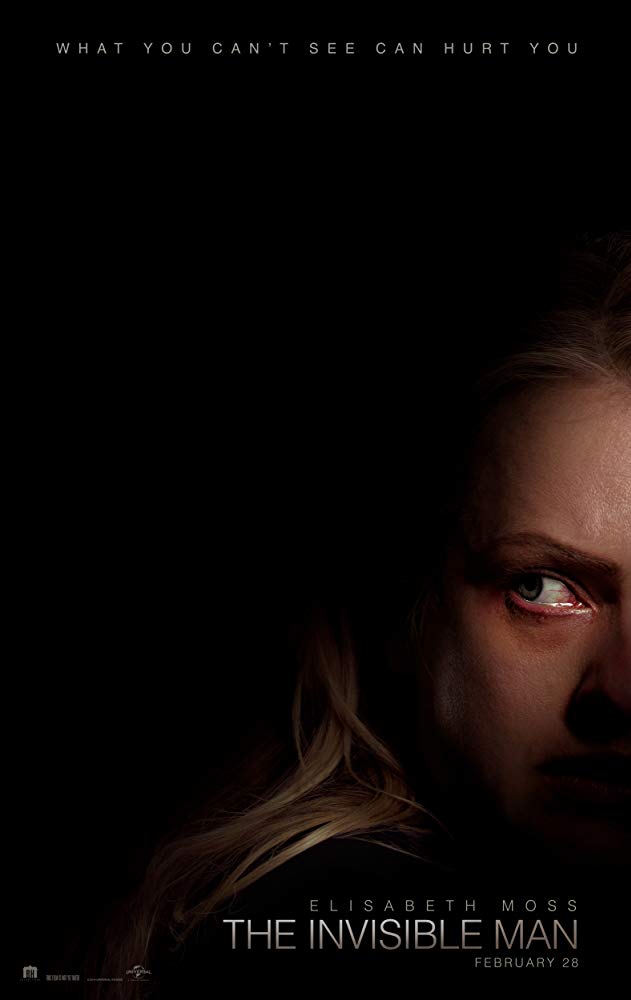
“The Invisible Man” Horror Film Review

You won’t believe your eyes! Finally, a remake of a classic horror film that has the soul of the original yet feels completely fresh. Just when the Universal Monsters were about to be sealed in their coffins and sarcophaguses for all eternity, following the abysmal Mummy remake in 2016, writer-director Leigh Whannell delivers an excellent horror film that proves to us that a remake of a classic film can work! While the Invisible Man may not be in the cultural zeitgeist to the same degree that Dracula, Frankenstein’s monster (tho, creation is more precise), the Creature from the Black Lagoon, or the Mummy are, he is the Universal Monster that is by far the most psychotic, sharing a lot in common with the modern slasher. Furthermore, the Invisible Man demonstrates negative psycho-social characteristics, when exhibited by people in real life and not in check, are utterly terrifying. Perhaps the trademark characteristic of the Invisible Man is his uncanny genius that ostensibly isolates him both psychologically and spatially from society; moreover, this self-imposed isolation gives way to the extreme superiority complex that fuels the disconnect with mankind. Unlike a psychopath, the Invisible Man is fully aware of what he is doing, so he is much more of a sociopath. Sociopaths are cognitively aware of the violent or otherwise destructive acts he or she is committing, and that makes them far more dangerous than psychopaths. In order to provide audiences with a new experience, not only does Whannell update the science behind just how the invisibility works, but he also shifts focus to a different central character. Instead of the Invisible Man, it is Elisabeth Moss whom takes center stage as our tormented central character. Keep your ever watchful eyes wide open because you will see that everything in the film is both incredibly interesting and has everything to do with the plot.

The Invisible Man written and directed by horror veteran Leigh Whannell is a remake of the classic Universal Monster horror film by the same name and an adaptation of the original novel by H.G. Wells. When Cecilia’s (Elisabeth Moss) abusive ex Adrian (Oliver Jackson-Cohen) takes his own life and leaves her his fortune, she suspects his death was a hoax. As a series of coincidences turn lethal, Cecilia works to prove that she is being hunted by someone nobody can see. Her explanations fall on seemingly deaf ears as the evidence seems hollow. (IMDb)

The strength in this remake lies in the excellent screenplay by Whannell. While all the technical and creative elements work incredibly well, it is the strong visual storytelling and plotting that forms such a solid foundation for reimagining The Invisible Man for a 21st century audience. You will find elements of the classic film Gaslight, H.G. Wells’ original novel, and the original 1933 Universal film. Cecilia is a compelling character with immense depth because she is experiencing psychological and physical abuse that may have a supernatural component but feels unapologetically real, nevertheless. Whannell’s Invisible Man is a character-driven story that explores the psychological toll that one experiences when the world does not believe you, no matter how disturbing the evidence. In this case, it’s domestic abuse turned other mass violent acts, including murder, but it could just as easily be any number of major and minor abuses that are difficult to prove especially when the world doesn’t believe you. Moss’ Cecilia is a relatable character for anyone that has ever been unsuccessful in convincing the world of your trauma and abuse. She carries the weight of her abusive relationship around with her every minute of everyday. Even before Adrian was truly terrorizing her in a sadistic poltergeist-like fashion, his specter was already haunting her. This film provides an avenue for Whannell to explore the far-reaching abuse sustained by Cecilia at the hands of a–by the world’s standards–a great man of scientific achievement and intellect.

We see very little of the Invisible Man, but this only helps the film deliver outstanding tension and suspense. Because we cannot see the Invisible Man, we are constantly looking for him in every corner of the screen. Suspense is achieved through not relying on the actions of the Invisible Man, but rather on the absence of him. Once his capabilities are established, and we get that first glimpse into his sadistic actions, then we go relatively long periods of nothing from him. And that is precisely what this film needed! This staggering of Invisible Man moments delays what we are expecting, thus building solid suspense. Whannell takes a page out of the Alfred Hitchcock handbook by transferring the horror on screen into the minds of the audience. Here, the horrors are such much more visceral and lasting. The Invisible Man’s torments of Cecilia start out small and then grow with intensity. And not just the same kinds of torments, but strategically different ones that When Cecilia’s abusive ex takes his own life and leaves her his fortune, she suspects his death was a hoax. As a series of coincidences turn lethal, Cecilia works to prove that she is being hunted by someone nobody can see. every aspect of her life. His goal is to cut her off from everyone and everything, including her own sanity. Only then, can he control and manipulate her to the extent he desires. Each attack on Cecelia, or someone close to her, disconnects her from that which is familiar and makes her feel safe. Like a lion separating prey from the larger group, in order to move in for the kill, Adrian is calculating in his movements.

The score and cinematography are right out of a classic monster horror movie! Much like A Quiet Place relies upon the power of silence to heighten the senses and keep, The Invisible Man also uses strategically placed moments of silence to create a fantastic sense of unease that keeps you on edge. The score in this film does a terrific job of setting the mood and tone right from the very beginning; furthermore, the score feels like a direct extension of the emotional beats of every scene. The cinematography may not have anything in particularly stylistic about it, but the framing of each scene is perfectly executed. Each frame is so important to us because we are always looking for little signs of the Invisible Man. It’s like Whannell was playing a game with us! There are shots framed in such a way that you think the Invisible Man is going to make some kind of appearance, but he usually doesn’t. But you will be convinced you saw him, and that is such a fun part of the movie. It’s not only the plot that keeps us guessing, but each and every shot does the same!

Elizabeth Moss’ performance as Cecilia was nothing short of an outstanding achievement! From the moment we first meet her to her last frame, she delivers a compelling performance that will stick with you long after you leave the cinema What’s truly mindblowing is the fact she is playing off nobody (in real life anyway). It’s just her on that set and the film crew, and that’s it. Not only does she wow us with her terrifyingly convincing facial expressions, but her entire body is fully engaged in each and every moment. Never once do I see the actor, I see only her character of Cecilia. While I know Moss is an accomplished actor from her past roles, including last year’s Us, she surpassed all of my expectations of her acting. Her performance is right up there with Toni Collette’s in Hereditary. This isn’t simply a great delivery for a horror film, it’s a superlative performance for any film period. And it’s not just in her more manic scenes; even in the calmer scenes, the subtleties of each movement, twitch, glare are hauntingly authentic and leap off the screen. The central character of a motion picture is our conduit into the story in order to vicariously experience the plot and emotions. Moss’ Cecilia is relatable, genuine, and demonstrates equal parts vulnerability and strength.

Leigh Whannell’s The Invisible Man is a testament to the ability for a writer-director to take inspiration from a classic movie and reimagine it for a new generation while keeping the soul or the original alive. I don’t take issue with remakes of classic movies, but I do take issue with remakes that have no respect for the original source material. This film feels both fresh and familiar as it takes what the original did well, and use those elements in a modern way. The bones of the original and this remake are largely the same, but the muscles are developed differently in order to deliver a new story. While we haven’t been officially told that Universal’s Dark Universe is back on, the critical and box office success of this film may just reignite those embers that were snuffed out by the awful Mummy from the other year.

Ryan teaches screenwriting at the University of Tampa. If you like this article, check out the others and FOLLOW this blog! Interested in Ryan making a guest appearance on your podcast or contributing to your website? Send him a DM on Twitter or email him at RLTerry1@gmail.com! You can catch Ryan most weeks at Studio Movie Grill Tampa, so if you’re in the area, feel free to catch a movie with him!

Follow him!

Twitter: RLTerry1

Instagram: RL_Terry

“1917” Film Review

Outstanding dramatic and technical achievement! 1917 is an anxiety-inducing, gripping motion picture. Sam Mendes’ direction is exemplary and the cinematography mind-blowing. Winner of two Golden Globes, and destined for Oscar nominations, this film is one that I highly recommend that you watch in Dolby or IMAX (if Dolby is not available in your cinema). While 1917 is not a horror film in the conventional sense, it delivers unparalleled wartime brutality that forces us to face the real horrors of war and never let up for the duration of the film. After the box office bomb that was Cats, Universal Pictures needed a homerun for both revenue and awards-possibilities. Suffice it to say, 1917 will rake in the award wins and nominations and the box office revenue that the legacy studio needs to keep financing/distributing original films of both mid and high budgets. This film is more than a cinematographic exercise of telling a feature-length visual story with one continuous tracking shot. Obviously there are moments of cuts (if you try to look for them); but for all intents and purposes, Mendes sells audiences on the tracking shot, even when the camera literally glides across the water. The film is both gorgeous in its technique and beautiful in the story. It’s not simply another war movie, it is a powerful experience that places you at the front lines of World War I. Compared to past films about WWI or WWII, I cannot think of a single other film that captured the atrocities of war and the unending violence and anxiety in nearly as brilliant or artistic a fashion. Tension will run high, and continue to ratchet up as the story unfolds. While much emphasis has been placed on the “single take” approach to shooting this film, there was the risk of the film not allowing for other elements of a good story; however, Sam Mendes delivers both a film that is shot brilliantly and one that delivers a dynamic, complex central character within a simple yet compelling plot.

During World War I, two British soldiers — Lance Cpl. Schofield (George MacKay) and Lance Cpl. Blake (Dean-Charles Chapman) — receive seemingly impossible orders. In a race against time, they must cross over into enemy territory to deliver a message that could potentially save 1,600 of their fellow comrades — including Blake’s own brother.

Let’s start out with the element that is being talked about more than anything else–and that is the cinematography by Roger Deakins. There is so much more to this film, but I want to address that aspect first. It’s not one continuous shot. And so what??? It is unrealistic to shoot an epic (much less war movie) in a single take for two hours. However, the film certainly feels like one continuous take more than 90% of the time. And to that end, the this technical achievement is phenomenal! While it may not be innovative (as it has been done before) how the commitment to the single take approach was was executed was outstanding! There is even a moment that our two central characters are navigating navigating around a giant crater and the camera glides across the water, never stopping before or after. Talk about fantastic! More than an exercise whether or not this could be accomplished as nearly flawlessly as it was, there is also the added benefit of the enveloping experience of being on that battle field with our characters, because there is no break. A cut or break could remind us that we are safely in the auditorium, but continuing the shot never allows for a break in the excelling rising tension for the whole film. All that said, I did experience a disadvantage of knowing about the whole one shot going into the film because I found myself looking for the moments when a cut happened. And it was ultimately a distraction in the beginning. As the film progressed, I was less obsessed with looking for the cuts and simply allowed myself to get lost in the film. So my advice to filmmakers and critics watching this film is to not look for those cuts as it could become a distraction.

Here’s where it’s met with some opposition from critics: the story (inclusive of characters). There has been some notion that the method of story execution (the aforementioned “single tracking shot”) prohibited traditional story, character, and plot development. While the single tracing camera approach does minimize the amount of time that can be covered (because the story exists mostly in real time) and the points of view from the camera, there is still a powerful story of courage and determination. It is clear that Mendes desired to do for WWI what Saving Private Ryan did for WWII, and in my opinion, he did just that–and more! We are introduced to our two central characters: one is determined (Blake) and the other apprehensive but compliant (Schofield). Without going into details that would get into spoilers, there is sufficient character development that shows a transformation in worldview and level of purpose and courage when these characters are faced with grueling conflict and setback after conflict and setback. Through the brutalities of war, these two characters, of which Schofield emerges as THE central character (with Blake chief supporting), we witness demonstrable growth that affects Schofield in such a way that he is forced to take certain actions that directly impact the plot and his personal development. I don’t mean to be vague, but it’s important that you go into the film with a little knowledge of details as possible.

Once our two soldiers are sent on their mission from the General to take orders to another company on the other side of what is referred to as No Man’s Land (through German encampment), it is a nonstop brutal adventure with stakes as high as life and death. Mendes shies not away from the gritty violence and total destruction of war. At one point, one of our main characters cuts his hand on barbed wire, then not long after, plunges his hand into the chest cavity of a corpse. And that is as tame as it gets–only gets more terrifying and brutal from there. Everything feels so incredibly real. Like, you should duck for cover yourself as the bullets and shells fly across the screen. If you choose to see it in Dolby (as I did), you will feel as though you are in the middle of the battle field and deep in the trenches along with the brave men fighting for the freedom of France and the rest of the world. Not since Saving Private Ryan has there been such a masterful war motion picture to hit the silver screen.

Don’t sleep on this film, even if you are not typically into war pictures. Take me for example. I am not ordinarily into war films (or sports movies). And yet, I find this one truly compelling! There’s an unapologetic authenticity in everything Mendes’ film has to offer audiences. Do yourself a favor and watch one of the best films of 2019/2020.

Ryan teaches screenwriting at the University of Tampa. If you like this article, check out the others and FOLLOW this blog! Interested in Ryan making a guest appearance on your podcast or contributing to your website? Send him a DM on Twitter or email him at RLTerry1@gmail.com! You can catch Ryan most weeks at Studio Movie Grill Tampa, so if you’re in the area, feel free to catch a movie with him!

Follow him!

Twitter: RLTerry1

Instagram: RL_Terry