TITANE French Extremity Horror Review

Zero to sixty in three seconds, but loses traction toward the end. When I first read David Ehrlich describe Julia Ducournau’s Titane as “the sweetest movie ever made about a serial killer who has sex with a car,” I as instantly intrigued.  And for the first half of the movie, that is exactly what I got.  It was a brutal, thrilling, and raw (pun intended!) ride.  The main character, Alexia, is an erotic dancer at a car venue with a sadistic side – hinted at in her interactions with a fellow dancer in the showers and made even more obvious with her murder of a fanboy later in the evening.  While it may seem like a one-off act of self-defense, the mechanical precision and heartless manner in which she swiftly kills and stows her victim suggest otherwise.  We later learn she is a wanted serial killer terrorizing the south of France. 

Her heartless nature can be reflected in her relationship with cars.  After surviving an automotive accident as a child, a titanium plate is inserted into her head with the scars of the procedure following her onward into adulthood.  She physically has become more machinelike form this operation, and when discharged, she does not take solace with her parents, but rather begins to passionately kiss their car.  As an adult, this “auto” eroticism will manifest into her literally having sex with cars and later, even conceiving.

Alexia continues on with her killing spree, until one night she miscalculates – what she thinks is a quiet secluded night in to kill her colleague turns out to be a small gathering, with several guests in the home.  It becomes a massacre, as she stresses over making sure each new witness meets their demise in order to keep the situation under control.  But it all goes wrong when one girl escapes.  From this moment on, she will no longer be a mysterious killer able to move freely in plain sight, she will be a wanted criminal with her police sketch plastered everywhere.

At this point, around midway, the movie takes an odd pivot and never recovers the thrill of the first half.  What started as a violent adventure with a sensual huntress becomes a drawn-out family melodrama as the film slams on the brakes in tone and pacing.

Alexia is on the run and sees a sign for missing children that have been digitally aged.  She decides she can pose as one of them and goes into a bathroom to undergo a brutal transformation involving a haircut, binding her breasts, and several excruciating attempts – one finally being successful – to break her own nose.  She turns herself in at a police station and is now “Adrien” the long-lost son of an unknown man who instantly “recognises” her and takes her home – even refusing a DNA test to confirm.

Whilst Alexia was an alluring figure –leading men and women to their deaths through seduction, once she makes the transformation to Adrien, she loses that spark.  Even her attempt to murder her foster father comes across as half-hearted.  She, like this film, has lost her gusto.

Adrien hardly mutters a word – a presumptive attempt to prevent outing herself as a female – and takes on a shy, timid nature.  Maybe it is deeper- a commentary on the silencing of women in a “man’s world” and her change in demeanour and “worth” due to the loss of her alluring sexuality.  In any event, Alexia as Adrien must work hard to keep her secret, which becomes especially harder as she realises she is pregnant and beginning to show.  She binds her stomach and breasts at all times unless showering or sleeping.  Still, there are many close-call instances where she must quickly grab a blanket or a towel to prevent her foster father from seeing her naked body as he busts into the room unannounced.  The challenge is greater still when whatever is growing inside her starts causing motor oil to secrete from her mammary glands and groin.  

Her new father is a fire chief and gets his “son” to start working at the station.  Fitting in is difficult, with Adrien coming across as awkward and weak.  One fellow firefighter even starts to catch on to the ruse and poses yet another challenge to keeping the secret intact.  However, it soon becomes clear that the task will not be so difficult, as the father simply does not care if this person is truly his son.  Even when confronted about it, he refuses to discuss it.  And when his estranged ex-wife arrives to see their newly found son, she tells Alexia she knows she is a con (even seeing her naked to remove all doubt), but that she does not care because it is helping her ex-husband to cope with his trauma.  The father’s apathy to the truth and is finally made blatantly clear when the he ultimately does see Adrien’s breasts in the shower and is completely unphased, and then later when he helps her as she goes into labour.  She dies during childbirth, with the final scene showing the father embracing the new-born, who like its mother is a hybrid of human and titanium with a metal spine protruding on its back.

This film certainly has a lot to say – although it is not always clear what that is.  It touches on gender roles and androgyny, misogyny and the objectification of women, and delusion as a coping mechanism – willful ignorance, or even denial, can be bliss.  There are Biblical references, with a perverse protocol son scenario and even mention of Adrien being Jesus-like figure.  The line is blurred between the “human” and the “mechanical.”  And it certainly has its fair share of brutal bodily pain – from an older man shooting up steroids and overdosing to a woman scratching, taping, and even secreting motor oil from her pregnant body.  Whatever she has conceived with the car is causing her immense physical pain, with metal cutting through her flesh.  

Fire plays an important role, even Alexia’s car – yes, the one she has intercourse with – is covered in flame motives.  She later decides to entrap her family in a burning house as she makes her great escape from the law.  Her newfound father is a firefighter and finds himself surrounded by fire in both simulations and real-life scenarios.  The destructive power of fire acts to both destroy and provide opportunity – Alexia can leave her old family behind without a trace and later the fellow firefighter, who suspects Adrien is not what he/she seems, succumbs to a forest fire, his inquisitive distrust dying with him.  The father even sets himself on fire when a match falls on his alcohol drenched shirt from a drink he has coughed up on his chest.

The second half of Titane is almost unrecognizable from the first half – it feels like an entirely different film.  Had the movie unfolded in the reverse – the slow, crawling pace of the Adrien portion leading up to a motorized, satisfying payoff, perhaps as a flashback– then I probably would have left with a different view.  But starting with a bang and then faltering towards the conclusion, the film left me unsatisfied.  I found myself wishing that the movie that it started as was the movie it finished as; namely “the sweetest movie ever made about a serial killer who has sex with a car,” which, in the absence of any competition, I suppose it still technically is.

This review was written by Justin Schubert.

You might also like to read the review on another French horror film Knife+Heart.
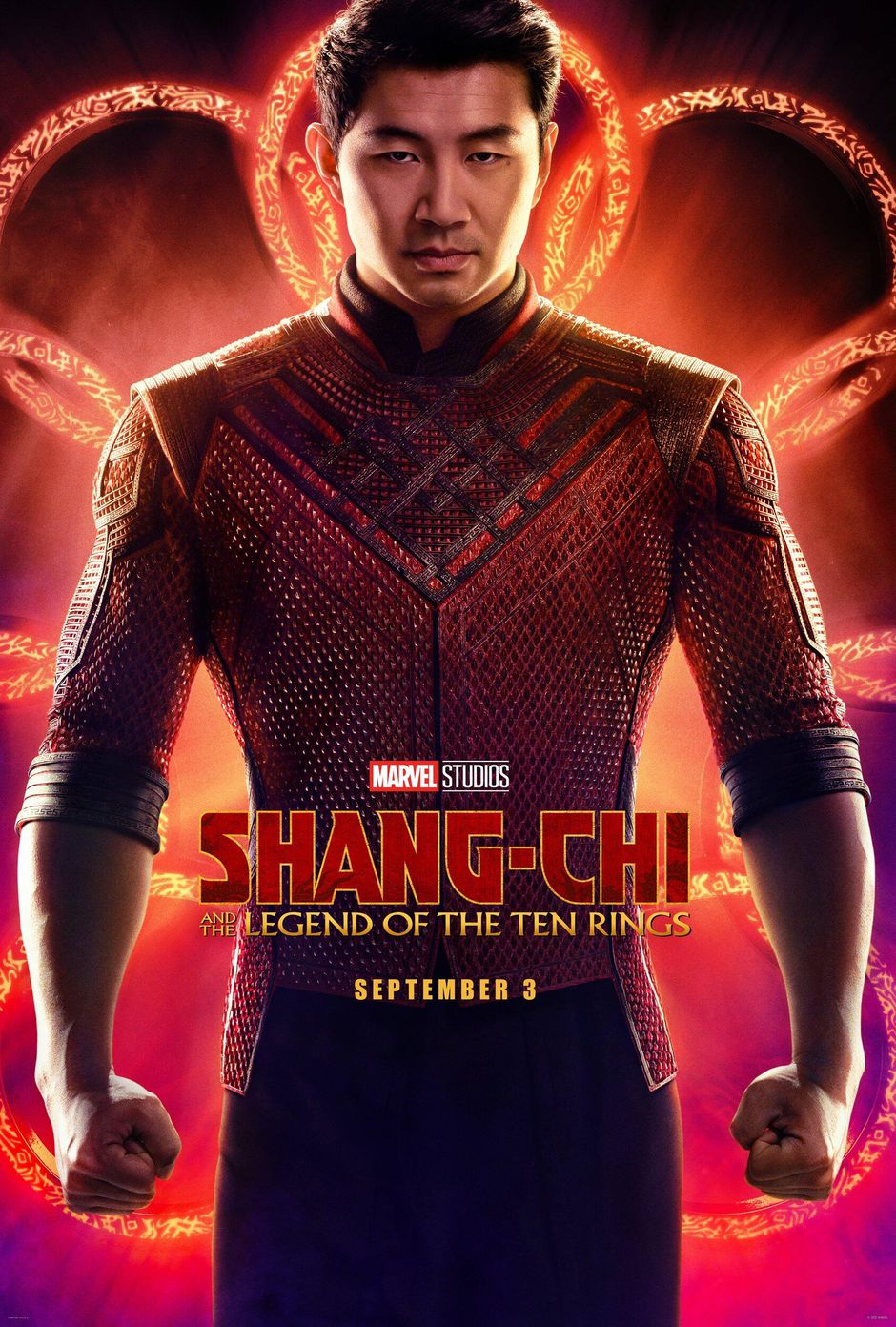
Shang-Chi (2021) Review

An action-packed reimagination of the classic kung-fu movie that is equally enjoyable as a stand-alone movie or MCU world-building installment that is best experienced on the BIG SCREEN. It’s no secret that I can take or leave the MCU, same with the DCEU. I’ll be up front and say that I like a select few superhero movies (Batman Returns, 89, Wonder Woman, all the X-Men movies), Batman Returns being my favorite (and I still argue the best comic book movie ever); however, all that said, I thoroughly enjoyed Shang-Chi! From beginning to end, it’s filled with explosive action and properly seasoned with moments of hilarity. Whether you are watching it because you are a Pavlovian MCU fan boy or girl that simply salivates over anything Marvel (or Disney) or you are seeking to be entertained in a cinematic escape for a couple of hours, then this film fits the bill.

Even though there are some cliche extreme wide landscape shots at the beginning that are working hard to convince you that the best place for the movie is on the BIG SCREEN, that’s not why you want to experience it in that ideal environment. You want to experience it on the BIG SCREEN because of the big action moments, mind-blowing fight choreography, intimate character-development scenes, and laughter and cheers from the audience!

Shang-Chi: and the Legend of the Ten Rings boasts a great cast that includes a key supporting role played by the indelible Michelle Yeoh. Our lead Shaun/Shang-Chi is played by the handsome Simu-Liu and his best friend played by the popular Awkwafina. These actors are supported by a well-written screenplay that not only delivers plenty of adrenaline-pumping sequences, one-liners and zingers (mainly from Awkwafina), but never loses focus on the external goal and internal needs. Simple plots with complex characters make some of the best movies!

While there are times that the mystical elements of the movie do seem a bit over-the-top, even for a superhero movie, the superpowers (be they derived from nature or from a weapon), don’t cross the threshold between suspension of disbelief and utter ridiculousness. The movie lays out the rules of its worlds in the first act, so you are willing to accept whatever is thrown at you. Writing tip: you can get away with nearly anything if you properly set it up. We learn everything we need to follow the story at the beginning of the movie.

If you’re seeking to be entertained by a solid high-concept movie, then you don’t want to miss seeing Shang-Chi and the Legend of the Ten Rings on the BIG SCREEN. Seriously, you can go into it the movie, not being that familiar with the preceding MCU movies, and still be able to thoroughly enjoy your time. If you are an MCU geek and love all the nods, Easter eggs, and world-building details, then you will also be happily satisfied. I hope this movie is an indication of the types of movies we are to witness in the next stage(s) of the MCU.

This image has an empty alt attribute; its file name is profile_pic.jpg

Ryan teaches American and World Cinema at the University of Tampa. If you like this article, check out the others and FOLLOW this blog! Interested in Ryan making a guest appearance on your podcast or contributing to your website? Send him a DM on Twitter or email him at RLTerry1@gmail.com! If you’re ever in Tampa or Orlando, feel free to catch a movie with or meet him in the theme parks!

Follow him on Twitter: RLTerry1

Candyman (2021) Review

Candyman (2021) - IMDb

Sweet on the outside, sour on the inside. A visually impressive attempt to provide a thoughtful exploration on duality and identity, is overshadowed by heavy-handed ideology. Nia DaCosta delivers audiences a spiritual sequel to the cult horror film Candyman (1992) that is grounded in much of the lore of the original, yet forges a new frontier that simultaneously serves as a vehicle for horror legend Tony Todd to pass the hook onto Yahya Abdul-Mateen II. DaCosta is joined by writer-producer Jordan Peele and screenwriter Win Rosenfeld to “tell everyone” who dares to look in a mirror and call out his name five times. Admit it, even in our most rational state, we are still a little apprehensive to stare at our reflection and call out Candyman, Candyman, Candyman, Candyman, Candym–. That’s the power of horror films! These fictional stories on screen have their mystical ways of affecting the collective conscious in such a manner that we change or question our behavior. Another great example of this effect is the iconic highway scene in Final Destination 2. And challenging audiences was certainly what the three screenwriters had in mind when writing the story for Candyman (2021). Unfortunately, the agenda-driven message steels the focus away from the stunning visuals, and ultimately fails to effectively paint a portrait of reality that invites all to engage in the important conversations the film is trying to have, instead, alienating audience members that don’t share the filmmakers’ opinions. Suffice it to say, this film is Peele for the course.

In present day, a decade after the last of the Cabrini towers were torn down, rising star artist Anthony (Abdul-Mateen II) and his partner move into a loft in the now gentrified Cabrini. A chance encounter with an old-timer exposes Anthony to the true story behind Candyman (Todd). Anxious to use these macabre details in his studio as fresh grist for paintings, he unknowingly opens a door to a complex past that unravels his own sanity and unleashes a terrifying wave of violence. (IMDb)

If you’ve never seen the original Candyman, don’t worry. While having seen the original will certainly help audiences to appreciate world-building and backstory elements, there is enough context given to help those that may be unfamiliar. Following the screening I attended, I heard individuals negatively critique the retconning of plot elements in the original; truth is, the parts of the original that were reimagined to fit the backstory of 2021’s Candyman were thoughtfully adapted.

While I have my reservations with the film, I would be remiss to not highlight the excellent direction, cinematography, editing, costuming, production design, and even the performances! Visually, the movie is stunning! All the mise-en-scene elements work together to create a BIG SCREEN experience. And talk about outstanding performances. Back in the heyday of the slashers (late 70s through the 90s), we did not expect to be impressed by the performances of the cast. And while there are notable exceptions of horror films WITH brilliant performances, usually it’s not expected. Over the last 7–10 years, horror films have been stepping up their performance game. The lead and most of the supporting cast will all captivate you. Unfortunately, there are useless characters like Brianna’s (Anthony’s girlfriend’s) brother and his boyfriend. Having no real affect on the plot, this interracial gay couple was little more than a token that could be removed from the movie, and the movie still play out the same way. However, if it weren’t for these two characters, the movie would be lacking ANY humor. So I suppose that was their purpose, to add humor.

There are so many beautifully crafted shots and shot sequences in this film. From juxtapositions of the old meeting with the new to geometric shapes and lines, there are many excellent compositions. The production and set design and lighting, of this film, are used in similar ways that the designs in expressionism are used. Expressionism uses the design of buildings, costumes, lighting, and camera angles to externalize emotions, psycho-social states of being, and ideas. And with expressionism being part of the formula of horror (expressionism+surrealism+Poe+Freud), it makes sense how and why there would be this care shown in the mise-en-scene.

All the backstory elements are communicated through the brilliant use of shadow puppets. The shadow puppet sequences are perhaps my favorite recurring diegetic device used in the film. Not only do these shadow puppets provide exposition, they also move the plot forward in action and subtext.

The idea of shadow puppets as a storytelling device is best explored in Plato’s Cave. French film theorist Jean-Louis Baudry likened the movie theatre to Plato’s famous allegory Plato’s Cave found in Plato’s Republic. But since we’re not all film or philosophy theorists, here is a quick explanation of Plato’s Cave:

The allegory states that there exists prisoners chained together in a cave. Behind the prisoners is a fire, and between the fire and the prisoners are people carrying puppets or other objects. This casts a shadow on the other side of the wall. The prisoners watch these shadows, believing them to be real. Essentially, what Plato is exploring is the concept of “belief vs knowledge.” The prisoners (or audience) in this analogy believe the images on the wall as reality; when in actuality, it is only the puppeteers version of reality. The analogy goes on further to describe a prisoner breaking free and venturing from the cave out into the real world. Two things happen (1) the newly freed prisoner completely rejects the imagery in the cave and returns to warn the prisoners of their one-dimensional view of reality, and risk being killed for a radical view, or (2) the freed prisoner fears or cannot reconcile actual reality and retreats back into the cave, where there is comfort in the surroundings, to warn the prisoners not to leave. Therefore, this highlights how a lack of knowledge leads to blind belief.

Despite being centuries old, the allegory is appropriate for filmmaking. After all, the audience watches images on a screen. We’re meant to believe it to be real, but we know it’s false. Only when we step out of the theater back into reality can we take what we’ve learned in the cinema and apply it to our lives. In a literal sense, a movie is just a series of images. But digging deeper, they present unique ideas and themes that we can take with us into the real world. Numerous movies utilize this concept in their plots and themes. You have probably seen films where a character believes one reality and then becomes exposed to another, greater reality and is never the same. In the case of 2021’s Candyman, DaCosta, Peele, and Rosenfeld have metaphorically trapped the audience in an ideological cave to present their versions of our reality that exists outside the cinema’s doors.

The movie has some great kills! But it highlights a moral problem plaguing this movie. From the art gallery to the critic to the girls at the prep school, the only victims, to meet their gruesome demise ON screen, are white characters. While there are a couple of off-screen deaths of black characters, the only ones in the visible mise-en-scene to meet with Candyman’s iconic hook are white. Had this movie been directed and/or written by a white writer-director and only killed and disparaged black characters, there would already be a #cancel campaign on Twitter. In my five years as a film professor and seven years as an active critic, I cannot ever recall a horror movie (in particular, a slasher movie) that ONLY killed black characters and disparaged the black community in virtually every scene from the opening to the closing. So if that would not be tolerated by the public–and for good reason, a movie released like that in 2021 (or ever) would be in incredibly poor, despicable, disrespectful taste–then the inverse should not be acceptable here.

I get what DaCosta, Peele, and Rosenfeld are trying to do with this horror movie. From the time of Cabinet of Dr. Caligari and Nosferatu, horror has been used to comment on societal observations to either warn of an impending dangerous ideology, to provide allegorical material that can be used as a framework to better understand marginalized groups, or even to challenge systems or institutions. Which is why horror is often far more truthful than a straight drama. Of course, one can make the argument that this is a fictional film in a fictional Chicago, which is not untrue; however, the problem therein is that little (if anything) in this fictional Chicago sets it apart from the real world, except for the supernatural character of Candyman, because these filmmakers have a point to make. But the problem here is that the very people that these writers want to challenge are the very people that are being unfairly represented in the movie. How is any of that constructive to the conversations of race relations and policing??? Short answer: it’s not.

The symbolism I did appreciate in the film are the moments that we explore the duality in ourselves and our environments. This is represented through literal and metaphoric reflection. Mirrors (or reflections) are regularly used to communicate duality. One of the best examples in recent years, in how mirrors are an effective cinematic device, is the mirror scene in I, Tonya. Just before her final competition in the film, as Tonya is applying her high contrast makeup, we witness in the mirror the internal struggle. On the outside, she is this accomplished figure skater (probably the best athlete the sport has ever seen) but on the inside she is tormented by her mother, her abusive marriage, and what she did or didn’t know about the incident. Likewise, in Candyman we explore the history and identity of Anthony and his neighborhood. Anthony has a secret in his past that has been painted over, that is trying to resurface, and his neighborhood of Cabrini Green has a sordid history that it has tried to cover and hide behind a fresh coat of paint. History is always there. It cannot be erased. And if it’s not dealt with, it can become a specter and haunt you and your environment. The mirrors and other reflective surfaces of Candyman are brilliantly used to communicate this idea of duality.

It is clear that DaCosta is a gifted director, but I hope that she works with different writers in the future that can find that balance of commenting on or raising awareness of something important, but also finding the ways to bring everyone to the table for a thoughtful discussion. The power of cinema, and in particular horror films, is that it can bring diverse groups of people together from all walks of life to both be entertained and challenged through screams, jumps, and laughter.

This image has an empty alt attribute; its file name is profile_pic.jpg

Ryan teaches American and World Cinema at the University of Tampa. If you like this article, check out the others and FOLLOW this blog! Interested in Ryan making a guest appearance on your podcast or contributing to your website? Send him a DM on Twitter or email him at RLTerry1@gmail.com! If you’re ever in Tampa or Orlando, feel free to catch a movie with or meet him in the theme parks!

Follow him on Twitter: RLTerry1

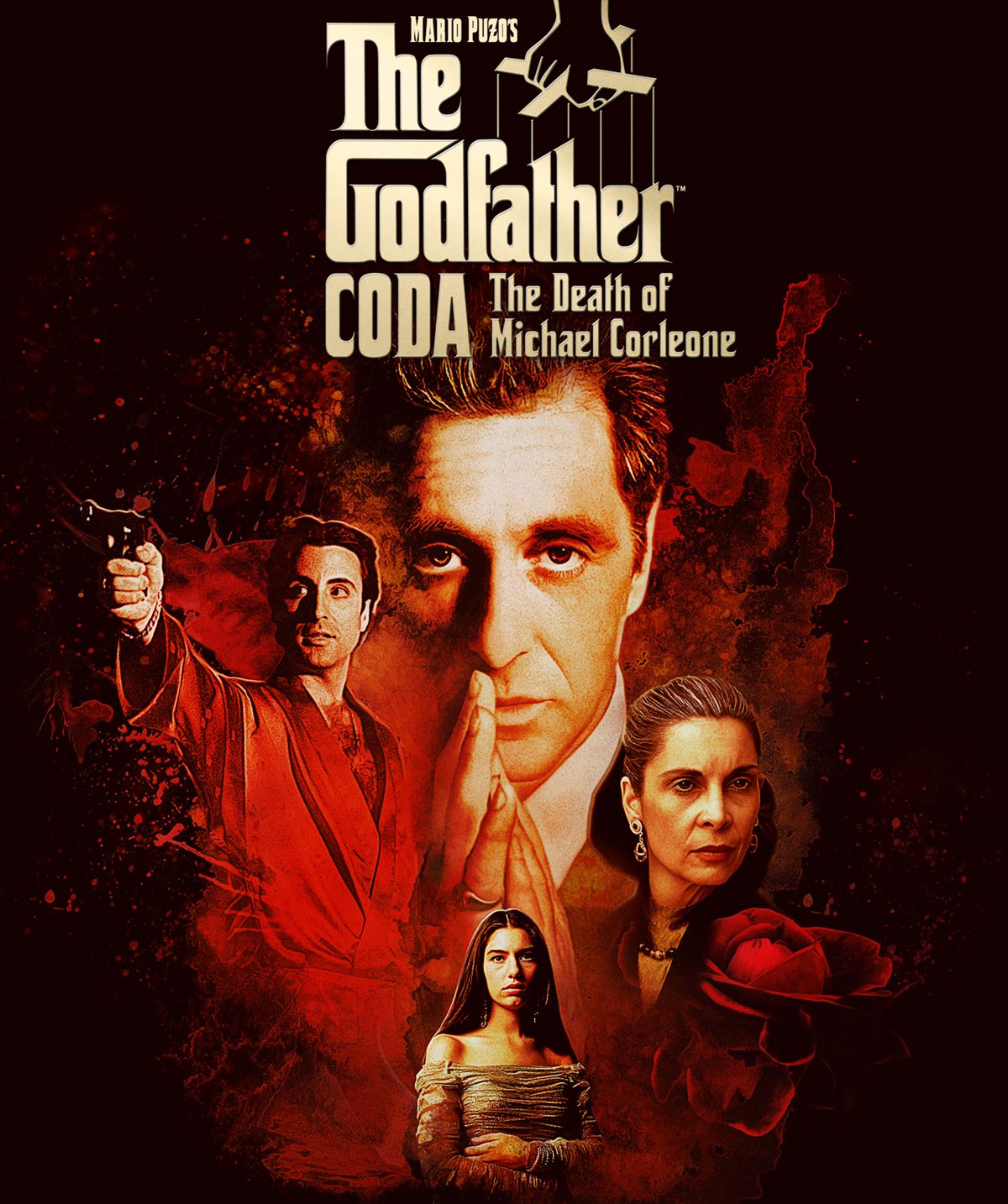
Mario Puzo’s The Godfather Coda: the Death of Michael Corleone

A testament to the timeless, evolving art of theatrical motion pictures! Cinematic genius Francis Ford Coppola reedits and retitles the past in the exclusively theatrical release of Mario Puzo’s The Godfather Coda: the Death of Michael Corleone. Whoa, that was a mouthful. I can see why it didn’t exactly work for most marquees back in 1990. I appreciate Paramount gifting us with a limited theatrical run, which is positively the best way to experience and return to the complex world of the Corleone family. For those that are uncomfortable attending the cinema, The Godfather Coda will be available to own on physical media in the coming weeks. Other than the title, the most significant changes from Godfather: Part III are to the beginning and ending. But throughout the film, Coppola reedited and rearranged scenes so that this “director’s cut” is leaner than the original version. The Godfather series is no stranger to re-releases and supercuts for premium television. It’s as if this masterpiece is a work of art that Coppola is never truly satisfied or finished with, allowing him to tinker with it through the decades. One can liken his reedit of this film with his remix of Apocalypse Now. Since the very end is different from the original, I will not address the changes other than to state that it feels much more complete, and satisfying both narratively and emotionally.

In terms of the main action plot, this reedit is still about an aging Michael Corleone whom strives to abandon his old ways and become a legitimate businessman and philanthropist by developing a foundation and bailing out the Catholic Church’s crippling bank. Unfortunately, his personal journey of morality and redemption does not bode well for ancillary organized crime arms of the greater mafia. And thus, he becomes a target within the world he godfathered. Although concentrated in this installment, the global story in The Godfather saga is one of morality and redemption. As I regularly point out to my students, you may not agree with the business practices and skewed worldview of the Corleone family, but you have to admire the respect for tradition, family, and order. And in their own way, they adhere to strong moral and ethical values; and it’s that devotion to moral and ethical principles that we can admire. The collective history of The Godfather saga is as storied and illustrious as the history of the Corleone family itself. When discussions about the very nature of cinema are in discourse, The Godfather saga is one that is often cited as an example of a film that is the very definition of cinematic.

Harkening back to key moments from Godfather I/II, the reedits allow the film to better and more effectively mirror iconic and character-defining moments from the–let’s face it–stronger first two films. From opening the film on a party to intercutting violence against a high-profile public event towards the end, The Godfather Coda is a thoughtful exploration of dramatic irony and foreboding omen. By engaging in the art of montage (French for assembly), Coppola demonstrates how assembly can greatly impact the experience of the motion picture. Same story, but assembled differently in order to create a leaner, more coherant narrative. Upon watching The Godfather Coda, fans of Part III will appreciate how the plot is less (not far less, but less) convoluted than the original. Although there are still screenwriting and directing missteps, that are ostensibly ghosts from the past that will always be present, the changes greatly improve the story.

The coda to the Corleone family saga is a deeply moving cinematic motion picture that reminds us of the power of cinema. While even recut, it doesn’t match the level of critical and cultural success of the first two films, it is still full of excellence in visual storytelling for the silver screen.

Ryan teaches screenwriting and film studies at the University of Tampa. If you like this article, check out the others and FOLLOW this blog! Interested in Ryan making a guest appearance on your podcast or contributing to your website? Send him a DM on Twitter or email him at RLTerry1@gmail.com! If you’re ever in Tampa or Orlando, feel free to catch a movie with or meet him in the theme parks!

Follow him on Twitter: RLTerry1

“Kajillionaire” Film Mini-Review

An exercise in how bored can you leave the audience before they fall asleep. Miranda July’s Kajillionaire is a thoughtful story that attempts to explore how one’s family can hold one back from healthy personal and professional development; however, the method of plot execution leaves the audience wondering why they should even care about the story. Had it not been for the compelling performances by the ensemble cast, I would’ve lost completely interest in the film. Kajillionaire desperately wants you to be engaged, but outstanding performances alone cannot keep an audience’s attention for the duration of the runtime. The film is billed as a comedy, but I never found myself laughing or even chuckling. Tonally, the film is all over the place. Had the film committed to striking a consistent tone, then perhaps the comedic elements would have stood out more instead of feeling random and forced. Clearly July set out to craft a motion picture that commented on brainwashing, neglect, and child rearing with a lack of empathy, sexual discovery, and those elements are depicted; but the film delivers a narrative that was so preoccupied with the message, that it forgot that it also needed to be even mildly entertaining. Quite frankly, the film has the personality and dimension of cardboard. Which is unfortunate, considering that the subject matter aims to be thought provoking. This film strikes me as one of those that is tailor-made made for #FilmTwitter to posit as the next great indie darling, when the story and characters are largely forgettable. What I will remember most about the film is the excellent performances delivered by the cast.

PS. I hope to be back to full reviews soon, but assisting the Florida Department of Health with COVID-19 data collection and analysis and writing for Four’s a Crowd Podcast, and of course my academic work at the University of Tampa, leaves me with limited time presently.

Ryan teaches screenwriting and American cinema at the University of Tampa. If you like this article, check out the others and FOLLOW this blog! Ryan is also the creator of the Four’s a Crowd sitcom podcast now streaming on your favorite podcatcher. Interested in Ryan making a guest appearance on your podcast or contributing to your website? Send him a DM on Twitter or email him at RLTerry1@gmail.com! If you’re ever in Tampa or Orlando, feel free to catch a movie with or meet him in the theme parks!

Follow him on Twitter: RLTerry1