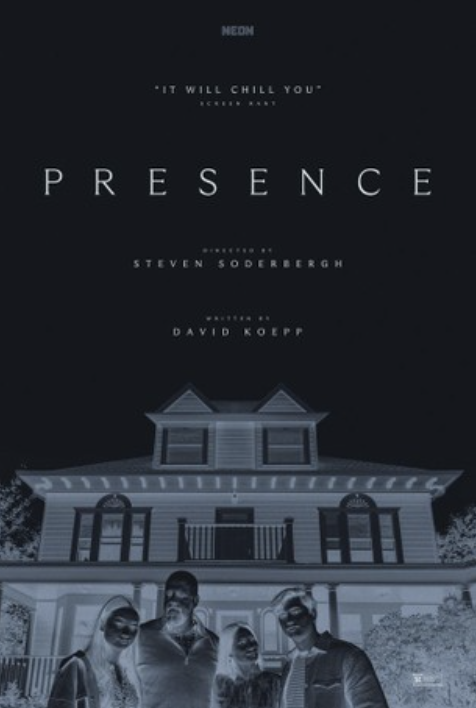
It’s, well, interesting. As soon as I saw that David Koepp was the screenwriter, I was instantly intrigued. While I’m hit or miss with Soderbergh, I’m generally hit with Koepp. But, I find this film’s apparatus to be more interesting than the story itself. While Presence is ostensibly a ghost story, it derives much of its intrigue–not from its narrative–but from its formal and technological apparatus. Soderbergh, known for his experimental approach to filmmaking, employs an innovative first-person perspective; however, this stylistic choice, coupled with Soderbergh’s meticulous control over framing, lighting, and movement and Koepp’s minimalist screenplay, resulted in elevating the film’s formal qualities above its forgettable plot and one-dimensional characters.
In short, the film is about a family that moves into a suburban house and becomes convinced they’re not alone.
The film unfolds through the perspective of an unseen spectral presence, effectively turning the camera into an active participant rather than a passive observer. This shift from traditional storytelling to experiential cinema foregrounds the act of seeing and being seen, inviting viewers to consider their own complicity in the voyeuristic aspects of horror. The film’s reliance on long takes and fluid camerawork creates an unsettling sense of omnipresence, emphasizing the medium’s ability to manipulate space and perception.
While Koepp’s screenplay is serviceable in its exploration of haunted house tropes, it often feels secondary to the film’s preoccupation with its own form. Koepp’s screenwriting is characterized by minimalistic dialogue and a structure devoid of conventional plotting. Rather than relying on his penchant for exposition-heavy scripts, Koepp wrote a screenplay that relied primarily on subtext and visual cues, thus inviting the audience to experience the story through mood versus visually-driven stimuli. The film’s thees such as literal and metaphoric isolation, family dysfunction, and the effects of trauma, feel much more like scaffolding for Soderbergh’s technical experimentation than an actual story. Koepp’s unconventional screenplay paired with Soderbergh’s experimental filmmaking results in a film wherein the mechanics of cinema take precedence over traditional storytelling.
Ultimately, Presence is most compelling when considered as an exercise in film form rather than a compelling story itself. The filmmaking apparatus generates a more profound engagement than its plot and characters, which hurts the potential this film had given its pedigree of talent. Soderbergh and Koepp crafted a film that is less about a haunted house and more about reimagining the voyeuristic capabilities of cinema itself. By leveraging cutting-edge camera systems and post-production techniques, Soderbergh set out to blur the line between observer and observed, in an attempt to create an uncanny sense of intimacy and detachment, but it failed to stick with this critic long after the credits rolled.
Ryan is the general manager for 90.7 WKGC Public Media in Panama City and host of the public radio show ReelTalk about all things cinema. Additionally, he is the author of the upcoming film studies book titled Monsters, Madness, and Mayhem: Why People Love Horror. After teaching film studies for over eight years at the University of Tampa, he transitioned from the classroom to public media. He is a member of the Critics Association of Central Florida and Indie Film Critics of America. If you like this article, check out the others and FOLLOW this blog! Follow him on Twitter: RLTerry1 and LetterBoxd: RLTerry
 R.L. Terry ReelView