THE KING OF KINGS animated film review

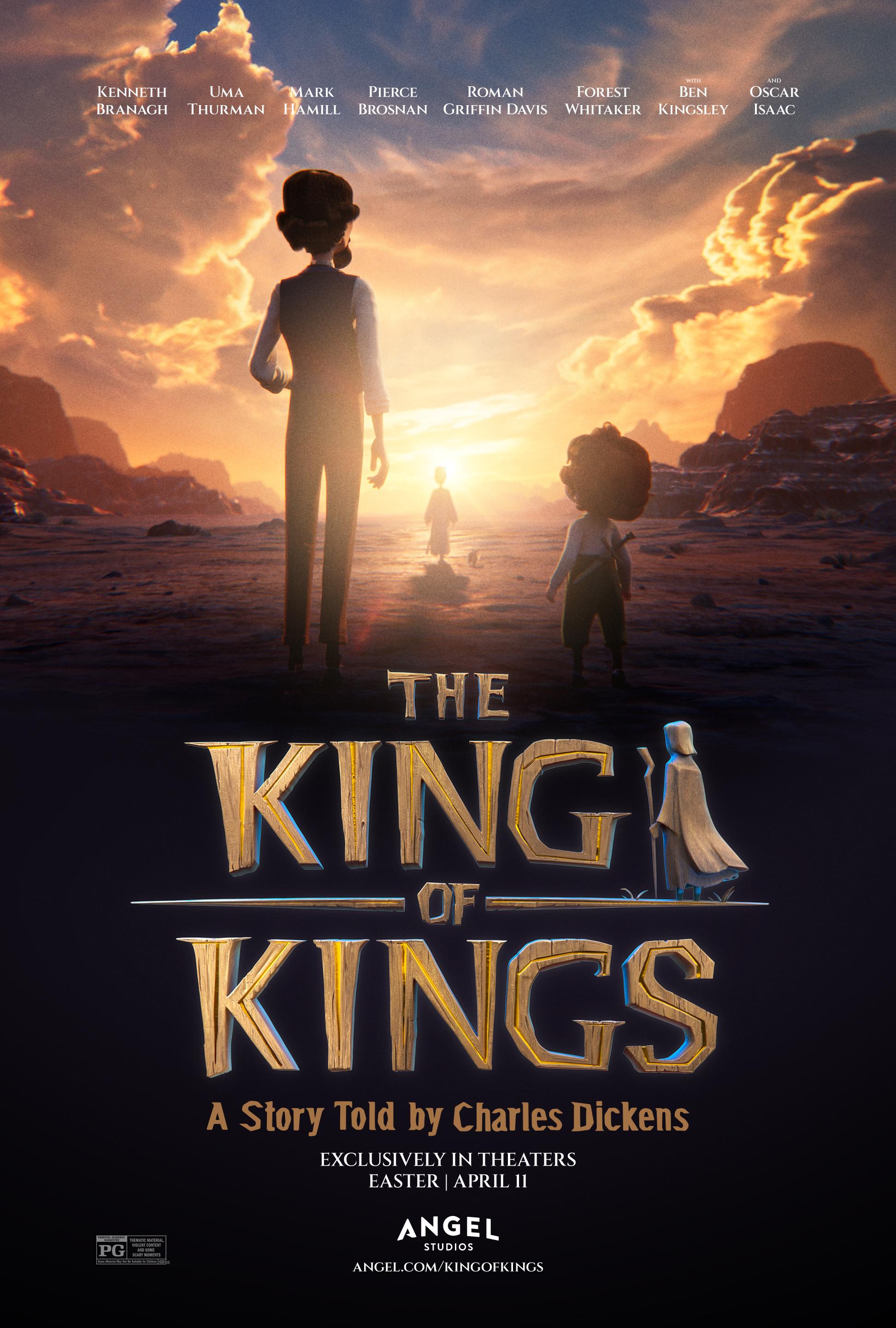
Surprisingly good! Masterful storytelling, stunning hand-drawn sequences, and emotional depth are at the heart of King of Kings. Delivering a rich tapestry of contemporary CGI-derived imagery fused with hand-drawn animation, the visual storytelling creates a distinctive style that feels both modern and timeless. King of Kings is a star-studded animated feature that follows Charles Dickens as he regales his son with the “greatest story ever told.” The scale and scope of this story is not typically one that can effectively fit into a runtime of just over an hour and a half; but in the vein of the critically acclaimed Prince of Egypt, the film’s narrative is lean yet never sacrifices diegetic nuance or quality. The impact of the film is aided by a stellar voice cast and characters that are relatable, vulnerable, and ultimately human. This compelling feature film brings history to life for audiences in one of the strongest and most engaging cinematic adaptations of the gospel.

Renowned writer Charles Dickens shares the story of Jesus Christ with his son, Walter. As his father narrates the stirring tale, Walter becomes captivated with the events of Jesus’ life.

King of Kings strikes a tone and pacing that defied any expectations I had for this film. From beginning to end, the film remains engaging. The film’s opening sequences establish the setting and stakes with efficiency, drawing viewers into its world without overwhelming exposition. The narrative unfolds at a steady rhythm, alternating between introspective character moments and energetic action sequences. The excellence in screenwriting and direction is witnessed in the effective oscillation between the serious or reverent and brief moments of levity or comedy. By punctuating scenes and sequences with humorous emotional resets allows for emotional beats to resonate whilst keeping the momentum alive. Despite the film’s epic scope, the story never lingers too long in one place. Key moments in the gospel story are given the space they need to land with full impact, without feeling rushed or drawn out. The climax builds with a gripping intensity even though the story and history are well-known. The film’s showdown culminated in a resolution that is both satisfying and emotionally powerful.

Among the cinematic elements that surprised me the most when I watched this film was the star-studded cast that includes Kenneth Branagh, Uma Thurman, Oscar Isaac, Ben Kingsley, Mark Hamill, and James Bond himself Pierce Brosnan. Additionally, the film’s original song is recorded by Broadway royalty Kristen Chenoweth. The compelling performative dimension elevates the film beyond its breathtaking animation. Each actor brings a distinct energy to their respective role, seamlessly blending emotion, gravitas, and authenticity to create a truly immersive cinematic experience. Whether delivered by a leading or supporting actor, each line of dialogue is delivered with conviction, making even the quietest moments resonate with emotional power. The collective efforts by the cast and director breathe a discernible heart and soul into the film.

There are many layers to the visual storytelling in King of Kings. Ostensibly, we have a story within a story because the film opens with Charles Dickens delivering a dramatic reading of his titular novella A Christmas Carol, later he tells his son the story of Jesus from birth to resurrection. Within this story, there are sequences that dramatically depict the exodus and Adam and Eve’s expulsion from the Garden of Eden. Each layer of the film as a whole are delivered with their own distinctive aesthetic. And within this aesthetic, the characters feel like an extension of their respective worlds rather than merely an extension of the artists drawing and programming the movie. The character animations are fluid and expressive, capturing subtle facial movements and gestures that bring an incredible level of realism to the performances. Battle sequences explode with kinetic energy, yet remain clear and visually stunning, avoiding the chaotic clutter that plagues many action-heavy animated films. The combination of motion-capture technology with traditional animation techniques results in characters that move with breathtaking realism while retaining an artistic, almost mythic quality.

Just in time for Easter, King of Kings reminds us that we, in the words of Chenoweth’s song, want to “live like that.” In a world that often feels so cynical and self-centered, comes an adaptation that challenges us to examine our lives and grow in how we impact the community and world around us. Jesus challenged the pious, bureaucratic leaders that built religious empires and He also made a difference in the lives of the discarded and ignored individuals in His community. Whether you go into this film a Believer or not or whether you emerge a Believer or not, there is little doubt that the actions of Jesus will challenge you to be a better person to friends, neighbors, colleagues, and members of your community.
Ryan is the general manager for 90.7 WKGC Public Media in Panama City and host of the public radio show ReelTalk about all things cinema. Additionally, he is the author of the upcoming film studies book titled Monsters, Madness, and Mayhem: Why People Love Horror. After teaching film studies for over eight years at the University of Tampa, he transitioned from the classroom to public media. He is a member of the Critics Association of Central Florida and Indie Film Critics of America. If you like this article, check out the others and FOLLOW this blog! Follow him on Twitter: RLTerry1 and LetterBoxd: RLTerry

Disney’s “A Christmas Carol” (2009) movie review

d_a_christmas_carolAn exhilarating visual array of breathtaking motion-capture animation with a touch of the macabre! Disney’s A Christmas Carol directed by Robert Zemeckis is an outstanding adaptation of the literary classic. Instead of attending the cinema this week, with the box office offerings on the anemic side as we gear up for the bulk of Oscar season heavy hitters, I decided to rewatch Disney’s A Christmas Carol. Charles Dickens’ masterpieces have long sense been a source of inspiration for film adaptations of literature. Specifically, A Christmas Carol was actually one of the earliest films period–let alone adaptations. The first adaptation of A Christmas Carol was a British film in 1901 titled Marley’s Ghost. This classic work has been adapted for film, theatre, radio, and television more than 100 original/separate times, collectively. But why??? Why this novel? Quite possibly, this single work of literature has been brought to life for the stage, speaker, or screen more than any other with only a few possible exceptions. Perhaps, because it is simply timeless–transcends all generations. Writer-director Robert Zemeckis showcases his ability to put his spin on the timeless tale by perfecting the motion-capture animation techniques that made his adaptation of The Polar Express so visually stunning. Although Patrick Stewart’s Scrooge in the TNT original movie from 1999 is my favorite Scrooge, I feel strongly that Zemeckis’ film is closest adaptation to the spirit of the novel and brings it to life in the way Dickens himself may have imagined.

London may be anxiously awaiting the arrival of Christmas Day, but the old miser Ebenezer Scrooge (Jim Carrey) could not care any less. He much prefers the company of his money and micro-managing his humble clerk Bob Cratchit (Gary Oldman) at his counting house. After begrudgingly allowing Cratchit to have Christmas Day off, Scrooge heads home. Upon arrival to his stately but lonely townhouse, Scrooge encounters the ghost of his dead–and there is no doubt about that–business partner Jacob Marley (Oldman). In an effort to spare Scrooge his horrifying fate, Marley informs Scrooge that he will be listed by three spirits (Carrey). The ghosts of Christmas past, present, and yet to come respectively take Scrooge on a terrifying journey through his his life in hopes of transforming his selfish bitterness and embrace the selfless love and joy of Christmas.

Prior to analyzing this adaptation, as it is a story most of us know and cherish, I’d like to look at why. Why has this work of literature been adapted for nearly every storytelling medium? The short answer is that it is a story that is as relevant today as it was in the 1800s. Much like with his other masterpieces, Dickens captures so much about the human condition, in what amounts to a short story. The novel is not terribly long. With many in the U.S. feeling as though, much like in Dickens’ world, that we are being divided up into the rich and poor, this novel rings especially true. In fact, there are definitely high profile people in our economy echoing Scrooge’s words “have we no prisons; have we no work houses???” Not that we have a physical debters’ prison or work houses (in the old fashioned sense), but there are certainly elements of our society which parallel them. The story hits close to home for many. Furthermore, the novel, and subsequent adaptations, are regarded so highly because Dickens encapsulated every aspect by which mankind judges one another: past, present, and future. This is the foundation of a single person or people as a unit. Through Scrooge, Dickens shows us that if we look at our past, present, and future, then we can see the impact we have on those around us and even ourselves. By seeing how we really are, we can make the decisions to develop an approach to change ourselves to be about the business of mankind.

Interestingly, the ghosts show Scrooge how Christmas past was a time of magic (although it ended in heartbreak for Scrooge), Christmas present depicts how commercialism and greed have all but wiped out the magic with a glimmer of hope as shown by Cratchit and Fred, and Christmas yet to come shows Scrooge–and us–a world without the magic of Christmas: a world that we created. Another reason why this story is so powerful is because Dickens wrote the character of Scrooge to be a complex, multi-layered human who acts very much like a mirror to many of us. On the surface, he looks like a stereotypical old miser, but after looking into his past, we are given a glimpse of how he evolved–not unlike many of us. This story is also powerful for those who recognize the religious origins of Christmas or not. The focus of the story is on generosity, hospitality, love, compassion, as well as selfishness, greed, and sociopathy; but, it very much includes and makes reference to the religious underpinnings of this special time of year. Simply stated, this is a dynamic story of redemption that transcends generations of people.

Zemeckis’ adaptation is a beautiful usage of 3D storytelling technology. Ordinarily, I am not a fan of 3D movies, but this one is an exception for sure. I did not watch it in 3D last night, but I remember watching it in 3D when it came out in 2009 at the [then] Downtown Disney AMC. Zemeckis is one of few directors who knows how to use 3D effectively without it seeming like a gimmick. His use of 3D in A Christmas Carol greatly enhances the visceral appeal of the movie. One of the principle differences between this and other adaptations is just how supercharged it is with visual effects, intense chase scenes, and flying through the street of London. But, as Scrooge himself acknowledged, spirits can do anything–they’re spirits. Zemeckis does not hold back on the dark elements of the story. If you have read the novel, you will recognize that there are very dark parts. In many respects, A Christmas Carol is a supernatural horror film. After all, how else was Scrooge going be so scared that he would make a 180 and change his miserly ways???

It’s no surprise that Jim Carrey can be seen in the character of Scrooge; however, it is not as apparent that he is the infrastructure of the look of the characters he voiced, as was the case with Tom Hanks’ characters in Zemeckis’ The Polar Express. And this trend is even less apparent with Firth’s, Oldman’s, and Wright’s, respective characters. I love Zemeckis’ embrace of the macabre mood of the story. So often, adaptations of this story lose the very horrifying elements that absolutely terrify Scrooge. Although I remember hearing parents comment that this version was too scary for their kids, I think that having a version that is skewed towards teens and adults was important. Another great element in this film: the score! Alan Silvestri’s score sneaks in some traditional Christmas carols, but you have to listen for such as “God Rest Ye Merry, Gentlemen” when its distinctive cadences turn sinister during a perilous flight through London.

There are few Christmas movies that capture the spirit of the season better than A Christmas Carol. Zemeckis’ adaptation is my pick for best translation of page to screen. The cinematic excellence of Disney storytelling is woven throughout this film and makes for a thrilling journey. If you are planning to watch some Christmas movies this holiday season, I highly recommend this version of A Christmas Carol. But if you have very young children, it may be a little too scary for them. Whether you are young or young at heart, the magic of Christmas rings all too loudly in this timeless story brought to screen once again.