
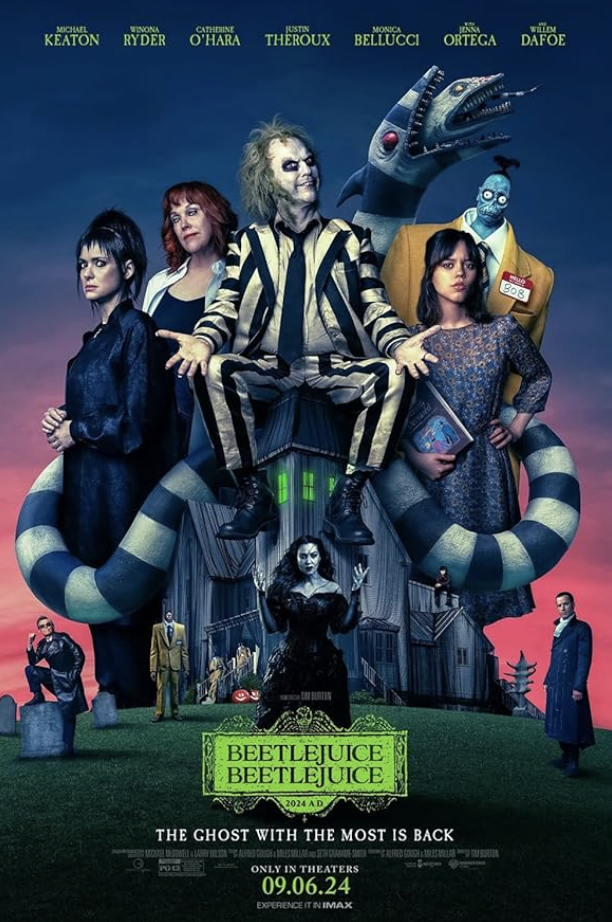
BEETLEJUICE BEETLEJUICE movie review

Forgettable and messy. The long awaited and much anticipated sequel to the campy cult classic Beetlejuice is unfortunately an underwhelming return to the fantastical, whimsical universe of colorful and dynamic characters. I’m left asking myself, this is the story for which Burton has been waiting???

Three generations of the Deetz family return home to Winter River after an unexpected family tragedy. Still haunted by Beetlejuice, Lydia’s life soon gets turned upside down when her rebellious teenage daughter discovers a mysterious portal to the afterlife. When someone says Beetlejuice’s name three times, the mischievous demon gleefully returns to unleash his very own brand of mayhem.

Beetlejuice Beetlejuice is a disjoined mess of setup after setup, with little development or meaningful resolution. Even though it successfully channels some of the charm and macabre whimsy of the original, this one is missing something vital–heart. What is most painful to witness is that there is actually a good and even compelling story in there, but its’ buried beneath a garbage heap of subplots and characters that are little more than the equivalent of an NPC (video game-speak for non player character). While the screenplay is abysmal, the bright spots in the movie are Michael Keaton’s delightful reprisal of Beetlejuice, despite his reveal appearing too early in the story. Other highlights of the movie are the quintessentially Burton special makeup and practical effects, including miniatures and puppetry. And composer Danny Elfman lends his distinctive authorship to the score. For fans of the original, this one is likely going to disappoint, but perhaps for those that may be getting introduced to the world of Beetlejuice for the first time, will seek out the original campy classic. At the end of the day, it’s not all bad, but it’s far from good. At best, it’s sufficiently entertaining.

Before getting into what didn’t work, which is substantive, I’d be remiss not to spotlight what the movie did right. The big question, did Burton and Keaton revive ol’ Beetlejuice? And the answer is, yes. The character of Beetlejuice himself is the reason the movie has enjoyable moments and will keep you moderately entertained. Keaton delivers a Beetlejuice that makes you forget that he hasn’t played this character in nearly 40 years. For the most part, he captures the energy, wit, sarcasm, and offbeat charm of his original incarnation. Unfortunately, that cannot be said for the rest of the performative dimension. But more on that later.

Over all, the design of the movie harkens back to the Burton’s golden age in the 80s and 90s, except when he lays practical effects over CGI backgrounds or oscillates between both mechanical and digital in jarring ways. From beginning to end, movie magic is witnessed everywhere. Burton was committed to capturing the imagery of the original in both the costumes and set design, and by in large, he accomplished just that. This movie is a reminder that computers cannot replace the way real light bounces off real objects into the camera lens. The magic of motion pictures is a combination of tactile, chemical, performative, and lighting elements. Despite the Afterlife lacking true camp value, it was a successful return to the imaginative world created by Burton in the original movie.

Regrettably, the movie fails to deliver a compelling or even coherent story. It’s a disjoined mess of ideas that couldn’t have possibly made sense on paper, let alone on the screen. The first act moves along sluggishly, but picks up pacing in the second and third; however, very little (if anything of meaningful value) is developed or resolved that is setup in the first and second acts. There are literally entire characters that serve little to no purpose in the story. And, without getting into spoilers, there is a compelling plot that is excellently setup, but the development and resolution is so sloppy it just hurts the narrative all the more. Even a notable cameo is completely wasted as it bears little importance to the story. It’s hard to even call it a story because it’s lacking a plot, a central character, and a character of opposition; there isn’t even a real goal to be achieved. While the character of Beetlejuice is known for his chaotic behavior, the narrative need’t exhibited the same level of randomness and chaos as exhibited by our title character.

Speaking of characters, the reason that the performative dimension is sorely lacking any modicum of substance is because the characters are given nothing to do. There is little reason for anyone to be doing anything. Furthermore, the Delia and Lydia we get in the original are not the Delia and Lydia we witness in this movie, and Lydia’s daughter Astrid is simply not believable as an angsty teenager. With a little motivation and dimension, the characters would’ve likely been highly entertaining and compelling; but, they are lacking any dimension whatsoever.

Tonally, the movie is all over the place. All over the place except for the one place it needed to be. And that is camp. For a movie that should’ve eat, slept, breathed camp, it plays it too seriously and tonally inconsistent. Yes, there are what we would usually refer to as campy costumes and characters in the movie, but the context is lacking that camp aesthetic and sensibility, for which Burton is (or used to be) known. Contributing to the tone of the movie is the Elfman score that only feels like Elfman sometimes. It’s like a composer imitating Elfman. Yes, we get the classic Beetlejuice theme music, but other than that, I’d be hard -pressed to identify any other musical moments that felt like Elfman.

The movie does deliver some entertaining moments, but sadly they are few in number. When the movie works, it works! But it simply does not work sufficiently enough. Also, the lines “…strange and unusual” and “it’s showtime” are nowhere to be found. There was also a setup for a much-needed scathing critique on influencers and influencer culture, but that setup too wasn’t developed. So many great ideas that are completely disconnected.

Watch if you simply want to enjoy some movie magic and familiar characters, but don’t expect to be quoting this sequel like you do the original. I’ll leave you with this, the fact that Lydia’s TV show is titled “Ghost House” is a nice nod to the original title of Beetlejuice.
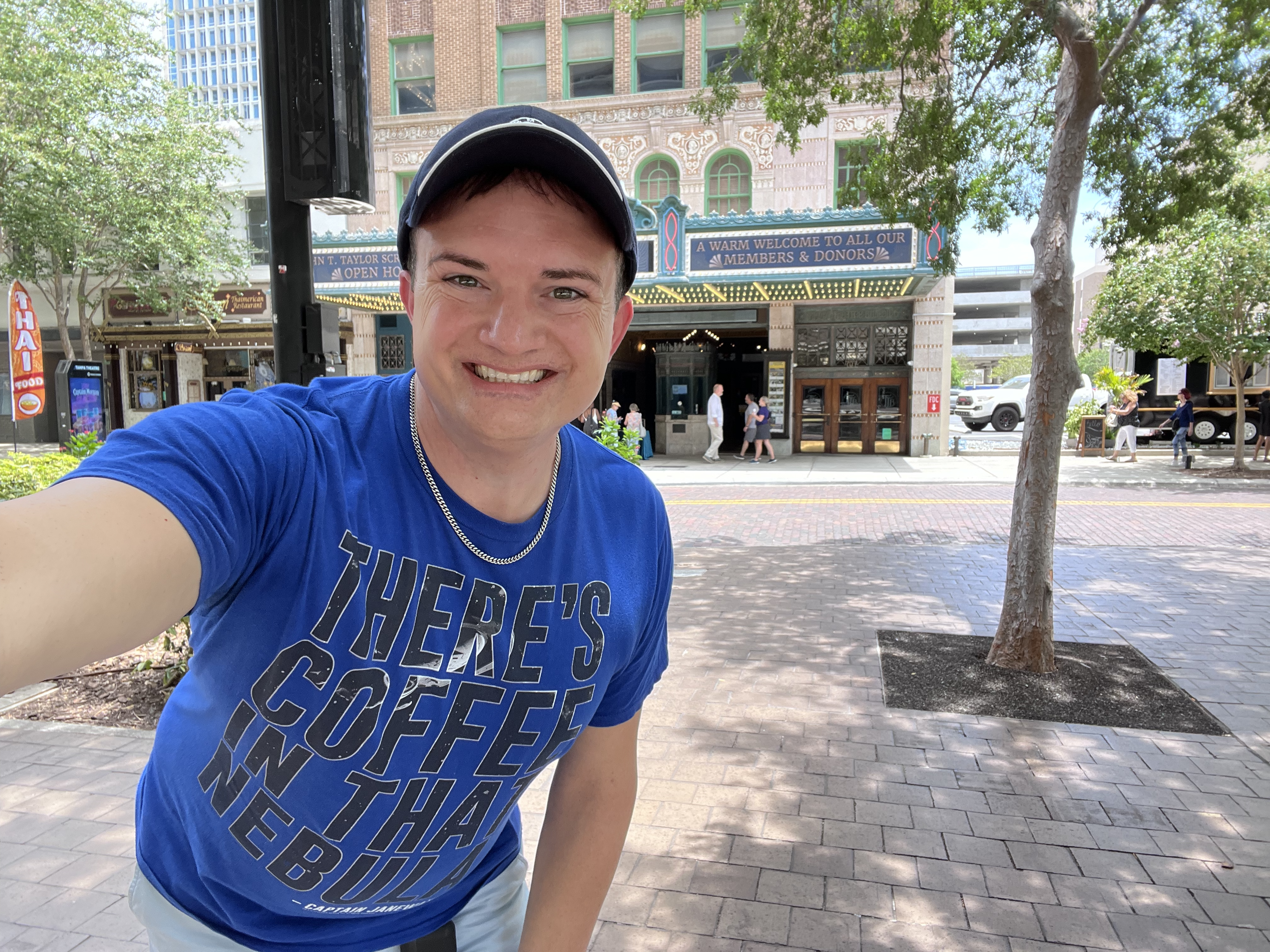
Ryan teaches Film Studies and Screenwriting at the University of Tampa and is a member of the Critics Association of Central Florida and Indie Film Critics of America. If you like this article, check out the others and FOLLOW this blog! Interested in Ryan making a guest appearance on your podcast or contributing to your website? Send him a DM on Twitter. If you’re ever in Tampa or Orlando, feel free to catch a movie with him.

Follow him on Twitter: RLTerry1 and LetterBoxd: RLTerry

BEETLEJUICE THE MUSICAL review

Stick to the movie. While I seldom review stage productions, whenever there is an adaptation from screen to stage, I am interested in reviewing it! Touring the country this year are Broadway versions of Beetlejuice, Moulin Rouge, Mrs. Doubtfire, and Clue. Quite the season for screen to stage adaptations. The film professor and critic in me is curious as to the narrative and experiential success of the stage version of a beloved classic movie. Some movies lend themselves to stage versions such as Moulin Rouge and Clue, but others require a bit more imagination such as Beetlejuice and Mrs. Doubtfire. I went into Beetlejuice with an open mind, as I had not read any of the reviews prior to watching it. Since I rarely watch trailers before I screen a film, I wanted to be as fair as possible to a Broadway show based on a movie. Suffice it to say, Beetlejuice the Musical failed to live up to the experience, reputation, and storytelling of the Tim Burton classic Beetlejuice.

Unfortunately, my impression of the musical was off to a negative start as the performance was delayed by 30-minutes–then compound that with two additional technical problem totaling about 30 more minutes of delays, and the musical was going to have to really work some magic to overcome the hobbling out the gate.

Since I am an expert in cinema (not Broadway), I am going to stick to my opinion of the translation from screen to stage, including narrative, design, and music.

The two areas wherein the show suffers most greatly is in narrative and music. But before I talk about the story and music, I want to focus on what the musical did well. And that is the set desigg, lighting, and effects.

Even though the set design, lighting, and effects may not be directly lifted from the stylized versions created by Tim Burton, there is a distinct style to the designs employed by the musical. All the sets feel like extensions of the movie, but still an original enough expression thereof. We even get the sandworm!! The appearance of the sandworm puppet was incredibly uplifting and brought the biggest smile to my face! Classic Burton designs are steeped in German expressionism, and that doesn’t entirely come through in the set designs; however, there are plenty of exaggerated shapes, harsh shadows, and emotive expressions in the design that remind us that this is a work inspired by the creative mind of Tim Burton. The technical theatre dimension of the show was outstanding! I adored the lighting and other effects that set the atmosphere and ambiance on stage.

The Broadway musical is a near complete departure from the movie version, and in the opening number Beetlejuice acknowledges that this is not the movie–however, it would have benefitted from being closer to the movie. When the musical is aligned with the movie, it works very well! Regrettably, when it departs from the movie, the plotting, characters, and music suffer. The best scenes in the show are the dinner party, the Netherworld, and the finale, all very much inspired by the movie. Throughout the show, there are movie moments recreated, but far too few. At least we got the memorable “I, myself, am strange and unusual” line. The stage Beetlejuice feels like a different character than Michael Keaton’s in the movie.

The dialogue and performative dimension of each character was forgettable. No one feels like they are an extension of the movie version, but a different character altogether. Even the dialogue was awful. I get it: Beetlejuice’s schtick is his crass, crude humor. But in the movie, it was always balanced out by more grounded characters and a tone of whimsy. This Beetlejuice is crass and crude simply to be crass and crude–with little paying off dramatically. While I appreciate some of the additional jokes, most were simply better suited for a standup routine than for a narrative work. The characters were speaking with the voices of the musical’s writers and not the voices of the characters as written for the movie. Each character is trying to be more over-the-top than the previous character, and what we wind up with is a cacophony of loud, boisterous, annoying characters.

The story is dramatically changed from the movie. To call it an adaptation is being generous, because there is little that is the same in both the plots from the movie and stage versions. Perhaps this is what happens when you take a 1.5hr movie and try to write a 2.5hr musical. There is simply an insufficient amount of plot to fill that additional hour. I suppose the foundation is the same, but the narrative is expressed very different in the stage version compared to the movie. When moments from the movie were included in the stage version, I literally clapped–that was about the only times I clapped during the performance. This musical should have stuck more closely to the plotting and characters of the movie instead of trying to improve upon it. Even though I will admit that some of the narrative connective tissue in the movie is a bit weak and some story elements feel disjointed, it’s in far more stable shape than the story from the musical.

Lastly, conspicuously absent from the stage version is the iconic Danny Elfman score. While there are moments in the musical’s songs and score that are somewhat reminiscent of the Elfman score, its absence was sorely felt. Not once did I hear the Beetlejuice theme music, not even in the overture or prologue. Elfman’s music is as stylistic as Burton’s cinematic visions, and this musical could have benefitted greatly from the music of Elfman. I had hoped that the musical numbers would have been like the musical numbers from The Nightmare Before Christmas, but they were not. They felt like generic AI-generated Broadway songs from another non-Burton-inspired intellectual property. Elfman’s music for films such as Beetlejuice, Batman and Batman Returns, and Nightmare Before Christmas cannot be lifted for and used for any other movie or stage production. His music is a tangible extension of the characters, plot, and atmosphere of the story. What we got was generic modern Broadway music and songs.

All in all, I was unimpressed with the musical, but I appear to be in the minority on my opinion of the show. My advice to anyone thinking of seeing this show is to go into it not wanting a stage adaptation of the movie, but rather a reimagination of the characters and concept from the movie.

Ryan teaches Film Studies and Screenwriting at the University of Tampa and is a member of the Critics Association of Central Florida and Indie Film Critics of America. If you like this article, check out the others and FOLLOW this blog! Interested in Ryan making a guest appearance on your podcast or contributing to your website? Send him a DM on Twitter. If you’re ever in Tampa or Orlando, feel free to catch a movie with him.

Follow him on Twitter: RLTerry1 and LetterBoxd: RLTerry