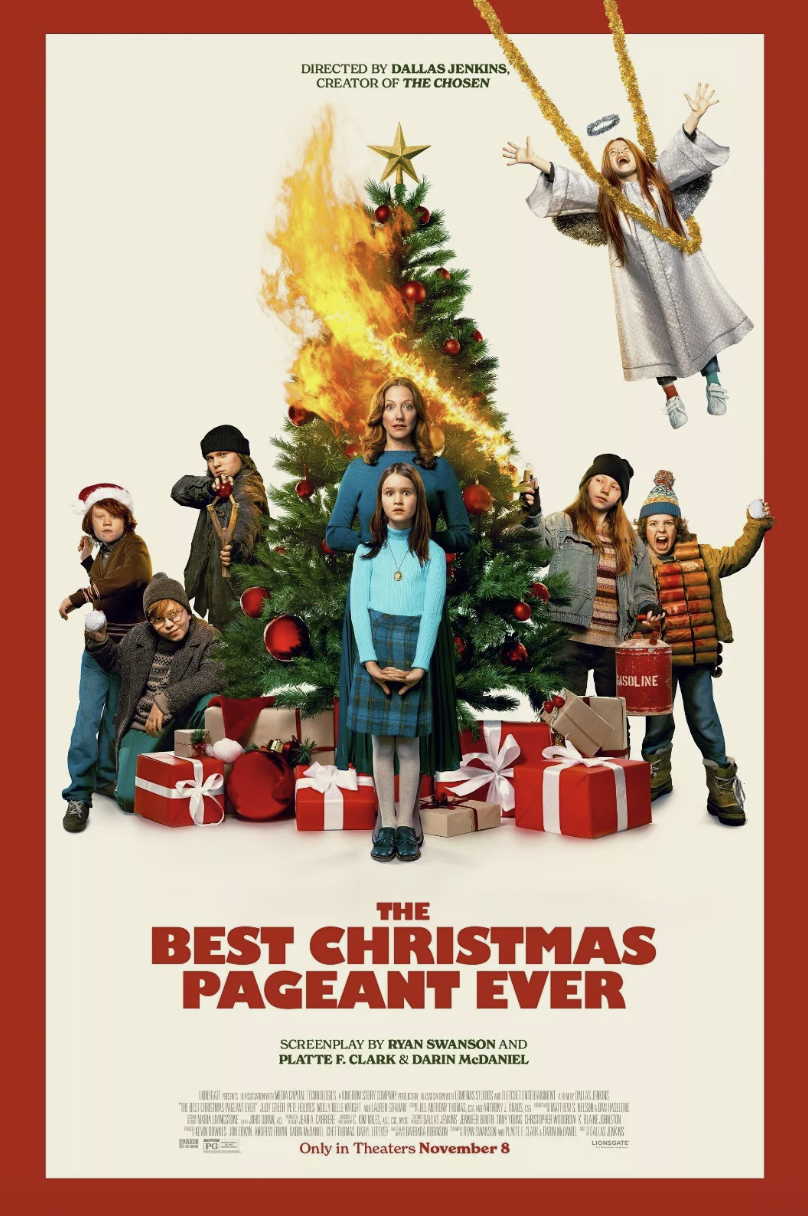
A heartwarming reminder of the importance of community. The movie also delivers a thoughtful critique of misplaced values. Based on the beloved 1971 children’s novel by Barbara Robinson, this big screen adaptation is a solid way to kick off the holiday season with a Christmas movie that is sure to fall into the annual movie rotations for many. Although the screenwriting demonstrably lacks refinement, there is still much to like about the movie. After a rocky first act, the movie finds its tone, despite the rough dialogue and poor pacing. Over all, it is an enjoyable movie that I will likely watch again before the Christmas season is over.
The Herdmans are six siblings who have a reputation for being the worst kids in the world. However, when they take over the local church Christmas pageant, they just might teach a shocked community the true meaning of Christmas.
Tonally, this movie falls somewhere between A Charlie Brown Christmas and A Christmas Story. While this movie may not have the same degree of memorable scenes that will find their way into the cultural zeitgeist, there are moments of hilarity and thoughtful poignancy. The movie shies not away from spotlighting the various prejudices and classism that permeate every town, particularly small towns and even amongst the imperfect people that makeup a church, but also uses the various social dynamics, at play, in the film to show how we can change for the better–after all, this is a redemption story. But it’s not a redemption story in the way we have seen in the past, with characters like Scrooge; rather, this is a redemption story about characters that talk the talk, but struggle to walk the walk. Moreover, this redemption story also follows those that are angry with the world and take out that anger and resentment on those around them. All around, this movie is full of imperfect people across the spectrum that need a wakeup call.
The movie works best when it leans into naturalism, but occasionally falters or feels uneven when it tries to strike a balance between typical faith-based movies and more mainstream ones. Some of the characters and conflicts feel like relatable albeit exaggerated versions of real life, while others feel incredibly forced and unnatural. From what I can remember, the Herdmans are more–how shall I say–earthy and raw in the book than in this film adaptation. And while we get glimpses of this, it would’ve been nice to have witnessed more of their behavioral aberrations to drive home how different they were perceived to be from their community. It’s here where we witness that Dallas Jenkins may be a better producer than director.
Bringing her trademark blend of strength, vulnerability, and sense of humor is Judy Greer as Grace, our house mom that unwittingly takes on the biggest event in her small town. All around, the principle cast is solid with a few standout performances. Some of those standout performances are from Knylee Heiman as the manic and terrifying Gladys, Beatrice Schneider as the crass Imogene, and Lorelei Olivia Mote as the self-centered diva Alice. The characters that work best are those that demonstrate stylistic differences compared to the rest of the cast. In other words, it’s the character actors that stand out in this film–and for good reason–they are both funny and act as an exaggerated reflection of real life people. We each know of people in our own lives that feel like these move people. I feel that if more characters were given something to do by the screenplay or director, that the performative dimension would’ve been above average.
Thematically, the movie reminds us that family and community traditions (particularly at Christmastime) are an important part of the human experience; however, the movie continues the conversation by its provocative reminder that traditions devoid of love and flexibility can become a trap or even a monster. It’s not the tradition itself that is important; it’s the love and community building that is most important. The tradition is merely a vessel through which we can extend love to one another. Just like Charlie Brown and his friends are reminded that Christmas is about the birth of baby King in a nondescript manger in a lowly town and, by extension, the radical changes He will bring to the world through His birth, life, death, and resurrection, the townsfolk in Emmanuel (the town in the movie) are reminded that Jesus was born for everyone, including the Herdmans, “the worst kids in the world.” And that we should care more about one another than we do keeping traditions the same simply for the sake of tradition.
After watching the movie, I am inspired to go back a reread the book. I remember reading it as a kid, and I imagine perhaps other kids of the 70s, 80s, and 90s remember reading the book as well.

Ryan taught Film Studies and Screenwriting at the University of Tampa for over eight years and has a book releasing next year titled Monsters, Madness, and Mayhem: Why People Love Horror. Recently, he has taken over 90.7 WKGC NPR in Panama City, and will be launching a film talk show soon. Additionally, he is a member of the Critics Association of Central Florida and Indie Film Critics of America. If you like this article, check out the others and FOLLOW this blog! Follow him on Twitter: RLTerry1 and LetterBoxd: RLTerry
 R.L. Terry ReelView