

Holiday Magic at SeaWorld’s Christmas Celebration and Busch Gardens’ Christmas Town

img_8142Central Florida is definitely not short on places to spend the holidays! From the theme parks to the zoos, aquarium, and large resorts, there is something for everyone. Last weekend, I experienced Christmas Town at Busch Gardens Tampa Bay and Christmas Celebration at SeaWorld Orlando. Both events feature Rudolph and his friends as well as Santa and his elves; however, the parks differ in the shows and other offerings. So, even though you can meet Rudolph and Santa at both parks, you will find that both are well worth a visit and will both contribute uniquely to your Christmastime celebrations! Since SeaWorld Orlando and Busch Gardens Tampa Bay are only one hour from each other, they both essentially pull on the majority of the same local population. Therefore, as similar as many of the experiences are, the offerings have to be different enough in order to convince locals to visit both. Having experienced them within the same weekend, I’ve been able to analyze the similarities and differences while both are fresh in my mind. If I had to sum up the experience at both Christmas Celebration and Christmas Town respectively, the one word that best encapsulates the overarching theme is nostalgia. From the Rudolph the Red Nosed Reindeer characters to the music, shows, and lights throughout the parks, the individual elements are combined to showcase a more traditional Christmas blend of carols, [Florida] snow, light-covered buildings, nativities, and live shows…For the full article CLICK HERE!

Such a variety! I think that is what I like best about how Busch Gardens and SeaWorld created this year’s Christmas limited engagement events. Whereas Disney’s Mickey’s Very Merry Christmas Party is a pricey hard ticketed event, SeaWorld, Busch Gardens, and even Universal’s holiday celebrations are included with with either your annual pass or day-ticket. That in and of itself, makes the SeaWorld and Busch Gardens events that much more fun! Why? Because it is quite difficult to fit everything in one night. Although the Christmas Celebration and Christmas Town events ARE included with your annual pass or day admission, the majority of the magic does not begin until the latter part of the afternoon. Unlike during Howl-O-Scream when Busch is opened until 12-1am, it closes at 9-10 during Christmas Town. SeaWorld keeps similar operating hours at Christmas to that of the Spooktacular. With the relatively abbreviated Christmas hours (as compared to Halloween), you may find yourself planning a return trip to the parks respectively or contemplating an annual pass. Since I go to the parks regularly, I have efficient time management down to a science and even I cannot get it all in. Even as I write this, there are some offerings I was unable to experience at both parks this past weekend. So, I am definitely going back! If you are only planning one trip to one or both, get there early and do your best to plan out the order in which you and your friends/family are going to experience everything.

Christmas Town at Busch Gardens is an annual event that has been going on since 2012. For the first two years it was a separately (hard) ticketed event but since 2014 has been included with day admission and annual passes. Since the event went from hard ticketed to complementary, there has been a mitigation in specialty offerings; however, the event is still full of holiday cheer and a great assortment of character meet and greets and limited engagement shows. There are so many wonderful photo opportunities throughout the park with beautiful and fun backdrops. The entire park is open with a few exceptions, meaning that you can ride all your favorite rides at night! For those who are familiar with the late Pinky [the dancing flamingo], there is a tribute to her near the front entrance with lots of pink Christmas lights. If you enjoy hearing traditional Christmas hymns, then be sure to stop by Christmas From the Heart in the old Madagascar stage. It’s a classy show with small band, and a moderately sized chorus. Perhaps you prefer traditional and contemporary pop hits! Then, stop by the Christmas Celebration show in the Pantopia Theatre. With a wide range of hits featuring some of your favorite singalong tunes and of course Santa himself, this show is incredibly fun and festive. The cast and crew at the Moroccan Theatre put a Christmas spin on the daily iceskating show that is certainly not to be missed. Don’t forget to stop by the Crown Colony restaurant across from Cheetah Hunt to watch thousands of dancing lights move to the beats of Trans-Siberian and Mannheim Steamroller. Think of it as Osborne Lights lite. An incredible assortment of shows that feature lots of different kinds of music and acts with the central theme of Christmas. I love the variety of shows because they do not feel like something that you can get everyday. Feels truly like a special seasonal event.

Headlining Christmas Town (and Christmas Celebration) this year is Rudolph and his friends from the Rankin-Bass holiday classic. Even before meeting the characters, the queue is filled with little vignettes from the movie–great for photo opportunities. You get to meet Yukon Cornelius, Bumble, Clarice, and Rudolph! There are also some wonderful plushies (I bought one) and ornaments to choose from in the gift shoppe. A staple at Christmas Town is Santa’a House sponsored by Coca-Cola. Appropriate because the whole idea of the red jolly Santa we all know and love comes from a Coca-Cola ad campaign. Even before meeting the big man himself, you get to spend time with elves and Mrs. Claus. One elf in particular–Curley–she was incredibly friendly and created a warm inviting atmosphere from the time she opened the door! It’s more than a meet and greet, there is an entire show element to the Santa experience. Lastly, no review of Christmas Town would be complete without mentioning the Singalong Train! Boarding at the North Pole station outside of Santa’s house, park guests can ride the train (normally used for the safari) and ride around signing Christmas carols and songs with one another. Takes the idea Christmas caroling to the next level! The singalong train is always my favorite activity at Christmas Town.

Just a hop, skip, and a jump away from Busch Gardens is SeaWorld’s Christmas Celebration. At Christmas Celebration you’ll find Rudolph and his friends as well as Santa Claus but there is so much more that is truly different from Christmas Town. SeaWorld transforms their seasonay operating Ports of Call into a Christmas Village! From a miniature train sets to live acts, the Christmas Village is incredibly festive and fun! Be sure to get some hot cocoa. So many wonderful places to take selfies and group photos. I love all the lights! Speaking of lights, you will definitely be able to watch the Sea of Trees light up and dance to some of your favorite Christmas songs. You can either catch the show shoreside or take a stroll along the boardwalk across the lagoon. Over one million lights! Much like Busch Gardens, SeaWorld also has some stunning seasonal show offerings to delight everyone young and old. Although not part of daily operations, SeaWorld also has an iceskating show at Christmastime. Winder Wonderland on Ice is a terrific show featuring talented figure skaters moving to many different carols and songs. Preceding the show is SeaWorld’s answer to Straight No Chaser. The male quarter entertains the audience for about 20mins with excellent harmony and jokes. If you’re lucky, you’ll time it just right to watch the Sea of Trees while you are waiting on the ice show to begin. Although I miss The Polar Express overlay on the Arctic Adventure, there are still many other rides available when you want a break from shows and character meet and greets.

Both the Clyde & Seamore and Shamu shows receive holiday overlays during Christmas Celebration. Since I did not experience the Christmas Miracle show at Shamu Stadium, I am unable to comment on that, but the Clyde and Seamore show’s Countdown to Christmas was fantastic! Even on a regular park ops day, it is one of my favorite shows at SeaWorld. Clyde and Seamore are back and funnier than ever in this holly jolly holiday show. Countdown to Christmas is about Clyde and Seamore’s goal to meet several requirements so Santa can visit! The most popular Christmas show a SeaWorld is not Clyde & Seamore nor Shamu, but O Wonderous Night located in the Nautilus Theatre. Not your typical nativity story, O Wonderous Night centers around the animals located in the stable where Mary and Joseph took baby Jesus more than two thousands years ago. We get to here the nativity story from the perspective of the animals who each played a special part in that wonderous night. If you plan to watch that show, you need to know that it is important to queue up at least an hour before showtime. It consistently fills up prior to curtain. Although Busch Gardens also has a Christmas Village in Gwazi Field, the village at SeaWorld seems to have more to offer.

Well, there ya have it! Two phenomenal ways to spend the holidays with your friends and family. Or, be like me and experience it Han style–solo. Although you might think that it isn’t as much fun on your own, you can still have a blast celebrating Christmas at SeaWorld Parks and Entertainment this holiday season. Lots of opportunities to sing, dance, and even meet some favorite characters along the way. Especially for those who enjoy a more traditional Christmas, these parks are the place to be. I guarantee that it will feel Christmassy from the time that you enter the park. It is so important that the parks make seasonal events feel special and unlike what you can typically get as part of daily/regular operations, and Busch Gardens and SeaWorld know how to create that holiday magic to warm your heart.

 

“Rogue One: a Star Wars Story” movie review

rogueoneJust when all hope was lost, the force has awakened this time. After the disappointingly stale installment last year, I did not have high hopes for Rogue One. To my surprise, the first standalone Star Wars franchise film exceeded expectations. Although the public is accustomed to Star Wars films coming in threes, Lucasfilm and Walt Disney Studios took a risk in creating an original single story to successfully setup A New Hope. Unlike when the force tried to awaken last year, THIS feels like a new Star Wars film. With twenty-some-odd years to fill between Revenge of the Sith and the original movie, how was one film going to do it? Focus on what was ultimately important. Not that the development of the Empire would be uninteresting, but the white elephant in the room was “how did the rebels get the plans that setup the events at the beginning of A New Hope“? And that is precisely what director Gareth Edwards did, and it paid off! Rogue One is as exciting as the original film; and furthermore, is built upon a solid plot that is mostly new with a little nostalgia and Easter Eggs (visual references to A New Hope) in the form of locations, props, shots/frames, and familiar featured characters and a surprising cameo. One of the elements that plagued Episode VII was the simple fact that it was little more than a remix and mashup of everything that had been done before, including main plot points, subplots, and predictable behavior. Rogue One feels fresh and new. Yes, there are obviously appearances and references to characters and settings from A New Hope, but that is to be expected since this film ends where the original film begins. Thematically darker than the original film but not as dark as Empire Strikes Back, this installment strikes a balance in the force that makes it interesting to watch. We all know that the rebels get the plans in the end, but this film makes the adventure worth watching as it unfolds.

With the old republic in ruins and the senate all but disbanded, the Galactic Empire has  its eyes set on a feat of engineering never seen before. But they need to attach the right scientific talent in order to create that which would become known as the Death Star. Galen Erso (Mads Mikkelsen) is a brilliant scientist and former Imperial officer, devoted husband, and loving father. Director Krennic, head of the secret Death Star project, arrives at Erso’s home to forcibly recruit him to head up the science and engineering divisions. When recruitment does not go as planned, Erso is separated from his family and taken away. Escaping to the caves, his daughter evades capture. Many years later, Jyn (Felicity Jones) finds herself a criminal and angry that her father never came back for her. When an Imperial pilot allegedly defects and claims to have a message from Galen for the Rebel Alliance, Jyn is recruited by the rebels to lead them to a former rebel turned rogue and ultimately to her father. With Captain Cassian Adnor (Diego Luna) at the helm and lead of the small band of rebels accompanying Jyn to her father, they uncover a secret that thousands will die for in order to attempt to make things right in the galaxy. All the while, they have no idea that this clandestine mission will spark events that they could have never imagined.

Already, this film seems to have sparked arguments among fans of the franchise and those who enjoy them but may not be fanboys. Even this morning, I noticed many comments on social media that commented on the film positively or negatively. Interestingly, at first glance, it seems as those who liked Episode VII: The Force Awakens did not like Rogue One, and those–like me and the friends I went with last night–who thought The Force Awakens was garbage but found Rogue One to be exciting, dynamic, and refreshing. Of course, there are plenty of people who like both films released under the Disney banner, either because the Big D can’t possibly do anything wrong or because they are true fans for better or worse of the nearly forty-year-old franchise and staple in the future fantasy genre (notice I did not say science-fiction–no real science here). At this point, I am unsure why those who liked last year’s film may not have liked this weekend’s installment; however, it appears to be clear from multiple comments and reviews that the reason why those who did not like Episode VII enjoyed Rogue One is the newness of a film that embodies the spirit of the original but provides audiences with a new adventure that connects well without redundancy. One of the reasons for the success of the original film–aside from a great cast–is the focus on the drama between characters and camps. There is the drama between Rebels and the Empire but also drama within the camps themselves. Rogue One borrows from A New Hope in that the focus is more on the drama than resting its laurels on the technical elements. Not that this film lacks in the technical category. Rogue One comes complete with great direction, color grading, cinematography, and impressive editing (especially with some rather surprising CGI that will definitely cause you to do a double take utter delight).

For all that this installment did well, the beginning of the film following the prologue was dreadfully ill-conceived and mostly unnecessary. Unlike all the other Star Wars films, this one did not open with the trademark scrolling written prologue offering exposition to setup the movie. Instead, after the “A long time ago, in a galaxy far far away” the film cuts to the opening scene of Krennic recruiting Galen. Following the prologue and rather PowerPoint-looking Rogue One title card, is a rapid, incoherent, and confusing sequence of montages. Honestly, I am still unsure why that whole sequence was necessary. Between the PowerPointy title card and this sequence of montages, I did not have hope for the film at all. Obviously, I ended up enjoying it immensely, but I look back and feel strongly that it could have been left out. The settings/planets that were depicted did not play into the plot at any level of significance. Felt like filler. Thankfully, the scenes following the prologue are but a small portion of the film and the film really begins to take off after Captain Cassian and his team rescue Jyn from a prison transport vehicle. After Jyn’s rescue covert operation, the rest of the film is nicely paced and developed. Other than knowing the ending, the majority of the film was unpredictable. Unpredictable in that you know the direction it’s going and ultimately what’s going to happen but you don’t know HOW it all happens and works together to setup A New Hope.

Just the right amount of nostalgia and Easter Eggs. For those who are fans of or simply familiar with the movies, there are cameos, references, and shots taken from the chronologically preceding films (mostly A New Hope). Just enough nods to and direct connections to provide the audience with a film that IS as much a part of the Star Wars saga as the official Star Wars cannon. It’s no surprise that the Death Star is a big part of Rogue One, Senator Mon Mothma is seen leading the rebels, Darth Vader (still voiced by James Earl Jones) makes several brief appearances, and a couple other nostalgic cameos; but there are some characters who are included in the diegesis of this film who will delight old and new fans alike–one in particular that will incite an eruption of cheers! Beyond the human characters, there are other appearances by iconic ships and war machines that aid in cementing this story in with the rest of the franchise. While the film contains some lighthearted, witty dialog between the core group of principle and supporting characters, the film also contains some dark moments. Personally, I think the film should have been a little darker since it sets up the installment all about hope reborn; but, the atrocities of war are definitely not hidden from the audience and events transpire that are atypical of future fantasy films between heroes and villains. In a manner of speaking, and as I mentioned in my opening paragraph, the film’s diegesis strikes a balance in the force in terms of the light and dark content.

Rogue One: a Star Wars Story is an exciting narrative that successfully sets up the film that started it all. If you’re a fan of the original trilogy but did not enjoy Episode VII, you will most likely enjoy this installment. If you are a fan of the original trilogy and liked Episode VII, then there is moderate chance that you may not like this story. It will be interesting to see how this film plays out amongst mild, moderate, and hard core Star Wars fans from both the Disney and Fox camps. I had my doubts of Disney taking the reigns of the franchise after last year; but this film gives me a new hope that Disney may be able to successfully navigate the rest of the franchise.

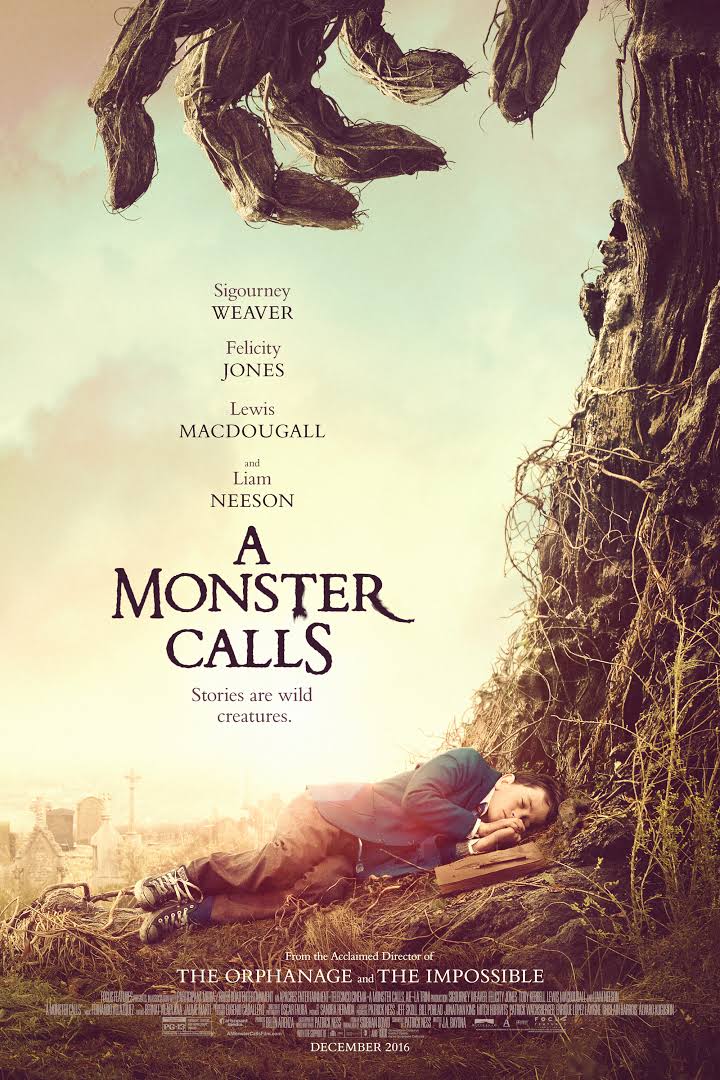
“A Monster Calls” movie review

monstercallsA breathtakingly beautiful and dynamic film that typifies the art of visual storytelling in the gothic style. Focus Features’ A Monster Calls directed by J.A. Bayona is nothing short of a Terms of Endearment, in theme anyway, for a new generation. You are certain to laugh and cry your way through the film. Based upon the novel by the same name, written by Patrick Ness and illustrated by Jim Kay and conceptualized Siobhan Dowd, Bayona’s adaptation of the novel plays out to be a deep, rich story that will touch the hearts and minds of each and everyone in the audience. For anyone going through the stages of grief, this film will especially ring true and perhaps bring about comfort. Although the protagonist Connor, played by Lewis MacDougal, is twelve years old, this dark melodrama with a plot revolving around terminal illness is not typically something that will appeal to kids of Connor’s age. Despite the fantasy elements and the young protagonist, A Monster Calls is more suited for older teens and adults; however, by the same token, the movie isn’t entirely going to initially appeal to adults since the protagonist is quite young. I screened the movie last night in an auditorium filled with patrons of all ages and there was not one dry eye in the audience. Looking at the film from the outside and analyzing the plot and cast, it would appear that it may not attract droves of people because of the gothic fantasy nature, typically aimed at kids and young teens, with content and theming best suited for older audiences; however, the film truly transcends age barriers and stereotypes to touch those who are young or young at heart.

While most twelve year old boys are busy with school and learning to develop socially or even romantically, or just simply playing video games and having Stephen King type adventures, Connor (MacDougal) is dealing with far more than a kid should every have to deal with. Connor’s mother (Felicity Jones) is very ill and Connor is forced to grow in many ways kids should not quite quickly to take care of her. Not entirely going through this terminal illness alone, Connor has a grandmother (Sigourney Weaver) who looks in on him and his mother–a grandmother with whom he shares little in common. With Connor’s father settling down in Los Angeles, Connor feels very much alone while dealing with his mother’s illness. Expressing his emotions and thoughts through water color and sketch artwork, Connor uses his penchant for beautiful art as a form of therapy. Just when all seems lost, an unexpected ally in the form of a rather gothic tree-like monster (Liam Neeson) appears in his window one night. Apprehensive at first, Connor befriends the monster who guides him on a journey of courage, truth, and faith that combine in a powerful fusion of imagination and reality.

This is certainly a year for fantastic monsters and fantasy, isn’t it? However, A Monster Calls is definitely not your typical fantasy. It deals with deep emotions, dark themes, and material usually better suited for adults. Why then choose such a young protagonist? Perhaps the author Patrick Ness wanted to reach those kids who are going through tough times and who are dealing with situation that most kids won’t face until they are much older. Some kids are just forced to grow up more quickly than others. It’s important that cinema and literature not forget them because words on pages or moving pictures may be the only source of comfort, escape, or allegory. Director J.A. Bayona appears to have successfully translated the novel to screen–from what I know. Interesting that the movie opens with the narrator describing Connor as being too old to be a kid but to young to be an adult. By extension, that is precisely where this movie fits in. It’s too “old” to be a kid’s movie but too “young” to be an adult movie. And that’s okay. Growing up is hard, and when faced with a family member or close friend with a terminal illness, life is exponentially more difficult emotionally and even psychically. Unconventional as it may seem, this film is powerful and transcends the age spectrum to provide a strong emotional journey that audiences can appreciate and from which people may receive comfort. If for no other reason, having a kid starring in a melodrama brings audiences of all ages together–many who may be going through something similar as the child, parent, spouse, or lover of someone who is terminally ill. It’s okay to grieve and let go.

From the opening credits alone, I was confident that this was going to be a visually stunning movie. The water color animation and brushstrokes are reminiscent of the story of the three brothers in Harry Potter. Absolutely beautiful. Much in the same way Kubo and the Two Strings was an innovative animated film, A Monster Calls also contains unconventional and innovative methods of telling its story. Similar to how the animated story of the three brothers in Harry Potter was integrated into the diegesis of a live action movie, so it is with this film. The more I thought about the technical and emotional elements of A Monster Calls, it is clear that it’s truly a dynamic means of cinematic art. Dynamic in that there are three different types of storytelling methods used diegetically each highlighting a different form of art: (1) motion pictures (2) visual art (3) oral storytelling. It’s been said that the novel is an extension of oral storytelling, the play an extension of the novel, and motion pictures an extension of the play. At the root of all those methods of communicating through art is the very concept of storytelling. And A Monster Calls has the art of storytelling in spades. There are so many levels to the diegesis in this film; much like an onion or matryoshka doll, this film has a message of how to deal with grief at its core but there are many different routes to get to that central theme. Each layer teaches Connor and the audience something different and valuable. The cinematic storytelling elements of direction, cinematography, editing, and score are all equally beautiful.

Structurally, A Monster Calls is an intimate story reinforced and surrounded by artistic German expressionism calling attention to its own artifice. From the exterior shots to interior rooms, the various sets appear to be meticulously constructed on a stage and the wardrobe much like perfect costumes. The art tells the story effectively with little exposition required. Fernando Velazquez’ score is so incredibly moving that you may find yourself listening to the score as it too truly assist in the overarching means of telling this story. The design of the monster is brilliant and ominous all at the same time. Almost animatronic in nature, the tree plays out like there is a puppeteer on the inside articulating the movements. The monster feels just as much like an actor as the actors playing the human characters. Liam Neeson was a perfect choice to cast as the tree’s voice. His deep bass is comforting, warm, and wise-sounding. But just who is the tree (in the story)? Although we are never told whose spirit inhabits the tree that has seen thousands of years go by, there are a couple of hints as to who it might be if you pay close enough attention to subtleties in the film. At the end of the day, whether it’s the spirit of someone or the personified life of the tree itself, it is of little consequence to the movie. Still, its definitely fun and interesting to talk about as my friend and I did after the film.

If you enjoy movies such as The Iron GiantThe Giving Tree, or Terms of Endearment, then you will immensely enjoy this film. Presently in advanced screenings and limited releases, you may need to wait a few weeks before it is at a theatre near you. Although slated for a January wide-release, it may make its way through many markets before then. Originally set for an October release, it makes since to have held it until Oscar season since this is one of those films that could grab the attention of the academy. Definitely bring your tissues.

“Nocturnal Animals” movie review

nocturnalanimalsA meta-thriller that is equally shocking, seductive, bizarre, and beautiful all at the same time. Tom Ford’s adaptation of the best-selling novel Tony and Susan (1993) will either repulse or intrigue you from the opening credit sequence. There is definitely a pronounced shock value in this cinematic erotic mystery that includes an incredible amount of symbolism and theming just eager to be interpreted and dissected. Not typically found in mainstream cinema, the avant-garde seems to be the inspiration for many films this year. Nocturnal Animals is one of those films that is destined for discussion in a film or media studies graduate class. With solid acting, writing, and cinematography, you will be sucked into this twisted mystery within the world that the wealthy live in and the real world that most of us live in. You will likely find yourself thinking about what everything means, how it might apply to you, or simply appreciate non-linear storytelling. Although the film certainly rests upon the flashback as a chief storytelling method, Ford plays his cards right and creates a film in which all three stories are equally interesting. You may have heard it said–even by me–that some good movies are poor films; but, this is a case of a good film but a poor movie. That is usually the case with films that fall into the artistic or avant-garde stylistic way of conducting a visual story that contains a strong emotional impact.

Susan Morrow (Amy Adams) is an incredibly successful art gallery owner in Los Angeles. However, the marriage to her second husband is not nearly as successful. He’s often away on business trips to New York. One evening, Susan receives a manuscript written by her first husband (Jake Gyllenhaal)–a once struggling writer and graduate student turned college professor and now professional author. She finds the novel gripping and disturbing. As she continues to pour over the pages dripping with intrigue, she is impacted on a personal level as she uses the world of the novel as a mirror on her own life. Taking her to dark places in her past, Susan finds herself on a path of self-evaluation as she is presently going through emotional and financially hard times.

Cognitive cinema. Focus Features’ Nocturnal Animals is one of those films that requires higher thinking in order to truly appreciate the symbolism and theming. Not that it cannot be enjoyed as a beautifully dark and disturbing story, but there is so much that can be analyzed in this film. From the sequence of obese nude females dancing with sparklers, ringmaster hats, and cheerleader regalia to the reoccurring imagery of crosses and death–both in terms of emotional and physical–director Tom Ford provides audiences with a film that can only be characterized as a mystery that is meta-thriller meets hints of erotica. Even now, I am analyzing the symbolism and theming as I write this review. There are so many elements to talk about. And I think that is the best part about a movie like this. Don’t watch it alone. Not because it is too intense or scary but because you will want to talk to someone about the theming or emotional commentary. I find myself with a deep desire to analyze the film with someone, but none of my friends or colleagues have seen it yet. Visually driven. Even without the dialog, Ford’s Nocturnal Animals can be understood through the imagery in and of itself. Trace amounts of Tom Ford’s legacy as a high fashion designer can easily be seen in the design of this film. And I am not just talking about Adams’ stunning wardrobe and hair/makeup. In many ways, this film–as a whole–is symbolic of high fashion clothing. It can be read in some of the same ways fashion is read and appreciated. Because this is only the second feature length film from Ford, there are elements of the story that give the impression that his talent for visual storytelling is still in the development process as there are times that his method of directing is that of an observant student or scholar of cinema.

There are three distinct narrative threads in this film. (1) is the main story that we open up to at the interpretive and conceptual art exhibit establishing Susan, her gallery, her husband, and lavish lifestyle (2) is the narrative of her first husband Edward Sheffield (Gyllenhaal)’s novel Nocturnal Animals and (3) is the story of the rise and fall of the relationship between Susan and Edward. Juggling three plots is no easy task. Contrary to how it may appear, the narratives are not confusing or incoherent. Each plays an important role in the overarching theme and story of the film. The incoherency is found in the interpretation and analysis of what everything means. It’s as if the film is providing the audience with puzzle pieces that can be arranged to depict something different for everyone. Perhaps you want to read the film as commentary on the relationship between Susan and Edward. Maybe you view it as symbolic of the estranged relationship between Susan and her current husband. Or maybe the novel is self-reflexive of the life Susan has created for herself.

Each story is stylized in such a way that they complement one another–do not necessarily correlate or match each other, but the narratives are complementary. Although the audience is asked to draw their own respective conclusions to the story, presumably Susan’s once lavish and charmed life will continue to rot and crumble as her husband is likely cheating on her just like she cheated on Edward. Still, there is a lot left up to interpretation in the best possible way. The Roger Ebert website review of this film commented that there are parallels between this film and Alice Through the Looking Glass. Fascinating take on this film. That is probably the best analogical interpretation of Nocturnal AnimalsLooking at the film in such a way that Susan is Alice and the two other narrative threads are her adventures in Wonderland opens a whole new window through which to view the events as they unfold. On the surface level, there is a clear theme of revenge woven throughout the plot. This is indicated by a painting that catches Susan’s attention on her way to a board meeting. The metaphysical thrilling aspect to the subplot of revenge is the revenge the past has on the present and the present on the past. In a manner of speaking, Susan is listed by ghosts of her past, present, and future. Okay, perhaps not in the same way Scrooge was visited, but there are certainly some commonalities.

If you enjoy films that make you think, then this is definitely one to watch! As it was on a limited release until this weekend, you may not have heard of it but look for it at your local movie theatre. Fans of Blue Velvet will likely enjoy this film as well. Intriguing writing, solid acting, and beautiful cinematography make this a fascinating movie to prompt deep discussions afterwards.


Disney’s “A Christmas Carol” (2009) movie review

d_a_christmas_carolAn exhilarating visual array of breathtaking motion-capture animation with a touch of the macabre! Disney’s A Christmas Carol directed by Robert Zemeckis is an outstanding adaptation of the literary classic. Instead of attending the cinema this week, with the box office offerings on the anemic side as we gear up for the bulk of Oscar season heavy hitters, I decided to rewatch Disney’s A Christmas Carol. Charles Dickens’ masterpieces have long sense been a source of inspiration for film adaptations of literature. Specifically, A Christmas Carol was actually one of the earliest films period–let alone adaptations. The first adaptation of A Christmas Carol was a British film in 1901 titled Marley’s Ghost. This classic work has been adapted for film, theatre, radio, and television more than 100 original/separate times, collectively. But why??? Why this novel? Quite possibly, this single work of literature has been brought to life for the stage, speaker, or screen more than any other with only a few possible exceptions. Perhaps, because it is simply timeless–transcends all generations. Writer-director Robert Zemeckis showcases his ability to put his spin on the timeless tale by perfecting the motion-capture animation techniques that made his adaptation of The Polar Express so visually stunning. Although Patrick Stewart’s Scrooge in the TNT original movie from 1999 is my favorite Scrooge, I feel strongly that Zemeckis’ film is closest adaptation to the spirit of the novel and brings it to life in the way Dickens himself may have imagined.

London may be anxiously awaiting the arrival of Christmas Day, but the old miser Ebenezer Scrooge (Jim Carrey) could not care any less. He much prefers the company of his money and micro-managing his humble clerk Bob Cratchit (Gary Oldman) at his counting house. After begrudgingly allowing Cratchit to have Christmas Day off, Scrooge heads home. Upon arrival to his stately but lonely townhouse, Scrooge encounters the ghost of his dead–and there is no doubt about that–business partner Jacob Marley (Oldman). In an effort to spare Scrooge his horrifying fate, Marley informs Scrooge that he will be listed by three spirits (Carrey). The ghosts of Christmas past, present, and yet to come respectively take Scrooge on a terrifying journey through his his life in hopes of transforming his selfish bitterness and embrace the selfless love and joy of Christmas.

Prior to analyzing this adaptation, as it is a story most of us know and cherish, I’d like to look at why. Why has this work of literature been adapted for nearly every storytelling medium? The short answer is that it is a story that is as relevant today as it was in the 1800s. Much like with his other masterpieces, Dickens captures so much about the human condition, in what amounts to a short story. The novel is not terribly long. With many in the U.S. feeling as though, much like in Dickens’ world, that we are being divided up into the rich and poor, this novel rings especially true. In fact, there are definitely high profile people in our economy echoing Scrooge’s words “have we no prisons; have we no work houses???” Not that we have a physical debters’ prison or work houses (in the old fashioned sense), but there are certainly elements of our society which parallel them. The story hits close to home for many. Furthermore, the novel, and subsequent adaptations, are regarded so highly because Dickens encapsulated every aspect by which mankind judges one another: past, present, and future. This is the foundation of a single person or people as a unit. Through Scrooge, Dickens shows us that if we look at our past, present, and future, then we can see the impact we have on those around us and even ourselves. By seeing how we really are, we can make the decisions to develop an approach to change ourselves to be about the business of mankind.

Interestingly, the ghosts show Scrooge how Christmas past was a time of magic (although it ended in heartbreak for Scrooge), Christmas present depicts how commercialism and greed have all but wiped out the magic with a glimmer of hope as shown by Cratchit and Fred, and Christmas yet to come shows Scrooge–and us–a world without the magic of Christmas: a world that we created. Another reason why this story is so powerful is because Dickens wrote the character of Scrooge to be a complex, multi-layered human who acts very much like a mirror to many of us. On the surface, he looks like a stereotypical old miser, but after looking into his past, we are given a glimpse of how he evolved–not unlike many of us. This story is also powerful for those who recognize the religious origins of Christmas or not. The focus of the story is on generosity, hospitality, love, compassion, as well as selfishness, greed, and sociopathy; but, it very much includes and makes reference to the religious underpinnings of this special time of year. Simply stated, this is a dynamic story of redemption that transcends generations of people.

Zemeckis’ adaptation is a beautiful usage of 3D storytelling technology. Ordinarily, I am not a fan of 3D movies, but this one is an exception for sure. I did not watch it in 3D last night, but I remember watching it in 3D when it came out in 2009 at the [then] Downtown Disney AMC. Zemeckis is one of few directors who knows how to use 3D effectively without it seeming like a gimmick. His use of 3D in A Christmas Carol greatly enhances the visceral appeal of the movie. One of the principle differences between this and other adaptations is just how supercharged it is with visual effects, intense chase scenes, and flying through the street of London. But, as Scrooge himself acknowledged, spirits can do anything–they’re spirits. Zemeckis does not hold back on the dark elements of the story. If you have read the novel, you will recognize that there are very dark parts. In many respects, A Christmas Carol is a supernatural horror film. After all, how else was Scrooge going be so scared that he would make a 180 and change his miserly ways???

It’s no surprise that Jim Carrey can be seen in the character of Scrooge; however, it is not as apparent that he is the infrastructure of the look of the characters he voiced, as was the case with Tom Hanks’ characters in Zemeckis’ The Polar Express. And this trend is even less apparent with Firth’s, Oldman’s, and Wright’s, respective characters. I love Zemeckis’ embrace of the macabre mood of the story. So often, adaptations of this story lose the very horrifying elements that absolutely terrify Scrooge. Although I remember hearing parents comment that this version was too scary for their kids, I think that having a version that is skewed towards teens and adults was important. Another great element in this film: the score! Alan Silvestri’s score sneaks in some traditional Christmas carols, but you have to listen for such as “God Rest Ye Merry, Gentlemen” when its distinctive cadences turn sinister during a perilous flight through London.

There are few Christmas movies that capture the spirit of the season better than A Christmas Carol. Zemeckis’ adaptation is my pick for best translation of page to screen. The cinematic excellence of Disney storytelling is woven throughout this film and makes for a thrilling journey. If you are planning to watch some Christmas movies this holiday season, I highly recommend this version of A Christmas Carol. But if you have very young children, it may be a little too scary for them. Whether you are young or young at heart, the magic of Christmas rings all too loudly in this timeless story brought to screen once again.