UNWELCOME horror movie review

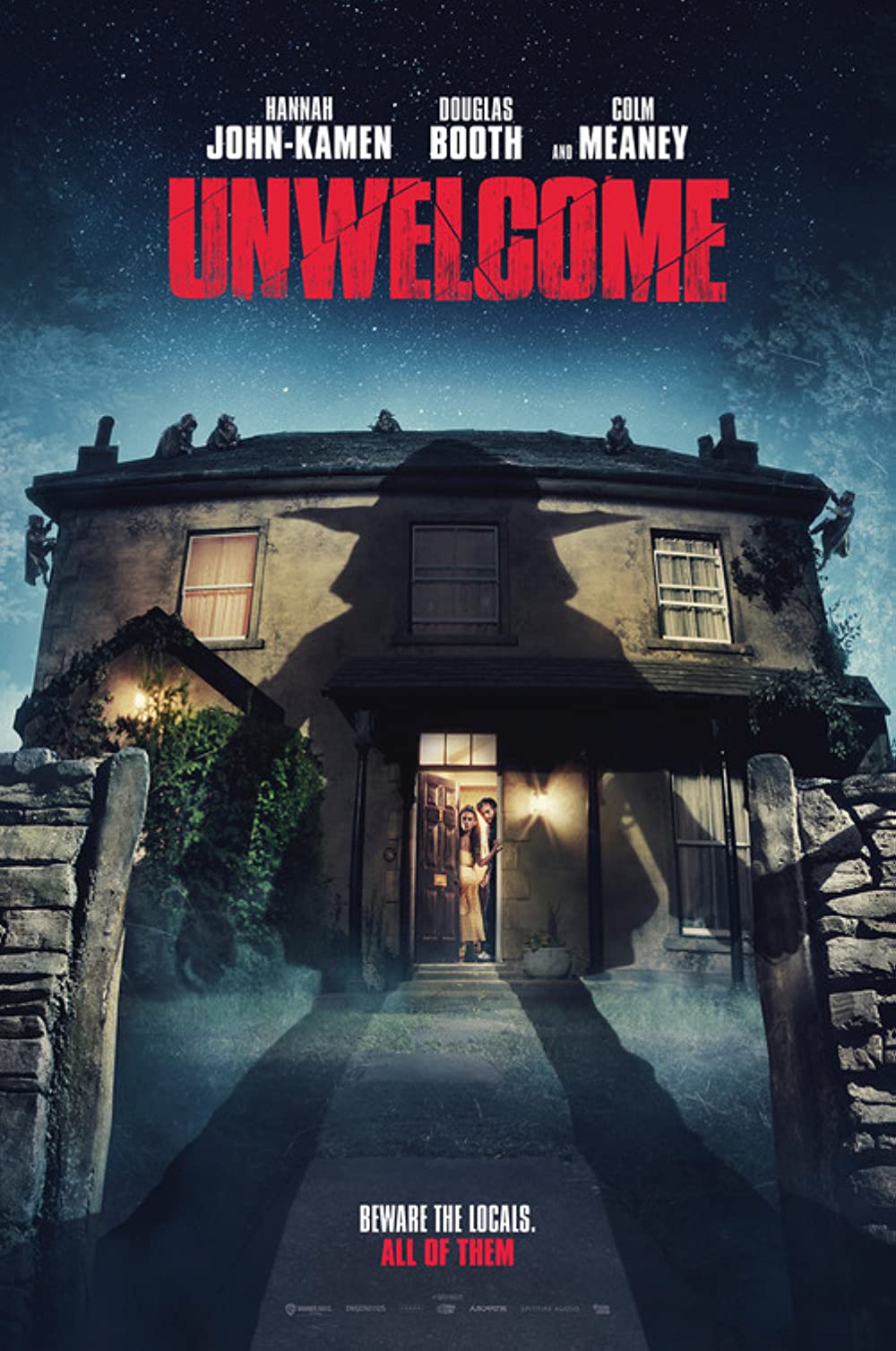
Whimsical and creepy. Jon Wright’s Unwelcome is a dark fantasy steeped in Irish folklore, but with a sinister spin. While the first act is a bit clunky, after the intense prologue that is, once the second act kicks into gear, the movie delivers on thrills and kills—and cheers for practical effects!! Fellow Trekkies will also enjoy the cameo from Star Trek’s Chief O’Brien.

A couple escape their urban nightmare to the tranquility of rural Ireland, only to hear stories of mysterious creatures who live in the gnarled, ancient woods at the foot of their garden. As warned by their new neighbors, the creatures come when called to help souls in dire need of rescue, but it’s crucial to remember that there’s always a dear price to pay for their aid.

Unwelcome draws audiences in with its immersive atmosphere and chilling mythos, but falters in pacing. After a gripping prologue, the first act struggles to find its footing to keep the pacing suitable for the rest of the setup. Often times this screenwriting problem occurs when the writer and/or director attempts to add greater gravitas to the story than is required or needed. Moreover, there is time spent with side characters and establishing setting that delays the transition to the development stage of the story, which would have benefitted the overall pacing of this quasi-methodical horror film. Once audiences are launched into the second act, the remainder of the film unfolds nicely.

Even though this is in-part a dark fantasy, when the kills hit, they hit! Wright (along with cowriter Mark Stay) strike a fantastic balance between horror and fantasy, simultaneously satisfying the expectations for both. While the kills may not be inordinately creative, they are sufficiently entertaining. By relying on practical effects, the experience of the film increases in dimension significantly. And I’m not just talking about the kills, but the excellent puppetry, makeup effects, and prosthetics of the little people. Over all, Unwelcome is a decent horror film that deserves a watch if you enjoy folklore-based stories that are familiar yet still find ways of surprising you.

Ryan teaches Film Studies and Screenwriting at the University of Tampa and is a member of the Critics Association of Central Florida and Indie Film Critics of America. If you like this article, check out the others and FOLLOW this blog! Interested in Ryan making a guest appearance on your podcast or contributing to your website? Send him a DM on Twitter. If you’re ever in Tampa or Orlando, feel free to catch a movie with him.

Follow him on Twitter: RLTerry1 and LetterBoxd: RLTerry

COCAINE BEAR horror movie review

Bonkers fun! Cocaine Bear is just what you imagine it to be: no holds barred carnage meets slapstick campy comedy. Inspired by the true story of a drug run gone wrong, this movie will keep you laughing from beginning to end. When it comes to the bear carnage, it’s delivers in spades; but, suffice it to say, the human characters are mostly annoyingly flat and uninteresting, save discount Officer Winslow. That’s not to say that you’ll be underwhelmed–quite the contrary–I’ve little doubt that you won’t laugh as much as I did! If you’re a fan of horror comedies, you’ll likely find Cocaine Bear to be in the vein of the brilliant Tucker and Dale vs Evil, but ultimately less cleverly written.

After a 500-pound black bear consumes a significant amount of cocaine and embarks on a drug-fueled rampage, an eccentric gathering of cops, criminals, tourists, and teenagers assemble in a Georgia forest.

Directed by Elizabeth Banks and written by Jimmy Warden, audiences will encounter a movie wherein the bear scenes were written first, and received the most care, while the human characters and stories mostly received demonstrably less care and attention. Fortunately, there are a couple of human characters that were crafted with more care, but most of them are flat and lifeless. Moreover, few of the characters will prompt you to care enough about their survival, and you’ll mostly be rooting for the bear.

If you’re interested in the true story upon which this movie is based, in real life, the bear OD’d after consuming the massive amounts of cocaine. That’s it. In fact, you can see the bear, wearing a hat, on display in a Kentucky mall. This presents the best possible setup for this movie, because the inciting incident is true, while everything else is completely fictionalized. This vast creative latitude is the perfect canvas on which to paint this wild and crazy movie! Cocaine Bear may not be one that earn the rewatchability that Tucker and Dale does, but it’s certainly one to watch on the BIG SCREEN with a group of friends, and just turn you brains off to enjoy the highly entertaining spectacle.

Come for the ridiculous setup and stay for the hilarious kills! From the moment the movie opens, you are queued into the story and antics you are about to encounter in the wild. But this movie would not be nearly as entertaining if it wasn’t for the heavy dose of comedy to act as an emotional reset between the kills. Everything about this movie’s plot is utterly ludicrous. And the character mix is equally bonkers. Wherein the movie could’ve be stronger is in the various character subplots and dialogue, and the human characters could have been more interesting.

But all in all, it’s a fun movie that will make you laugh and even jump!

Ryan teaches Film Studies and Screenwriting at the University of Tampa and is a member of the Critics Association of Central Florida and Indie Film Critics of America. If you like this article, check out the others and FOLLOW this blog! Interested in Ryan making a guest appearance on your podcast or contributing to your website? Send him a DM on Twitter. If you’re ever in Tampa or Orlando, feel free to catch a movie with him.

Follow him on Twitter: RLTerry1 and LetterBoxd: RLTerry

KNOCK AT THE CABIN movie review

Knock on a different cabin. M.Night Shyamalan’s latest horror film Knock at the Cabin attempts to explore thoughtful themes but the storytelling is clunky due to the poor plotting and contrived character development. Moreover, this is a case wherein film form is employed as a tool to compensate for underdeveloped meaning and story structure. Where the film excels is in the characters and casting. Yes, the character development is contrived, but I appreciate Shyamalan’s character mix. In particular, it’s a refreshing mix because the fact the parents are a same-sex couple doesn’t factor heavily into the plot nor become a sermon, like it so often does. It simply is and that’s it. Furthermore, the casting of not only the central parental couple, but all of the characters shines because of the realistic representation of everyman. Bautista is provided a platform to portray a much different character than he has in the past, which is fantastic to witness! He is given an conduit through which he can more freely exercise his acting chops. Visually, the film is striking; there is an emotive dimension to the montage of the motion picture and the cinematography. Again, the film form is outstanding! Unfortunately, the screenplay is lacking the same degree of thought that was found in the technical approach to crafting this film.

While vacationing at a remote cabin in the woods, a young girl and her parents are taken hostage by four armed strangers who demand they make an unthinkable choice to avert the apocalypse. Confused, scared and with limited access to the outside world, the family must decide what they believe before all is lost.

Knock at the Cabin excels in montage and cinematography because of how the eye of the camera oscillates between subjective and objective placement, much in the same way our own eye (and mind’s eye) operates in real life. Treating the camera as our own eyes allows Shyamalan a brilliant opportunity to bring the audience into the narrative. Unfortunately, this is hampered by the clunky storytelling. However, because of the stylistic choices for camera placement and scene framing, the film is successful in delivering an unsettling mood and suspense with the camera (in a Hitchcockian manner). Furthermore, the film proves to be exemplary in the area of montage (or dramatic film assembly) demonstrated by the stylistic choices that provide the film with steady pacing and guiding our focus from character to character or scene to scene. While the story may be lacking refinement, the editing crafts a visual narrative that is lean and mean.

Struggling narratively, the film fails to sufficiently provide thoughtful critique (or commentary) on any area on which it concerns itself. I don’t mean to sound vague, but to discuss the themes, symbolism, or commentary would require me to divulge spoilers. What I can say, without getting into spoilers, is that there is an attempt to critique: preconceived opinions or judgments of people, willful disbelief in the face of evidence, and toxic ideologies. I appreciate what Shyamalan set out to accomplish; it’s clear that this film was supposed to be a vessel to foster conversations about the themes and subtext, but no single area of theme or subtext was setup or developed adequately. We receive glimpses in the dots Shyamalan attempted to connect, but they are glimpses at best. Flashbacks are used as a tool to provide clarity on present conflicts, but that (often abused) storytelling tool is wielded ineffectively and wastefully.

Ryan teaches Film Studies and Screenwriting at the University of Tampa and is a member of the Critics Association of Central Florida and Indie Film Critics of America. If you like this article, check out the others and FOLLOW this blog! Interested in Ryan making a guest appearance on your podcast or contributing to your website? Send him a DM on Twitter. If you’re ever in Tampa or Orlando, feel free to catch a movie with him.

Follow him on Twitter: RLTerry1 and LetterBoxd: RLTerry

M3GAN horror movie review

Old school plot meets 2020s world. Universal and Blumhouse’s M3GAN sets the bar high for 2023 horror movies. Solidly written, this horror movie proves that some ideas and themes are simply timeless! M3GAN can be read as a cautionary tale of the terrors of technology. Moreover, a closer reading reveals that it also concerns itself with an exploration of the responses to grief, sudden life change, and fears of parenting. While the movie takes itself seriously, the conflict and violence is done for laughs–and it certainly delivers both chilling and laughable moments! I can easily see it becoming a house at a future Halloween Horror Nights at Universal Orlando and Hollywood.

A robotics engineer at a toy company builds a life-like doll that begins to take on a life of its own. Short synopsis, but that’s pretty much it. Simple, yet effective storytelling.

From the 1930s to the 1950s, horror/sci-fi movies were often about the dangers of technology. Ultimately, it can be boiled down to fear of the unknown, but this exploration of when technology rebels against its creator is a premise that remains timeless as technology is always changing. Back in the early to mid 20th century, it was robots; and here we are in the 21st century, and it’s still robots (well, more accurately androids or AI). The possibility of intelligent robots turning on us has always stoked fear because of the loss of control. Even in Terminator and Terminator 2, we witness the attempt to wipe out humanity. I appreciate this movie’s premise and themes for taking direct inspiration from and paying homage to all the horror-scifi movies to comes before it that fall within this subgenre of horror.

M3GAN reminds me of a feature length episode of Black Mirror or The Twilight Zone. Written by Akela Cooper (writer of Malignant), the pacing and structure are lean and never lag; however, there are elements of the story (provided by James Wan) that should have been better developed. These shortcomings do not significantly impact the movie’s immense enjoyment factor. Where the film most noticeably struggles is in the direction by relatively new director Gerard Johnstone. That’s not to say that it’s poorly directed–not at all–but had the directing been stronger, the performative dimension would have benefitted. Still, I’m eager to continue to follow Johnstone as he develops as a director.

Universal and Blumhouse take the terror of a killer android and place it within a child’s toy. Again, this isn’t new, but it is a new approach to the Talkie Tina episode of The Twilight Zone or Child’s Play. Much like Black Mirror was a better Twilight Zone than Jordan Peele’s Twilight Zone remake, M3GAN may be a better Child’s Play than the remake/reboot of Child’s Play from 2019. I haven’t rewatched the Child’s Play remake since it released, so I will be careful not to presume M3GAN to be better. But my gut reaction is that I enjoyed this movie more than the quintessential killer doll legacy property.

Beneath the outside/action plot of the self-aware killer robot, are themes of grief/loss and parenting fears. After Katie loses her parents in a tragic car accident, she is placed under the guardianship of her (moderately) estranged aunt Gemma whom is an engineer for a Funko-like toy company (in the movie, the toy company is named Funki). Clearly, Katie’s aunt is uninterested in being a parent–she wasn’t even interested in being an aunt–but Katie has nowhere else to go except to her father’s weird family in Jacksonville, FL. So Gemma reluctantly becomes her guardian. Where the film is particularly fascinating, in the area of commentary on parenting in the 2020s, is Gema and Katie’s interactions (or lack thereof) with one another.

Gemma takes an analytical approach to parenting by identifying logistical problems and providing measurable solutions. When Katie doesn’t respond as anticipated, Gemma is at a loss as to what to do. Gemma lacks the empathy and emotive responses that a parent (biological or adopted) needs to exhibit when rearing a child. Gemma’s life plan was abruptly interrupted and introduced to dynamics over which she had little control. In her desire to control, she builds M3GAN as both a groundbreaking toy and as a surrogate parent-like figure in Katie’s life. Through the events of the movie, Gemma learns that there is more to being a parent than providing food, shelter, clothing, and companionship. Furthermore, this serves as a cautionary tale of parents turning child rearing and education over to technology. Without human empathy, critical thinking, and intuition, a child’s cognitive and social development may be warped.

The other area on which this horror movie provides commentary is on grief/loss. Not a new theme in horror movies, it is explored in a new way in M3GAN. Katie suffers the worst loss a child can: the death of both parents. Because of the lack of real empathy and emotive care from aunt Gemma, Katie forms an unhealthy attachment to M3GAN. Because Gemma and Katie never talk about what happened (and the therapist is pretty much useless), Katie never goes through all the stages of grief and therefore never processes (to what extent a child can) the tragedy and how to move forward. M3GAN provides that which is (and should be) provided by parents and friends, but as the events of the movie unfold, we learn just how dangerous that attachment can be for Katie and those around her.

While the writing is mostly strong (save a couple of setups that aren’t followed through in a substantive way), the direction is weak in places. Over all, fairly well directed. But the performative dimension is where the movie struggles. Even though some of the characters are more-or-less caricatures of types of people we have in our lives, there are several scenes in which the performances aren’t campy enough to be funny nor are they realistic enough to be taken more seriously. Some performances fall somewhere in the middle. Perhaps it’s a casting issue, but this is where a director needs to be strong enough to get the appropriate performance out of the actor.

For those that are so often worried about a horror movie with a PG-13 rating (a sentiment that I’ve never understood), rest assured that M3GAN is wildly entertaining and, yes, you still get some fun kills and bone-chilling scenes. That said, I imagine that there will be an unrated or R-rated release of the movie on BluRay. If this movie is an indicator of that we are to expect from 2023 horror, it may be a banner year! Only time will tell, but regardless, it is one that horror fans are sure to enjoy!

Don’t wait for M3GAN to his Peacock or Prime, if you’re a horror fan, then you want to see it on the big screen! You’re definitely in for a wild ride that will have you jumping and laughing.

Ryan teaches Film Studies and Screenwriting at the University of Tampa and is a member of the Critics Association of Central Florida and Indie Critics of America. If you like this article, check out the others and FOLLOW this blog! Interested in Ryan making a guest appearance on your podcast or contributing to your website? Send him a DM on Twitter. If you’re ever in Tampa or Orlando, feel free to catch a movie with him.

Follow him on Twitter: RLTerry1 and LetterBoxd: RLTerry

THE PALE BLUE EYE period mystery review

The unsettling atmosphere will transport, while the macabre mystery intrigues. Scott Cooper’s The Pale Blue Eye is both a period murder-mystery drama and serves as an imaginative origin story for Edgar Allan Poe. With skeletons in every character’s closet, the enigma of a mystery will beckon audiences to solve the mystery along with Christian Bale’s character. Based on the novel by the same name, the film adaptation is in the same vein as The Cursed from earlier this year and Antlers from last year. Both of which are among my favorites of the last two years. So, if you liked either of those films, you will mostly likely enjoy this one as well. In addition to the aforementioned, the film also reminds me a little of Tim Burton’s Sleepy Hollow (1999). Unlike the film’s to which I have likened this one, The Pale Blue Eye is heavier on mystery than it is horror. While Edgar Allan Poe’s short stories and poems have been the inspiration for hundreds of films, and his writing itself, foundational in the development of the American Horror Film (expressionism+surrealism+Freud+Poe), this is one of few films that feature Poe himself–or rather–a fictionalized version of the towering literary figure. What I appreciate about this imaginative origin story is showing a different side to Poe–a side that is actually funny and quirky. Because this is a mystery, I am unable to discuss details as that could spoil important plot points. But it’s important to note that this film’s mise-en-scene strikes a balance between one that is concerned with atmosphere and proper plotting. So often, films that are heavy on atmosphere are lacking in the story-structure department, but not this one. Despite the runtime of 2-hours, no scene ever lingers too long. If you enjoy period murder-mysteries, then you’ll undoubtedly enjoy this film. The Pale Blue Eye hits cinemas on December 23rd and Netflix on January 6th.

Ryan teaches Film Studies and Screenwriting at the University of Tampa and is a member of the Critics Association of Central Florida. If you like this article, check out the others and FOLLOW this blog! Interested in Ryan making a guest appearance on your podcast or contributing to your website? Send him a DM on Twitter. If you’re ever in Tampa or Orlando, feel free to catch a movie with him.

Follow him on Twitter: RLTerry1