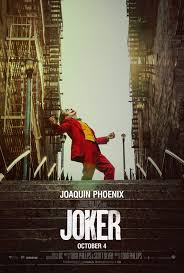
 A truly phenomenal motion picture with a tour de force lead performance and relevant social commentary for today’s audience. Warner Bros’ highly anticipated Joker opens everywhere this week. Once again, we get an origin story of Batman’s favorite nemesis. Only this time, it’s told through an extremely heavy film that is less about the violence, that so many seem to be fixated on, and more about the unapologetic character study of someone whom has suffered egregious psychological and physiological trauma at the hands of those whom are supposed to be loving caregivers, friends, or mental health professionals. Prepare yourself to go down the rabbit hole of the mind of a madman in this no holds barred exploration of the far reaching effects of untreated trauma, grief, and schizophrenia. From a critical perspective of analyzing this as a motion picture, I find there is so much to admire! If I was to grade this film on a 1 to 10 scale, it would honestly be 8s, 9s, and 10s across the board. But you know what, if I am to be perfectly candid with my readers, I did not particularly care for the story, lack of likable characters, or even this iteration of The Joker. While I cannot deny the critical achievement of this motion picture (or film), as a movie, I did not care for it. I know some may use the terms film and movie interchangeably, but I often differentiate between them when drawing a distinction between art and entertainment. Some movies are both. For example, since we are in the Batman universe for this one, I will point out that my favorite Batman movie is equal parts film and movie, an “arthouse film masquerading around as a superhero movie,” and that would be Batman Returns. Even after watching Joker, my favorite iteration of the iconic character is still Jack Nicholson’s in Batman (89). That being said, Joaquin Phoenix is acting circles around Jack in this film and blows us away with his spectacular performance as this version of Joker.
Forever alone in a crowd, failed comedian Arthur Fleck (Joaquin Phoenix) seeks connection as he walks the streets of Gotham City. Arthur wears two masks — the one he paints for his day job as a clown, and the guise he projects in a futile attempt to feel like he’s part of the world around him. Isolated, bullied and disregarded by society, Fleck begins a slow descent into madness as he transforms into the criminal mastermind known as the Joker. (IMDb)
This film is extremely heavy. Usually I don’t make it a point to mention that element of a film; but in the case of this one, it is important that you go in knowing what’s in store for you. Joker is both a character study and an exploration of our present day society as viewed through a 1980s lens. It also sets up Batman, but that is only a small part of this film. Prior to reviewing the performance of Phoenix, I feel it’s important for me to mention that I don’t see him as portraying The Joker as much as I do an authentic, genuine, terrifying madman. It’s no surprise to my readers that I prefer the Burtonverse to the Nolanverse when talking Batman, so my Bat-par is set by 89 and Returns. Nicholson is the standard against which I measure up all other iterations of Joker. And suffice it to say, Joaquin Phoenix’ Joker is not Joker. A brilliant performance as a sociopath, a psychopath, or just plain crazed serial killer with a sordid past brought on by unimaginable trauma, YES; but “Joker,” he is not. Joker is not just a madman, he’s an intelligent, calculating, organized crime boss with a penchant for murder and mayhem that is told through exemplary, if not sinister, showmanship! At the end of the day, Joker is an entertainer. We love to watch him on screen, and even root for him sometimes. There is little reason to root for this Joker. He may start out as an underdog who kills two men in defense; but then starting with the third victim, he is just interested in killing, anarchy, and watching the world burn. He lacks what we love about this iconic villain, and for that reason, I do not feel that this he IS Joker.
While I may not see Phoenix as portraying The Joker (and this has much more to do with the screenplay than his performance), his performance as this madman is off-the-charts great and could possibly be the best performance delivered by Phoenix ever. There is an unapologetic, candidness about this performance that feels incredibly genuine–no pretense about it. Phoenix is 110% committed to this character and stays true to Arthur Fleck the entire time. He is vulnerable and terrifying all at the same time. When analyzing the performance of Phoenix, I am reminded of Norma Desmond’s lines from Sunset Boulevard when she states “my eyes, I can say anything with my eyes” and “we didn’t need dialogue, we had faces.” Phoenix could have played a mute Arthur Fleck, and we would still have known precisely what he was thinking and more importantly feeling. He embodies the sage screenwriting words of “dramatize, don’t tell.” Phoenix is consistently committed to the character of Arthur Fleck from beginning to end. And I say “Arthur Fleck” because I don’t believe him to be portraying The Joker. In an exchange on Twitter with my friend Jeremiah that I had (as I was writing), I was reminded of what I learned in geometry, “every square is a rectangle, but not every rectangle is a square.” From that we can extrapolate that a theory could be “every Joker is a madman, but not every madman is The Joker.” I’ve seen a lot of great performances over the decades, but I can honestly say that this lead performance by a male actor is among the best I’ve ever witnessed. Perhaps Nicholson is still my favorite Joker, but Phoenix’ Joker is certainly the most realistic portrait of the descent from slightly crazy to utter destructive madness to the point that one laughs as the world implodes around them.
Joker is rich with poignant thought-provoking social commentary on our current state of affairs (albeit exaggerated) as the divide between the rich and poor is growing ever so rapidly. Just as American Psycho used the self-centered, consumer-centric, self-indulgent late 1980s to comment on the late 90s//early 2000s, this film also uses the early 1980s lens to comment on the late 2010s/early 2020s. The choice to use the early 1980s as the setting isn’t only because 80s is popular right now, what with Stranger Things, American Horror Story 1984, IT, and more, it’s because it was a highly transitional time in the country. The 1960s was pretty much peaceful, the 1970s was experimental that turned chaotic, and everything came to a head in the early 80s before the economy turned around and the late 80s ushered in the bountiful, progressive 1990s. So the choice to set this film in the inner city of the early 1980s allows it to comment on similar issues that are plaguing us today. Perhaps not to this extreme, but we encounter conflicts that parallel the ones outlined in the film. Instead of treating mental illness, often our society masks it with medication or hides it from view to deal with it later (only later never comes). The rich just keep getting richer, and the poor just keep getting poorer, all while the rich blame the poor for their circumstances and standby and watch the lower rungs on the ladder just fall off; survival of the fittest, one might say. Self-centeredness runs rampant throughout the streets of Gotham as it does in our own cities and towns today. Everyone is so concerned with themselves that they stop to think about building a community that builds up one another to construct a society that is just as much about the quality of life for its citizens as it is the produces and services it can crank out. How do you view our world? As a factory or as a community?
I wish I had known just how heavy this film was going to be before I watched it, as I was not prepared for how dark it was. There are no moments of levity in this film, which I find to be particularly dangerous for audiences. As a screenwriting lecturer, I remind my students that it’s important to use levity strategically even in dark dramas or horror movies. It serves the purpose of not leaving the audience in a depressed state and allows for the writer to deliver an impactful punch when the audience least expects it. Levity relieves negative stress and resets the emotional barometer. I was feeling so oppressed by the tone of this film that I nearly left the cinema because I couldn’t’ take the darkness anymore. And that says a lot, considering that I watch a lot of dark movies and TV shows. Beyond the absence of levity, there aren’t any likable characters. To put it bluntly, everyone is an asshole. The treatment of everyone’s fellow man is despicable. It’s important for a film to establish one or more characters that the audience can identify with and even root for, but I find that everyone is so unlikable that I cannot connect with any of them. Yes, those whom have experienced trauma will likely identify with Arthur, but even he offers nothing redeeming or endearing. Unfortunately, Joker is a film that I may never watch again, despite praising it for its critical achievement as a motion picture.
If you are searching for a film that offers a prolific amount of content for purposes of a character study or cinematic study, then this is an excellent one to put on your list. Personally, I did not care for the story even though by all measurable accounts it’s a great film. But I suppose sometimes there comes along films that we acknowledge for their artistic and critical achievement but do not necessarily need to see again.
Ryan teaches screenwriting at the University of Tampa. If you like this article, check out the others and FOLLOW this blog! Interested in Ryan making a guest appearance on your podcast or contributing to your website? Send him a DM on Twitter or email him at RLTerry1@gmail.com! You can catch Ryan most weeks at Studio Movie Grill Tampa, so if you’re in the area, feel free to catch a movie with him!
Follow him!
Twitter: RLTerry1
Instagram: RL_Terry

 Worth the wait! Whereas some sequels try to imitate the original, Zombieland: Double Tap functions as a hilarious companion piece to the original. Perhaps the plot isn’t as compelling, and lacks the social commentary of the original, but you will undoubtedly have a fantastic time watching this movie. Personally, I enjoyed it even more than the first one. Believe me, I was as shocked as you are right now. If you loved the chemistry between all the characters in the first tone, you will be delighted to know that the characters are just as strong thanks to the return of the original writers and director! To be fair, this doesn’t function as a stand-alone movie, and needs the relationship with the original for much of the humor. However, as I mentioned, this is a companion piece to the first one. There is demonstrable growth witnessed in our ensemble case of central characters, but they aren’t the only ones to have developed off screen over the last decade. Hoards of new zombies have evolved that pose quite the threat to our favorite zombie hunters. In addition to encountering new zombies, we are introduced to some new human survivor characters as well. While this movie may not be as deep as the original, it does a great job of driving home the message of the importance of family. Even when your family is make-shift, the needs for love, acceptance, and even independence are still the same. Highly recommend for fans of the original! Be sure to stay for the end credits scene featuring Bill Murray.

 R.L. Terry ReelView