Liebster Award

liebster

To my surprise, I was nominated by REMCO of the blog The Silver Screen Savant for the Liebster Award! Thank you very much 🙂

The Liebster Award is an award for bloggers. It helps to discover new blogs and to build a sense of community in the blogging world!

Okay, So Here are the Rules:

  • Thank the blogger(s) who nominated you
  • Answer the 11 questions the blogger gives you
  • Nominate 11 bloggers that you think are deserving of the award
  • Let the bloggers know you nominated them
  • Give them 11 questions of your own

QUESTIONS from REMCO

– If you could only read one genre for the rest of your life, what genre would you choose? Ashamedly, I don’t read books for pleasure. I do, however, have a great deal of books. But, I look at them as furniture. In order to satisfy the inquiry, I could enjoy reading mysteries for the rest of my life.
– What is your favourite book and why?
My favorite book is easily Charles Dickens’ A Christmas Carol because the writing is excellent, the characters are each unique and strong, and the message is timeless. It will forever be a testament to not allowing the commercialism of Christmas overshadow the magic of the season.
– Which writer inspires you the most?
That is a close call because there are two writers that have always been inspirational to me: Charles Dickens and Dr. Seuss (Theodore Geisel).
– What was the first book you ever read?
I am unsure. However, if I was to make an educated guess, I would say How the Grinch Stole Christmas.
– Who is your favourite character from any book, movie, tv show etc. and why?
Quite the broad question. Hmm… My favorite character amongst all formal storytelling methods would be Scrooge because he is each and every one of us at some point in our lives in a given situation. He also established a character arc that is used as a barometer to this very day. He shows how even the hardest of hearts can be turned around–if given the right motivation.
– What is your favourite literary/poetic quote?
Not literary or from a poem, but my favorite quote is from Cecil B. DeMille, “the greatest art is the art of storytelling.”
– What’s your favourite movie?
Easy. Jurassic Park (1993).
– What is your favourite place in the entire world? And why?
As I have not traveled abroad, despite the fact that I now have a passport, my favorite place is Biltmore Estate (Asheville, NC).
– What place have you not visited but would you like to visit the most? And why?
Rome. Because it was the turning point in modern Western civilization and was years ahead of its time in technology, arts, and education. The crossroads of the world, so to speak.
– What is your favourite time in history?
Honestly, I like present day. However, I know that is not the intent of the question. So, looking through the past, I think I like the height of the Roman Republic/Empire.
– Tell me a random fact about you!
I’m over 30 and single, and often think about taking my dating experiences (or lack thereof) and working them into a stand-up comedy routine because audiences love self-deprecating humor.

MY NOMINEES

Vinnieh of Vinnieh

Heinrich Domingo of Cinetactic

Lukeluna of Geeky Cheeky Always Sneaky

Austin Wiggins of Writings by Ender

Hammy Reviews of Hammy Reviews

Remo of the Silver Screen Savant

ReviewsWithB of ReviewsWithB

Danielle Ogo of It’s a Great Blog After All

Clarke Ellis of By Clark Ellis

The Brooklyn Hallowss of The Brooklyn Hallowss

Gareth Rhodes of Gareth Rhodes Film Reviews

MY QUESTIONS to MY NOMINEES

  1. What are your top five favorite movies?
  2. Select your top two favorite movies; why are they so special to you?
  3. Why did you start blogging?
  4. What is your favorite theme park and/or attraction, and why?
  5. What are your top five favorite television (or the equivalent) shows?
  6. If money were no object, where would you like to go on your next vacation?
  7. What is your spirit animal, and why do you identify with that one?
  8. Which Golden Girl are you, and why?
  9. Who is your favorite vocal artist and why?
  10. What is your favorite Broadway musical?
  11. What is your dream car?

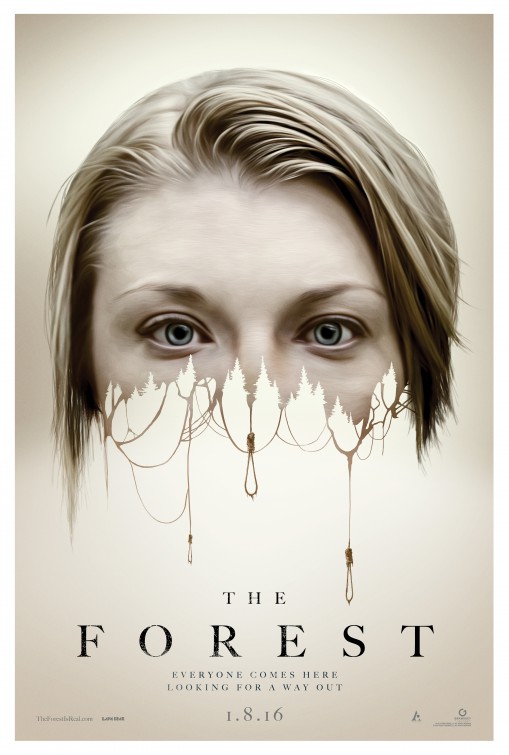
“The Forest” movie review

The ForestInto the woods…off to find a body. The Forest is a brilliant example of January’s reputation as a movie graveyard. Banking on its ability to over-utilize the cliche jump-scare to get a heightened emotional response from the audience, this film demonstrates little uniqueness in this sub-genre of horror; however, I gotta give it a little credit. It was successful in causing me to jump in my seat a few times and even cringe a little. If for no there reason, this film will possibly prompt you to lookup the legends of the Aokigahara Forest, surrounding the foothills and floor of famed and picturesque Mount Fuji in Japan. Starting off as a movie that feels as if it will have a slow burn but then pick up in the second and third acts, The Forest is more like an annoyingly dripping faucet that has a perpetual clog that you wish would eventually explode with excitement. There is definitely a sense of anticipation and anxiousness, but the movie fails to provide a thrilling release. The only intriguing element of the movie is that this fictional story is indirectly connected to true stories of the Aokigahara Forest. Unfortunately, the stories of people going into the forest with the intent to either commit or contemplate suicide is all too true. Furthermore, a friend of mine who lives in Japan told me that the forest really does seem to have a mystical power that compels people to harm themselves or others. Interesting. If you ever visit Aokigahara Forest, be sure to stay on the path and never remain in the forest after dark.

The Forest is about a young American woman named Sara (Natalie Dormer) who senses something has terribly befallen her identical twin sister Jessica. With the intent on finding her sister, Sara flies to Japan and begins to investigate the whereabouts of Jessica. Learning of the legends surrounding the mystical Aokigahara Forest at the base of Mount Fuji, Sara starts to develop a plan to rescue her. Unfortunately, the reputation of the forest scares the locals so much that she is unable to find anyone to help her. Just when all hope is nearly lost, Sara meets local Austrailian travel expert and writer Aiden (Taylor Kinney) and he contacts his guide friend Michi (Yukiyoshi Ozawa) to lead them into the dark and twisted pathways of the forest. Against the recommendation of locals and Michi, Sara and Aiden remain in the forest after dark to find Jessica, but they have no idea that they are about to encounter the tormented souls of those who are looking to add to their numbers.

The characters aren’t the only ones who stray from the pathway, the film itself strays from the pathway of a well-paced and developed plot. I am not sure if the movie is supposed to be self-reflexive in that it is about exploring dark, repressed memories that subconsciously torment the soul or if it supposed to be a superficial cliche horror flick that provides an hour and a half of mild to moderate entertainment. From poorly written dialog to including too many poorly placed flashbacks, this film is all over the place. I have often commented on my dislike for films that rely on flashbacks to support or tell the story. Every once in a while, there come films that actually utilize the flashback in a way that works extremely well–but those are few and far between–this is definitely not one of them. The first several minutes of the film feels like a ping pong match because the audience is constantly tossed back and forth between present day and 20-30 year old flashbacks.

I feel strongly that this is a horror film that could have really used much more character development for Sarah. Not that horror films are the place to find development amongst its lead characters, but the story being told here was actually a good platform for integrating that element into the narrative. It’s almost like the writers were going that direction, but failed to see it through. Films like this one are not produced to add to the artistic medium of visual storytelling or offer up any degree of legitimate critical value, but still these types of horror films should continue to the library of other horror films by adding something new–even a small contribution. That being said, the fact that the film does integrate true elements of local folklore and true stories of suicide in the forest does give the film a little something that many do not have–a direct connection to the horrific reality of a place that anyone can visit on their trip to Mount Fuji. After talking with my expatriate friend who resides in Japan, I do look at this film a little different since the narrative appears to hit very close to home for many who live with news of the dark side of that forest as part of their lives.

For what it’s worth, it’s a fun movie to watch if you are looking for some cheap scares. Like with most horror films, it is best enjoyed or appreciated in a group setting.

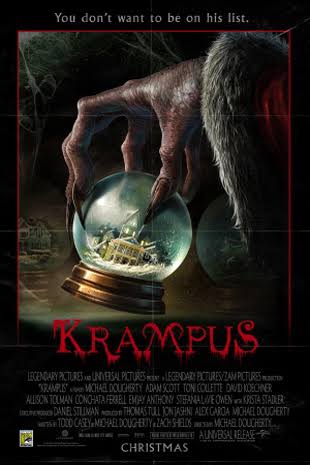
“Krampus” movie review

KrampusTwas truly a nightmare before Christmas! What would happen if Charles Dickens, Dr. Seuss, and the Brothers Grimm would combine their unparalleled literary social commentary and storytelling abilities for a Christmas movie? The answer is Universal and Legendary Pictures’ Krampus. Based on an actual legend of German origin, Krampus is the antithesis of Santa Claus. Whereas this narrative is not based soley on the legend per se, many of the insidious characters are. A Christmas horror movie is nothing new–recently watched Silent Night Deadly Night with a friend–but a movie of this quality, in terms of production design and plot is, and provides us with a movie that is equal parts a holiday and horror film. In an unconventional way, this movie highlights what Seuss and Dickens wrote about in their timeless tales: Christmas becoming more commercialized and about selfish material gain rather than the spirit of sacrifice, giving, and relationships. Just like Scrooge was so terrified emotionally and physically by the ghosts of Christmas past, present, and yet to come, that he believed in Christmas with all his heart, you may also call your behavior, this holiday season, into question as a result of coming face to face with Krampus.

You better watch out, you better not cry, you better not reject Christmas, I’m telling you why, Krampus is coming! For those who lose sight of the true spirit of Christmas and get selfishly wrapped up in their own negativity instead of wrapped up in love, ancient European legend speaks of Krampus (the shadow of Santa Claus) who visits the houses of non-believers who have turned their back on Christmas. Krampus is about a family that, much like yours, is getting together for the holidays. And most likely, just like your extended family, there are members who do not get along with one another–and even resent one another. The Engel family is about to find out the hard way not to lose sight of the magic this time of year. During the course of a day, young Max (Emjay Anthony) falls out of the spirit of Christmas after his dysfunctional family continues to squabble and rejects the spirit of the season. After he rips up his heartfelt letter to Santa in rage, Max unknowingly unleashes the spirit of Krampus and his fractured family must ban together in order to save their very lives from Santa’s sinister shadow.

Following a montage of what looks like Walmart or Best Buy on Black Friday juxtaposed against cheerful Christmas songs, the movie opens on a scene from a film adaptation of Charles Dickens’ A Christmas Carol. Krampus establishes the subtext of this unconventional Christmas movie up front. It is no surprise that there are many self-reflexive elements in this movie; but, it is surprising how well-executed the plot of this film is. Despite the fact the trailer was quite good, I had fairly low expectations for this film because usually Christmas horror movies are just campy. However, there are naturally exceptions to that trend in films like Tim Burton’s Nightmare Before Christmas or A Christmas Carol. A Christmas Carol? Yes. For those who have read the masterpiece, you know that it is a very macabre story in many respects. It had to be. How else was Scrooge going to be so scared for his life and the future if he wasn’t terrified and truly desire to embrace the spirit of the holidays? Maybe A Christmas Carol film adaptations are not traditional horror films, but they certainly contain many horror elements. Krampus takes the idea of developing a horror film out of Christmas to a whole new level. One that is billed as a horror comedy, but it is really more of a traditional horror film.

Horror films, like other genres, often follow the “order–>disorder–>order again” plot structure, but there are times in which it is more like: “order–>disorder–>order–>disorder again.” As I have written in my own research and previously on my blog, horror is concerned with warping that which is otherwise safe or familiar in order to comment on a societal problem or trend. Not always, but many times horror films can enable us to look at gender roles, sexuality, racism, economic, and technological sociological factors in a different light either positively or negatively. That has always been the case since the days of Nosferatu to Psycho to Alien to Silence of the Lambs. Horror films usually have substantial twists or reveals; and one in Krampus definitely caught me by surprise. Just when you think everything is going to be fine and follow a more cliche path, you are blindsided! Although the dialog is typically not strong in a horror film, Krampus contains well-written dialog that is both funny and fitting. Regarding the dark-comedic content in the plot, the comedy is more subtle than prominent; although, watching a jack-in-the-box devour a small child has a degree of demented humor in it.

Like with Universal and Legendary’s Crimson Peak, German expressionism is presented quite well in Krampus. In my previous writings, I have highlighted that German expressionism is at the root of the American horror film. There is even an animated sequence integrated very well into the diegesis that contains copious examples of German expressionism with elongated buildings, gothic design influence, and the use of natural and artistic shadows. Not as pronounced, the rest of the movie clearly shows that German expressionism was included in the designs of the creatures, Krampus himself, and in the neighborhood. By using shadows and warping the perception of landscape and residential engineering, the otherwise upper-middleclass neighborhood looks like it jumped right out of Nosferatu. Whereas this may be an unconventional Christmas movie, it still very much embodies the holiday season. We are reminded to never lose sight of the spirit of sacrifice, tolerance, giving, and relationships. Furthermore, this movie is instrumental in encouraging us to not allow the holidays to become a mechanical reaction, but to truly allow the magic of Christmas to aid us in bringing cheer to those around us.

If the lyrics “he sees you when you’re sleeping, he knows when you’re awake, he know if you’ve been bad or good, so be good for goodness sake” were not creepy enough as it is, then knowing that the shadow of Santa will be unleashed and not come to give, but to collect, if you turn your back on Christmas, then they just became even more terrifying. Universal has proven for more than 100 years that they are the king of horror; and this newest addition to both horror and Christmas movies continues that tradition of a commitment to being the subject of our nightmares.

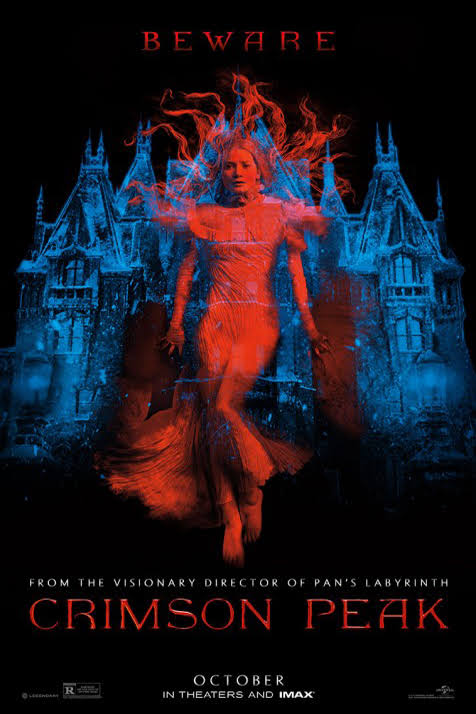
“Crimson Peak” movie review

CrimsonPeakNo flowers in this attic. From the studio that pioneered the horror film back in the early days of cinema, comes the truly avant-garde German expressionist film Crimson Peak. Universal and Legendary Pictures provide us with a thought-provoking classically produced horror film that contains prolific imagery that invites interpretation, even from the most veteran of film scholars. Visionary director Guillermo Del Toro lives up to his reputation as a master of the macabre. Although the dialog and acting are weak, the film is beautifully shot and will constantly have you on the edge of your seat in anticipation of what is about to happen. This is definitely one of those horror films that will undoubtedly make its way into film appreciation classes because of the vast material there is to dissect and explore. There is also a very self-reflexive element in the movie that is quite fascinating to think about. Not your traditional Halloween fair or ghost movie, this one part ghost story and one part mystery film is still a remarkable addition to the horror library because of the adherence to the very essence of what makes a horror film great.

Crimson Peak is about Edith Cushing (Mia Wasikowska), the daughter of a wealthy engineer in Buffalo, NY who is swept off her feet by the charming old English money Baronet Sir Thomas Sharpe (Tom Hiddleston). Following tragedy in Edith’s life in Buffalo, she marries Sir Thomas and moves to the countryside estate of Allerdale Hall in Cumberland, England with Thomas and his highly aristocratic sister Lady Lucille Sharpe (Jessica Chastain). Despite Sir Thomas’s family name, he and his estate, built upon clay mining, are virtually bankrupt. Hoping that she can help to revitalize Thomas’ family estate, Edith begins to move her assets over to England; however, after a series of encounters with specters of the night in the dark and dank mansion, she begins to feel like something is terribly wrong and her very life may be in danger of meeting the same fate as the ghosts and ghouls.

One of the most noticeable elements of the movie Crimson Peak is the commitment to a truly classically produced horror film in the vein of German expressionism and the avant-garde. Interestingly, it is highly appropriate that Universal Pictures released this film because the founder of Universal Carl Laemmle made it a staple of early horror films released by the then fledgling studio. Although there is no one single definition of what indicates a German expressionist film, common characteristics are: using extreme distortions in the production design to indicate inner feelings or subtext, a very dark and moody style of filmmaking, strategic placement of lighting to create harsh shadows, unique and emotional architecture, and creating a sense of disorientation. Tell tale signs of this cinematic influence in Crimson Peak‘s production design can be seen in the very design of Allerdale Hall. Due to the very artistic nature of German expressionism, there is also a high degree of avant-garde because of the experimental production style, particularly in how it relates to the mystery at the center of this movie.

Although there are many positive elements in this film, some of the negative elements are the underdeveloped dialog and, by extension, the acting, lack of exposition, and at times sloppy editing. Common in German expressionism and avant-garde cinema are these characteristics. Note, that does not excuse the film for not delivering but does help to understand why they can be found in such a high budget movie directed by such an accomplished director. Had the dialog been better developed and even fifteen more minutes of exposition (or backstory) has been added, then I feel the acting would have increased in quality and delivery. As far as the occasional sloppy editing, there is no explanation and could have definitely been carried out with more finesse. Part of what makes this such a beautifully macabre film is the cinematography and production design. There are even sequences that will genuinely make you squirm and cringe at the highly visceral action with a hint of gore.

If you are looking for a traditional ghost story, this is definitely not the movie for you. To quote Edith, “the ghosts are a metaphor.” However, if you are looking for a great movie that embodies the thrills and chills of the Halloween season, then this is one to catch in theaters this month. Because of the expressionistic style of filmmaking, I can definitely see the advantage of and recommend watching it in IMAX (provided it’s the 2D version). It has a little of everything that a well-written horror film needs: death, romance, disorientation, and mystery. For the filmmakers or film scholars out there, prepare to have your mind stimulated as you attempt to interpret what the various symbols mean beyond the more superficial plot of the story.

“The Martian” movie review

TheMartianHouston, we have a problem…with Ridley Scott’s directing. Despite the fact that his is an extremely well-known name among directors and both “Alien” and “Gladiator” are critically acclaimed films, Scott just keeps proving over and over again that he can create a very visual movie with a star-studded cast; but, his films over the last decade have just not held up to the hype behind his name or the caliber of director he used to be. The Martian is a prime example of when junior executives at motion picture studios decide that a given plot/sub-genre is popular and keep cranking them out. The problem is, by the time the studios pick up on what the public wants, when the next copycat film gets released, often times the public is tired of that kind of movie. This makes the third epic space movie in three years. Pretty sure both Matt Damon and Jessica Chastain just used their same costumes from Interstellar. One thing’s for sure, if NASA was looking for a film to showcase their brand in an indirect effort to increase funding and rally support for the essentially mission-less organization, this may not have been the best one. In many ways, it just showcased their bureaucracy and inefficiency. Perhaps, space travel should be mostly conducted by private organizations with some infrastructural support on the federal level.

The Martian is about rescuing Mark Watney (Damon) a stranded astronaut-botonist on Mars after a research expedition was abruptly cut short due to an unforeseen storm. The Mars research team, led by Commander Lewis (Chastain), heads back to earth on not knowing that the comrade they thought dead was now completely abandoned on the red planet. Following some minor self-surgery, Watney realizes that he will have to learn to survive on Mars until he can be rescued by growing his own food and repairing the communication technologies in order to make contact with NASA. After NASA discovers the Watney is alive and in reasonably good condition, they must mount an effort to deliver supplies and get him home. Following some failed attempts, NASA eventually teams up with the most unlikely of players in the space game as a collaborative effort to work together for the greater good.

Now I know what you may be saying, ‘this guy doesn’t like most high concept, popular movies.’ That is definitely not the case at all. However, I feel that high concept films often suffer from under-developed plots and poorly executed directing. Just because you have a handful of hits such as AlienBlade Runner, and Gladiator, doesn’t mean that you should be given a pass for all subsequent films. That’s what I and other critics have noticed with his theatrical releases over the last decade. I just don’t think movie-going audiences needed another space movie after Gravity and Interstellar. Certainly not a film about a rescue mission or one with two of the same actors in similar roles from last year. The Martian is definitely beautifully shot, and that is of no surprise, since Scott’s films are often filled with stunning cinematography and production design. If only the actors were just as exemplary in their respective roles. Most of the more prominent roles were just under-developed. Don’t highlight a particular character if there is no real reason for the special attention.

Although you may be thinking that I didn’t like this movie at all, you would be mistaken to rush to that conclusion. In fact, there are definitely a few reasons why I liked certain elements of the film. I thoroughly enjoyed the commitment to real science in this science-fiction story. That was my biggest negative criticism of the plot of Interstellar. In the plot of the aforementioned, we were asked to constantly engage in the suspension of disbelief and blindly accept scientific information that was never explained or even made logical sense within the world of the film. Fortunately, The Martian played out as a believable film that is taking place not that far into our future. Throughout the film, the science is explained in carefully crafted exposition that is seamlessly integrated into the plot. Never does it feel that we are to blindly accept some science or logic just for the sake of moving the plot along. The believability of the plot and production design is what helps this film succeed as a good example of a science-fiction theatrical release.

As we gear up for Oscar season, I hope that this isn’t what we are to expect: movies that have many great elements paired with poor direction overall. If for no other reason, The Martian shows us how we could colonize Mars and travel back and forth. Although his performance wasn’t stellar, Damon pretty much holds the audience’s attention through the use of comedic relief during some of the most stressful times in the movie. For the aeronautical and and jet propulsion communities, this is a good example of research and development in the area of space exploration.