“Ex Machina” Movie Review

Ex_MachinaA thought provoking science-fiction film. Universal Pictures and Film 4’s Ex Machina is a brilliant work of fantasy/science-fiction. From the time the movie begins to the time the credits roll, your mind will have a heightened sense of anticipation of what is about to happen next. This is one of those movies that will eventually find its way into film appreciation classes in order to dissect the many themes, both direct and indirect, implied and inferred, woven meticulously throughout the narrative. Over the years, there have been numerous other artificial intelligence (AI) movies, but this one is likely the best example and best produced movie in this sub-genre of science-fiction and fantasy. Maybe it’s because the dawn of AI is most likely upon us? Or, just because for once, a more serious and more realistic approach to tackling this fascinating subject is being showcased in theatres. From the writing, to the directing, to the cinematography, to the acting, Ex Machina is definitely a film to catch if you are a fan of science-fiction films that have real sociological themes and comment on the age-old quandary: man vs machine.

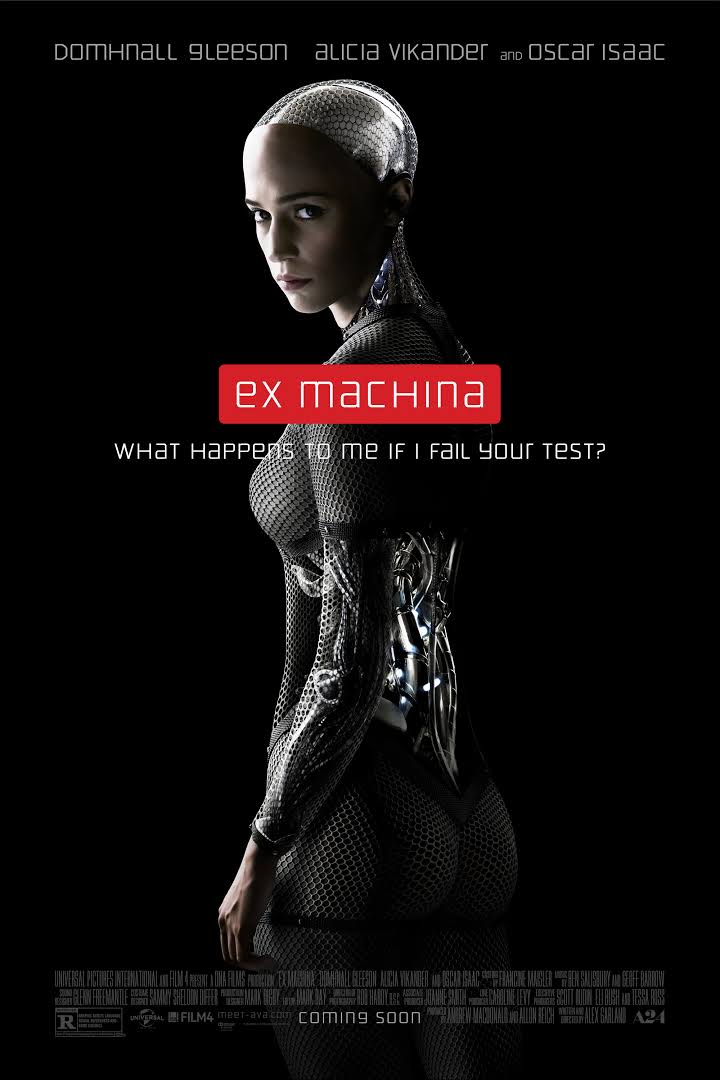
Ex Machina is about a young programmer/coder named Caleb (Domhall Gleeson) who works for the very “Google-like” company called BlueBook. Upon winning a contest to meet with the reclusive founder of BlueBook, Caleb is whisked away by helicopter to the beautiful mountain residence of founder Nathan (Oscar Isaac). Shortly after his arrival, Caleb learns that Isaac used the contest as a rouse in order to select a candidate for the Turing Test (an AI evaluation test, so to speak, to determine if an AI actually has human-like intelligence and reasoning). Caleb is astounded to come face-to-face with the world’s first true AI (Ava, played by Alicia Vikander) in the form of a beautiful woman who is precisely his type. After a few days of testing, it becomes clear to Caleb that there is something more than meets the eye; something darker underscores the bizarre testing in the remote mountain retreat.

Director Alex Garland, best known for 28 Days Later and Sunshine, demonstrates his writing-directing prowess in this beautiful, cutting edge movie. Although it is ordinarily fairly easy to become bored watching three principle and one supporting characters for nearly two hours, Garland uses his gift to orchestrate this film in such a way that each scene is fresh and clearly advances the plot. This film is one of the best examples of a well-developed plot that is constantly reinforced, checked, and advanced throughout the narrative. His handiwork is also seen in the character development, expressions on, and blocking of the actors. Like building a model, Garland provides solid plot structure upon which the more superficial elements are laid. Beyond the high concept plot, there are brilliant themes and provocative subtext that will aid in the overall performance of the film, and give film scholars, writers, and the scientific community something to toss around in spirited debates. Aside from the running theme of man vs machine, there are also themes of whether or not a machine is “born” hetero or homosexual, much in the same way that very debate is discussed in regards to humans. A quick note regarding the exquisite production design, it is simple yet absolutely perfect for the movie. I really enjoyed the straight lines and sharp angles, very Frank Lloyd Wright.

If you know anything about literature or screenwriting, you are most likely familiar with the term or plot device known as deus ex machina (latin for “god from the machine”). The textbook definition is something to the effect of a plot device whereby seemingly unsolvable dilemmas are suddenly and abruptly resolved by the unexpected intervention of a new character, event, or object; this often occurs when the writer has painted him/herself into a corner. Knowing this, analyzing the title is quite interesting. Essentially the title means “from the machine.” After watching the movie, I am unsure as to what is coming ‘from the machine,’ unless you count the emergence of human-like intelligence. Otherwise, it really isn’t explained–the significance of the title–beyond the fact the movie centers in and around the testing of an AI machine. It’s entirely possible that the title was selected simply because it sounds cool, fits easily on a marquee, and does point to the plot. Exploring the significance of titles and title sequences can often unlock hidden meanings in the film. On a side note, next time you watch Ridley Scott’s Alien, really pay attention to the opening title/credit sequence.

At the center of the movie is the Turing Test. Nathan tasks Caleb with the responsibility of objectively and subjectively analyzing and evaluating Ava to see whether or not she possesses human reasoning, problem solving, dialoging, and cognitive processing. His goal is to determine if Ava is essentially human. The following analysis does contain some information that may spoil the movie for some–fair warning–if you need to, please skip to the last paragraph. Following a sequence of events, Caleb devises a plan to escape with Ava after she professes feelings for him and he falls in love with her. Although at first in disbelief regarding her humanness, he believes she has the capacity to love and process cognitively equal to and perhaps superior to flesh-and-bone humans. Like any good antagonist, Nathan discovers the plan by way of a hidden camera; and instead of eliminating Caleb, explains that Ava is actually screwing with his mind–pretending to love him. He doesn’t believe Nathan, and continues with his plan that was already hatched, unbeknownst to Nathan. After a struggle, Ava is set free and winds up killing Nathan. Despite the professed feelings for Caleb, Ava leaves him locked away in a room with no means of escape. She boards the helicopter and heads off to the world of humans with no one to blow her cover or enslave her.

This is where the plot does leave room for question. Although the ambiguity of the reasoning behind Ava’s decisions involving murder and entrapment may have been intentional, the driving force behind the decisions to murder Nathan and leave Caleb trapped in the house, left to die should have been made clearer. But on the other hand, the ambiguity is perfect material for debating what may have been going through her “mind.” The reasoning for her murder of Nathan is fairly clear. He caused both mental and physical abuse, oppressed her, leaving her locked in a glass room like a lab rat. He stood in her way between slavery and freedom, and she needed him eliminated. Here’s where it gets tricky: why leave Caleb to die in the house when she professed her love? I think it’s because she was way more human than either Nathan or Caleb could have dreamt. She pretended to love Caleb. If pretending to have feelings for someone in order to use them to your benefit isn’t as human as it gets, I don’t know what is. Even though we never get a definitive answer in the diegesis of the movie, the audience is previed to that information.

Another interesting possible theme to discuss is Ava’s first encounter with another AI. There is a shot sequence between Ava and another female Asian AI immediately following her emergence from her glass cage. In the manner in which this encounter is shot, it could be read as lesbian undertones. No explicit romance is witnessed, but there are subtleties that Ava may be sexually attracted to the beautiful Asian female AI. Is it possible that something switched on inside her when she encountered another female for the first time? Perhaps innate repressed feelings were ignited, despite what Isaac said he programmed her to be? Maybe feelings that weren’t there for Caleb were made more intense by the other “female” in the house? This gets back to the argument if a human or machine is programmed from day one to be hetero or homosexual. These are questions best left up to those who want to speculate the inner-workings of Ava’s psychology and chemistry. But, nevertheless, are fun to talk about. Most likely, she was just plotting with the other AI, against Nathan and Caleb; but I feel there is a slight possibility of the former.

Ex Machina represents some of the best that the science-fiction/fantasy movies have to offer. It contains social commentary, science, and excellent subtext. While many science-fiction films suffer from adequate and well-crafted plot development, this one is a shining example of how beautifully produced a science-fiction/fantasy film can be. What makes this movie an excellent one to watch is the ability to intrigue the audience with both a scientific element and one that taps at your psyche and prompts you to think about the positive and negative consequences of developing a human-like AI. If you haven’t seen the movie yet, definitely plan to catch it in theatres.

Ryan is a screenwriting professor at the University of Tampa and works in creative services in live themed entertainment. If you like this article, check out the others and FOLLOW this blog!

Follow him!

Twitter: RLTerry1

Instagram: RL_Terry

Thrillz (theme parks): Thrillz.co


Unfriended

Unfriended-posterBe careful what you post. Universal Pictures’ Unfriended is a new breed of horror that will have you terrified from beginning to end. Despite watching, what amounts to FaceTime/Skype, iMessage windows, and Safari the entire time, this film will keep you on the edge of your seat as the horror unfolds and the mystery comes closer to being solved. The studio that essentially invented the American horror film is back to the forefront of the minds of movie-going audiences everywhere with this spine-tingling and groundbreaking method of visual and visceral storytelling for the screen. A new take on the tried and true ‘ghost vengeance’ horror plot, Unfriended will have you completely hooked from the time the entity shows up in the group video chat. Of course, you will likely be asking yourself throughout the movie ‘with friends like these, who needs enemies?’ Although this is a revolutionary new concept, I feel strongly it should remain a one-time thing.

Unfriended is about a group of friends who encounter what they feel is a glitch in their group video chat. It isn’t long before the group deduces that the glitch is a molevolant individual hell-bent on seeking revenge for a shaming video that was posted to to the internet one year prior that was also the driving force behind a local high school girl’s suicide. With all the friends denying that they had anything to do with the video and gross taunting and shaming, the “ghost” engages them in a little game of “never have I ever…” that has deadly consequences.

This is one of those horror films that is pretty well straight forward. So, I don’t really have a whole lot to critique. The direction, writing, and score were excellent and the pacing of the film was spot-on. It’s a very well crafted and produced horror film that will likely become a cult favorite of those who appreciate and thoroughly enjoy this genre. Although there isn’t any traditional cinematography in the film, the camera acts as the eyes of one of the characters as we stare at her computer screen the entire time, and effectively communicates the focus of a given point in the story. One of the technical elements that stands out to me is the editing. Now, on one hand, it does not look like an incredible amount of talent and time would go into a film such as this; but, that is the beauty of high quality editing. The fact that it does not feel “edited” is proof that the editor did an excellent job in cutting the thrilling narrative together. My biggest negative critique in the production is the fact the respective wifi signals weren’t disabled when the power goes out. Unless each of the characters was using a battery powered hotspot or had a cellular/data signal in their computers, when the power disconnected, the wireless internet signal should have died too.

Although there isn’t really much in the way of character development, each of the characters can be read as possessing one of more of the infamous ‘seven deadly sins.’ This metaphoric perspective can be extended to the manner in which the various characters die during the movie. One of the characters possesses the “sins” of gluttony and sloth very clearly, another exhibits traits of wrath and greed, one of the friends is very prideful, showing acute signs of the sin of envy are seen in one of the main characters, and the sins of lust and bearing false witness (yes, I’m aware this isn’t one of the “deadly sins”) is demonstrably shown by the main protagonist. The aforementioned character traits are showcased throughout the narrative and are directly related to how each of the characters die. Yes, even the virgin dies in this film that breaks away from many horror tropes.

Gather a group of friends and head to the movies to be thrilled during this horror film for the social media enthusiasts. Watch as high school drama goes way overboard and has deadly consequences. This is definitely a great date movie because I guarantee that you will be able to put on the “movie move” (as coined by Carmike Cinemas). If you don’t know what that is, you probably need to go on more dates.

If you liked this review, please follow/subscribe to my blog. Thanks!

Woman in Gold

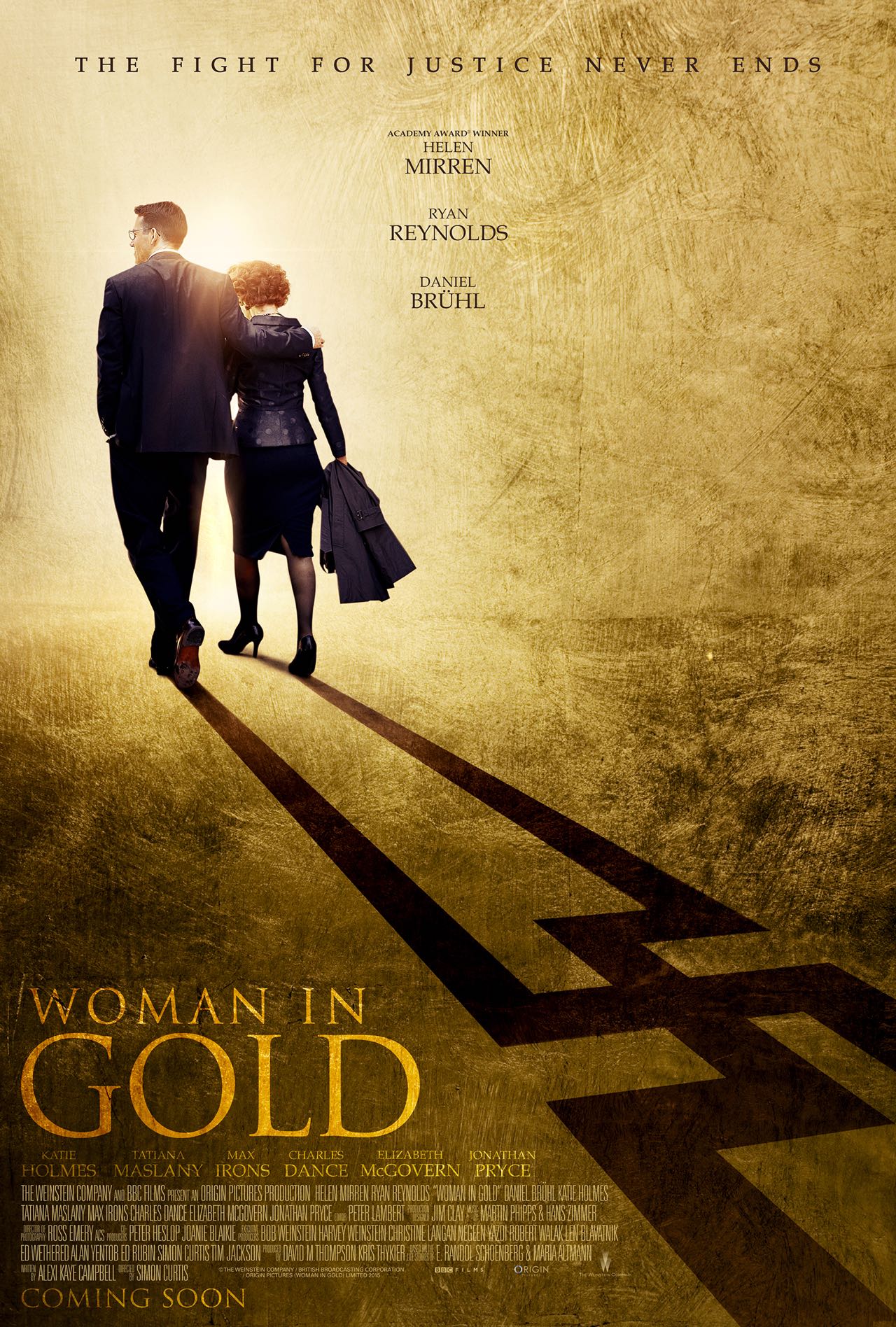
WomanInGoldAn absolutely beautiful film about art, history, and seeking justice. They say a picture is worth a thousand words, but The Weinstein Company and BBC’s Woman in Gold is demonstrably worth 120 pages of words. Woman in Gold is a powerful movie with a timeless, unparalleled story about returning Nazi-stollen art to its rightful owner. Veteran actors Helen Mirren and Ryan Reynolds deliver commanding performances in this film based on the true story of one of the cases in Austria’s Art Restitution program. Follow along for a compelling journey that is both an historic investigation and a gripping courtroom drama that goes all the way to the US Supreme Court. Witness one woman’s fight to have returned what is rightfully hers, but meeting with seemingly unsurmountable obstacle after obstacle along the way. Woman in Gold is one of those films that will quickly become a favorite of many because of the passion, beauty, and determination showcased in this true story about justice.

Woman in Gold begins with the death of Maria Altman’s (Mirren) sister. Following the funeral, she discovers paperwork that reveals that now-famous paintings, that once belonged to her family prior to the pillaging by the Nazis, are hanging in the Belgrade Museum in Vienna. Also at this time, the Austrian Government has initiated an Art Restitution program to return artwork to its rightful owners–art that was unjustly stolen and illegally acquired by the Nazis. The painting, known as Gustave Klimt’s Adele, is the Austrian equivalent of DaVinci’s Mona Lisa. Facing the daunting fight to get the painting back, Maria hires newly-minted lawyer Randol Schoenberg (Reynolds) to lead and advise her in her legal quest. Their battle will take them from Maria’s quiet Los Angeles bungalow to the bustling historic streets of Vienna, and eventually all the way to the US Supreme Court. Join Maria and Randol for an adventure to right a wrong that dates all the way back to WWII.

Women in Gold is a beautifully produced movie that comes complete with art, history mystery, and litigation. The bedrock of a film like this one requires an incredible screenplay, otherwise, it could turn out to be nothing more than a National Geographic or Smithsonian Channel docudrama special. Alexi Campbell’s screenplay is meticulously written to include both the present action paired alongside the historic events that lead up to the case, which would come to be known as Republic of Austria v. Altman (2004). It is important to note that movies that heavily use flashbacks can take away from the importance of the story at hand; but Campbell’s screenplay strikes a powerful balance between the two, keeping the present story center stage. Director Simon Curtis takes Campbell’s words and brings them to life for the screen. His ability to create a dynamic experience for the audience is showcased well in this film–he truly brings the audience into the world of Maria and her impossible battle for justice. Underscoring the visuals and the gut-wrenching words is an incomparable score by Hans Zimmer. He successfully pairs a classical sound with a modern flare to match the mood of the film set by Curtis, Campbell, and cinematographer Ross Emery in each and every scene.

Once again, Helen Mirren shines beautifully, as she always does, in the roles she plays.  Without a doubt, she was the best choice for this historic role. Her elegant mannerisms with her sharp tongue and quick wit bring Maria to life. The role of Maria is a complex one that required Mirren to have the faced of strength and determination whilst revealing vulnerability and frailty. Playing her counterpart, is the handsome and talented Ryan Reynolds as lawyer Randol Schoenberg. Reynolds was an excellent choice for the role because he can both deliver the character of an underdog lawyer and boyish charm concurrently. His chemistry with Mirren is evident in each and every scene. Even though most of the film is spent with just the two actors principally, the audience will never grow tired of their arguments and banter back and forth. Supporting the principle performers, is an excellent cast that creates the world in which this story of justice and love of art takes place.

For lovers or art and history, this is definitely a movie to catch while in theatres. Seeing the famous Klimt Adele on the screen is overwhelming at times. Thankfully, the world can still see the painting, acquired by Ronald Lauder, in the Neue Museum in New York City. Although this film has not received the attention it deserves, it could very well be one of the year’s first films on its way to an Oscar nomination since Oscars 2015 proved that movies, released early in the year, can make it all the way to the Academy Awards. If you enjoyed The Monuments MenBig Eyes, or Museum Hours, you will likely fall in love with this film.

It Follows

It_FollowsWhat the??? Most likely, that is what you will be asking yourself. It’s entirely possible that this is either one of the worst horror/suspense films in recent years OR one of the best. At first glance, it looks like something that you may have stumbled across on Netflix; but a closer look will reveal a fantastically orchestrated suspense film with a powerful message. Interestingly, this is one of few movies that actually ticked up on IMDb, RottenTomatoes, and MetaCritic. But, after sitting on this review overnight, I can understand why the rating has gone up and not stayed the same or ticked down. Although the acting is less than adequate and the plot is a little over-the-top at times, the allegorical message is very well written into this YA suspense-thriller.

It Follows is about a group of teenagers who find themselves on the run from an unknown specter that stalks its prey. The movie centers in and around a young lady named Jay (Maika Monroe) who, following a strange sexual encounter with an attractive young man named Hugh (Jake Weary), becomes the focus of an evil entity that slowly stalks her anywhere she is. With all others unable to see the specter, she begins to wonder if she is going mad. After some sleuthing with her best friend Paul (Keir Gilchrist), Jay finds herself in a tangled web with many moral and ethical dilemmas facing her and her friends.

Reminiscent of Nightmare on Elm StreetIt Follows takes place on a normal nondescript middle-class street with promiscuous teenagers trying to find their places in an adult world. Between the nostalgic set design and old-school score, you will think that Robert Englund is about to appear with his iconic Freddy Kruger razor glove. But, the enemy in this suspense-thriller is one part psychological (like Freddy) and one part physiological. It is very unclear as to the time and space in which this story occurs. You will find personal electronic device technology that we enjoy today along side TVs from the 1980s existing in a city in whose glory days had long-past. Although it isn’t until the height of the crisis that we learn that the nearly-abandoned city that serves as the backdrop is present-day Detroit, hints as to the location are sprinkled throughout the narrative. On that note, all the stories you’ve heard about vacant houses and neighborhoods in gross disrepair in the motor city, are very true–it’s scary.

From a technical perspective, the movie is fairly lacking; however, despite the low-quality lenses, cameras, and lighting that were obviously used, the cinematography is quite good. The balance between objective and subjective shots is used effectively to highlight and advance the plot through the well-structured narrative. Proper pacing is crucial in a horror film, and Writer-Director David Robert Mitchell has proven that even on a small budget (~$2MIL), that a great horror movie can be produced in today’s climate of film competing with TV competing with streaming services. Although this movie will likely find a greater audience once it hits Netflix and Hulu+, it has received a fairly good welcome during its theatrical release, for a film that has been under the radar except in larger cities.

!!CONTAINS SPOILERS!! (skip to the last paragraph for the closing remarks)

Regarding the not-so-subtle allegorical theming of the movie, it is clearly a movie about STD/I’s. On one hand, it comes off as an after-school special or a movie that is shown to Middle/High Schoolers; but on the other, it is an extremely clever way to talk about a touchy and tough subject. Not so contrary to the 80s slasher movies that basically had the message “if you’re a horny teenager and you have sex, you will die,” this movie takes a more realistic approach in dealing with the scary world of not always knowing if someone has something, or if you may have something that could get passed on and “follow” someone. Although the idea of supernatural specters haunting teenagers or young people who have casual or random sex is unrealistic, the entities represent the fact that anyone can have a STD/I and pass it on to someone else. I feel strongly that the 80s feel of the setting is directly related to the fact that the AIDS scare happened during that decade. Even though society has learned a lot about STD/I’s since then, and has come a long way in educating and appropriately mitigating irrational reactions from people, it is vitally important that sexually-active people–especially teenagers and young adults–be very cautious and protect themselves against something that could “follow” you and/or your sexual partner(s) for a very long time, if not forever, or maybe even kill you. The consequences (good and bad) of sexual behavior outside of a relationship are very real. And in many respects, can very well haunt your mind and body.

If you enjoy well-directed and written suspense movies rich with sociological and societal themes, then check out It Follows while it is in theatres. Although you may be inclined to dislike the movie immediately following the close of the story, I can almost guarantee that you will grow to like it because it will undoubtedly prompt you and your friends to think about the message and the creative execution. The longer the movie sits on your mind, the more you will learn to appreciate it. That was the case with me. At first I didn’t care for it, and now I find it to be a remarkable movie that hits all the right sensational and pleasurable-unpleasure marks that a horror film needs to hit in order to become a cult classic.

Home (2015) Review

HomeWhile there have been many live-action and animated movies in the alien encounter/invasion genre, 20th Century Fox and DreamWorks’ Home is a family-oriented colorful and fun addition to the pantheon of alien-based films. Although messages such as conquering fear, understanding others, and commitment are commonplace in the friendlier variety of alien movies, this film combines the fanciful plot with rich subtext that acts as social commentary on issues such as ethnocentrism, imperialism, and colonization. These social issues are as real today as they were centuries ago. Just like Dr. Seuss was a master at breaking down complex adult issues into a form that a child could understand and adults could appreciate, DreamWorks provides us with a movie that pairs a comical narrative with real-life societal issues from which we may be able to gain a better understanding of what it’s like to be the nation invaded by another for a supposed greater good.

Home is about an alien race, known as the Boov, who has decided to invade earth and relocate the human ace to Australia. The Boov are running from another alien race, known as the Gorg, and need to find a new home. Upon invading earth, the Boov setup new neighborhoods on the Australian continent and relocate all the “humans persons” to their new “home” as the Boov move in to claim this new planet for their own. Evading the forced human transport, Tip (voiced by Rihanna) hides from the alien race in an effort to buy time so she can develop a plan to find her mom (Jennifer Lopez). Whilst on her mission, Tip encounters an outcast Boov named Oh (Jim Parsons) who is running from his own race because of a massive eVite he sent out to the entire galaxy for his “warming of house” party. Unfortunately, this eVite is also sent to the Gorg. Hot on the trail of Oh is traffic cop Boov Kyle (voiced by the incomparable Steve Martin). During their respective missions, Oh and Tip must learn to tolerate one another and understand one another if they are ever going to find Tip’s mom and Oh stop the Gorg from invading planet Earth.

Home is the type of animated alien movie that will likely evoke nostalgic memories of Disney’s Lilo and Stitch and possibly, to some extent, DreamWorks’ Shrek. However, after How to Train Your Dragon 2 lost to the lesser film Disney’s Big Hero 6 at the Academy Awards BUT won against it at the Golden Globes, the embattled DreamWorks needed its only offering for 2015 to come in like, not to quote Miley Cyrus, a wrecking ball. Instead, it played it safe; and in doing so, it did not capture the imaginations and attentions of audiences like it should have. DreamWorks needed Home to be its Lilo and Stitch. But, instead, it will likely go by way of the Croods. Somehow, a lonely Hawaiian girl and ill-tempered koala bear-like alien creature found its way into the hearts of audiences but Home will not likely do the same. This is probably because Home plays too close to Lilo and Stitch instead of breaking new ground and living on the edge.

On the surface level, it is all too easy to see Home as a movie that is a tastes great but less filling version of Lilo and Stitch, but a closer look will reveal subtext that the Disney classic could only dream of. While both films deal with the idea of understanding one another and learning to cooperate, Home provides us with a deeper meaning behind the one-dimensional, vapid plot. It takes the idea of learning to understand one another and friendship development further by allowing us to view the invasion/encounter from both sides. In an effort not to spoil the twist at the end of the movie, I will no go into great detail. But, it is very clear to see that this movie can be read as social commentary on the U.S. invasion in the various middle-eastern countries. Note: this movie is not suggesting it is wrong to fight those who aim to harm you, but it is suggesting that in an effort to do good that there are sometimes negative consequences that may occur to a people or society. Sometimes, while a nation believes it is BRINGING civilization to a people, seen as lesser, it is entirely possible that they are actually TAKING from the native people instead. For the anthropologists in the audience, you will greatly enjoy the themes in the movie that will likely get missed by the typical movie-goer.

After the previews of Home built up a general interest and excitement for the animated movie, it will unfortunately disappoint most movie patrons who choose to see it this weekend. However, it is still a very cute movie that will keep you and your kids mildly entertained for the appropriate runtime of an hour and a half. I hope that after this movie does not perform as well as projected, that it inspires DreamWorks to rethink their approach to the next movie. I’ve seen great potential in the stories DreamWorks tells, and many of them are better cinematically than the Disney-Pixar ones; but, they need to bring the creative geniuses at their studio together to focus on rebranding despite the fact the Oscars always favor Disney-Pixar just because of the brand.