Written by Ryan L. Terry & Derek Rosenberg
While Universal parks have Halloween Horror Nights, Busch Gardens parks host Howl-O-Scream, Knott’s Berry Farm celebrates Halloween with Knott’s Scary Farm as well as many other theme parks’ Halloween events, don’t forget that your area may also offer some great local haunts to terrify you during this festive season made up of what haunts you in your nightmares. Whether you are searching for a local haunt that has that quintessential small town Halloween feel or you seek a haunt that takes you where no theme park can without getting sued, there is likely a haunted house or trail located within driving distance of your house that beckons for you to brave the horrors that lie within.
I must confess, I have not supported my local Central Florida area haunts in the past–and that’s always bothered me. Always spent my time at the Universal, Disney, Busch Gardens, and SeaWorld events. So this year, I made it a point to make it to at least one, if not more, in order to support local Halloween enthusiasts who enjoy crafting something enjoyably terrifying for the community to enjoy during the Halloween season. And you know what I found? Local haunts are great! They can do things that theme parks aren’t able to do for reasons of liability. They can also do little things that enhance the experience by giving the haunt a more intimate feel. I am certainly not disappointed with my experience; and friends of mine that have supported local haunts this year as well, have commented that the haunted trails and houses offered uniquely fun experiences.
Our first stop is Sir Henry’s Haunted Trail! Located between Tampa and Orlando in Plant City, famous for the annual Strawberry Festival, Sir Henry’s offers two trails and a house. The house was an addition to the annual trails because it was located in Bartow, FL where it suffered major damage from Hurricane Irma. The folks at Sir Henry offered to include the house in order for the owners to recuperate the money it takes to build and support a haunted house AND for additional exposure from people who wouldn’t ordinarily drive the hour from Orlando or Tampa for a local house. Talk about an excellent example of a community uniting after a disaster! I gathered from that story that the owners, designers, and builders of local haunted attractions must be a close-knit community that steps in to help one another out, all while maintaining friendly competition amongst each other.
Parking was free! That was a great start to Sir Henry. You can purchase admission individually for the trails and house (three total attractions), or you can buy a combo ticket. My two friends and I purchased the combo ticket for $30 (saved $6). Individually, the attractions sell for $12/ea. From the moment we walked in, we knew that it would be fun. There were fire pits roaring, people roasting marshmallows, local vendors selling souvenirs and Halloween decorations, and kids whose parents obviously dropped them off for a night of nightmarish experiences. It felt like I stepped into a Halloween event held in one of those towns found in shows on The CW–you know the ones I’m talking about. I was thoroughly impressed by the craftsmanship and simple but effective technologies used in bringing these houses to life. A big difference between the theme park events and these local haunts is the group size. At Sir Henry, groups are broken up into smaller groups of three or four. Furthermore, guests are sent through the trails and house in intervals. This is instrumental in a desire for each guest to experience a scare without seeing it up ahead with other group. The trails and house were definitely maze-like in the design, because we took a few wrong turns and had to backtrack–only to find our pathway blocked by scareactors.
One of my favorite effects that I saw at Sir Henry’s was the fog and green laser that made it look like a swamp. Come to find out, that effect is achieved by cooling the fog to a temperature that causes it to remain condensed and about 3-4 feet above the ground. The addition of the green laser effect actually made it feel like I was wading through a swamp as my friends and I were navigating the maze. Being out in a field was a lot of fun and much different than being in a theme park setting. I really had no idea where scares were going to be; and therefore, I was always processing from turn to turn with heightened senses. It was a great feeling! Demented colonists, abandoned subdivisions, deadly butchers, chainsaw wielding sociopaths, you’ll find them all at Sir Henry’s Haunted Trail in Plant City, Florida.
Let’s head over to Winter Haven, located between Orlando and Lakeland.
The Shallow Grave has been a staple haunted attraction in Winter Haven, Florida for the last 5 years. I have always heard great things about this haunt and had never taken the time to experience it, but couldn’t pass it up this year, after hearing it will be their last year due to low attendance numbers. Built in a 13,000 square foot warehouse, Shallow Grave offers two haunted mazes giving you two very different experiences. Parking is $5 in the field across the street and as soon as we arrived the atmosphere was electric. They have several different ticket options including General Admission for $25 (includes both houses, one admission per house), Quick Death for $40 (allows you to skip the lines, one admission per house), Feargasm Pass for $35 (unlimited access to both houses), Season Pass for $150 (admission to each house for all 14 nights they are open), and the Combo Pass with Chamber of Terror for $55. They also sell Shallow Grave t-shirts to really support your local haunt. There are a few animatronic figures or statues outside the houses that add to the creepy atmosphere and allow for some great photo ops. Standing in line was where we got our first taste of how this is different than your typical theme park haunt. Scareactors are milling about outside the houses, pushing through the lines and popping up to scare guests before they even make it inside. They then tend to be happy to pose for a photo to show off their costumes and makeup.
Now we get into the houses. Updated for 2017 we first have Betrayal. You find yourselves on the haunted property of Thaddeus Van Buren during a rise of the undead. Shambling zombies and chainsaw wielding hillbillies stalk this maze which includes a rundown house and graveyard. This felt like a pairing of the Texas Chainsaw Massacre with a zombie flick, which are two of my favorite genres. The returning house this year is Pavor Nocturnus (latin for night terror) which delves into the realm of phobias and those subconscious fears you might not realize you have. This house covers spiders, caves, snakes, swamps, voodoo, prison, hospitals, and asylums in all the best and worst ways possible. With sets and props that match Busch Garden’s Howl-O-Scream quality, scareactors grisly costumes and makeup, and not your average animatronics and puppets, you haven’t been through a maze quite like these before. These are the scariest houses I’ve ever been through, which comes from several reasons. They only let groups of 6 through the house at a time and there isn’t always a clear indication of which way you are supposed to go, so it does truly feel like you’re having to find your way through this maze of horrors. The scareactors are also able to touch you and although it’s typically only a light squeeze of your arm, it’s a whole different experience once that barrier of “safety” is shattered. Having been going to haunted events at theme parks for the last 12 years, I can say that this is one of the best experiences I’ve ever had. It’s a real shame that this is their last year and I’ve only gone once. I’m hoping they find a new home or financial backer so we can see The Shallow Grave return in the future.
Now, we head to Downtown Tampa for quite the unique experience!
When buying tickets we went with the Combo Pass so that we could also check out the Chamber of Terror in Tampa, Florida. This haunt is built on the SS American Victory, a WWII-era cargo shipped docked behind the Florida Aquarium in Channelside. Parking is available at the Channelside Parking Garage across the street from the aquarium. Ticket options include General Admission for $25, Immediate Demise for $40 (skip the line pass), and the Combo Pass with The Shallow Grave for $55 (skip the lines pass for both locations). From the moment you walk up to this haunt it feels different than any other because you’re walking up to an actual ship. Walking down the darkened alley to the water for the reveal of a huge ship is pretty spectacular. Scareactors amble around outside ready to scare you in line as a taste of what’s to come. Soon you will find yourself deep in the hold of this haunted ship, inhabited by Captain Berwick and his undead crew, lashing out to terrorize you and hoping to add some new bodies to their hoard.
Our combo pass allowed us to skip the line so we almost immediately were sent up the gangplank onto the deck of the ship. The steel door swings open and a group of 6 are beckoned through by an undead shipmate who leads you to the elevator. Here you are shut into a box where the only light is being shown in your face by a scareactor holding a flashlight and shouting while lowering us down into the depths of the ship. What follows is a twisting, turning maze of narrow corridors and staircases that take you through many different sections of the ship including the main deck, which gives you a nice view of the water. This haunt is interesting because each section of the ship plays out like an interactive scene that plays for your group before being reset for the group following well behind you. The costuming and props are great and the scareactors have no problem invading your personal space, especially in the crew quarters. The different levels of the ship disorient you into not knowing where the next scare is coming from and where the terror will take you next. While I didn’t find this haunt as scary as Shallow Grave, it was still a lot of fun and a different experience than I’ve had before. I definitely plan to check out the Chamber of Terror in the years to come to see what changes are made and for more nautical haunt fun.
The final stop on our tour of Central Florida’s local haunts was Scream-A-Geddon in Dade City. Having only been around for a few years, it’s the newest local haunt in greater Orlampa (Orlando/Tampa). We had such a great time! A fantastic variety of haunts including three houses, one trail, and a hayride! That’s right. A Hayride in Florida! From the moment we entered, we could tell that we were in for a spooktacular time. The theme of the event revolves around a classic carnival setup. The ticket windows, entrances, and midway resemble a classic carnival or traveling circus. The scareactors are not confined to the houses, but there are roaming sociopaths and ghastly hillbillies throughout the midway. In addition to the official haunts, Scream-A-Geddon also offers a gift shop, carnival food, and even games. If you’re feeling a big cold, there are two giant fire pits as well. With the night being unseasonably cold for Florida, the climate added to the experience because it felt like how Halloween is supposed to feel in the air.
Blackpool Prison is where the worst of the worst criminals are sent and during a blackout the inmates take control. This was our first house of the night and it was probably the best place to start. Here we were introduced to an element that makes Scream-A-Geddon different than most other haunts, the interactive glow stick necklace. Before you go inside the house, those who are 18 or older are given the option to either go in as a spectator or to where a glow stick necklace to become part of the horror, which allows the scareactors to interact with you. We’re sent into the prison in a group of 6, with 2 in our party wearing necklaces, and I took point. I was almost immediately grabbed by an inmate, taken into a cell, and shoved up against a wall where the inmate screamed in my face that I was going to die in this prison. I was then sent back out of the cell and, having been separated from my group, had to walk alone through the house for a while. Our friend Dani was also grabbed several times and between us we were yelled at, shoved against walls, locked into jail cells, threatened with bodily harm, and in Dani’s case with having her teeth pulled out. The house was very dark and smoky to simulate a rioting prison during a blackout, with threatening inmates and the few prison guards still left alive begging for our help. The set pieces weren’t as spectacular as other haunts, but the atmosphere coupled with walking through sections of this house alone makes that forgivable. This was a great introduction of the best parts of Scream-A-Geddon and got us ready for what was to come in our second house.
We then headed over to check out Infected: Ground Zero, the new house for 2017. Following a meteorite crashing near a rural campsite, a viral infection rapidly spreads, leading to a military quarantine of the area. Before heading out into the chaos we are again asked if we wanted to spectate or take part, Dani and I opted in again and were sent in as a group of 6. Dani was almost immediately grabbed and pulled away from our group and we didn’t see her again until we made it out of the house. This haunt is a maze through quarantine tents, dilapidated cars, and a house of cannibalistic horror. I was eventually grabbed and stuck in an X-ray room where I was hit with a bright light and blast of air and toward the end of the haunt I was pulled into a tent off the main path where the scareactor began shaving my hair to help stave off the infection. The end section was a squared off maze of lit tents, a central tower that spewed fire out the top every 60 seconds or so, and a chainsaw wielding madman chasing you through to the exit. After we made it out we were reunited with Dani where she told us of her experiences inside, which included: being zipped in a body bag and left alone for a few minutes, being forced onto a table where a buzz saw was ran across her forehead, and nearly being grabbed by another scareactor to be given a shot with the antidote. The frantic nature of this haunt was incredible and never knowing what the next section might hold made it the best experience Scream-A-Geddon has to offer and an experience that should not be missed.
The next two haunts on our tour placed us in the middle of the woods–Dead Woods to be precise. At this offering, you are sent on a deathly journey through the woods surrounding a nearly abandoned settlement with only a few cabins remaining. Lurking within the walls of these cabins in the woods, are deadly settlers who refused to leave when the rest of the village took to the city. While the haunts of this attraction were spread a little too thin for my taste–lots of “dead” space–the design of the cabins was great! Derek, Dani, and I really enjoyed the concept and layout. In the future, Scream-A-Geddon may want to consider making each cabin a different theme or including a greater variety of scares. This was also the longest wait, and over all woods did not justify the wait time. Don’t get me wrong, it was fun. But I think this attraction could use a little more “haunt” to compensate for the longer than average wait. Having to use a light stick to find our way was a lot of fun and added to the experience of being lost in the woods. Although using a faceod of a cabin would have sufficed for some haunts, this offering boasted five full cabins that we walked through and encountered the locals who were not happy that we were uninvited house guests. Probably because we witnessed all the sinister things they were up to. Walking through the haunted woods on our self-guided tour, was a great experience!
From walking through haunted woods to riding on a tractor-drawn hay wagon, we headed over to Cursed Hayride. This was my favorite experience at the carnival of terrors because it offers a unique experience. Unique for this part of Florida because hay isn’t something that you see in numerous quantities around the area, especially if you live in an urban core. I hadn’t been on a hayride in more than a decade. Although the ride load, unload and guest circulation could be improved a little, the wait wasn’t terrible. And certainly worth the experience. The theme was two part haunted farm and one part Old Western ghost town. The ride was filled with several pyro effects and scareactors to terrify you on your journey. A small group of girls on our hay wagon were particularly terrified and were all over the wagon. Along your ride, you will encounter farm equipment the has a mind of its own and will try to bail you will the hay. Watch out for a giant man-eating gator too. My favorite part was going through the ghost town. Reminded me a lot of the Western scene in the late Great Movie Ride at Disney’s Hollywood Studios. In fact, I remarked “what is this, Joisey???” An homage to the gangster on GMR. The tour through the ghost town was complete with a bank robbery, shoot out between the law and outlaws, and a terrifying priest. Such a unique experience that ranks highly for me this season.
Our last experience of the night was Bedlam 3D, which is a trip through a carnival madhouse gone mad. No interactive glow stick necklaces here, everyone gets the same experience. Taking some cues from Circus of Superstition 3D that ran at Busch Garden’s Howl-O-Scream for many years, we are sent through a glow in the dark, neon colored, clown invested, insane asylum. The 3D used here is similar to what you’ll see at other haunted theme park attractions, but is different than what you see in the theater. ChromaDepth 3D relies on the color spectrum where red appears to pop out at you, and blue appears to recede, with differing levels of depth effect for colors that fall in between. This was not the scariest house, but it was incredibly fun. The 3D effects, paint, and laser lights made the house very disorienting. The whole house is lit by black lights, so everything glowed, and it gave a really unsettling effect on the clowns’ makeup and costumes. Some good uses of drop doors, moving props, and a bungie scare really gave this house a zany feel and the scareactors were having a great time confusing guests on which way they needed to go through the maze. This was honestly one of the best 3D haunts I’ve ever been through and a really fun way to end our night.
Well, there you have folks! We’ve explored some excellent haunts outside the world of the theme parks, and hope we have encouraged you to support your local haunts (those that are open on Halloween and the remainder of the week). It really is so important to support your local haunted attractions because they have some great ideas and love to scare you! Whether the local haunt is someone’s sole livelihood or a glorified hobby, they should be encouraged to keep going and developing ideas because this is a way to support your local artistic community. As much fun as you have being scared, those who direct, act in, or build these community offerings love to see you having fun. And in order for these haunts remain around for you to enjoy, it’s important to spend the time and money at them so they can keep growing! This Halloween, remember to support local!


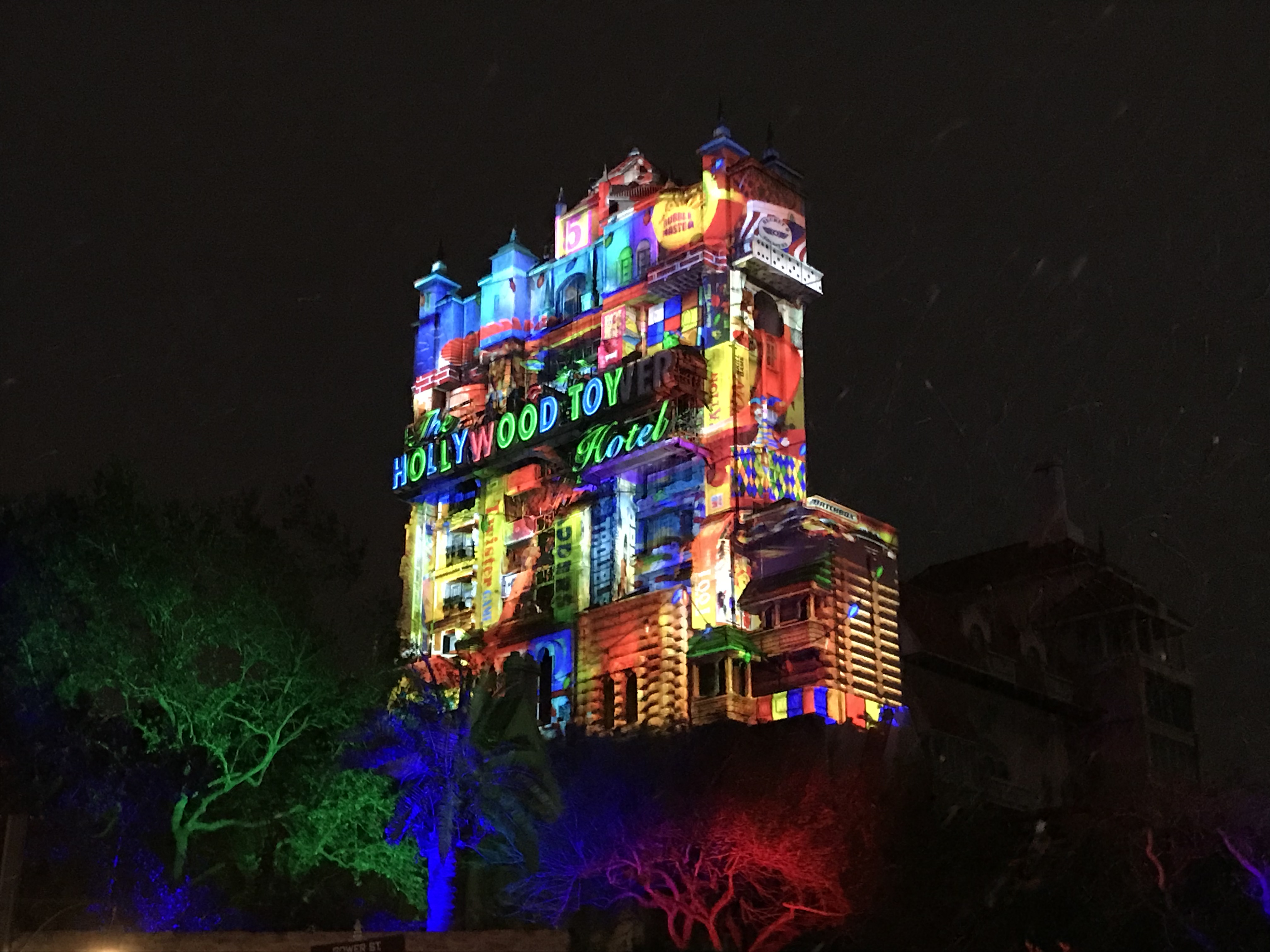 The Holiday season is in full swing at Disney’s Hollywood Studios! Sunset Seasons Greetings debuted last week along with the return of Jingle Bell Jingle BAM. Accompanied by snow flurries surrounding you on Hollywood and Sunset Boulevards, you will be energized by the joy and cheer of crowds of guests singing some of your favorite Christmas songs–you’ll definitely want to join in. Although the park still feels empty at Christmastime without the late Osborne Family Spectacle of Dancing Lights, the seasonal offerings at the park do help to fill the void. The present shows still fall short of the immersive experience of the incredible brilliance and beauty of the famous dancing light show. But I digress. My friend Dani and I had a fun time watching the two nighttime Christmas spectaculars….(more)